干旱区地理 ›› 2026, Vol. 49 ›› Issue (2): 235-244.doi: 10.12118/j.issn.1000-6060.2025.138 cstr: 32274.14.ALG2025138
陈宇( ), 岳游松()
收稿日期:2025-03-13
修回日期:2025-06-13
出版日期:2026-02-25
发布日期:2026-02-27
通讯作者:
岳游松(1975-),男,博士,教授,主要从事体育文化等方面的研究. E-mail: yueyousong@163.com作者简介:陈宇(1995-),男,博士研究生,主要从事体育旅游等方面的研究. E-mail: cy19952013@163.com
基金资助:
CHEN Yu(), YUE Yousong()
Received:2025-03-13
Revised:2025-06-13
Published:2026-02-25
Online:2026-02-27
摘要:
冰雪旅游正成为区域经济与文化振兴的关键动力之一。综合运用可达性测度方法、冷热点分析、地理探测器等方法,测算了黄河流域冰雪旅游目的地的可达性,并分析了其空间分布特征及影响因素。研究发现:(1) 黄河流域冰雪旅游目的地在空间分布上呈现“东密西疏、集群分布”的特征,下游地区数量最多,上游地区最少;省域层面山东、山西和河南3省较多,市域层面济南、郑州、青岛数量较多。(2) 黄河流域冰雪旅游目的地可达性呈现“下游便捷、中游适中、上游受限”的空间格局,旅游体验型的数量占优,但可达性偏弱。(3) 黄河流域冰雪旅游目的地可达性热点区和次热点区主要分布在山东和河南北部城市;冷点区和次冷点区主要分布在上游和中游地区的城市。(4) 黄河流域冰雪旅游目的地可达性受社会、经济和生态三维因素的综合作用,其中公路里程、城市化率和年均降雪量是主要影响因素。研究结果为优化黄河流域冰雪旅游资源配置及区域协调发展提供了科学参考。
陈宇, 岳游松. 黄河流域冰雪旅游目的地可达性及影响因素研究[J]. 干旱区地理, 2026, 49(2): 235-244.
CHEN Yu, YUE Yousong. Accessibility and influencing factors of ice and snow tourism destinations in the Yellow River Basin[J]. Arid Land Geography, 2026, 49(2): 235-244.
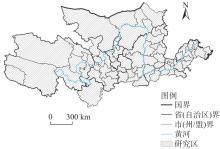
图1
研究区示意图 注:基于自然资源部标准地图服务网站审图号为GS(2024)0650号的标准地图制作,底图边界无修改。下同。"
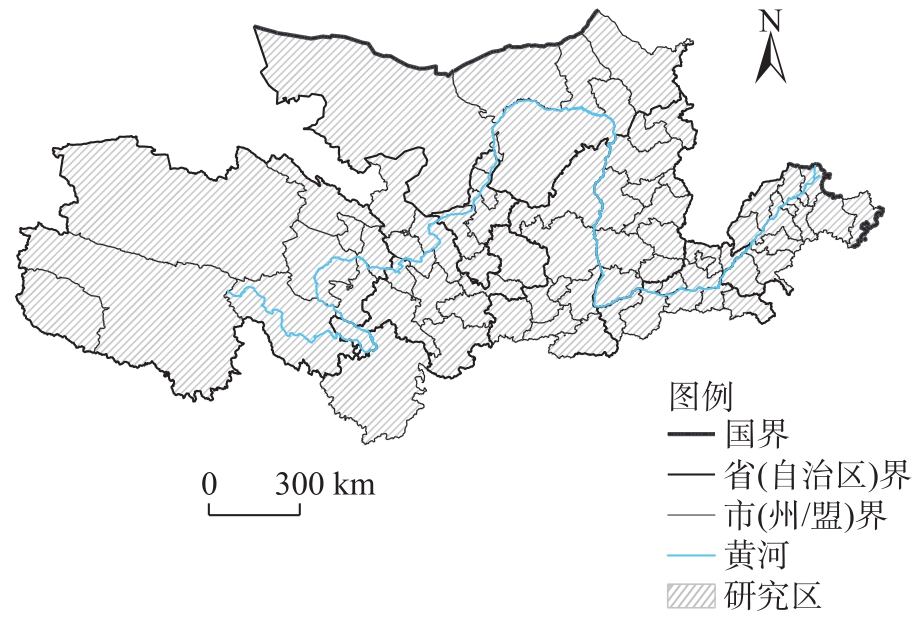

表1
黄河流域冰雪旅游目的地可达性影响因素"
| 维度 | 变量 | 符号 | 含义 |
|---|---|---|---|
| 社会维度 | 人口密度/人·km-2 | X1 | 反映人口集聚程度 |
| 人均体育场地面积/m2 | X2 | 反映居民体育资源供给水平 | |
| 城市化率/% | X3 | 反映整体基础设施水平 | |
| 经济维度 | 人均可支配收入/104元 | X4 | 反映居民消费水平 |
| 旅游收入/108元 | X5 | 反映地级市旅游经济的活跃程度 | |
| 公路里程/km | X6 | 反映地级市内交通网络的建设水平 | |
| 生态维度 | 年均降雪量/mm | X7 | 反映冰雪资源禀赋 |
| 高程/m | X8 | 反映地形特点 | |
| 森林覆盖率/% | X9 | 反映生态环境特征 |
表2
黄河流域冰雪旅游目的地在不同功能类型与流域分区下的可达性"
| 维度 | 类别 | 数量 | 比例/% | 可达性 |
|---|---|---|---|---|
| 功能类型 | 旅游体验型 | 178 | 76.72 | 3.85 |
| 城郊学习型 | 47 | 20.26 | 3.58 | |
| 目的地度假型 | 7 | 3.02 | 3.40 | |
| 流域分区 | 上游 | 36 | 15.52 | 4.83 |
| 中游 | 76 | 32.76 | 4.26 | |
| 下游 | 120 | 51.72 | 3.17 |
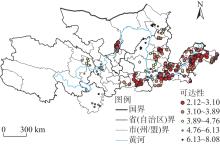
图2
黄河流域冰雪旅游目的地可达性空间格局"
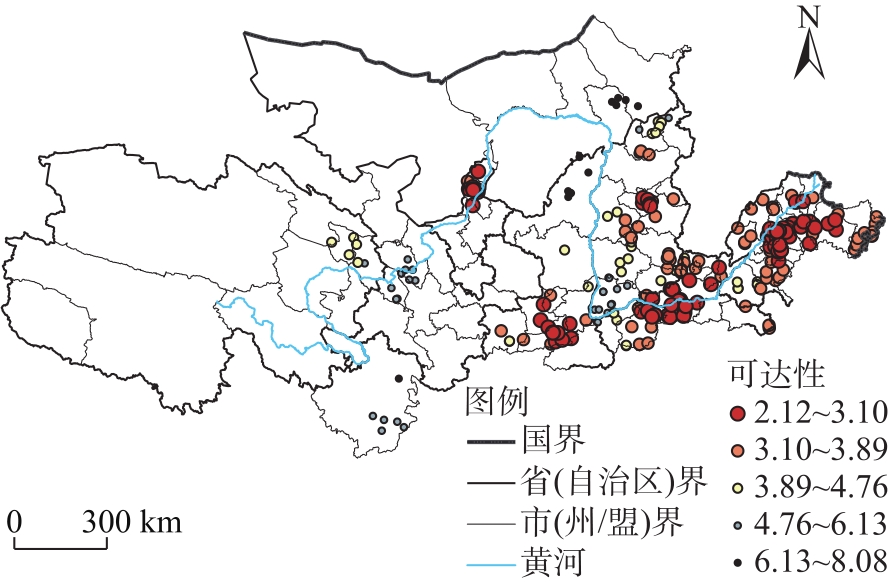
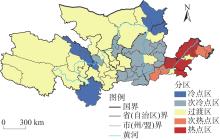
图3
黄河流域冰雪旅游目的地可达性冷热点分析"
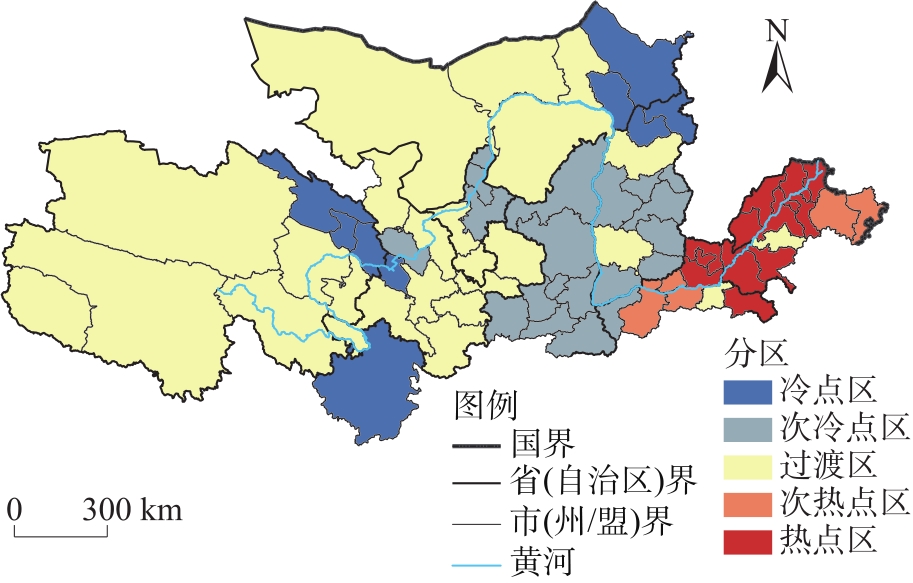
表3
地理探测器因子探测结果"
| 变量 | X1 | X2 | X3 | X4 | X5 | X6 | X7 | X8 | X9 |
|---|---|---|---|---|---|---|---|---|---|
| q值 | 0.58 | 0.37 | 0.71 | 0.53 | 0.41 | 0.85 | 0.60 | 0.49 | 0.35 |
表4
不同流域因子探测结果"
| 流域 | X1 | X2 | X3 | X4 | X5 | X6 | X7 | X8 | X9 |
|---|---|---|---|---|---|---|---|---|---|
| 上游 | 0.81 | 0.24 | 0.62 | 0.46 | 0.33 | 0.72 | 0.37 | 0.74 | 0.36 |
| 中游 | 0.27 | 0.31 | 0.51 | 0.81 | 0.47 | 0.77 | 0.43 | 0.79 | 0.85 |
| 下游 | 0.77 | 0.84 | 0.72 | 0.53 | 0.35 | 0.89 | 0.73 | 0.38 | 0.24 |
| [1] | 央广网. 把“冷资源”转化为“热动力”让冬季旅游“燃”起来[EB/OL]. [2024-12-01]. https://news.cnr.cn/native/gd/20241201/t20241201_526995329.shtml. |
| [China National Radio. Transforming “Cold Resources” into “Hot Power” to ignite winter tourism[EB/OL]. [2024-12-01]. https://news.cnr.cn/native/gd/20241201/t20241201_526995329.shtml.] | |
| [2] | 冯雪玉. 冰雪出圈, 文旅出彩[N]. 内蒙古日报, 2025-02-18(002). |
| [Feng Xueyu. Ice and snow breaks out, cultural tourism shines[N]. Inner Mongolia Daily, 2025-02-18(002).] | |
| [3] | 王涛. 打好三张文化牌[N]. 中国旅游报, 2025-04-04(001). |
| [Wang Tao. Playing the three cultural cards[N]. China Tourism News, 2025-04-04(001).] | |
| [4] | 牛莹, 马青彦. 热“雪”陇原五彩“冰”纷[N]. 中国旅游报, 2025-02-20(002). |
| [Niu Ying, Ma Qingyan. Hot “Snow” on Longyuan, colorful “Ice” displays[N]. China Tourism News, 2025-02-20(002).] | |
| [5] | 罗浩, 万发达, 李娟. 黄河流域文体旅资源开发与空间集聚特征[J]. 社会科学家, 2024(5): 79-86. |
| [Luo Hao, Wan Fada, Li Juan. Development and spatial agglomeration characteristics of cultural, sports, and tourism resources in the Yellow River Basin[J]. Social Scientist, 2024(5): 79-86.] | |
| [6] | 杨铭. 黄河下游地区体育旅游产业高质量发展: 逻辑、困境与纾解[J]. 体育与科学, 2024, 45(1): 96-105. |
| [Yang Ming. High-quality development of sports tourism industry in the downstream area of the Yellow River: Logic, dilemma and optimize[J]. Journal of Sports and Science, 2024, 45(1): 96-105.] | |
| [7] | 戢晓峰, 薛唯, 李静, 等. 基于时空效用法的黄金周自驾游可达性测度及影响因素研究[J]. 干旱区资源与环境, 2024, 38(11):197-208. |
| [Ji Xiaofeng, Xue Wei, Li Jing, et al. Measurement of accessibility of self-driving tour during Golden Week basedon spatio-temporal utility method[J]. Journal of Arid Land Resources and Environment, 2024, 38(11):197-208.] | |
| [8] | 杨利峰, 高晓宁. 河南省4A级及以上景区公路交通可达性研究[J]. 地域研究与开发, 2023, 42(3): 129-134, 141. |
| [Yang Lifeng, Gao Xiaoning. Study on evolution of adaptation space between county traffic dominanceand agglomeration of tourism industry: A case study of Henan Province[J]. Areal Research and Development, 2023, 42(3): 129-134, 141.] | |
| [9] |
曹开军, 商宁, 王秘秘. 中国西北五省乡村旅游重点村时空分布格局与可达性分析[J]. 干旱区地理, 2023, 46(7): 1196-1205.
doi: 10.12118/j.issn.1000-6060.2022.531 |
|
[Cao Kaijun, Shang Ning, Wang Mimi. Spatial distribution pattern and accessibility analysis of the key ruraltourism villages in the five northwestern provinces of China[J]. Arid Land Geography, 2023, 46(7): 1196-1205.]
doi: 10.12118/j.issn.1000-6060.2022.531 |
|
| [10] |
崔亚芹, 范超云, 梁慧龙, 等. 产业融合进程中冰雪旅游产业高质量发展的系统解构与驱动机制[J]. 沈阳体育学院学报, 2024, 43(6): 8-15.
doi: 10.12163/j.ssu.20241002 |
|
[Cui Yaqin, Fan Chaoyun, Liang Huilong, et al. System deconstruction and driving mechanisms for high-quality development of ice and snow tourism industry in the process of industrial integration[J]. Journal of Shenyang Sport University, 2024, 43(6): 8-15.]
doi: 10.12163/j.ssu.20241002 |
|
| [11] | 王恒, 宿伟玲. 冰雪文化体育旅游融合发展机制、模式及路径[J]. 社会科学家, 2024(1): 87-95. |
| [Wang Heng, Su Weiling. Mechanism, model, and path of the integration of ice and snow cultural sports tourism[J]. Social Scientist, 2024(1): 87-95.] | |
| [12] |
杨建平, 唐凡, 郭新瑜, 等. 中国冰雪旅游发展模式及其体系建构[J]. 冰川冻土, 2023, 45(6): 1923-1939.
doi: 10.7522/j.issn.1000-0240.2023.0147 |
|
[Yang Jianping, Tang Fan, Guo Xinyu, et al. Development modes and system establishments of ice and snow tourism in China[J]. Journal of Glaciology and Geocryology, 2023, 45(6): 1923-1939.]
doi: 10.7522/j.issn.1000-0240.2023.0147 |
|
| [13] | 唐承财, 方琰, 厉新建, 等. 新时代中国冰雪旅游高质量发展模式构建与路径创新[J]. 干旱区资源与环境, 2023, 37(12): 140-150. |
| [Tang Chengcai, Fang Yan, Li Xinjian, et al. Construction of high-quality development model and innovation path of China’s ice and snow tourism in the new era[J]. Journal of Arid Land Resources and Environment, 2023, 37(12): 140-150.] | |
| [14] |
Tóth G, Lóránt D. Tourism and accessibility: An integrated approach[J]. Applied Geography, 2010, 30(4): 666-677.
doi: 10.1016/j.apgeog.2010.01.008 |
| [15] | 朱政, 朱翔. 基于空间模拟的都市圈旅游景区综合交通可达性分析——以长株潭都市圈为例[J]. 旅游学刊, 2024, 39(1): 130-146. |
| [Zhu Zheng, Zhu Xiang. Analysis on comprehensive transportation accessibility of scenic spots in metropolitan area based on spatial simulation: A case study of Changsha-Zhuzhou-Xiangtan metropolitan area[J]. Tourism Tribune, 2024, 39(1): 130-146.] | |
| [16] | 付强, 杨壮, 董锁成, 等. 河南省国家级传统村落空间可达性及影响因素研究[J]. 河南师范大学学报(自然科学版), 2021, 49(6): 82-90. |
| [Fu Qiang, Yang Zhuang, Dong Suocheng, et al. Research on spatial accessibility and influencing factors of national traditional villages in Henan Province[J]. Journal of Henan Normal University (Natural Science Edition), 2021, 49(6): 82-90.] | |
| [17] |
何小芊, 刘策. 长江经济带国家级自然保护地空间可达性及影响因素[J]. 长江科学院院报, 2022, 39(11): 9-16.
doi: 10.11988/ckyyb.202111682022 |
| [He Xiaoqian, Liu Ce. Spatial accessibility of national nature reserves in the Yangtze River Economic Belt and its influencing factors[J]. Journal of Changjiang River Scientific Research Institute, 2022, 39(11): 9-16.] | |
| [18] | Coppola P, Carbone A, Aveta C, et al. Assessing transport policies for tourist mobility based on accessibility indicators[J]. European Transport Research Review, 2020, 12(1): 56, doi: 10.1186/s125-44-020-00444-4. |
| [19] | Recchi E, Deutschmann E, Gabrielli L, et al. The global visa cost divide: How and why the price for travel permits varies worldwide[J]. Political Geography, 2021(86): 102350, doi: 10.1016/j.polgeo.2021.102350. |
| [20] |
Muñoz C, Álvarez A, Baños J. Modelling the effect of weather on tourism: Does it vary across seasons?[J]. Tourism Geographies, 2023, 25(1): 265-286.
doi: 10.1080/14616688.2020.1868019 |
| [21] | Sun F, Xu M, Li Z, et al. Spatial distribution, accessibility, and influencing factors of the tourism and leisure industry in Qingdao, China[J]. Sustainability, 2024, 16(16): 6961, doi: 10.3390/su16-166961. |
| [22] |
Pütz M, Gallati D, Kytzia S, et al. Winter tourism, climate change, and snowmaking in the Swiss Alps: Tourists’ attitudes and regional economic impacts[J]. Mountain Research and Development, 2011, 31(4): 357-362.
doi: 10.1659/MRD-JOURNAL-D-11-00039.1 |
| [23] |
Knowles N, Scott D, Steiger R. Climate change and the future of ski tourism in Canada’s western mountains[J]. Tourism and Hospitality, 2024, 5(1): 187-202.
doi: 10.3390/tourhosp5010013 |
| [24] |
Komatsu H, Ohe Y. The effectiveness of countermeasure services against declining visitor numbers to ski resorts in Nagano, Japan[J]. Tourism Economics, 2025, 31(3): 538-556.
doi: 10.1177/13548166241281801 |
| [25] |
窦文康, 王世金, 韩彤彤, 等. 中国滑雪场可达性及市场潜力测度[J]. 地理科学, 2021, 41(2): 319-327.
doi: 10.13249/j.cnki.sgs.2021.02.015 |
| [Dou Wenkang, Wang Shijin, Han Tongtong, et al. Measurement of accessibility and market potential of ski resorts in China[J]. Geographical Science, 2021, 41(2): 319-327.] | |
| [26] | 张宇飞, 任艳路. 东北三省滑雪场空间分布与可达性研究[J]. 大连民族大学学报, 2023, 25(2): 135-140. |
| [Zhang Yufei, Ren Yanlu. Study on the spatial distribution and accessibility of ski resorts in the Three Northeastern Provinces[J]. Journal of Dalian Minzu University, 2023, 25(2): 135-140.] | |
| [27] |
唐承财, 肖小月, 秦珊. 中国冰雪旅游研究: 内涵辨析、脉络梳理与体系构建[J]. 地理研究, 2023, 42(2): 332-351.
doi: 10.11821/dlyj020220353 |
| [Tang Chengcai, Xiao Xiaoyue, Qin Shan. Research on ice and snow tourism in China: Connotation identification, context sorting and system construction[J]. Geographical Research, 2023, 42(2): 332-351.] | |
| [28] | 张瑞林. 新时代冰雪旅游协同生态文明建设: 逻辑理路与推进策略[J]. 体育学研究, 2024, 38(2): 52-62. |
| [Zhang Ruilin. Collaborative ecological civilization construction of ice and snow tourism in the new era: Logic and promotion strategies[J]. Sports Studies, 2024, 38(2): 52-62.] | |
| [29] |
孙辉, 刘冬磊, 王子朴. 中国式现代化视域下冰雪产业高质量发展: 基础、使命与路径[J]. 沈阳体育学院学报, 2023, 42(2): 9-16.
doi: 10.12163/j.ssu.20221593 |
| [Sun Hui, Liu Donglei, Wang Zipu. High-quality development of ice and snow industry in the perspective of chinese path to modernization: Foundation, missions and paths[J]. Journal of Shenyang Sport University, 2023, 42(2): 9-16.] | |
| [30] |
梁巧霞, 韦孟丹, 梁赛, 等. 新疆滑雪产业的经济和社会效应分析[J]. 冰川冻土, 2023, 45(4): 1401-1412.
doi: 10.7522/j.issn.1000-0240.2023.0107 |
|
[Liang Qiaoxia, Wei Mengdan, Liang Sai, et al. Analysis of economic and social effects of ski industry in Xinjiang[J]. Journal of Glaciology and Geocryology, 2023, 45(4): 1401-1412.]
doi: 10.7522/j.issn.1000-0240.2023.0107 |
|
| [31] | 张莹, 王飞, 王志博. 新疆滑雪旅游服务实践经验与优化路向[J]. 体育文化导刊, 2024(1): 91-96, 110. |
| [Zhang Ying, Wang Fei, Wang Zhibo. Practical experience and optimization path of skiing tourism services in Xinjiang[J]. Sports Culture Guide, 2024(1): 91-96, 110.] | |
| [32] | 刘贝, 刘欢欢, 王国荣. 东北三省冰雪体育旅游高质量发展研究[J]. 体育文化导刊, 2024(8): 84-90. |
| [Liu Bei, Liu Huanhuan, Wang Guorong. High-quality development of ice and snow sports tourism in the three provinces of northeast China[J]. Sports Culture Guide, 2024(8): 84-90.] | |
| [33] |
李鹏, 王熙尧, 王辉, 等. 中国东北三省冰雪旅游产业时空格局演变特征及优化策略研究[J]. 地理研究, 2025, 44(5): 1342-1360.
doi: 10.11821/dlyj020240640 |
| [Li Peng, Wang Xiyao, Wang Hui, et al. Spatio-temporal characteristics and optimization strategy ofice and snow tourism industry in northeast China[J]. Geographical Research, 2025, 44(5):1342-1360.] | |
| [34] | 冯俊新, 李墨寒, 李时宇. 中国内地公路可达性演变研究——基于三种可达性指标的视角[J/OL]. 经济地理. [2024-10-09]. http://kns.cnki.net/kcms/detail/43.1126.K.20241008.1109.002.html. |
| [Feng Junxin, Li Mohan, Li Shiyu. The evolution of road accessibility in Chinese mainland:Analysis withthree accessibility indicators[J/OL]. Economic Geography.[2024-10-09]. http://kns.cnki.net/kcms/detail/43.1126.K.20241008.1109.002.html.] | |
| [35] | 杨玉珍, 闫佳笑, 杨洋, 等. 黄河流域旅游生态效率时空演变及空间溢出效应———基于73个城市数据的分析[J]. 生态学报, 2022, 42(20): 8202-8212. |
| [Yang Yuzhen, Yan Jiaxiao, Yang Yang, et al. The spatio-temporal evolution and spatial spillover effect of tourism eco-efficiency in the Yellow River Basin: Based on data from the 73 cities[J]. Acta Ecologica Sinica, 2022, 42(20): 8202-8212.] | |
| [36] | 胡玉洁, 蒋凯伦, 陈准, 等. 山区县域旅游资源空间结构及其交通可达性分析——以河南栾川县为例[J]. 农业现代化研究, 2023, 44(5): 869-880. |
| [Hu Yujie, Jiang Kailun, Chen Zhun, et al. Analysis of the spatial structure of tourism resources and traffic accessibility in mountainous counties: Taking Luanchuan County, Henan Province as an example[J]. Research of Agricultural Modernization, 2023, 44(5): 869-880.] | |
| [37] |
周海涛, 马钰松, 樊亚宇, 等. 内蒙古红色旅游资源空间分布及可达性分析[J]. 干旱区地理, 2023, 46(5): 814-822.
doi: 10.12118/j.issn.1000-6060.2022.423 |
|
[Zhou Haitao, Ma Yusong, Fan Yayu, et al. Spatial distribution and accessibility analysis of red tourismresources in Inner Mongolia[J]. Arid Land Geography, 2023, 46(5): 814-822.]
doi: 10.12118/j.issn.1000-6060.2022.423 |
|
| [38] | 大同市人民政府. 大同市召开2024—2025大同冰雪季赛事活动情况介绍新闻发布会[EB/OL]. [2024-12-01]. https://www.dt.gov.cn/dtszf/xwfbh/202412/fb355bd8dc254fec9884c20aa7941406.shtml. |
| [Datong Municipal People’s Government. Press conference introducing the events of the 2024—2025 Datong ice and snow season[EB/OL]. [2024-12-01]. https://www.dt.gov.cn/dtszf/xwfbh/202412/fb355bd8dc254fec9884c20aa7941406.shtml.] | |
| [39] | 山东省体育局. 2025年全国体育产业工作会议现场直击[EB/OL]. [2025-04-17]. http://ty.shandong.gov.cn/tycy/cyxx/202504/t2025-0417_4816071.html. |
| [Shandong Provincial Sports Bureau. Live coverage of the 2025 national sports industry work conference[EB/OL]. [2025-04-17]. http://ty.shandong.gov.cn/tycy/cyxx/202504/t2025-0417_4816071.html.] | |
| [40] | 新华网. 济南冰雪经济持续升温各滑雪场客流量增多[EB/OL]. [2024-12-28]. http://www.sd.xinhuanet.com/20241228/f329222f-24434663b451fbd44ce355eb/c.html. |
| [Xinhua News Agency. Jinan’s ice and snow economy continues to heat up as ski resorts see increased visitor numbers[EB/OL]. [2024-12-28]. http://www.sd.xinhuanet.com/20241228/f329222f24434663b451fbd44ce355-eb/c.html.] | |
| [41] |
朱磊, 李燕楠, 徐佳慧, 等. 中国冰雪旅游地空间分布格局及成因[J]. 干旱区地理, 2024, 47(8): 1399-1410.
doi: 10.12118/j.issn.1000-6060.2024.120 |
|
[Zhu Lei, Li Yannan, Xu Jiahui, et al. Spatial distribution pattern and causes of ice and snow tourism in China[J]. Arid Land Geography, 2024, 47(8):1399-1410.]
doi: 10.12118/j.issn.1000-6060.2024.120 |
|
| [42] | 人民网. 全国主要城市3小时通达, 2035年山东交通将变成这样[EB/OL]. [2024-12-20]. http://sd.people.com.cn/n2/2024/1220/c166188-41081901.html. |
| [People’s Daily. Nationwide major cities reachable within 3 hours: How Shandong’s transportation will transform by 2035[EB/OL]. [2024-12-20]. http://sd.people.com.cn/n2/2024/1220/c166188-41081901.html.] | |
| [43] | 黄馨, 韩玲, 赵永华, 等. 城市社会-生态系统研究理论基础与分析框架[J]. 生态学报, 2024, 44(15): 6892-6905. |
| [Huang Xin, Han Ling, Zhao Yonghua, et al. Theoretical foundations and analytical frameworks for urban socio-ecological system[J]. Acta Ecologica Sinica, 2024, 44(15): 6892-6905.] | |
| [44] | 新华网. 济南公交推出观光巴士双线双日畅游通票[EB/OL]. [2024-12-25]. http://www.sd.xinhuanet.com/20241225/4ba8400-a888e4384b8682794fdd71946/c.html. |
| [Xinhua News Agency. Jinan public transport launchestwo routes, two-day sightseeing bus pass[EB/OL]. [2024-12-25]. http://www.sd.xinhuanet.com/2024-1225/4ba8400a888e4384b8682794fdd71946/c.html.] | |
| [45] | 赵静, 郭佩云, 汪辉. 黄河流域文化产业—旅游产业—生态环境耦合协调研究[J]. 人文地理, 2024, 39(5): 184-192. |
| [Zhao Jing, Guo Peiyun, Wang Hui. Research on coupling coordination of the cultural industry, the tourism industry, and the ecological environment in the Yellow River Basin[J]. Human Geography, 2024, 39(5): 184-192.] | |
| [46] | 闫静, 刘光怡, 徐诗枧, 等. 我国冰雪体育旅游可持续发展研究[J]. 体育文化导刊, 2024(10): 77-83. |
| [Yan Jing, Liu Guangyi, Xu Shijian, et al. Sustainable development of ice and snow sports tourism in China[J]. Sports Culture Guide, 2024(10): 77-83.] |
| [1] | 王慧丽, 李妞, 刘英, 刘咏涵. 黄河流域水资源-生态韧性动态耦合与级层障碍解析[J]. 干旱区地理, 2026, 49(3): 569-580. |
| [2] | 周文丽, 武珊珊, 苏鹏. 新质生产力对旅游业高质量发展的影响效应研究——基于黄河流域9省区的实证[J]. 干旱区地理, 2026, 49(2): 224-234. |
| [3] | 魏丽蓉, 程占红, 石烨, 张玉尧, 王紫彦, 牛莉芹. 黄河流域旅游生态安全的演化特征和影响因素分析——基于社会网络分析视角[J]. 干旱区地理, 2026, 49(2): 245-254. |
| [4] | 孙国军, 李家瑶, 王子轩. 黄河流域数文旅产业发展水平评价与耦合协调时空特征分析[J]. 干旱区地理, 2026, 49(1): 117-127. |
| [5] | 杨迪, 邹进, 马晓飞, 张珣, 周锐, 刘艳春, 石金莲. 体育旅游资源空间分布特征及可持续发展研究——以新疆为例[J]. 干旱区地理, 2026, 49(1): 140-150. |
| [6] | 彭文英, 赵爽, 单子溢, 陈泽宇. 黄河流域新质生产力生态化水平测度与障碍因子[J]. 干旱区地理, 2025, 48(9): 1648-1659. |
| [7] | 田小波. 黄河流域城市旅游业高质量发展水平测度与空间格局特征[J]. 干旱区地理, 2025, 48(9): 1660-1671. |
| [8] | 李慧, 姚西龙. 水足迹视角下黄河流域可再生能源制氢节水潜力研究[J]. 干旱区地理, 2025, 48(8): 1353-1362. |
| [9] | 仲嘉维, 郑军, 张明月. 农业社会化服务如何影响粮食生态效率——以黄河流域71个地级市为例[J]. 干旱区地理, 2025, 48(8): 1385-1395. |
| [10] | 程鹏, 彭海洋, 侯丁榕, 孙明东, 宋晓伟. 黄河流域农业灰水足迹强度空间格局及演进趋势[J]. 干旱区地理, 2025, 48(7): 1185-1197. |
| [11] | 徐铭璟, 段宝玲, 冯强, 吕萌. 生态系统服务及其权衡/协同关系多情景模拟——以黄河流域山西段为例[J]. 干旱区地理, 2025, 48(7): 1206-1219. |
| [12] | 白雪雅, 张志斌, 马晓敏, 李化英, 付兰星. 老年群体视角下兰州市医疗设施可达性研究[J]. 干旱区地理, 2025, 48(7): 1317-1327. |
| [13] | 任诗琦, 王永瑜. 黄河流域地级市绿色发展水平测度与空间收敛性研究[J]. 干旱区地理, 2025, 48(6): 1031-1042. |
| [14] | 郭念发, 王录仓. 兰州市主城区幼儿园入学可达性及影响因素分析[J]. 干旱区地理, 2025, 48(6): 1043-1054. |
| [15] | 魏建飞, 袁悠燃, 李强, 董佩佩, 刘玖榕. 黄河流域国土空间效率时空变化及障碍因子分析[J]. 干旱区地理, 2025, 48(6): 1055-1066. |
|
||