干旱区地理 ›› 2025, Vol. 48 ›› Issue (8): 1445-1456.doi: 10.12118/j.issn.1000-6060.2025.150 cstr: 32274.14.ALG2025150
高帅( ), 张务伟()
收稿日期:2025-03-19
修回日期:2025-05-08
出版日期:2025-08-25
发布日期:2025-08-21
通讯作者:
张务伟(1972-),男,教授,主要从事区域经济、城市经济方面的研究. E-mail: zhangwuwei315@163.com作者简介:高帅(2000-),男,硕士研究生,主要从事区域经济、城市经济等方面的研究. E-mail: 19860915703@163.com
基金资助:
GAO Shuai(), ZHANG Wuwei()
Received:2025-03-19
Revised:2025-05-08
Published:2025-08-25
Online:2025-08-21
摘要: 为探究新质生产力与新型城镇化间的协同演化机制,缓解二者矛盾,助力实现中国式现代化发展目标。以中国31个省(市、自治区)为研究对象,构建“新质生产力-新型城镇化”协同理论框架,运用CRITIC权重分析法、哈肯协同演化模型,测度中国31个省(区)新质生产力与新型城镇化水平,剖析二者的协同演化机制。结果表明:(1)观察期内新型城镇化与新质生产力水平显著提升,空间分异特征愈发明显,呈现出“东部领跑、中部追赶、西部滞后”的区域发展态势。(2)新质生产力在双新复合系统中发挥主导作用,是引领系统有序演化的核心变量。同时,系统内部及系统间均存在正反馈机制,系统内部要素的累积性与自增强性是形成正反馈机制的关键动力。(3)双新协同演化经历了“快速推进(2014—2020年)、稳定运行(2020—2023年)”2个阶段;空间上仍呈“东强西弱”的分布特征。因地制宜地培育新质生产力、建设新型城镇化,优化双新协同机制,持续为双新系统注入新兴要素,是实现双新系统向上演化的关键路径。研究结果可为实现新质生产力与新型城镇化协同发展,破解经济效率与社会公平间的矛盾,达成中国式现代化目标提供思路与建议。
高帅, 张务伟. 中国新质生产力与新型城镇化的协同演化研究[J]. 干旱区地理, 2025, 48(8): 1445-1456.
GAO Shuai, ZHANG Wuwei. Synergistic evolution of new quality productivity and new urbanization in China’s provinces[J]. Arid Land Geography, 2025, 48(8): 1445-1456.
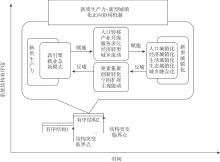
图1
新型城镇化与新质生产力的协同演化机制"
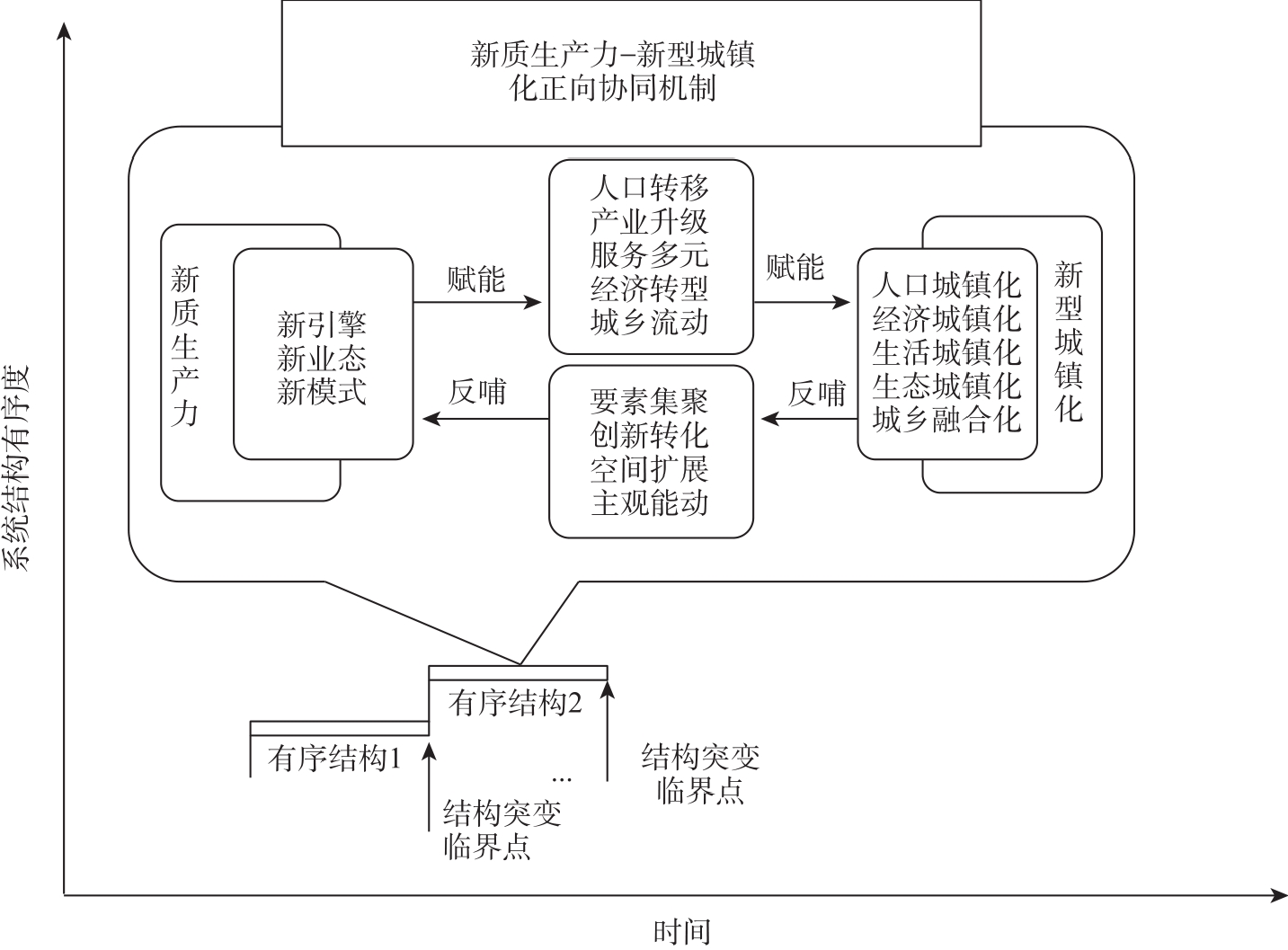

表1
新型城镇化评价指标体系"
| 目标层 | 准则层 | 要素层 | 指标层 | 量化方式 | 单位 | 权重/% |
|---|---|---|---|---|---|---|
| 新型城镇化 | 生活城镇化 | 居民生活 | 生活用水 | 城市用水普及率 | % | 2.26 |
| 生活燃气 | 城市燃气普及率 | % | 3.72 | |||
| 城市建设 | 人均城市建设用地面积 | m2 | 2.85 | |||
| 人口城镇化 | 人口规模 | 城镇人口比重 | 城镇人口数量/总人口数量 | % | 9.22 | |
| 居民就业 | 城镇就业结构 | 二、三产业就业人口/总就业人口 | % | 7.47 | ||
| 城镇失业率 | 城镇失业人口/城镇适龄劳动人口 | % | 9.57 | |||
| 社会保障 | 居民养老 | 城镇基本养老保险参保比例 | % | 9.36 | ||
| 居民医疗 | 城镇基本医疗保险参保比例 | % | 6.53 | |||
| 经济城镇化 | 经济发展 | 国内生产总值 | 人均GDP | 104元 | 13.24 | |
| 经济运行 | 居民消费 | 城镇人均社会消费品零售额 | 104元 | 2.63 | ||
| 生态城镇化 | 生态宜居 | 绿地生态 | 城镇人均绿地公园面积 | m2 | 4.93 | |
| 绿色生活 | 垃圾处理 | 城市生活垃圾无害化处理率 | % | 2.87 | ||
| 废水处理 | 人均污水排放量 | m3 | 2.49 | |||
| 城乡融合化 | 收入同步 | 城乡收入差距 | 城乡居民人均可支配收入比 | % | 7.83 | |
| 社保融合 | 城乡医疗差距 | 城乡人均医疗保健支出比 | % | 5.05 | ||
| 城乡养老差距 | 城乡养老保险覆盖率比 | % | 3.67 |
表2
新质生产力评价指标体系"
| 目标层 | 准则层 | 要素层 | 指标层 | 量化方式 | 单位 | 权重/% |
|---|---|---|---|---|---|---|
| 新质生产力 | 新引擎 | 创新储备力 | 创新潜力 | 每万人拥有在校大学生数 | 人 | 10.37 |
| 创新经费投入 | R&D经费支出/财政总支出 | % | 14.34 | |||
| 创新人员规模 | R&D从业人员/就业人口 | % | 11.73 | |||
| 创新转化力 | 科技创新水平 | 人均专利数量(专利授权数量/总人口) | 件 | 6.79 | ||
| 新业态 | 产业协调 | 产业结构合理化 | 泰尔指数 | % | 8.43 | |
| 产业转型 | 电信产业发展 | 人均电信业务量 | 104元 | 6.81 | ||
| 产业结构高级化 | 第三产业产值/第二产业产值 | % | 9.48 | |||
| 新模式 | 绿色生产 | 污染防治质量 | SO2排放/GDP | % | 5.21 | |
| 绿色发明成果 | 绿色专利申请数/专利申请数 | % | 4.49 | |||
| 数字增长 | 电子商务交易占比 | 电子商务交易额/电子商务企业数 | % | 7.14 | ||
| 互联网相关从业人员 | 计算机服务和软件业从业人员占比 | % | 11.92 | |||
| 数字金融 | 数字普惠金融指数 | % | 13.66 |
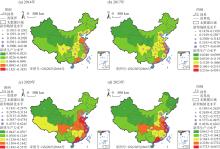
图2
2014—2023年中国新型城镇化与新质生产力的空间分布"
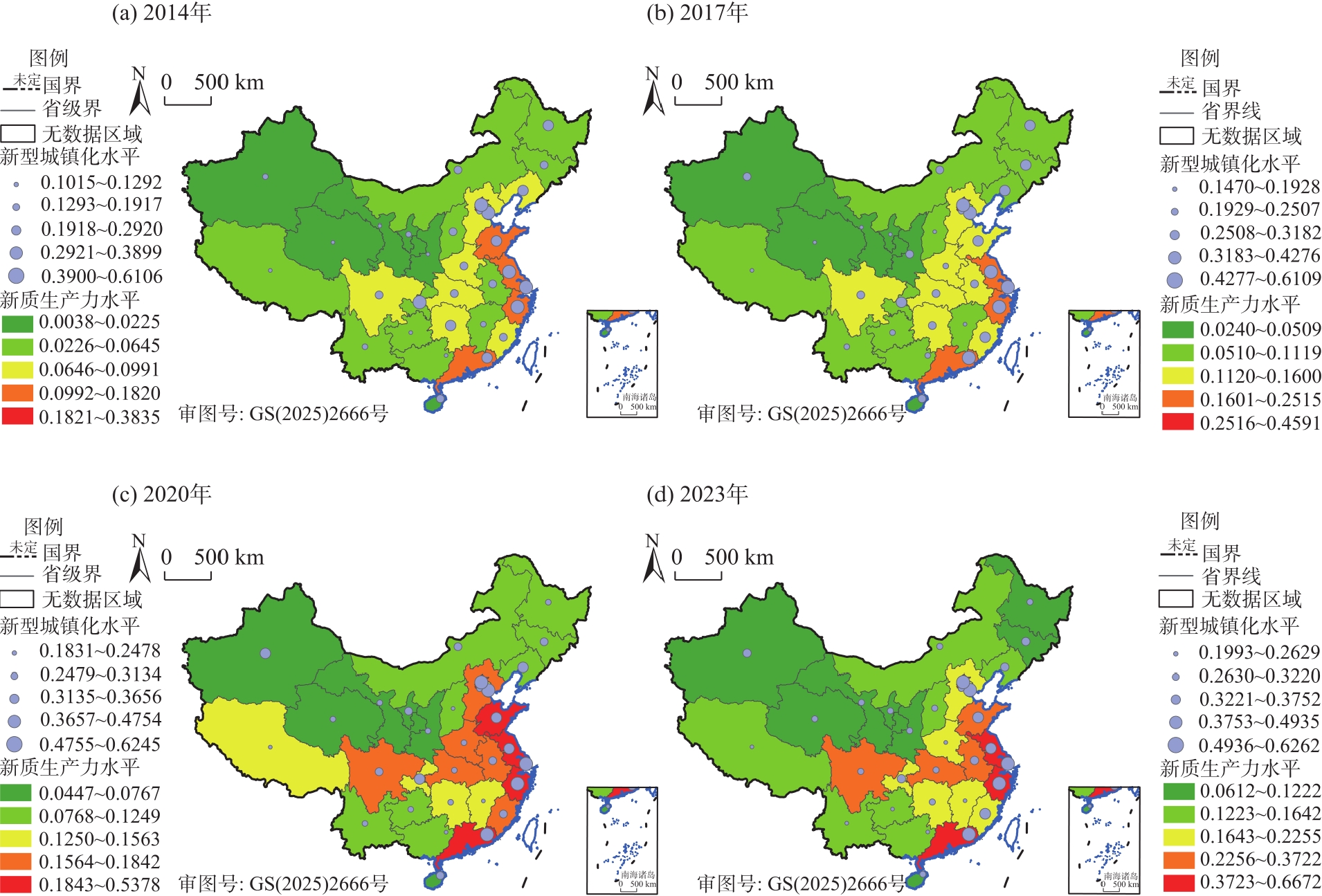
表3
中国新质生产力与新型城镇化协同演化序参量识别结果"
| 假定序参量 | 演化方程 | 控制参量 | 结论 |
|---|---|---|---|
| 新型城镇化 | γ1=0.295 γ2=-0.119 a=-0.067 b=-0.093 | 方程成立 不满足绝热近似假设 原假设不成立 | |
| 新质生产力 | γ1=0.225 γ2=0.286 a=-0.256 b=0.301 | 方程成立 满足绝热近似假设 原假设成立 |
表4
2014—2023年新型城镇化与新质生产力协同类型演化历程"
| 经济区 | 地区 | 协同类型 | |||
|---|---|---|---|---|---|
| 2014年 | 2017年 | 2020年 | 2023年 | ||
| 北部沿海 | 北京 | 优质协同(0.566) | 优质协同(0.579) | 优质协同(0.646) | 优质协同(0.633) |
| 天津 | 中级协同(0.402) | 优质协同(0.538) | 优质协同(0.590) | 优质协同(0.524) | |
| 河北 | 初级协同(0.329) | 中级协同(0.432) | 中级协同(0.494) | 中级协同(0.458) | |
| 山东 | 中级协同(0.433) | 优质协同(0.517) | 优质协同(0.565) | 优质协同(0.532) | |
| 平均值 | 中级协同(0.433) | 优质协同(0.517) | 优质协同(0.574) | 优质协同(0.537) | |
| 东部沿海 | 上海 | 优质协同(0.539) | 优质协同(0.583) | 优质协同(0.675) | 优质协同(0.719) |
| 江苏 | 中级协同(0.417) | 优质协同(0.542) | 优质协同(0.579) | 优质协同(0.565) | |
| 浙江 | 中级协同(0.474) | 优质协同(0.564) | 优质协同(0.626) | 优质协同(0.638) | |
| 平均值 | 中级协同(0.477) | 优质协同(0.563) | 优质协同(0.627) | 优质协同(0.641) | |
| 南部沿海 | 福建 | 中级协同(0.374) | 中级协同(0.486) | 优质协同(0.581) | 优质协同(0.533) |
| 广东 | 中级协同(0.443) | 优质协同(0.573) | 优质协同(0.601) | 优质协同(0.625) | |
| 海南 | 系统失调(0.204) | 初级协同(0.292) | 系统失调(0.252) | 初级协同(0.317) | |
| 平均值 | 初级协同(0.340) | 中级协同(0.450) | 中级协同(0.478) | 中级协同(0.492) | |
| 长江中游 | 安徽 | 初级协同(0.273) | 中级协同(0.388) | 中级协同(0.441) | 中级协同(0.389) |
| 江西 | 初级协同(0.193) | 初级协同(0.284) | 初级协同(0.319) | 初级协同(0.301) | |
| 湖北 | 系统失调(0.326) | 中级协同(0.437) | 中级协同(0.483) | 中级协同(0.442) | |
| 湖南 | 初级协同(0.384) | 中级协同(0.493) | 优质协同(0.538) | 优质协同(0.524) | |
| 平均值 | 初级协同(0.294) | 中级协同(0.401) | 中级协同(0.445) | 中级协同(0.414) | |
| 黄河中游 | 山西 | 初级协同(0.263) | 初级协同(0.287) | 系统失调(0.243) | 系统失调(0.224) |
| 内蒙古 | 系统失调(0.243) | 系统失调(0.217) | 系统失调(0.242) | 系统失调(0.211) | |
| 河南 | 初级协同(0.293) | 中级协同(0.391) | 中级协同(0.439) | 中级协同(0.411) | |
| 陕西 | 系统失调(0.244) | 系统失调(0.329) | 中级协同(0.374) | 初级协同(0.348) | |
| 平均值 | 初级协同(0.261) | 中级协同(0.306) | 初级协同(0.325) | 初级协同(0.299) | |
| 西南地区 | 广西 | 系统失调(0.158) | 系统失调(0.242) | 初级协同(0.285) | 初级协同(0.268) |
| 重庆 | 初级协同(0.293) | 初级协同(0.382) | 初级协同(0.351) | 中级协同(0.415) | |
| 四川 | 初级协同(0.259) | 中级协同(0.361) | 中级协同(0.418) | 中级协同(0.393) | |
| 贵州 | 系统失调(0.164) | 系统失调(0.223) | 系统失调(0.193) | 系统失调(0.239) | |
| 云南 | 系统失调(0.159) | 系统失调(0.247) | 初级协同(0.315) | 初级协同(0.278) | |
| 平均值 | 系统失调(0.207) | 初级协同(0.291) | 初级协同(0.312) | 初级协同(0.319) | |
| 西北地区 | 甘肃 | 系统失调(0.236) | 系统失调(0.223) | 中级协同(0.241) | 中级协同(0.259) |
| 青海 | 系统失调(0.167) | 系统失调(0.191) | 系统失调(0.179) | 系统失调(0.213) | |
| 宁夏 | 系统失调(0.169) | 系统失调(0.224) | 系统失调(0.203) | 系统失调(0.237) | |
| 新疆 | 系统失调(0.183) | 初级协同(0.263) | 初级协同(0.271) | 初级协同(0.282) | |
| 西藏 | 系统失调(0.103) | 系统失调(0.107) | 系统失调(0.088) | 系统失调(0.061) | |
| 平均值 | 系统失调(0.172) | 系统失调(0.202) | 系统失调(0.196) | 系统失调(0.210) | |
| 东北地区 | 辽宁 | 初级协同(0.278) | 中级协同(0.422) | 中级协同(0.466) | 中级协同(0.441) |
| 吉林 | 系统失调(0.223) | 系统失调(0.238) | 初级协同(0.277) | 系统失调(0.243) | |
| 黑龙江 | 系统失调(0.237) | 系统失调(0.226) | 系统失调(0.234) | 系统失调(0.178) | |
| 平均值 | 系统失调(0.246) | 初级协同(0.295) | 初级协同(0.326) | 初级协同(0.287) | |
| [1] |
陈瑶, 陈湘满. 房价、房价收入比对中国城镇化的影响与空间效应实证分析[J]. 经济地理, 2021, 41(4): 57-65.
doi: 10.15957/j.cnki.jjdl.2021.04.008 |
| [Chen Yao, Chen Xiangman. Impact of house price and house price-to-income ratio on urbanization of China: Empirical analysis based on spatial econometric model[J]. Economic Geography, 2021, 41(4): 57-65. ] | |
| [2] | 陈姝兴, 丁任重. 新时期中国城镇化发展若干理论与实践问题研究[J]. 福建论坛(人文社会科学版), 2021(12): 77-89. |
| [Chen Shuxing, Ding Renzhong. Research on some theoretical and practical issues of China’s urbanization development in the new era[J]. Fujian Tribune (The Humanities & Social Sciences), 2021(12): 77-89. ] | |
| [3] | 郭君平, 曲颂, 吴硕. 中国农民生活富裕的时空分异、宏观影响因素及作用机制[J]. 改革, 2024(4): 63-76. |
| [Guo Junping, Qu Song, Wu Shuo. Spatial and temporal differentiation, macro influencing factors and mechanism of farmers’ living affluence in China[J]. Reform, 2024(4): 63-76. ] | |
| [4] | 王亚军, 郑晓冬, 方向明, 等. 留守经历对新生代农民工多维贫困的影响——来自中国流动人口动态监测调查的经验证据[J]. 农业技术经济, 2023(3): 53-70. |
| [Wang Yajun, Zheng Xiaodong, Fang Xiangming, et al. The impact of left-behind experience on multidimensional poverty of the new generation migrant workers: Evidence from the China migrants dynamic survey[J]. Journal of Agrotechnical Economics, 2023(3): 53-70. ] | |
| [5] | 郭蓉娜, 白景坤. 科技风投机制构建: 双边冒险精神耦合增强耐心资本制度效应的路径[J]. 中国软科学, 2025(1): 34-46. |
| [Guo Rongna, Bai Jingkun. Construction of techventure capital mechanism: The path to enhance the institutional effect of patient capital through bilateral risk-taking spirit coupling[J]. China Soft Science, 2025(1): 34-46. ] | |
| [6] | 石建勋, 徐玲. 加快形成新质生产力的重大战略意义及实现路径研究[J]. 财经问题研究, 2024(1): 3-12. |
| [Shi Jianxun, Xu Ling. Major strategic significance and implementation path of accelerating the formation of new quality productivity[J]. Research on Financial and Economic Issues, 2024(1): 3-12. ] | |
| [7] |
方创琳, 孙彪. 新质生产力的地理学内涵及驱动城乡融合发展的重点方向[J]. 地理学报, 2024, 79(6): 1357-1370.
doi: 10.11821/dlxb202406001 |
|
[Fang Chuanglin, Sun Biao. The connotation of new quality productive forces and research priorities for driving urban-rural integrated development from the geographical perspective[J]. Acta Geographica Sinica, 2024, 79(6): 1357-1370. ]
doi: 10.11821/dlxb202406001 |
|
| [8] |
刘苗苗, 吴卫东. 陕西省新型城镇化与乡村振兴耦合性实证研究[J]. 干旱区地理, 2024, 47(8): 1420-1430.
doi: 10.12118/j.issn.1000-6060.2024.030 |
|
[Liu Miaomiao, Wu Weidong. Empirical study of the coupling of new urbanization and rural revitalization in Shaanxi Province[J]. Arid Land Geography, 2024, 47(8): 1420-1430. ]
doi: 10.12118/j.issn.1000-6060.2024.030 |
|
| [9] | 陈司谨. 财政分权、数字新质生产力与经济增长质量[J]. 西南民族大学学报(人文社会科学版), 2024, 45(8): 117-129. |
| [Chen Sijin. Fiscal decentralization, digital new quality productivity and economic growth quality[J]. Journal of Southwest Minzu University (Humanities and Social Science), 2024, 45(8): 117-129. ] | |
| [10] |
邹亚锋, 张倩, 饶钰飞, 等. 中国西部省会城市新型城镇化发展水平演化研究[J]. 干旱区地理, 2023, 46(4): 636-648.
doi: 10.12118/j.issn.1000-6060.2022.224 |
|
[Zou Yafeng, Zhang Qian, Rao Yufei, et al. Evolution of new urbanization of provincial capitals in western China[J]. Arid Land Geography, 2023, 46(4): 636-648. ]
doi: 10.12118/j.issn.1000-6060.2022.224 |
|
| [11] |
李俊蓉, 冯惠敏, 林荣日, 等. 省域新型城镇化与共同富裕耦合协调水平的时空特征及其影响因素[J]. 经济地理, 2024, 44(5): 86-95.
doi: 10.15957/j.cnki.jjdl.2024.05.009 |
|
[Li Junrong, Feng Huimin, Lin Rongri, et al. Evolution and influencing factors of coupling coordination between new-type urbanization and common prosperity in China[J]. Economic Geography, 2024, 44(5): 86-95. ]
doi: 10.15957/j.cnki.jjdl.2024.05.009 |
|
| [12] |
周闯, 郑旭刚, 杨苘菲. 新型城镇化与乡村振兴的共同演化及其市民化效应[J]. 地理研究, 2024, 43(12): 3265-3288.
doi: 10.11821/dlyj020240177 |
| [Zhou Chuang, Zheng Xugang, Yang Tongfei. Coevolution of new urbanization and rural revitalization and its citizenization effect[J]. Geographical Research, 2024, 43(12): 3265-3288. ] | |
| [13] | 王洋. 数字新质生产力对农业农村现代化的影响: 指标体系构建与影响效应检验[J]. 统计与决策, 2024, 40(14): 23-28. |
| [Wang Yang. Impact of digital new quality productivity on agricultural and rural modernization: Index system construction and effect test[J]. Statistics & Decision, 2024, 40(14): 23-28. ] | |
| [14] | 尚路, 李东红, 韩思齐, 等. 产学研合作如何激发数字原生企业发展新质生产力——知识编排视角下的探索性单案例研究[J]. 中国工业经济, 2025(1): 174-192. |
| [Shang Lu, Li Donghong, Han Siqi, et al. How does industry-university-research cooperation drive the development of new quality productive forces in digital-native enterprises: An exploratory single-case study from a knowledge orchestration perspective[J]. China Industrial Economy, 2025(1): 174-192. ] | |
| [15] | 李玉洁, 贺正楚, 潘为华. 产业协同集聚对产业链韧性的影响: 来自人工智能等新质生产力的多维因素[J]. 科学决策, 2025(3): 22-40. |
| [Li Yujie, He Zhengchu, Pan Weihua. The impact of industrial collaborative agglomeration on the toughness of the industrial chain: Multidimensional factors from new quality productivity such as artificial intelligence[J]. Scientific Decision Making, 2025(3): 22-40. ] | |
| [16] | 黄徐亮, 徐海东. 科技金融政策与新质生产力发展[J]. 财经论丛, 2025(1): 47-58. |
| [Huang Xuliang, Xu Haidong. Science and technology finance policy and new quality productive forces development[J]. Collected Essays on Finance and Economics, 2025(1): 47-58. ] | |
| [17] | 于文广, 孙榕, 黄玉娟. 财政数字化转型与新型城镇化: 影响与机制[J]. 上海财经大学学报, 2025, 27(1): 77-92. |
| [Yu Wenguang, Sun Rong, Huang Yujuan. Fiscal digital transformation and new urbanization: Impact and mechanism[J]. Journal of Shanghai University of Finance and Economics, 2025, 27(1): 77-92. ] | |
| [18] | 常吉然. 县域主导产业带动新型城镇化发展研究[J]. 科学学研究, 2024, 42(6): 1179-1187. |
| [Chang Jiran. Research on the development of new urbanization driven bycounty-level leading industries[J]. Studies in Science of Science, 2024, 42(6): 1179-1187. ] | |
| [19] | 赵新宇, 万孟泽. 数字经济、新型城镇化与空间溢出效应[J]. 山东社会科学, 2023(11): 145-153. |
| [Zhao Xinyu, Wan Mengze. Digital economy, new urbanization and spatial spillover effects[J]. Shandong Social Sciences, 2023(11): 145-153. ] | |
| [20] | 李俊铭, 夏友富. 新型城镇化、市场化改革与数字经济发展[J]. 统计与信息论坛, 2024, 39(6): 32-44. |
| [Li Junming, Xia Youfu. New urbanization, market-oriented reform, and digital economy development[J]. Statistics & Information Forum, 2024, 39(6): 32-44. ] | |
| [21] | 井钦磊, 林琛, 章文光. 新型城镇化建设促进城乡产业融合发展了吗?——基于新型城镇化综合试点的准自然实验[J]. 改革, 2025(2): 132-146. |
| [Jing Qinlei, Lin Chen, Zhang Wenguang. Has new-type urbanization construction promoted urban-rural industrial integration development? A quasi-natural experiment based on the comprehensive pilot policy of new-type urbanization[J]. Reform, 2025(2): 132-146. ] | |
| [22] | 文丰安, 黄上珂. 新质生产力助力基于新型城镇化的数字乡村建设审视[J]. 西南大学学报(社会科学版), 2024, 50(3): 15-26. |
| [Wen Feng’an, Huang Shangke. The role of new quality productivity in digital rural construction based on new urbanization[J]. Journal of Southwest University (Social Science Edition), 2024, 50(3): 15-26. ] | |
| [23] | 刘伟. 中国式现代化进程中新型城镇化的改革红利与机制完善——学习贯彻党的二十届三中全会精神[J]. 重庆大学学报(社会科学版), 2024, 30(6): 12-25. |
| [Liu Wei. The reform dividend and mechanism improvement of new urbanization in the process of Chinese-style modernization: Study and implementation of the spirit of the third plenary session of the 20th CPC Central Committee[J]. Journal of Chongqing University (Social Science Edition), 2024, 30(6): 12-25. ] | |
| [24] | 蒋红. 科学理解“新质生产力”的三个基本问题[J]. 马克思主义理论学科研究, 2024, 10(8): 75-83. |
| [Jiang Hong. Scientific understanding of the three basic problems of “New Quality Productivity”[J]. Studies on Marxist Theory, 2024, 10(8): 75-83. ] | |
| [25] | Haken H. Synergetics: An introduction[M]. New York: Springer Verlag, 1983. |
| [26] |
王松茂, 牛金兰. 山东省旅游经济与城市生态韧性协同演化研究[J]. 地理学报, 2023, 78(10): 2591-2608.
doi: 10.11821/dlxb202310013 |
|
[Wang Songmao, Niu Jinlan. Co-evolution of tourism economy and urban ecological resilience in Shandong Province[J]. Acta Geographica Sinica, 2023, 78(10): 2591-2608. ]
doi: 10.11821/dlxb202310013 |
|
| [27] |
李光勤, 李梦娇. 中国省域新质生产力水平评价、空间格局及其演化特征[J]. 经济地理, 2024, 44(8): 116-125.
doi: 10.15957/j.cnki.jjdl.2024.08.014 |
|
[Li Guangqin, Li Mengjiao. Provincial-level new quality productive forces in China: Evaluation, spatial pattern and evolution characteristics[J]. Economic Geography, 2024, 44(8): 116-125. ]
doi: 10.15957/j.cnki.jjdl.2024.08.014 |
|
| [28] | 徐建伟, 李子文, 韩晓. 加快发展新质生产力: 推进思路与政策建议[J]. 改革, 2025(1): 40-52. |
| [Xu Jianwei, Li Ziwen, Han Xiao. Accelerating the development of new quality productive forces: Promoting ideas and policy suggestions[J]. Reform, 2025(1): 40-52. ] | |
| [29] | 陈子曦, 青梅. 中国城市群高质量发展水平测度及其时空收敛性研究[J]. 数量经济技术经济研究, 2022, 39(6): 42-60. |
| [Chen Zixi, Qing Mei. Research on the measurement of the high-quality development level of China’s urban agglomerations and its temporal and spatial convergence[J]. Journal of Quantitative & Technological Economics, 2022, 39(6): 42-60. ] | |
| [30] | 杨佩卿, 白媛媛. 黄河流域数字经济与新型城镇化耦合协调及驱动机制[J]. 西北农林科技大学学报(社会科学版), 2024, 24(4): 114-126. |
| [Yang Peiqing, Bai Yuanyuan. Study on the coupling coordination and driving mechanism of digital economy and new-type urbanization in the Yellow River Basin[J]. Journal of Northwest A & F University (Social Science Edition), 2024, 24(4): 114-126. ] | |
| [31] |
王金伟, 王启翔, 陆大道. 数字经济、旅游经济与新型城镇化时空耦合格局及影响因素: 以长三角地区为例[J]. 地理研究, 2024, 43(12): 3301-3326.
doi: 10.11821/dlyj020231126 |
| [Wang Jinwei, Wang Qixiang, Lu Dadao. Spatio-temporal coupling pattern and its influencing factors of digital economy, tourism economy and new urbanization: A case study of Yangtze River Delta region[J]. Geographical Research, 2024, 43(12): 3301-3326. ] |
| [1] | 周涛, 王亚娟, 刘小鹏. 宁夏沿黄城市群新型城镇化与低碳发展的耦合交互研究[J]. 干旱区地理, 2025, 48(8): 1457-1468. |
| [2] | 许静, 杨斌. 甘肃省新型城镇化与生态安全耦合协同及其驱动因素非平稳性[J]. 干旱区地理, 2025, 48(8): 1432-1444. |
| [3] | 刘苗苗, 吴卫东. 陕西省新型城镇化与乡村振兴耦合性实证研究[J]. 干旱区地理, 2024, 47(8): 1420-1430. |
| [4] | 周霞, 王佳. 中国省域经济韧性与生态效率测度及其协同演化分析[J]. 干旱区地理, 2024, 47(2): 319-331. |
| [5] | 邹亚锋, 张倩, 饶钰飞, 邓敏, 王淇. 中国西部省会城市新型城镇化发展水平演化研究[J]. 干旱区地理, 2023, 46(4): 636-648. |
| [6] | 邹亚锋, 李亚静, 袁志鸿 . 西部省会城市新型城镇化水平综合测度研究[J]. 干旱区地理, 2020, 43(6): 1612-1621. |
| [7] | 冯琰玮, 甄江红, 马晨阳. 呼和浩特市生境质量对城市用地扩展的时空响应[J]. 干旱区地理, 2020, 43(4): 1014-1022. |
| [8] | 唐志强 , 秦娜. 张掖市新型城镇化与生态安全耦合协调发展研究 [J]. 干旱区地理, 2020, 43(3): 786-795. |
| [9] | 刘晶, 何伦志. 丝绸之路经济带核心区新型城镇化驱动因素量化分析与对策——基于LASSO的变量筛选[J]. 干旱区地理, 2019, 42(6): 1478-1485. |
| [10] | 王彦霞, 王培安. 新型城镇化视角下县域城镇化时空格局及聚集特征——以浙江省为例[J]. 干旱区地理, 2019, 42(2): 423-432. |
| [11] | 陈莉, 闵晓飞. 农地“三权分置”下新疆新型城镇化与农业现代化协同发展研究[J]. 干旱区地理, 2018, 41(6): 1367-1375. |
| [12] | 黄昱然, 李志斌, 孙平军. 新常态下中国经济核心区节约集约用地内涵与实现对策研究[J]. 干旱区地理, 2018, 41(3): 643-651. |
| [13] | 穆学英, 刘凯, 任建兰. 新型城镇化背景下中国地级以上城市综合承载力空间格局研究[J]. 干旱区地理, 2017, 40(3): 671-679. |
| [14] | 牛晓春,杜忠潮,李同昇. 基于新型城镇化视角的区域城镇化水平评价——以陕西省10个省辖市为例[J]. 干旱区地理, 2013, 36(2): 354-363. |
|
||

