干旱区地理 ›› 2026, Vol. 49 ›› Issue (6): 1226-1237.doi: 10.12118/j.issn.1000-6060.2025.518 cstr: 32274.14.ALG2025518
杨岸( )
)
收稿日期:2025-08-29
修回日期:2025-10-30
出版日期:2026-06-25
发布日期:2026-06-29
作者简介:杨岸(1979-),男,博士,副教授,主要从事农村经济与数字金融研究. E-mail: yangan@hufe.edu.cn
基金资助:
YANG An()
Received:2025-08-29
Revised:2025-10-30
Published:2026-06-25
Online:2026-06-29
摘要:
依据马克思生产力三要素理论构建农业新质生产力指标体系,基于2011—2022年中国30个省(自治区、直辖市)的面板数据,运用熵值法、Dagum基尼系数、莫兰指数、马尔科夫链模型及障碍度模型对中国农业新质生产力发展水平进行测度并分析其时空演进特征及障碍因素。结果表明:(1) 研究期内,中国农业新质生产力发展水平稳步上升,但存在不平衡不充分问题,呈现“东高西低、南高北低”,由东部集聚向中西部地区扩散的空间分布格局。(2) 中国农业新质生产力发展水平差距呈现扩大态势,整体差异来源依次为区域间差异、区域内差异和超变密度;区域间差异主要来源于东-西部和东-中部地区,区域内差异主要来源于东部地区内部。(3) 中国农业新质生产力发展水平存在显著的空间正相关性,局部空间自相关类型以“高-高”和“低-低”集聚为主;农业新质生产力发展水平的演化趋势存在“俱乐部趋同”现象和“马太效应”,同时处于高水平省份的农业新质生产力具有显著的空间溢出效应。(4) 从障碍因素来看,障碍因子诊断显示新质劳动资料和新质劳动对象是制约农业新质生产力发展的主要因素;淘宝村数量占比和农村互联网普及率代表的新质产业,涉农专利数量和农产品标准化水平代表的科技创新,以及农户创业活跃度和农业科技活动人员比重代表的创新型劳动者是影响农业新质生产力提升的关键障碍因子。
杨岸. 中国农业新质生产力发展水平的测度、时空演进与障碍因素分析[J]. 干旱区地理, 2026, 49(6): 1226-1237.
YANG An. Measurement, spatiotemporal evolution and obstacle factors analysis of the development level of agricultural new quality productivity in China[J]. Arid Land Geography, 2026, 49(6): 1226-1237.
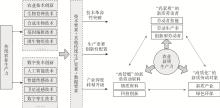
图1
农业新质生产力发展的内涵机制"
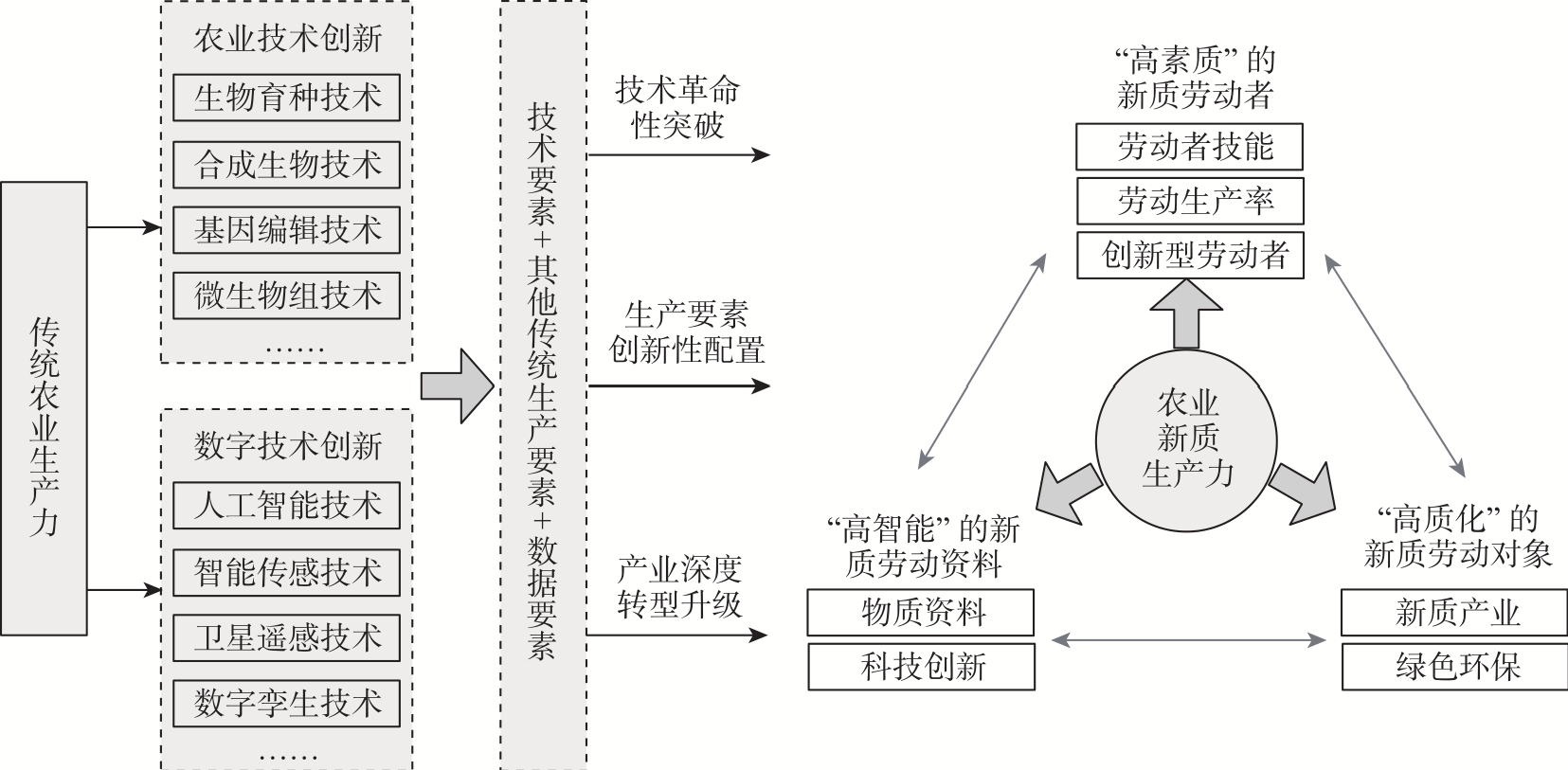

表1
农业新质生产力发展水平评价指标体系"
| 准则层 | 一级指标 | 二级指标(权重/属性) | 计算方法 | 单位 |
|---|---|---|---|---|
| 新质劳动者 | 劳动者技能 | 受教育程度X1(0.854%/+)[ | 农村劳动力人均受教育年限 | a |
| 农村人力资本X2(2.346%/+)[ | 农村实际劳动力人均人力资本 | 元 | ||
| 劳动生产率 | 人均农业生产总值X3(2.721%/+)[ | 农林牧渔业总产值/第一产业从业人员人数 | 元·人-1 | |
| 农村居民人均收入X4(2.908%/+)[ | 农村居民人均可支配收入 | 元 | ||
| 创新型劳动者 | 农业科技活动人员比重X5(4.983%/+)[ | 农业科技活动人员数量/第一产业从业人员人数 | % | |
| 农户创业活跃度X6(10.254%/+)[ | (农村私营企业就业人数+个体就业人数)/农村人口总数 | % | ||
| 新质劳动对象 | 新质产业 | 农业产业结构X7(3.375%/+)[ | 农林牧渔服务业总产值/农林牧渔业总产值 | % |
| 农村互联网普及率X8(5.186%/+)[ | 农村互联网宽带接入用户/该地区农村人口数 | 户·人-1 | ||
| 淘宝村数量占比X9(20.461%/+)[ | 省份的淘宝村数量/省份的行政村总数 | % | ||
| 农村网络支付数量及规模X10(1.714%/+)[ | 北京大学普惠金融县域指数 | |||
| 绿色环保 | 森林覆盖率X11(3.275%/+)[ | 森林面积/土地总面积 | % | |
| 单位面积化肥使用量X12(0.967%/-)[ | 化肥使用量/农作物总播种面积 | kg·hm-2 | ||
| 单位面积农药使用量X13(0.386%/-)[ | 农药使用量/农作物总播种面积 | kg·hm-2 | ||
| 农业碳排放强度X14(0.904%/-)[ | 农业碳排放量总和/农林牧渔业总产值 | kg·元-1 | ||
| 新质劳动资料 | 物质资料 | 农业机械化水平X15(2.577%/+)[ | 农业机械总动力/第一产业从业人员人数 | kW·人-1 |
| 农业生产电气化程度X16(3.856%/+)[ | 农林牧渔业增加值/农村用电量 | 元·kW-1 | ||
| 农村移动电话普及率X17(1.158%/+)[ | 每百户农村住户移动电话拥有量 | 部·人-1 | ||
| 农村物流基础设施X18(3.482%/+)[ | 单位行政村农村投递线路长度 | km | ||
| 科技创新 | 涉农专利数量X19(13.372%/+)[ | 农林牧渔业专利总和/第一产业从业人员人数 | 件·人-1 | |
| 农业研发投入强度X20(2.136%/+)[ | 农业研发经费内部支出/GDP | % | ||
| 农产品标准化水平X21(11.177%/+)[ | 绿色食品获证产品数量/耕地面积 | 个·hm-2 | ||
| 财政投入力度X22(1.908%/+)[ | 农林水事务支出/财政支出 | % |
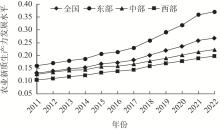
图2
中国及三大区域农业新质生产力发展水平的时序演化"
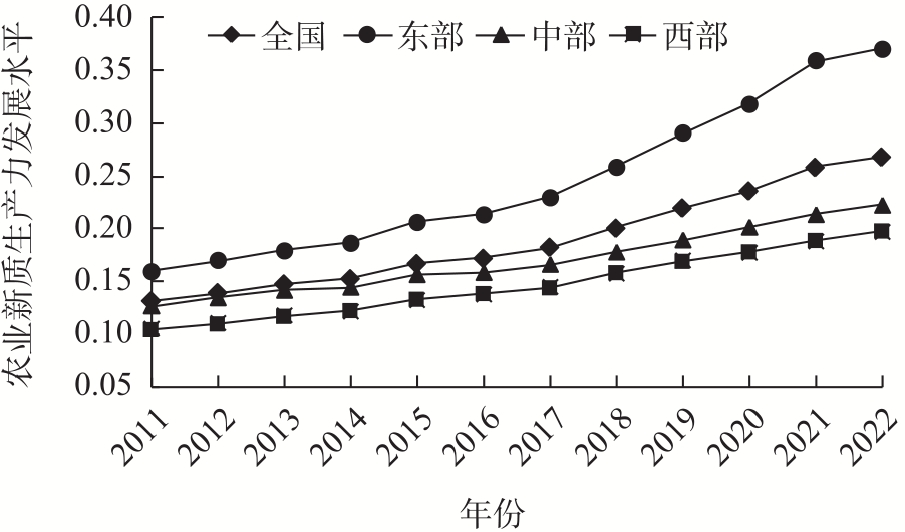
图3
中国农业新质生产力发展水平的空间分布"
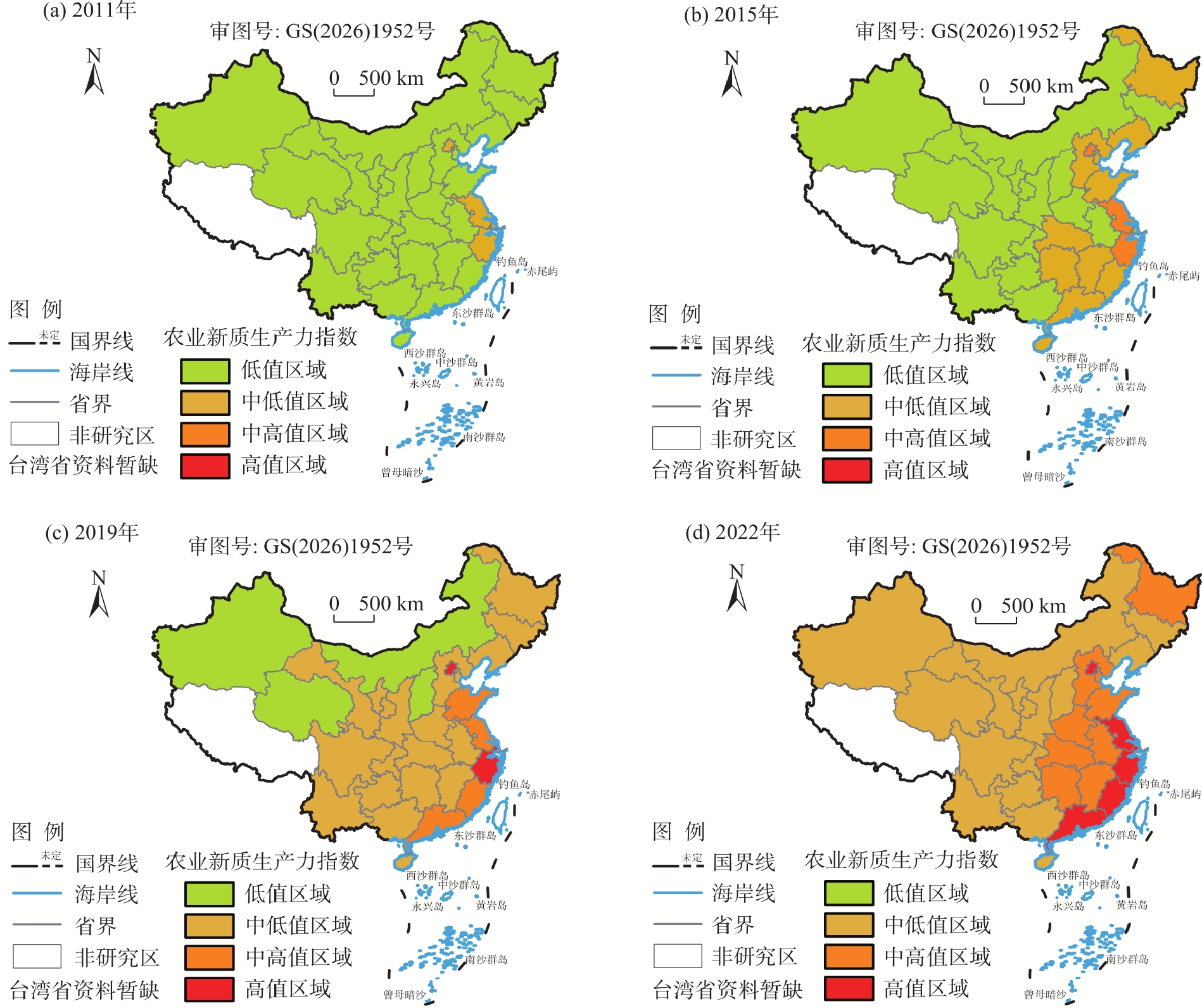
图4
农业新质生产力发展水平的地区差异及来源分解 注:Gw为组内差异;Gnb为组间差异;Gt为超变密度。"
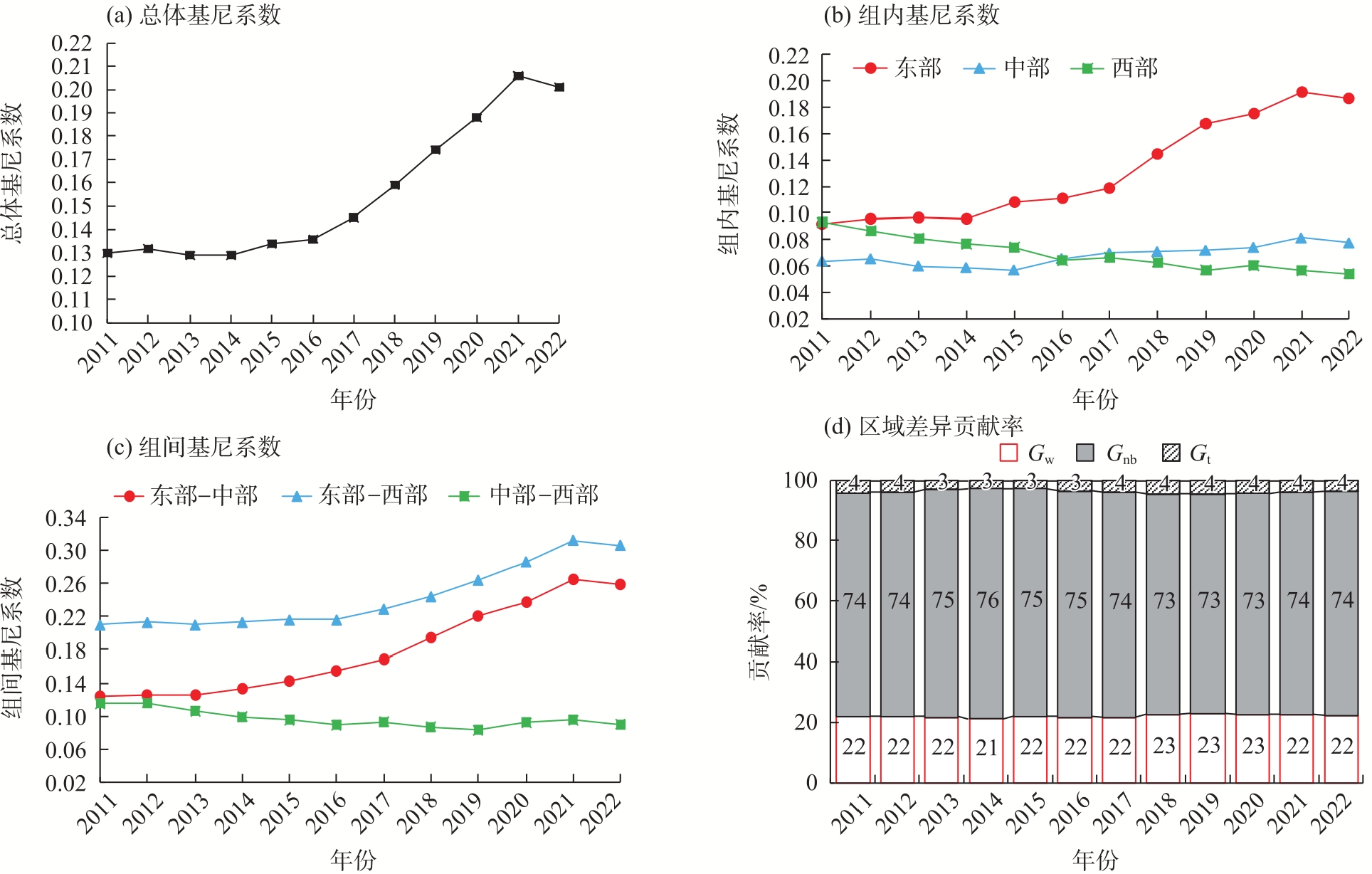
表2
中国农业新质生产力发展水平全局莫兰指数"
| 年份 | 2011年 | 2012年 | 2013年 | 2014年 | 2015年 | 2016年 | 2017年 | 2018年 | 2019年 | 2020年 | 2021年 | 2022年 |
|---|---|---|---|---|---|---|---|---|---|---|---|---|
| 全局Moran’s I | 0.405*** | 0.388*** | 0.389*** | 0.404*** | 0.423*** | 0.478*** | 0.498*** | 0.503*** | 0.506*** | 0.541*** | 0.531*** | 0.565*** |
| Z | 3.586 | 3.445 | 3.458 | 3.577 | 3.728 | 4.183 | 4.347 | 4.385 | 4.409 | 4.690 | 4.615 | 4.890 |
图5
农业新质生产力发展水平全局莫兰指数散点图 注:z为标准化后的观测值;Wz为空间滞后项。"
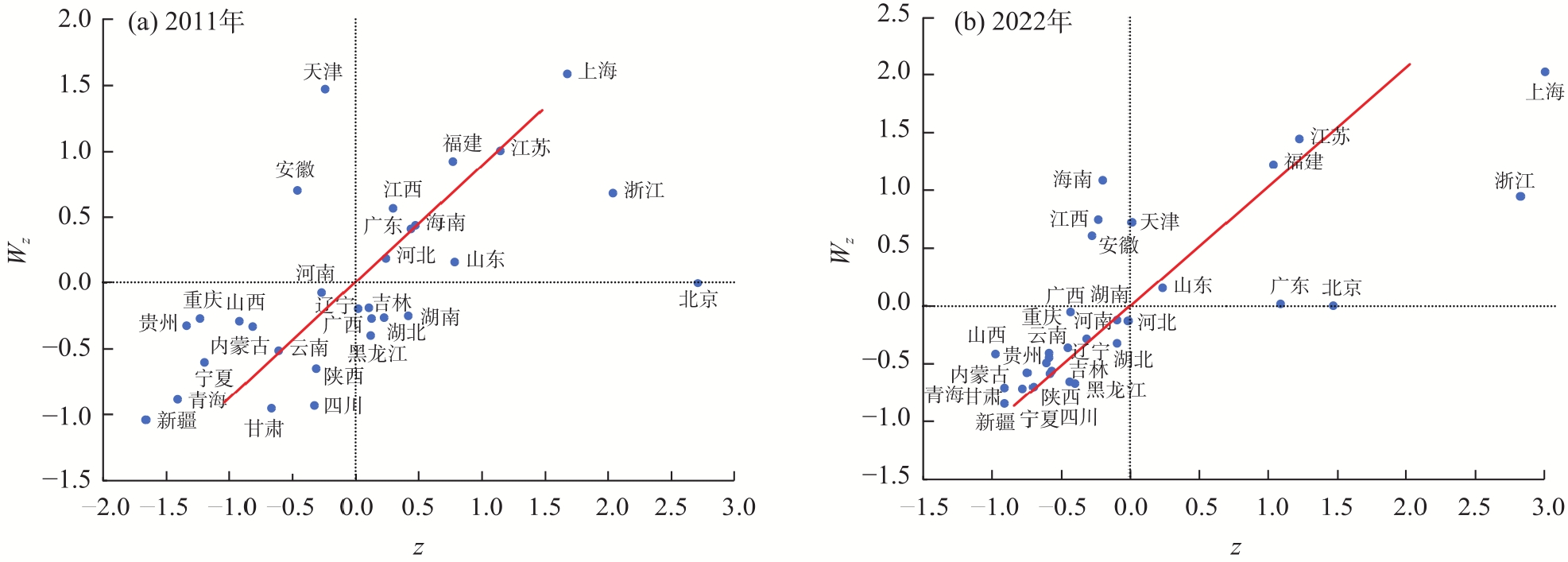
表3
农业新质生产力发展水平的传统马尔可夫转移概率矩阵"
| t/t+1 | 低 | 中低 | 中高 | 高 |
|---|---|---|---|---|
| 低 | 0.7253 | 0.2747 | 0.0000 | 0.0000 |
| 中低 | 0.0116 | 0.6860 | 0.3023 | 0.0000 |
| 中高 | 0.0000 | 0.0241 | 0.7590 | 0.2169 |
| 高 | 0.0000 | 0.0000 | 0.0000 | 1.0000 |
表4
农业新质生产力发展水平的空间马尔可夫转移概率矩阵"
| 领域类型 | t/t+1 | 低 | 中低 | 中高 | 高 |
|---|---|---|---|---|---|
| 低 | 低 | 0.8382 | 0.1618 | 0.0000 | 0.0000 |
| 中低 | 0.0769 | 0.8462 | 0.0769 | 0.0000 | |
| 中高 | - | - | - | - | |
| 高 | 0.0000 | 0.0000 | 0.0000 | 1.0000 | |
| 中低 | 低 | 0.3810 | 0.6190 | 0.0000 | 0.0000 |
| 中低 | 0.0000 | 0.7692 | 0.2308 | 0.0000 | |
| 中高 | 0.0000 | 0.0000 | 0.8000 | 0.2000 | |
| 高 | 0.0000 | 0.0000 | 0.0000 | 1.0000 | |
| 中高 | 低 | 0.5000 | 0.5000 | 0.0000 | 0.0000 |
| 中低 | 0.0000 | 0.3684 | 0.6316 | 0.0000 | |
| 中高 | 0.0000 | 0.0385 | 0.8269 | 0.1346 | |
| 高 | 0.0000 | 0.0000 | 0.0000 | 1.0000 | |
| 高 | 低 | - | - | - | - |
| 中低 | 0.0000 | 0.5000 | 0.5000 | 0.0000 | |
| 中高 | 0.0000 | 0.0000 | 0.5714 | 0.4286 | |
| 高 | 0.0000 | 0.0000 | 0.0000 | 1.0000 |
表5
中国农业新质生产力发展水平准则层障碍度"
| 准则层 | 2011年 | 2012年 | 2013年 | 2014年 | 2015年 | 2016年 | 2017年 | 2018年 | 2019年 | 2020年 | 2021年 | 2022年 |
|---|---|---|---|---|---|---|---|---|---|---|---|---|
| 新质劳动者 | 0.243 | 0.241 | 0.239 | 0.236 | 0.236 | 0.233 | 0.231 | 0.231 | 0.228 | 0.224 | 0.222 | 0.219 |
| 新质劳动对象 | 0.362 | 0.365 | 0.366 | 0.367 | 0.365 | 0.365 | 0.362 | 0.359 | 0.357 | 0.356 | 0.350 | 0.344 |
| 新质劳动资料 | 0.394 | 0.394 | 0.395 | 0.397 | 0.400 | 0.402 | 0.406 | 0.410 | 0.414 | 0.420 | 0.428 | 0.437 |
表6
中国农业新质生产力发展的主要障碍因子与障碍度"
| 障碍因子 | 2011年 | 2012年 | 2013年 | 2014年 | 2015年 | 2016年 | 2017年 | 2018年 | 2019年 | 2020年 | 2021年 | 2022年 |
|---|---|---|---|---|---|---|---|---|---|---|---|---|
| 第一障碍因子 | X9(0.233) | X9(0.235) | X9(0.237) | X9(0.238) | X9(0.241) | X9(0.240) | X9(0.241) | X9(0.242) | X9(0.243) | X9(0.242) | X9(0.237) | X9(0.235) |
| 第二障碍因子 | X19(0.150) | X19(0.151) | X19(0.151) | X19(0.152) | X19(0.153) | X19(0.153) | X19(0.153) | X19(0.154) | X19(0.158) | X19(0.156) | X19(0.155) | X19(0.164) |
| 第三障碍因子 | X21(0.125) | X21(0.127) | X21(0.128) | X21(0.129) | X21(0.131) | X21(0.131) | X21(0.133) | X21(0.134) | X21(0.133) | X21(0.138) | X21(0.139) | X21(0.139) |
| 第四障碍因子 | X6(0.111) | X6(0.112) | X6(0.112) | X6(0.112) | X6(0.113) | X6(0.112) | X6(0.111) | X6(0.112) | X6(0.113) | X6(0.115) | X6(0.118) | X6(0.120) |
| 第五障碍因子 | X8(0.055) | X8(0.054) | X8(0.054) | X8(0.054) | X8(0.053) | X8(0.051) | X5(0.050) | X5(0.051) | X5(0.049) | X5(0.046) | X5(0.045) | X5(0.044) |
| [1] | 罗必良. 新质生产力: 颠覆性创新与基要性变革——兼论农业高质量发展的本质规定和努力方向[J]. 中国农村经济, 2024(8): 2-26. |
| [Luo Biliang. New quality productive forces,disruptive innovation, and fundamental change: The essential requirements and striving direction for high-quality development of agriculture[J]. Chinese Rural Economy, 2024(8): 2-26. ] | |
| [2] | 高帆. “新质生产力”的提出逻辑、多维内涵及时代意义[J]. 政治经济学评论, 2023, 14(6): 127-145. |
| [Gao Fan. The logic, multidimensional connotation and current significance of “new quality productivity”[J]. China Political Economy Review, 2023, 14(6): 127-145. ] | |
| [3] | 周文, 许凌云. 论新质生产力: 内涵特征与重要着力点[J]. 改革, 2023(10): 1-13. |
| [Zhou Wen, Xu Lingyun. On new quality productivity: Connotative characteristics and important focus[J]. Reform, 2023(10): 1-13. ] | |
| [4] | 李晓华. 新质生产力的主要特征与形成机制[J]. 人民论坛, 2023(21): 15-17. |
| [Li Xiaohua. Major characteristics and formation mechanisms of new quality productive forces[J]. People’s Tribune, 2023(21): 15-17. ] | |
| [5] | 王世泰, 曹劲松. 新质生产力的缘起、生成动力与培育机理——基于马克思主义政治经济学视角[J]. 南京社会科学, 2024(3): 10-22. |
| [Wang Shitai, Cao Jinsong. The origins, formation and cultivation mechanism of China’s new quality productivity: Based on the perspective of Marxist political economy[J]. Nanjing Social Sciences, 2024(3): 10-22. ] | |
| [6] |
石卓达, 杨宏伟. 新质生产力对中国生态旅游高质量发展的影响[J]. 干旱区地理, 2026, 49(3): 440-450.
doi: 10.12118/j.issn.1000-6060.2025.375 |
|
[Shi Zhuoda, Yang Hongwei. Impact of new quality productive forces on the high-quality development of ecotourism in China[J]. Arid Land Geography, 2026, 49(3): 440-450. ]
doi: 10.12118/j.issn.1000-6060.2025.375 |
|
| [7] | 张林, 蒲清平. 新质生产力的内涵特征、理论创新与价值意蕴[J]. 重庆大学学报(社会科学版), 2023, 29(6): 137-148. |
| [Zhang Lin, Pu Qingping. The connotation characteristic, theoretical innovation and value implication of new quality productivity[J]. Journal of Chongqing University (Social Sciences Edition), 2023, 29(6): 137-148. ] | |
| [8] | 石建勋, 徐玲. 加快形成新质生产力的重大战略意义及实现路径研究[J]. 财经问题研究, 2024(1): 3-12. |
| [Shi Jianxun, Xu Ling. Major strategic significance and implementation path of accelerating the formation of new quality productivity[J]. Research on Financial and Economic Issues, 2024(1): 3-12. ] | |
| [9] | 蒋永穆, 乔张媛. 新质生产力: 逻辑、内涵及路径[J]. 社会科学研究, 2024(1): 10-18, 211. |
| [Jiang Yongmu, Qiao Zhangyuan. New quality productivity: Logic, connotation and path[J]. Social Science Research, 2024(1): 10-18, 211. ] | |
| [10] |
卢昭东, 秦璐, 马燕. 新质生产力对中国旅游经济高质量发展的影响[J]. 干旱区地理, 2026, 49(3): 451-461.
doi: 10.12118/j.issn.1000-6060.2025.305 |
|
[Lu Zhaodong, Qin Lu, Ma Yan. Impact of new quality productive forces on the high-quality development of tourism economy in China[J]. Arid Land Geography, 2026, 49(3): 451-461. ]
doi: 10.12118/j.issn.1000-6060.2025.305 |
|
| [11] | 王琴梅, 杨军鸽. 数字新质生产力与我国农业的高质量发展研究[J]. 陕西师范大学学报(哲学社会科学版), 2023, 52(6): 61-72. |
| [Wang Qinmei, Yang Junge. Research on digital new quality productivity and high-quality development of Chinese agriculture[J]. Journal of Shaanxi Normal University (Philosophy and Social Sciences Edition), 2023, 52(6): 61-72. ] | |
| [12] | 朱红根, 陈晖. 中国数字乡村发展的水平测度、时空演变及推进路径[J]. 农业经济问题, 2023(3): 21-33. |
| [Zhu Honggen, Chen Hui. Measurement, spatial-temporal evolution and promotion path of digital village development in China[J]. Agricultural Economic Issues, 2023(3): 21-33. ] | |
| [13] | 彭宸, 贾俊松, 余清项, 等. 中国农业碳排放的时空演化及影响因素分析[J]. 环境科学研究, 2024, 37(6): 1181-1192. |
| [Peng Chen, Jia Junsong, Yu Qingxiang, et al. Analysis of spatio-temporal evolution and influencing factors of agricultural carbon emission in China[J]. Research of Environmental Sciences, 2024, 37(6): 1181-1192. ] | |
| [14] | 郑建. 以新质生产力推动农业现代化: 理论逻辑与发展路径[J]. 价格理论与实践, 2023(11): 31-35. |
| [Zheng Jian. Promoting agricultural modernization with new quality productivity: Logicand development path[J]. Price Theory and Practice, 2023(11): 31-35. ] | |
| [15] | 罗必良, 耿鹏鹏. 农业新质生产力: 理论脉络、基本内核与提升路径[J]. 农业经济问题, 2024(4): 13-26. |
| [Luo Biliang, Geng Pengpeng. New quality agricultural productivity: Theoretical framework, core concepts, and enhancement pathways[J]. Agricultural Economic Issues, 2024(4): 13-26. ] | |
| [16] | 高原, 马九杰. 农业新质生产力: 一个政治经济学的视角[J]. 农业经济问题, 2024(4): 81-94. |
| [Gao Yuan, Ma Jiujie. New quality agricultural productivity: A political economy perspective[J]. Agricultural Economic Issues, 2024(4): 81-94. ] | |
| [17] | 朱迪, 叶林祥. 中国农业新质生产力: 水平测度与动态演变[J]. 统计与决策, 2024, 40(9): 24-30. |
| [Zhu Di, Ye Linxiang. Agricultural new quality productive force in China: Level measurement and dynamic evolution[J]. Statistics & Decision, 2024, 40(9): 24-30. ] | |
| [18] | 宋振江, 冷明妮, 周波, 等. 中国农业新质生产力: 评价体系构建、动态演进及政策启示[J]. 农林经济管理学报, 2024, 23(4): 425-434. |
| [Song Zhenjiang, Leng Mingni, Zhou Bo, et al. New quality agricultural productive forces in China: Evaluation system construction, dynamic evolution and policy implications[J]. Journal of Agricultural and Forestry Economics and Management, 2024, 23(4): 425-434. ] | |
| [19] | 黄敦平, 尹凯. 数字普惠金融发展能否提升农村创业活跃度[J]. 金融与经济, 2023(8): 43-53. |
| [Huang Dunping, Yin Kai. Can the development of digital inclusive finance increase the activity of rural entrepreneurship?[J]. Finance and Economy, 2023(8): 43-53. ] | |
| [20] | 马玉婷, 高强, 杨旭丹. 农村劳动力老龄化与农业产业结构升级: 理论机制与实证检验[J]. 华中农业大学学报(社会科学版), 2023(2): 69-79. |
| [Ma Yuting, Gao Qiang, Yang Xudan. Aging of rural labor force and the upgrading of agricultural industrial structure: Theoretical mechanism and empirical test[J]. Journal of Huazhong Agricultural University (Social Sciences Edition), 2023(2): 69-79. ] | |
| [21] | 王丽双, 傅新红, 蒋浩, 等. 农业新质生产力测度、区域差异及耦合协调研究[J]. 农林经济管理学报, 2025, 24(1): 55-64. |
| [Wang Lishuang, Fu Xinhong, Jiang Hao, et al. Development level measurement, regional differences and coupling coordination of agricultural new quality productivity[J]. Journal of Agricultural and Forestry Economics and Management, 2025, 24(1): 55-64. ] | |
| [22] | 罗光强, 宋新宇. 中国农业新质生产力: 生成机理、时空特征与区域差异[J]. 中国农业资源与区划, 2025, 46(6): 138-150. |
| [Luo Guangqiang, Song Xinyu. The production mechanisms, spatial and temporal characteristics, and regional differences of agricultural new quality productivity in China[J]. Chinese Journal of Agricultural Resources and Regional Planning, 2025, 46(6): 138-150. ] | |
| [23] | 慕娟, 马立平. 中国农业农村数字经济发展指数测度与区域差异[J]. 华南农业大学学报(社会科学版), 2021, 20(4): 90-98. |
| [Mu Juan, Ma Liping. Measurement of China’s rural digital economy development index and regional disparities[J]. Journal of South China Agricultural University (Social Sciences Edition), 2021, 20(4): 90-98. ] | |
| [24] | 赵丹玉, 崔建军. 中国农业农村高质量发展的时空特征、区域差异及影响因素[J]. 华中农业大学学报(社会科学版), 2024(3): 10-24. |
| [Zhao Danyu, Cui Jianjun. The spatial-temporal characteristics, regional disparities, and influencing factors of high-quality agricultural and rural development in China[J]. Journal of Huazhong Agricultural University (Social Sciences Edition), 2024(3): 10-24. ] | |
| [25] | 杨军鸽, 王琴梅. 数字技术与农业高质量发展——基于数字生产力的视角[J]. 山西财经大学学报, 2023, 45(4): 47-63. |
| [Yang Junge, Wang Qinmei. Digital technology and high-quality agricultural development: From the perspective of digital productivity[J]. Journal of Shanxi University of Finance and Economics, 2023, 45(4): 47-63. ] | |
| [26] | 黄修杰, 蔡勋, 储霞玲, 等. 我国农业高质量发展评价指标体系构建与评估[J]. 中国农业资源与区划, 2020, 41(4): 124-133. |
| [Huang Xiujie, Cai Xun, Chu Xialing, et al. Index construction and evaluation of high-quality development of agriculture in China[J]. Chinese Journal of Agricultural Resources and Regional Planning, 2020, 41(4): 124-133. ] | |
| [27] | 钟晓华. 乡村产业高质量发展与共同富裕的耦合协调测度与时空特征分析[J]. 统计与决策, 2023, 39(7): 67-72. |
| [Zhong Xiaohua. Coupling synergy measure and spatial-temporal characteristic analysis of high-quality development of rural industries and common affluence[J]. Statistics & Decision, 2023, 39(7): 67-72. ] | |
| [28] | 陈明华, 刘玉鑫, 刘文斐, 等. 中国城市民生发展的区域差异测度、来源分解与形成机理[J]. 统计研究, 2020, 37(5): 54-67. |
| [Chen Minghua, Liu Yuxin, Liu Wenfei, et al. Measurement, source decomposition and formation mechanism of regional differences in urban livelihood development in China[J]. Statistical Research, 2020, 37(5): 54-67. ] | |
| [29] |
韩建雨, 胡登月, 李平星, 等. 中国新质生产力水平时空格局及其影响因素[J]. 经济地理, 2025, 45(7): 1-12.
doi: 10.15957/j.cnki.jjdl.2025.07.001 |
|
[Han Jianyu, Hu Dengyue, Li Pingxing, et al. Spatio-temporal pattern and influencing factors of new quality productive forces in China[J]. Economic Geography, 2025, 45(7): 1-12. ]
doi: 10.15957/j.cnki.jjdl.2025.07.001 |
|
| [30] |
李艳丰. 省域跨境人民币结算的区域差异变化及影响因素[J]. 经济地理, 2023, 43(7): 139-150.
doi: 10.15957/j.cnki.jjdl.2023.07.014 |
|
[Li Yanfeng. Regional differences and influencing factors of provincial cross-border RMB settlement in provinces[J]. Economic Geography, 2023, 43(7): 139-150. ]
doi: 10.15957/j.cnki.jjdl.2023.07.014 |
|
| [31] | 李晓燕, 王倩, 张桐. 长江经济带农业高质量发展水平测度、地区差异与空间相关性研究[J]. 农村经济, 2024(7): 89-99. |
| [Li Xiaoyan, Wang Qian, Zhang Tong. Measurement of high-quality agricultural development level, regional differences and spatial correlation in the Yangtze River Economic Belt[J]. Rural Economy, 2024(7): 89-99. ] | |
| [32] |
杨川, 卢新海, 许进龙. 基于“大食物观”的中国粮食安全水平评价与动态演进[J]. 经济地理, 2024, 44(2): 166-174.
doi: 10.15957/j.cnki.jjdl.2024.02.017 |
|
[Yang Chuan, Lu Xinhai, Xu Jinlong. Evaluation and dynamic evolution of food security level based on big food concept[J]. Economic Geography, 2024, 44(2): 166-174. ]
doi: 10.15957/j.cnki.jjdl.2024.02.017 |
|
| [33] | 卢江, 郭子昂, 王煜萍. 新质生产力发展水平、区域差异与提升路径[J]. 重庆大学学报(社会科学版), 2024, 30(3): 1-17. |
| [Lu Jiang, Guo Zi’ang, Wang Yuping. Levels of development of new quality productivity, regional differences and paths to enhancement[J]. Journal of Chongqing University (Social Sciences Edition), 2024, 30(3): 1-17. ] | |
| [34] | 周迪, 程慧平. 中国农业现代化发展水平时空格局及趋同演变[J]. 华南农业大学学报(社会科学版), 2015, 14(1): 25-35. |
| [Zhou Di, Cheng Huiping. Evolvement of convergence and spatial patterns of agricultural modernization in China[J]. Journal of South China Agricultural University (Social Sciences Edition), 2015, 14(1): 25-35. ] |
| [1] | 付伟, 王煜承, 崔龙芳, 陈建成. 中国西部地区城乡居民食物消费碳排放差异与驱动因素分析[J]. 干旱区地理, 2026, 49(5): 1026-1038. |
| [2] | 郑孟林, 赵勇, 杨霞. 1961—2022年中国西北干旱区夏季降水变化特征[J]. 干旱区地理, 2025, 48(3): 367-379. |
| [3] | 李锦, 蒲娟, 李明亮, 赵兰兰, 余国新. 新型城镇化与和美乡村耦合协调发展水平测度、地区差异及动态演进[J]. 干旱区地理, 2025, 48(12): 2220-2231. |
| [4] | 夏文浩, 霍瑜, 逯渊, 王超毅. 新疆农业碳排放的时空差异与空间溢出效应分析[J]. 干旱区地理, 2024, 47(6): 1084-1096. |
| [5] | 吉泽男, 付文婷, 王鹏程, 廖升, 潘铮. 干旱区数字经济与农业绿色发展耦合协调研究——以新疆为例[J]. 干旱区地理, 2024, 47(11): 1981-1990. |
| [6] | 白洋,胡静轩,陈春燕,路雯. 旅游援疆效率的区域差异和影响因素——基于三阶段DEA和Tobit模型[J]. 干旱区地理, 2023, 46(8): 1366-1375. |
| [7] | 赵海莉, 李家亮, 李开丽, 杜雨涵, 王家明. 基于不同尺度的中国运动健身场所空间差异及影响因素研究[J]. 干旱区地理, 2022, 45(6): 1938-1948. |
| [8] | 李玲蔚,白永平,杨雪荻,张春悦,梁建设,王倩. 黄河几字湾地区可持续发展的动态演变及区域差异[J]. 干旱区地理, 2022, 45(2): 639-649. |
| [9] | 赵海莉,王启雯,朱立祥,李晓芹,田浩宇. 基于地理探测器的欠发达地区健康资源时空分异及影响因素研究[J]. 干旱区地理, 2021, 44(2): 594-603. |
| [10] | 范学伟, 郑有飞, 王立稳, 陈纹锋 . 基于CALIPSO卫星产品的中国区域异质核化冰云比例差异[J]. 干旱区地理, 2020, 43(5): 1210-1219. |
| [11] | 周迪, 周丰年, 郑楚鹏. 公平和效率视角的中国碳排放区域差异及其固化研究[J]. 干旱区地理, 2019, 42(6): 1461-1469. |
| [12] | 呼梦霞, 杜宏茹, 张小雷, 杨晶, 张璐. 基于主体功能区视角下新疆民生质量的区域差异及影响因素[J]. 干旱区地理, 2017, 40(3): 655-663. |
| [13] | 暴向平,薛东前,郭瑞斌. 陕西省旅游文化产业实力差异及空间结构构建[J]. 干旱区地理, 2015, 38(1): 190-198. |
| [14] | 于国斌,李忠勤,王璞玉. 近50 a祁连山西段大雪山和党河南山的冰川变化[J]. 干旱区地理, 2014, 37(2): 299-309. |
| [15] | 朱建佳,陈辉,郝立生,刘耀亮,刘纹瑕,邢星. 河北省气候变化对AO因子的响应探讨[J]. 干旱区地理, 2013, 36(1): 19-26. |
|
||