Arid Land Geography ›› 2026, Vol. 49 ›› Issue (8): 1737-1749.doi: 10.12118/j.issn.1000-6060.2025.446
• Urban and Rural Development • Previous Articles Next Articles
HUANG Jing1( ), XUE Dongqian2(), HAN Chen1, XU Jiaxiu1
Received:2025-08-05
Revised:2025-09-12
Online:2026-08-25
Published:2026-08-21
Contact:
XUE Dongqian
E-mail:huangjing1@wnu.edu.cn;xuedq@snnu.edu.cn
HUANG Jing, XUE Dongqian, HAN Chen, XU Jiaxiu. Transformation pattern of rural labor employment structure in oasis areas of arid regions and its economic effects: A case study of Ganzhou District[J].Arid Land Geography, 2026, 49(8): 1737-1749.
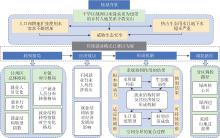
Fig. 1
Research framework on the transformation of rural labor employment structure and its economic effects in oases of arid regions"
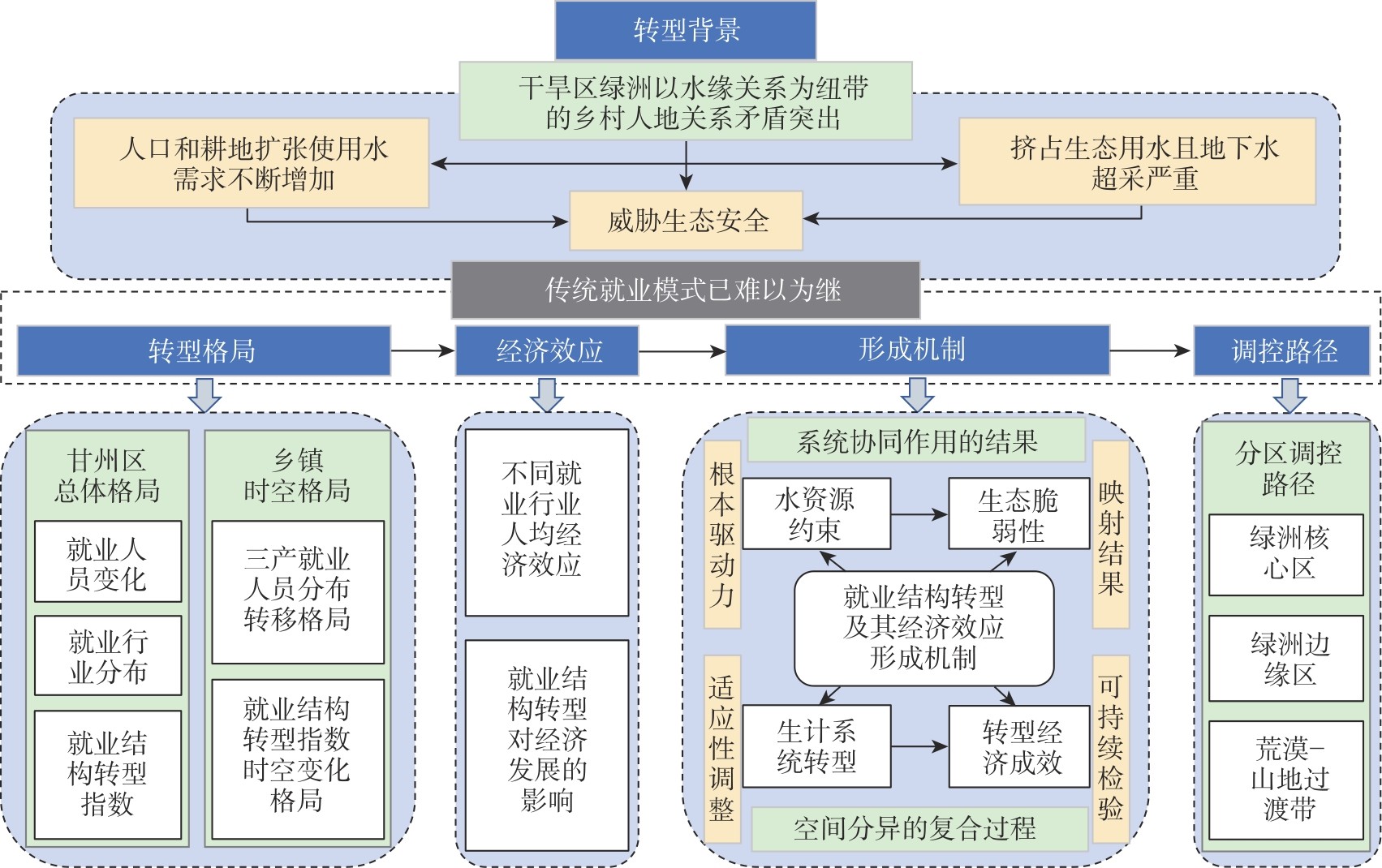
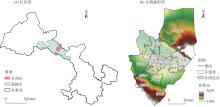
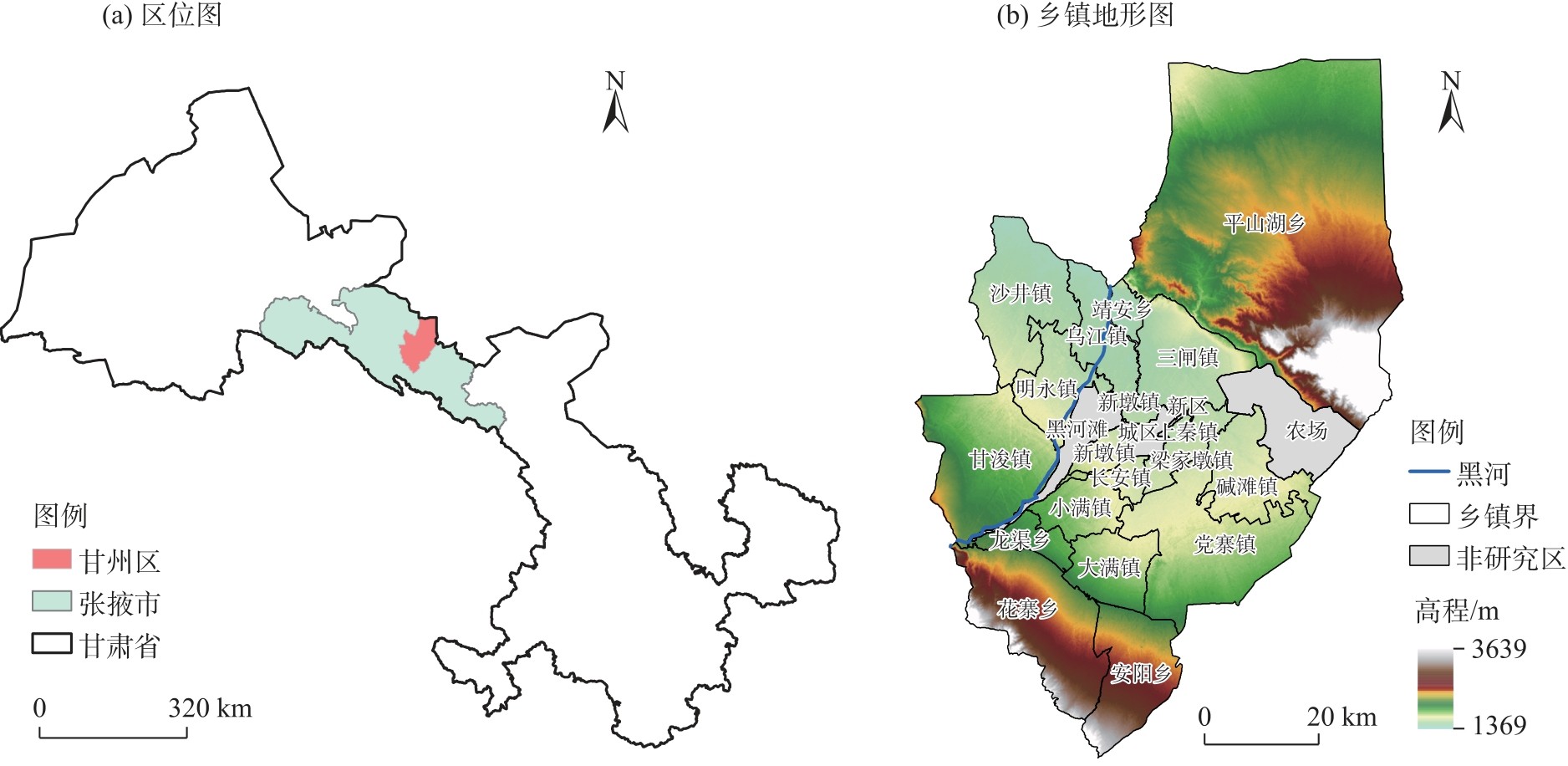
Fig. 2
Schematic diagram of the study area"

Tab. 1
Overview of rural labor employment by industry group in Ganzhou District"
| 产业大类 | 精细门类 |
|---|---|
| 第一产业 | 种植业、林业、牧业、渔业 |
| 第二产业 | 工业、建筑业 |
| 第三产业 | 交通运输仓储业和邮政业,信息传输、计算机服务和软件业,批发与零售业,住宿和餐饮业,科学研究事业和综合技术服务,教育、文化艺术和广播电视事业,卫生、体育和社会福利事业,乡镇经济组织(乡务)管理,金融保险事业,其他服务业 |
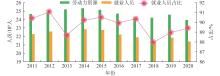
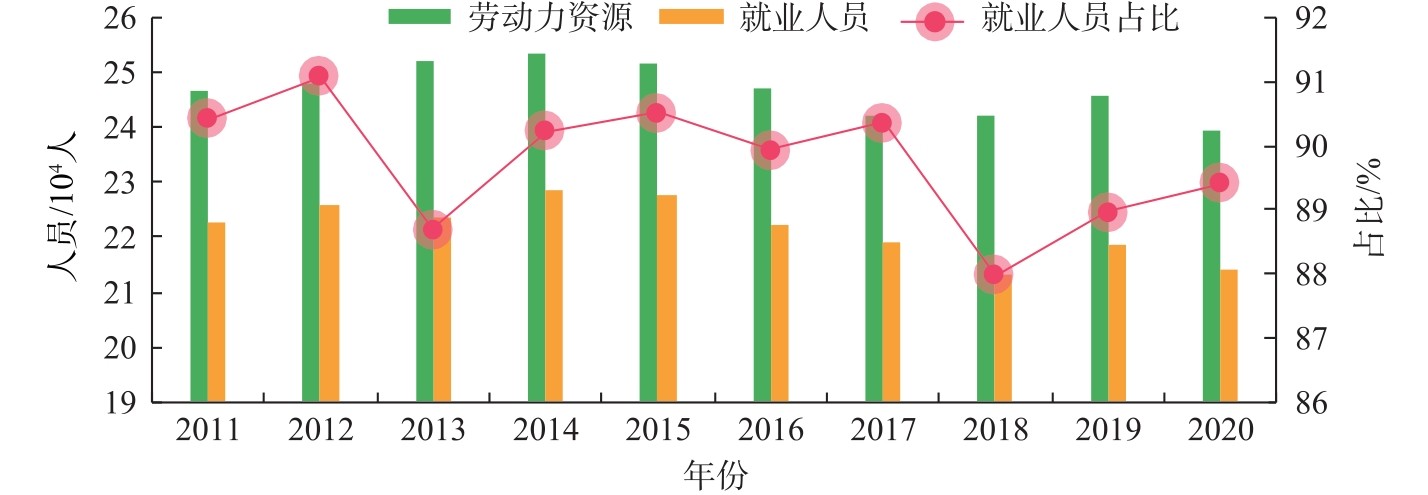
Fig. 3
Rural labor resources and employed persons in Ganzhou District from 2011 to 2020"
Tab. 2
Distribution proportion of rural labor employment by industry in Ganzhou District from 2011 to 2020"
| 行业类型 | 2011年 | 2012年 | 2013年 | 2014年 | 2015年 | 2016年 | 2017年 | 2018年 | 2019年 | 2020年 |
|---|---|---|---|---|---|---|---|---|---|---|
| 第一产业 | 54.26 | 52.49 | 52.71 | 52.75 | 53.28 | 52.66 | 54.22 | 58.24 | 57.31 | 56.22 |
| 种植业 | 46.08 | 44.54 | 43.89 | 43.57 | 44.11 | 43.61 | 44.93 | 48.58 | 47.85 | 46.50 |
| 林业 | 1.07 | 0.93 | 1.03 | 0.90 | 1.02 | 0.79 | 0.71 | 1.40 | 1.70 | 1.61 |
| 牧业 | 7.06 | 7.00 | 7.74 | 8.26 | 8.12 | 8.23 | 8.56 | 8.24 | 7.74 | 8.08 |
| 渔业 | 0.05 | 0.03 | 0.05 | 0.02 | 0.02 | 0.02 | 0.03 | 0.03 | 0.02 | 0.03 |
| 第二产业 | 16.89 | 17.56 | 17.48 | 17.54 | 17.61 | 17.97 | 17.75 | 16.60 | 16.07 | 16.17 |
| 工业 | 5.03 | 4.76 | 4.45 | 4.35 | 4.24 | 4.28 | 4.24 | 3.74 | 3.42 | 3.51 |
| 建筑业 | 11.86 | 12.80 | 13.03 | 13.19 | 13.37 | 13.69 | 13.50 | 12.86 | 12.66 | 12.65 |
| 第三产业 | 28.85 | 29.95 | 29.81 | 29.71 | 29.11 | 29.36 | 28.03 | 25.16 | 26.62 | 27.61 |
| 交通运输仓储业和邮政业 | 5.73 | 5.79 | 4.66 | 4.56 | 4.53 | 4.55 | 4.41 | 3.62 | 3.28 | 3.32 |
| 信息传输、计算机服务和软件业 | 0.58 | 0.52 | 0.52 | 0.51 | 0.49 | 0.49 | 0.52 | 0.50 | 0.54 | 0.55 |
| 批发与零售业 | 4.34 | 4.24 | 4.03 | 3.99 | 4.01 | 4.12 | 4.06 | 3.62 | 3.84 | 3.90 |
| 住宿和餐饮业 | 2.03 | 2.38 | 2.69 | 2.71 | 2.64 | 2.71 | 2.67 | 2.13 | 2.29 | 2.20 |
| 科学研究事业和综合技术服务 | 0.02 | 0.02 | 0.03 | 0.03 | 0.04 | 0.03 | 0.03 | 0.02 | 0.05 | 0.06 |
| 教育、文化艺术和广播电视事业 | 0.21 | 0.22 | 0.24 | 0.24 | 0.26 | 0.25 | 0.25 | 0.12 | 0.18 | 0.19 |
| 卫生、体育和社会福利事业 | 0.16 | 0.16 | 0.22 | 0.21 | 0.23 | 0.23 | 0.25 | 0.20 | 0.25 | 0.26 |
| 乡镇经济组织(乡务)管理 | 0.06 | 0.06 | 0.11 | 0.56 | 0.67 | 0.48 | 0.58 | 0.55 | 0.43 | 0.26 |
| 金融保险事业 | 0.32 | 0.26 | 0.35 | 0.31 | 0.49 | 0.33 | 0.50 | 0.43 | 0.70 | 0.52 |
| 其他服务业 | 15.40 | 16.31 | 16.96 | 16.58 | 15.76 | 16.19 | 14.75 | 13.97 | 15.05 | 16.35 |
| 甘州区在外就业人员 | 12.35 | 11.95 | 12.73 | 11.92 | 11.09 | 10.94 | 10.07 | 8.99 | 10.37 | 10.38 |
Tab. 3
Transformation index of rural labor employment structure in Ganzhou District from 2011 to 2020"
| 年份 | 三次产业间 | 精细门类间 | 本地-外出间 |
|---|---|---|---|
| 2011—2015 | 1.02 | 3.34 | 0.91 |
| 2015—2020 | 2.95 | 2.63 | 0.51 |
| 2011—2020 | 3.97 | 5.97 | 1.42 |
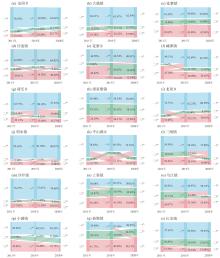
Fig. 4
Transfer pattern of distribution proportion of rural labor force employed population in Ganzhou District from 2011 to 2020"
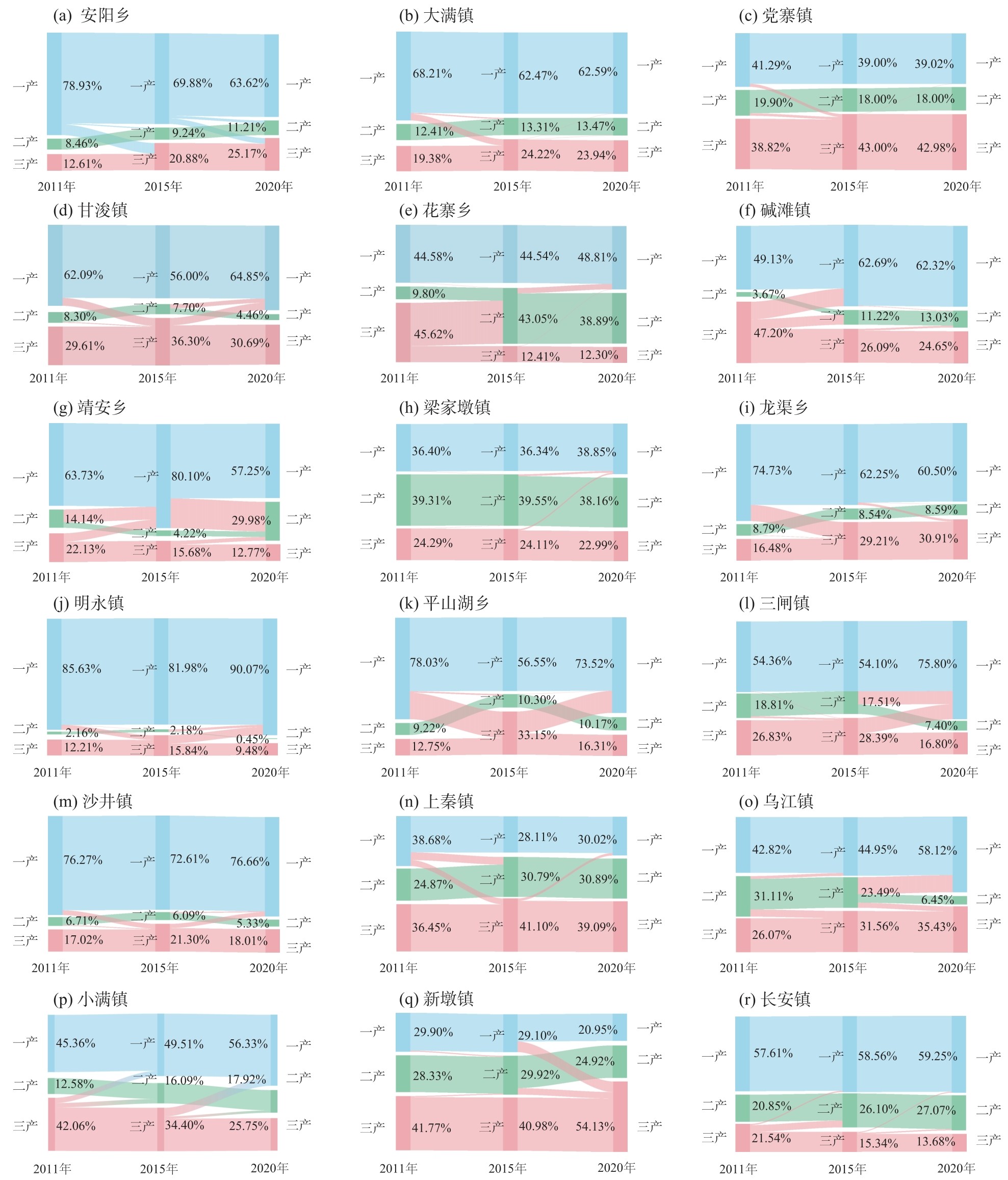
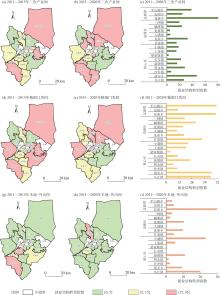
Fig. 5
Transformation index of rural labor employment structure in Ganzhou District from 2011 to 2020"

Tab. 4
Economic effect of rural labor force employment industry in Ganzhou District from 2011 to 2020"
| 就业行业 | 人均收入/元·人-1 | |||
|---|---|---|---|---|
| 2011年 | 2015年 | 2020年 | 平均值 | |
| 种植业 | 18665 | 32080 | 36531 | 29092 |
| 林业 | 50317 | 66670 | 46027 | 54338 |
| 牧业 | 81429 | 101283 | 133906 | 105539 |
| 渔业 | 66158 | 113800 | 92250 | 90736 |
| 工业 | 59827 | 93923 | 126619 | 93456 |
| 建筑业 | 24982 | 31403 | 53395 | 36593 |
| 服务业 | 25090 | 46847 | 64945 | 45627 |
Tab. 5
Impact of the transformation of the rural labor force employment structure in Ganzhou District on the per capita net income of farmers"
| 变量 | 标准化回归系数 | ||
|---|---|---|---|
| 2011— 2015年 | 2015— 2020年 | 2011— 2020年 | |
| 种植业转型差异矩阵 | -0.2233** | 0.0006 | 0.2249** |
| 林业转型差异矩阵 | 0.4094*** | 0.0228 | 0.3143** |
| 牧业转型差异矩阵 | -0.1224 | 0.0371 | 0.2449*** |
| 渔业转型差异矩阵 | -0.0794 | 0.1542 | -0.0658 |
| 工业转型差异矩阵 | 0.0004 | 0.1205 | 0.0915 |
| 建筑业转型差异矩阵 | -0.0358 | 0.2383* | -0.1142* |
| 服务业转型差异矩阵 | 0.3196** | -0.0801 | -0.0293 |
| 外出转型差异矩阵 | -0.1051 | -0.0231 | 0.0013 |
| R2 | 0.3310 | 0.3200 | 0.3520 |
| P值 | 0.0000 | 0.0000 | 0.0000 |
| [1] |
黄晶, 薛东前, 董朝阳, 等. 干旱绿洲农业区土地利用转型生态环境效应及分异机制——基于三生空间主导功能判别视角[J]. 地理科学进展, 2022, 41(11): 2044-2060.
doi: 10.18306/dlkxjz.2022.11.005 |
|
[Huang Jing, Xue Dongqian, Dong Chaoyang, et al. Eco-environmental effects and spatial differentiation mechanism of land use transition in agricultural areas of arid oasis: A perspective based on the dominant function of production-living-ecological spaces[J]. Progress in Geography, 2022, 41(11): 2044-2060.]
doi: 10.18306/dlkxjz.2022.11.005 |
|
| [2] |
周紫羽, 党若源, 杨舒喻, 等. 近40 a吐哈地区绿洲时空变化特征及影响因素研究[J]. 干旱区地理, 2025, 48(10): 1695-1706.
doi: 10.12118/j.issn.1000-6060.2025.152 |
|
[Zhou Ziyu, Dang Ruoyuan, Yang Shuyu, et al. Spatio-temporal variation and influencing factors of Turpan-Hami region oasis in the past 40 years[J]. Arid Land Geography, 2025, 48(10): 1695-1706.]
doi: 10.12118/j.issn.1000-6060.2025.152 |
|
| [3] | Zhang J M, Ding J L, Zhang Z H, et al. Study on the inversion and spatiotemporal variation mechanism of soil salinization at multiple depths in typical oases in arid areas: A case study of Wei-Ku Oasis[J]. Agricultural Water Management, 2025, 315: 109542, doi: 10.1016/j.agwat.2025.109542. |
| [4] |
吴孔森, 刘倩, 张戬, 等. 干旱环境胁迫下民勤绿洲农户生计脆弱性与适应模式[J]. 经济地理, 2019, 39(12): 157-167.
doi: 10.15957/j.cnki.jjdl.2019.12.018 |
|
[Wu Kongsen, Liu Qian, Zhang Jian, et al. Farmers’ livelihood vulnerability and adaptation model in Minqin Oasis under the arid environment stress[J]. Economic Geography, 2019, 39(12): 157-167.]
doi: 10.15957/j.cnki.jjdl.2019.12.018 |
|
| [5] |
Ma L, Long H L, Zhang Y N, et al. Agricultural labor changes and agricultural economic development in China and their implications for rural vitalization[J]. Journal of Geographical Sciences, 2019, 29(2): 163-179.
doi: 10.1007/s11442-019-1590-5 |
| [6] | 唐茂华, 黄少安. 劳动伦理与中国农村劳动力迁移——一个尝试性理论建构及解释框架[J]. 河南大学学报(社会科学版), 2011, 51(5): 53-59. |
| [Tang Maohua, Huang Shao’an. Work ethics and labor transfer: A tentative framework of theoretic construction and explanation[J]. Journal of Henan University (Social Science), 2011, 51(5): 53-59.] | |
| [7] |
祁新华, 朱宇, 周燕萍. 乡村劳动力迁移的“双拉力”模型及其就地城镇化效应——基于中国东南沿海三个地区的实证研究[J]. 地理科学, 2012, 32(1): 25-30.
doi: 10.13249/j.cnki.sgs.2012.01.25 |
|
[Qi Xinhua, Zhu Yu, Zhou Yanping. A “double-pull” model of rural labor migration and its in situ urbanization effect: Cases studies of three coastal areas in southeast China[J]. Scientia Geographica Sinica, 2012, 32(1): 25-30.]
doi: 10.13249/j.cnki.sgs.2012.01.25 |
|
| [8] |
Deng W, Zhang S Y, Zhou P, et al. Spatiotemporal characteristics of rural labor migration in China: Evidence from the migration stability under new-type urbanization[J]. Chinese Geographical Science, 2020, 30(5): 749-764.
doi: 10.1007/s11769-020-1147-7 |
| [9] | 蒋乃华, 封进. 农村城市化进程中的农民意愿考察——对江苏的实证分析[J]. 管理世界, 2002(2): 24-29. |
| [Jiang Naihua, Feng Jin. An investigation of farmers’ willingness in the process of rural urbanization: An empirical analysis of Jiangsu Province[J]. Journal of Management World, 2002(2): 24-29.] | |
| [10] | 卫龙宝, 胡慧洪, 钱文荣, 等. 城镇化过程中相关行为主体迁移意愿的分析——对浙江省海宁市农村居民的调查[J]. 中国社会科学, 2003(5): 39-49. |
| [Wei Longbao, Hu Huihong, Qian Wenrong, et al. Desire and behavior of relevant actors in the process of urbanization: A survey of farmers’ migration desire in Haining Zhejiang Province[J]. Social Sciences in China, 2003(5): 39-49.] | |
| [11] |
马历, 龙花楼, 张英男, 等. 中国县域农业劳动力变化与农业经济发展的时空耦合及其对乡村振兴的启示[J]. 地理学报, 2018, 73(12): 2364-2377.
doi: 10.11821/dlxb201812007 |
|
[Ma Li, Long Hualou, Zhang Yingnan, et al. Spatio-temporal coupling relationship between agricultural labor changes and agricultural economic development at county level in China and its implications for rural revitalization[J]. Acta Geographica Sinica, 2018, 73(12): 2364-2377.]
doi: 10.11821/dlxb201812007 |
|
| [12] | 马颖忆, 冯年华, 戈大专, 等. 农村一二三产业与劳动力融合的耦合关系——以江苏省为例[J]. 中国农业资源与区划, 2022, 43(9): 126-137. |
| [Ma Yingyi, Feng Nianhua, Ge Dazhuan, et al. Coupling analysis on integration of the primary, secondary and tertiary industries and their labor forces in rural villages: A case of Jiangsu Province[J]. Chinese Journal of Agricultural Resources and Regional Planning, 2022, 43(9): 126-137.] | |
| [13] | 李建伟. 我国劳动力供求格局、技术进步与经济潜在增长率[J]. 管理世界, 2020, 36(4): 96-113. |
| [Li Jianwei. Labor supply and demand pattern, technological progress and potential economic growth rate in China[J]. Journal of Management World, 2020, 36(4): 96-113.] | |
| [14] |
Zhang L X, Huang J K, Rozelle S. Employment, emerging labor markets, and the role of education in rural China[J]. China Economic Review, 2002, 13(2): 313-328.
doi: 10.1016/S1043-951X(02)00075-5 |
| [15] | 张川川, 王靖雯. 性别角色与女性劳动力市场表现[J]. 经济学(季刊), 2020, 19(3): 977-994. |
| [Zhang Chuanchuan, Wang Jingwen. Gender roles and the labor market outcomes of women[J]. China Economic Quarterly, 2020, 19(3): 977-994.] | |
| [16] | 李敏, 阎晓博, 黄晓慧. 人力资本对农民工返乡行为的影响——基于代际差异视角的分析[J]. 华中农业大学学报(社会科学版), 2021, 41(1): 90-98. |
| [Li Min, Yan Xiaobo, Huang Xiaohui. The impact of human capital on the behavior of migrant workers returning home: Based on the perspective of intergenerational differences[J]. Journal of Huazhong Agricultural University (Social Sciences Edition), 2021, 41(1): 90-98.] | |
| [17] |
Rijnks R H, Koster S, McCann P. Spatial heterogeneity in amenity and labor market migration[J]. International Regional Science Review, 2018, 41(2): 183-209.
doi: 10.1177/0160017616672516 |
| [18] | 姚文燕. 乡村振兴战略背景下的农村劳动力转移: 国内外经验总结、比较与启示[J]. 农业经济, 2022(8): 72-74. |
| [Yao Wenyan. Rural labor transfer in the context of rural revitalization strategy: Summary, comparison and enlightenment of domestic and foreign experiences[J]. Agricultural Economy, 2022(8): 72-74.] | |
| [19] | 李芳华, 姬晨阳. 乡村振兴视角下的农村劳动力回流弹性估计——基于空间断点回归的研究[J]. 中国农村经济, 2022(2): 36-55. |
| [Li Fanghua, Ji Chenyang. Estimation of return elasticity of rural labor force from the perspective of rural revitalization: Evidence based on spatial discontinuity design[J]. Chinese Rural Economy, 2022(2): 36-55.] | |
| [20] | 何田, 郎雨, 青丽波, 等. 乡村振兴视角下脱贫地区农村劳动力回流多维特征及形成机理——以重庆市奉节县为例[J]. 人文地理, 2024, 39(3): 132-141. |
| [He Tian, Lang Yu, Qing Libo, et al. Multi-dimensional characteristics and formation mechanism of rural labor reflow in poverty alleviation areas from the perspective of rural revitalization: A case study of Fengjie County, Chongqing[J]. Human Geography, 2024, 39(3): 132-141.] | |
| [21] | 王影, 尉京红. 数字乡村建设与农村劳动力就业——论“数字赋能”与“数字负能”[J]. 农业经济, 2024(9): 98-100. |
| [Wang Ying, Wei Jinghong. Digital rural construction and rural labor employment: On “Digital Empowerment” and “Digital Negative Energy”[J]. Agricultural Economy, 2024(9): 98-100.] | |
| [22] | 张圆刚. 数字文旅时代乡村旅游地劳动力返乡: 新特点、新角色、新挑战[J]. 旅游学刊, 2024, 39(11): 14-15. |
| [Zhang Yuangang. Labor return to rural tourism in the era of digital cultural tourism: New characteristics, new roles and new challenges[J]. Tourism Tribune, 2024, 39(11): 14-15.] | |
| [23] |
Chen Y N, Fang G H, Li Z, et al. The crisis in oases: Research on ecological security and sustainable development in arid regions[J]. Annual Review of Environment and Resources, 2024, 49: 1-20.
doi: 10.1146/energy.2024.49.issue-1 |
| [24] |
黄晶, 薛东前, 吴逸群, 等. 干旱区绿洲乡村地域系统韧性演化与适应对策——以甘肃省张掖市甘州区为例[J]. 地理科学进展, 2024, 43(8): 1542-1557.
doi: 10.18306/dlkxjz.2024.08.006 |
|
[Huang Jing, Xue Dongqian, Wu Yiqun, et al. Change in resilience and adaptation strategies of oasis rural regional system in arid areas: Taking Ganzhou District as an example[J]. Progress in Geography, 2024, 43(8): 1542-1557.]
doi: 10.18306/dlkxjz.2024.08.006 |
|
| [25] |
尹莎, 陈佳, 吴孔森, 等. 干旱环境胁迫下农户适应性研究——基于民勤绿洲地区农户调查数据[J]. 地理科学进展, 2016, 35(5): 644-654.
doi: 10.18306/dlkxjz.2016.05.011 |
|
[Yin Sha, Chen Jia, Wu Kongsen, et al. Adaptation of farming households under drought stress: Based on a survey in the Minqin Oasis[J]. Progress in Geography, 2016, 35(5): 644-654.]
doi: 10.18306/dlkxjz.2016.05.011 |
|
| [26] | Chen J, Yin S, Yang X J. The impact of adaptive management on community resilience in arid rural areas facing environmental change: An integrated analytical framework[J]. Environmental Science and Policy, 2023, 150, 103589, doi: 10.1016/j.envsci.2023.103589. |
| [27] | 林伟鹏, 丁望岳, 张洋华, 等. 大城市边缘区乡村劳动力转移就业的分异特征研究——以济南市为例[J]. 城市发展研究, 2024, 31(10): 17-28. |
| [Lin Weipeng, Ding Wangyue, Zhang Yanghua, et al. A study on the differentiation characteristics of rural labor force transfer and employment in the urban fringe areas of large cities: A case study of Ji’nan City[J]. Urban Development Studies, 2024, 31(10): 17-28.] | |
| [28] |
陆林, 周裕祺, 李冬花. 乡村旅游地回流劳动力的就业选择及其影响因素[J]. 经济地理, 2023, 43(10): 222-230.
doi: 10.15957/j.cnki.jjdl.2023.10.022 |
|
[Lu Lin, Zhou Yuqi, Li Donghua. Employment choice of returning laborers in rural tourism destinations and its influencing factors[J]. Economic Geography, 2023, 43(10): 222-230.]
doi: 10.15957/j.cnki.jjdl.2023.10.022 |
|
| [29] | 何田, 廖和平, 孙平军, 等. 西南贫困山区乡村振兴潜力与劳动力资源耦合关系——以贵州省望谟县为例[J]. 地域研究与开发, 2022, 41(1): 145-150. |
| [He Tian, Liao Heping, Sun Pingjun, et al. Coupling relationship between potential of rural revitalization and labor resources in poor mountainous areas in southwest China: A case of Wangmo County in Guizhou Province[J]. Areal Research and Development, 2022, 41(1): 145-150.] | |
| [30] | Huang J, Xue D Q, Huang M. Rural resilience evaluation and risk governance in the middle reaches of the Heihe River, northwest China: An empirical analysis from Ganzhou District, a typical irrigated agricultural area[J]. Land, 2025, 14(5): 926, doi: 10.3390/land14050926. |
| [31] |
蒋晓辉, 夏军, 黄强, 等. 黑河“97”分水方案适应性分析[J]. 地理学报, 2019, 74(1): 103-116.
doi: 10.11821/dlxb201901008 |
|
[Jiang Xiaohui, Xia Jun, Huang Qiang, et al. Adaptability analysis of the Heihe River “97” water diversion scheme[J]. Acta Geographica Sinica, 2019, 74(1): 103-116.]
doi: 10.11821/dlxb201901008 |
|
| [32] | 刘笑笑, 缑倩倩, 王国华. 塔里木盆地北缘绿洲-荒漠过渡带宽度动态分析[J]. 干旱区研究, 2025, 42(3): 534-544. |
|
[Liu Xiaoxiao, Gou Qianqian, Wang Guohua. Analysis of the width dynamics of the oasis-desert ecotone at the northern margin of the Tarim Basin[J]. Arid Zone Research, 2025, 42(3): 534-544.]
doi: 10.13866/j.azr.2025.03.13 |
|
| [33] | 吴孔森, 芮旸, 陈佳, 等. 旅游驱动下乡村转型发展的微尺度研究——以西安市上王村为例[J]. 地理科学进展, 2020, 39(6): 1047-1059. |
|
[Wu Kongsen, Rui Yang, Chen Jia, et al. Micro-scale study on rural transformation and development driven by tourism: Taking Shang Wang Village in Xi’an City as an example[J]. Progress in Geography, 2020, 39(6): 1047-1059.]
doi: 10.18306/dlkxjz.2020.06.014 |
|
| [34] | 孙淑惠, 陈晓楠. 中国数字乡村发展的地区差距测度、结构分解与影响因素识别[J]. 统计与决策, 2024, 40(10): 69-74. |
| [Sun Shuhui, Chen Xiaonan. Regional gap measurement, structural decomposition and influencing factors identification of China’s digital rural development[J]. Statistics & Decision, 2024, 40(10): 69-74.] | |
| [35] |
Chen Y N, Zhang X Q, Fang G H, et al. Potential risks and challenges of climate change in the arid region of northwestern China[J]. Regional Sustainability, 2020, 1(1): 20-30.
doi: 10.1016/j.regsus.2020.06.003 |
| [36] | Zeng T, Li Y, Ma L, et al. Unveiling latent interaction mechanisms influencing the spatial pattern of soil salinity in arid oases: Insights from integrated modeling[J]. Catena, 2025, 250: 108769, doi: 10.1016/j.catena.2025.108769. |
| [1] | WANG Yi-qiang,ZHAO Yuan. Regional coal resources flow and its macroeconomic effects:a case of Inner Mongolia [J]. , 2015, 38(1): 163-172. |
|
||

