干旱区地理 ›› 2026, Vol. 49 ›› Issue (6): 1122-1134.doi: 10.12118/j.issn.1000-6060.2025.464 cstr: 32274.14.ALG2025464
杨益1( ), 穆振侠1, 凌红波2(), 张延蕾2, 邓悦1
收稿日期:2025-08-18
修回日期:2025-09-14
出版日期:2026-06-25
发布日期:2026-06-29
通讯作者:
凌红波(1983-),男,博士,研究员,主要从事生态水文资源等方面的研究. E-mail: linghongbo@163.com作者简介:杨益(1999-),男,硕士研究生,主要从事生态水文水资源等方面的研究. E-mail: 15334453346@163.com
基金资助:
YANG Yi1(), MU Zhenxia1, LING Hongbo2(), ZHANG Yanlei2, DENG Yue1
Received:2025-08-18
Revised:2025-09-14
Published:2026-06-25
Online:2026-06-29
摘要:
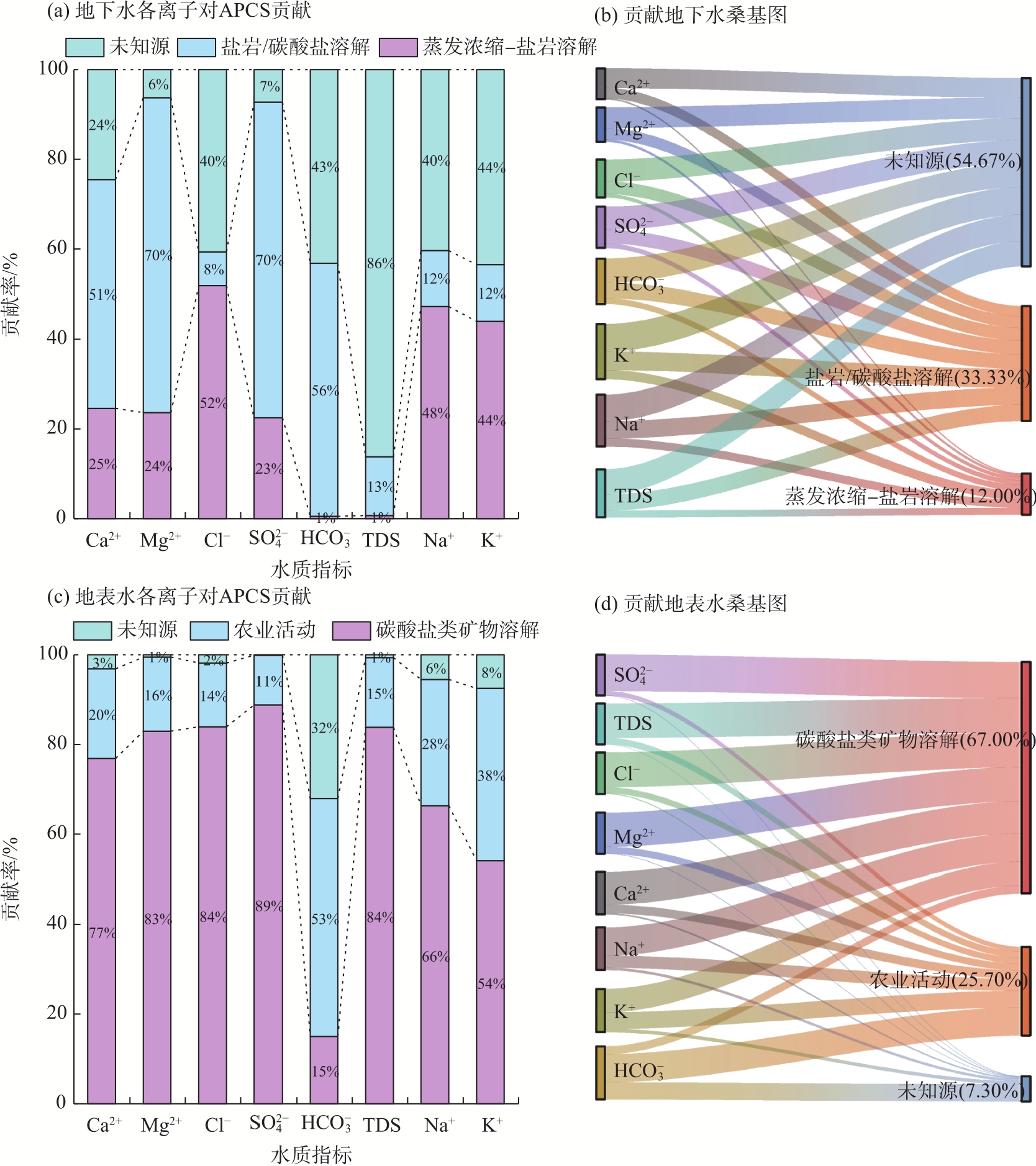
聚焦塔里木河流域在气候变化与高强度人类活动叠加影响下所面临的水体盐分来源不清、迁移机制不明等关键问题,尤其针对水环境劣化与盐平衡失调对水资源可持续利用及生态安全形成的制约,系统开展了水化学时空分异特征及其驱动机制研究,于2023—2024年枯水期与丰水期采集地表水与地下水样品,综合运用水化学方法及APCS-MLR模型进行解析。结果表明:(1) 总溶解性固体(TDS)与离子浓度枯水期高于丰水期、地下水高于地表水,地表水化学类型随季节变化指示补给来源由地下水向冰川融水转变。(2) 地下水化学受蒸发浓缩与岩盐溶解控制,地表水以碳酸盐风化为主。(3) TDS自西向东、自上中游向下游递增,反映灌溉排水盐分回流的显著影响。(4) 模型解析显示,地下水离子主要来源于盐岩碳酸盐溶解(33.33%)和蒸发浓缩-盐岩溶解(12.00%),地表水离子主要来自碳酸盐类矿物溶解(67.00%)和农业活动(25.70%),地下水未知源(54.67%)贡献较高,指示存在多源污染混合及复杂水文地球化学过程。研究揭示了流域水化学受自然与人为因素共同驱动,可为区域水盐调控与生态保护提供科学依据。
杨益, 穆振侠, 凌红波, 张延蕾, 邓悦. 塔里木河流域地表水地下水的水化学特征及控制因素分析[J]. 干旱区地理, 2026, 49(6): 1122-1134.
YANG Yi, MU Zhenxia, LING Hongbo, ZHANG Yanlei, DENG Yue. Hydrochemical characteristics and controlling mechanisms of surface water and groundwater in the Tarim River Basin[J]. Arid Land Geography, 2026, 49(6): 1122-1134.
图1
研究区示意图 注:基于自然资源部标准地图服务网站审图号为GS(2023)2767号的标准地图制作,底图边界无修改。下同。"
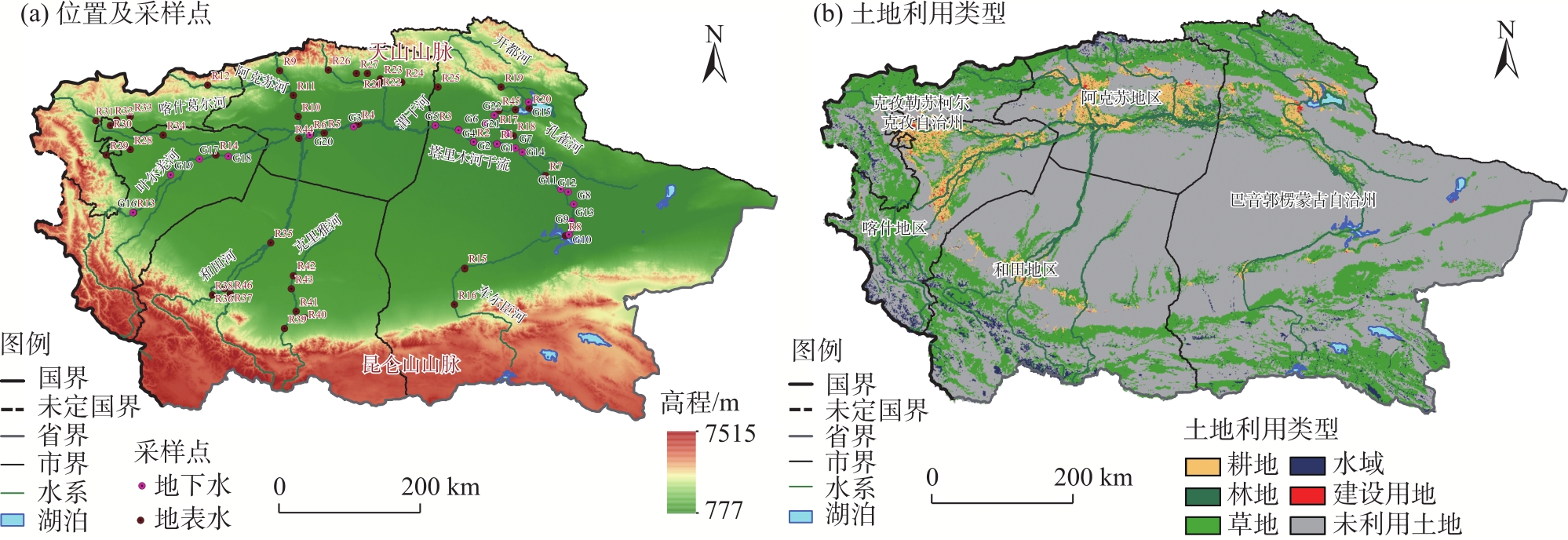
图2
枯、丰水期的地下水、地表水浓度变化箱型图 注:TDS为总溶解性固体。下同。"
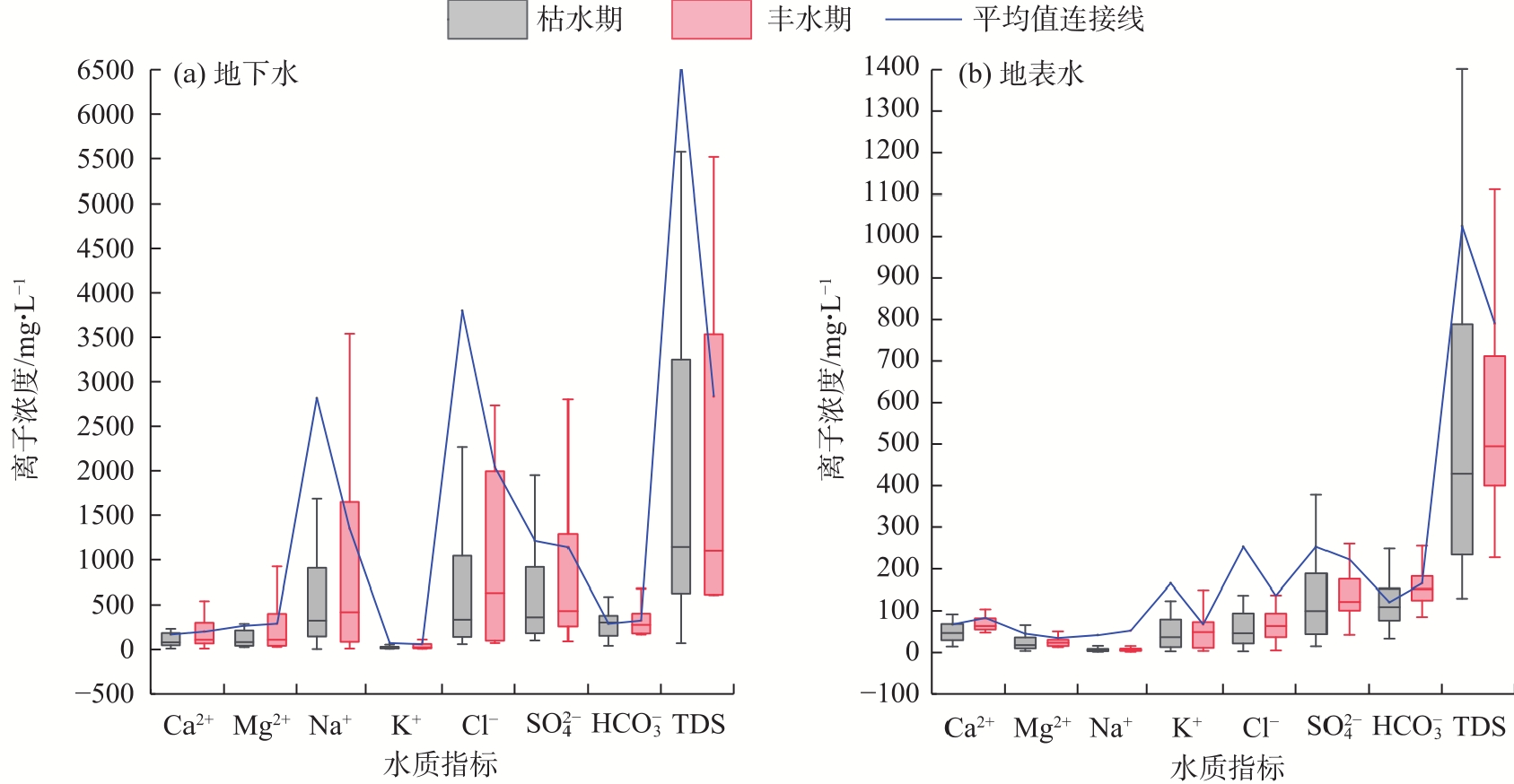
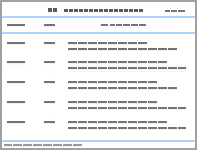
表1
塔里木河流域枯、丰水期的地下水、地表水水化学参数统计"
| 类型 | 项目 | TDS | 主要离子浓度 | ||||||
|---|---|---|---|---|---|---|---|---|---|
| Ca2+ | Mg2+ | Na+ | K+ | Cl- | SO42- | HCO3- | |||
| 枯水期地下水 (N=31) | 最大值 | 68390.0 | 1378.9 | 2329.5 | 47908.9 | 932.7 | 63677.2 | 10780.6 | 589.0 |
| 最小值 | 69.4 | 9.7 | 25.5 | 3.8 | 7.9 | 60.6 | 101.6 | 41.2 | |
| 平均值 | 6587.5 | 170.1 | 265.5 | 2816.7 | 71.4 | 3798.6 | 1213.9 | 289.9 | |
| 标准差 | 16773.7 | 284.9 | 518.6 | 9038.5 | 191.7 | 12125.9 | 2360.7 | 154.8 | |
| 枯水期地表水 (N=72) | 最大值 | 12045.9 | 481.1 | 466.8 | 1212.6 | 2939.7 | 4123.8 | 2839.5 | 248.5 |
| 最小值 | 129.1 | 14.5 | 3.9 | 1.3 | 2.4 | 2.6 | 14.7 | 33.5 | |
| 平均值 | 1025.1 | 67.4 | 45.0 | 41.6 | 164.8 | 252.5 | 252.4 | 120.6 | |
| 标准差 | 2007.0 | 76.2 | 81.4 | 181.9 | 475.5 | 684.5 | 486.9 | 56.2 | |
| 丰水期地下水 (N=20) | 最大值 | 14333.0 | 782.4 | 1704.2 | 11775.1 | 361.4 | 18393.3 | 8303.1 | 778.0 |
| 最小值 | 610.0 | 10.5 | 28.3 | 8.8 | 8.2 | 71.4 | 91.4 | 166.6 | |
| 平均值 | 2835.0 | 201.8 | 290.6 | 1349.5 | 58.4 | 2044.7 | 1390.9 | 355.5 | |
| 标准差 | 3686.3 | 225.7 | 408.8 | 2541.0 | 81.1 | 3972.1 | 1970.2 | 170.8 | |
| 丰水期地表水 (N=27) | 最大值 | 9660.0 | 414.7 | 398.7 | 2170.6 | 410.4 | 2992.3 | 2931.6 | 346.2 |
| 最小值 | 227.0 | 48.0 | 12.5 | 1.3 | 3.9 | 5.0 | 42.2 | 85.1 | |
| 平均值 | 790.1 | 83.0 | 34.8 | 52.7 | 67.3 | 136.6 | 222.2 | 165.3 | |
| 标准差 | 1289.6 | 61.7 | 54.1 | 294.3 | 82.7 | 406.1 | 400.1 | 57.4 | |
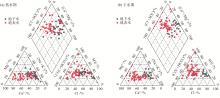
图3
塔里木河流域枯、丰水期的地下水、地表水Piper三线图"
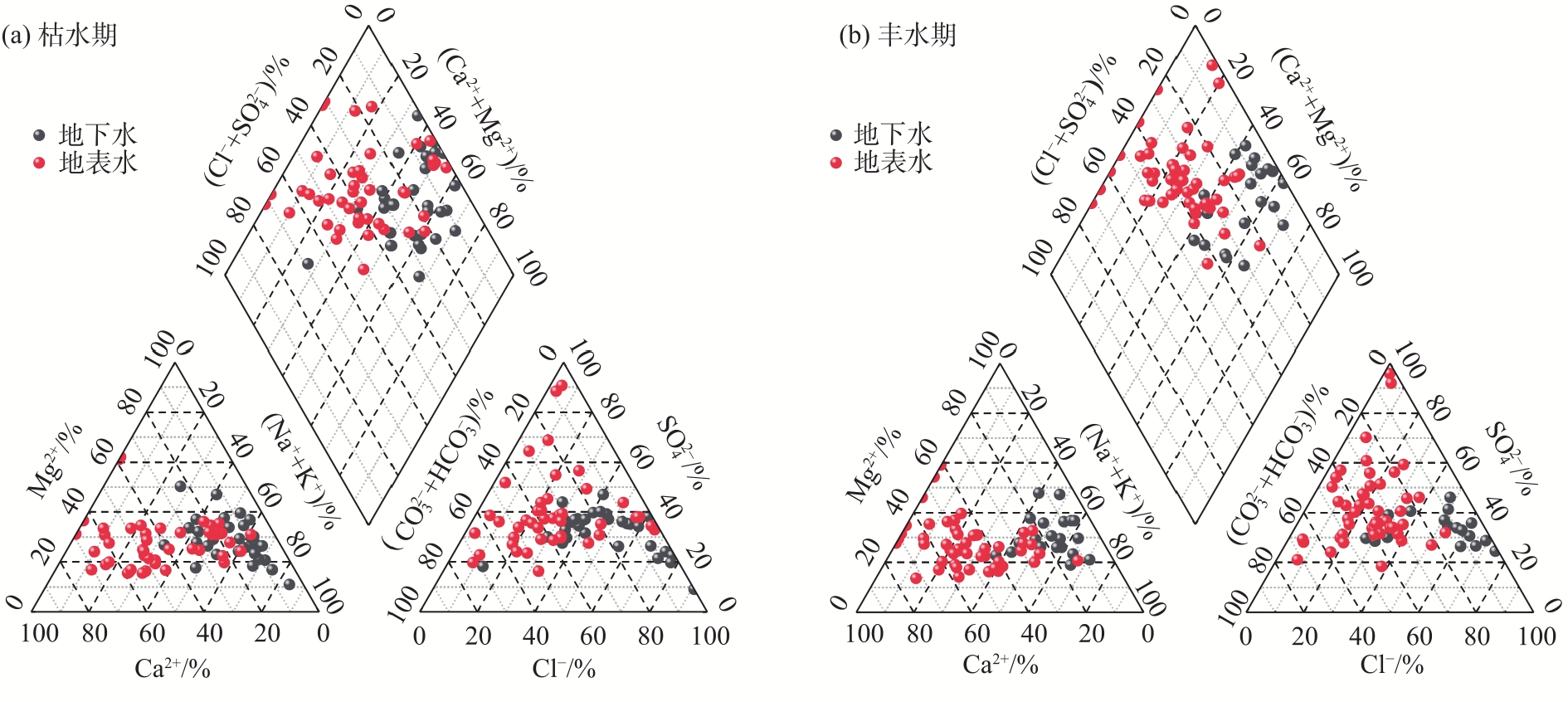
表2
塔里木河流域枯、丰水期的地下水、地表水主要水化学类型统计"
| 地下水 | 地表水 | |||||||
|---|---|---|---|---|---|---|---|---|
| 编号 | 水化学类型 | 枯水期 | 丰水期 | 编号 | 水化学类型 | 枯水期 | 丰水期 | |
| 20 | HCO3·SO4·Cl-Na·Mg | 22.58 | 0.00 | 41 | SO4·Cl-Na·Mg | 15.56 | 0.00 | |
| 41 | SO4·Cl-Na·Mg | 25.81 | 40.00 | 19 | HCO3·SO4·Cl-Na·Ca·Mg | 4.44 | 13.73 | |
| 40 | SO4·Cl-Na·Ca·Mg | 3.23 | 0.00 | 16 | HCO3·SO4·Cl-Ca·Mg | 6.67 | 15.69 | |
| 48 | Cl-Na·Mg | 3.23 | 0.00 | 42 | SO4·Cl-Na | 6.67 | 1.96 | |
| 42 | SO4·Cl-Na | 12.90 | 20.00 | 9 | HCO3·SO4-Ca·Mg | 11.11 | 15.96 | |
| 21 | HCO3·SO4·Cl-Na | 6.45 | 5.00 | 11 | HCO3·SO4-Na·Ca | 17.78 | 5.88 | |
| 19 | HCO3·SO4·Cl-Na·Ca·Mg | 9.68 | 20.00 | 18 | HCO3·SO4·Cl-Na·Ca | 13.33 | 17.65 | |
| 49 | Cl-Na | 12.90 | 5.00 | 2 | HCO3-Ca·Mg | 4.44 | 3.92 | |
| 6 | HCO3-Na·Mg | 3.23 | 0.00 | 29 | SO4-Ca | 4.44 | 1.96 | |
| 18 | HCO3·SO4·Cl-Na·Ca | 0.00 | 10.00 | 8 | HCO3·SO4-Ca | 4.44 | 9.80 | |
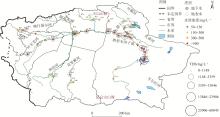
图4
塔里木河流域地下水、地表水中TDS浓度空间变化"
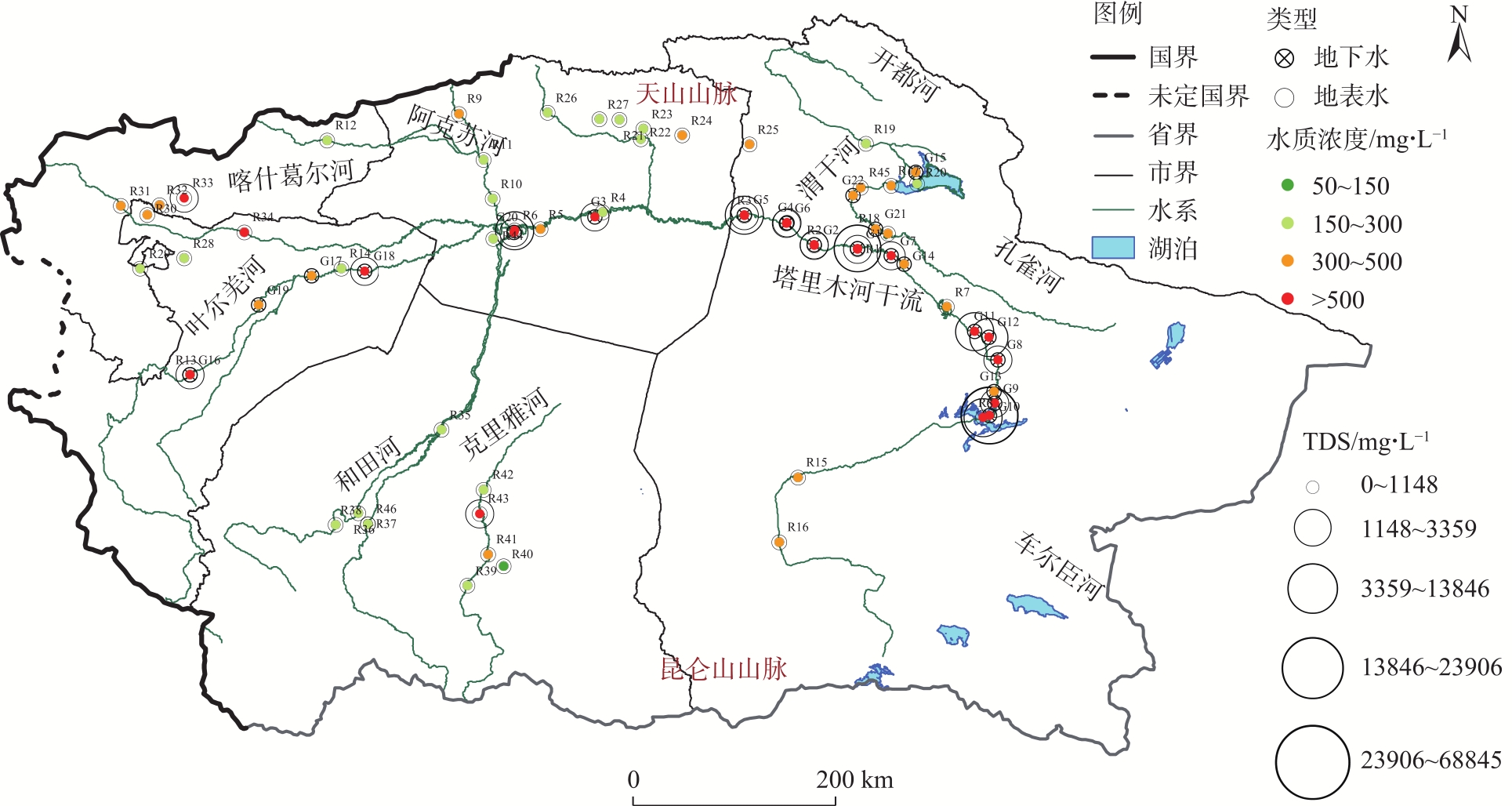
图5
塔里木河流域水体离子间相关性分析"
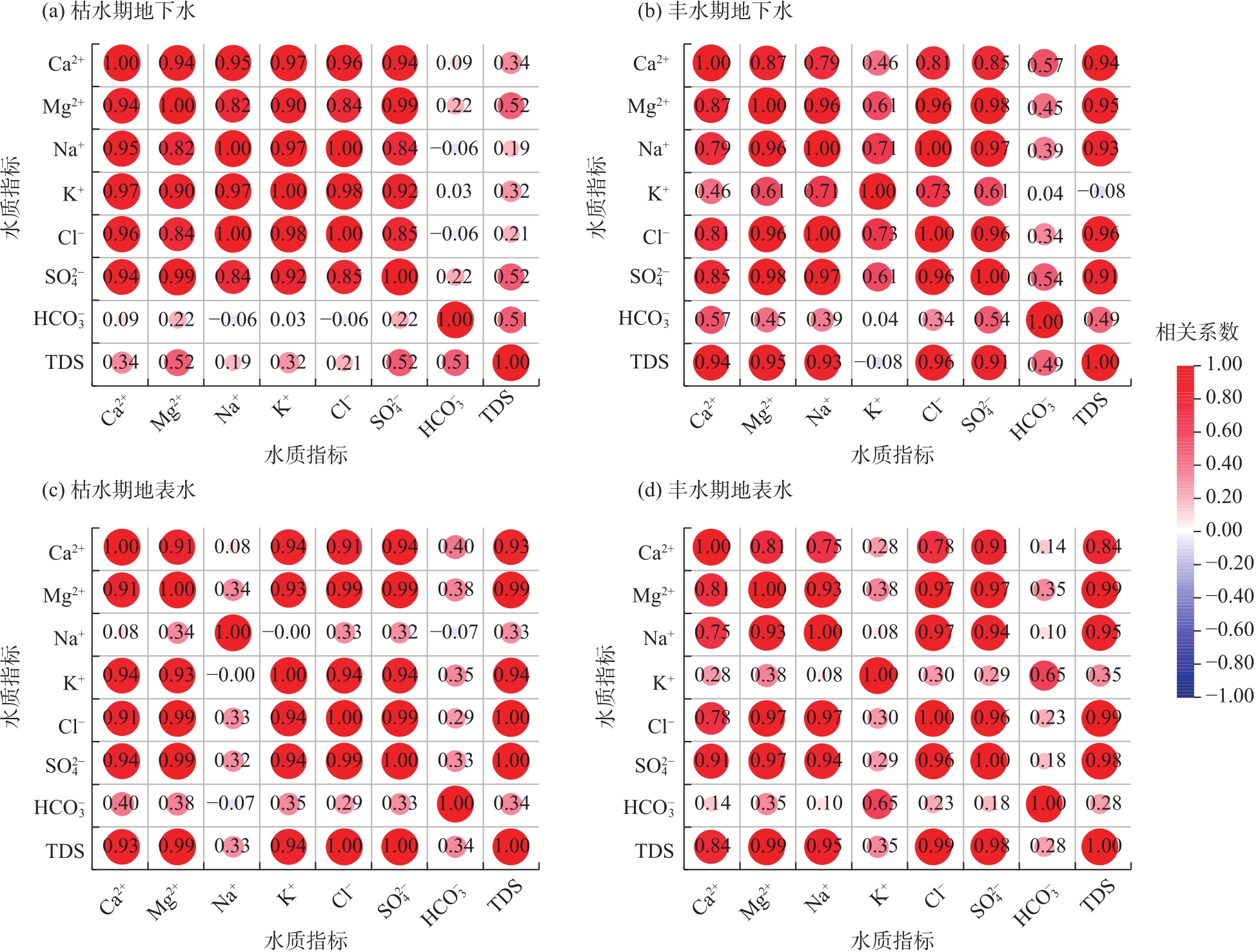
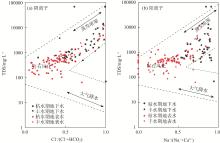
图6
塔里木河流域枯、丰水期的地下水、地表水Gibbs图"
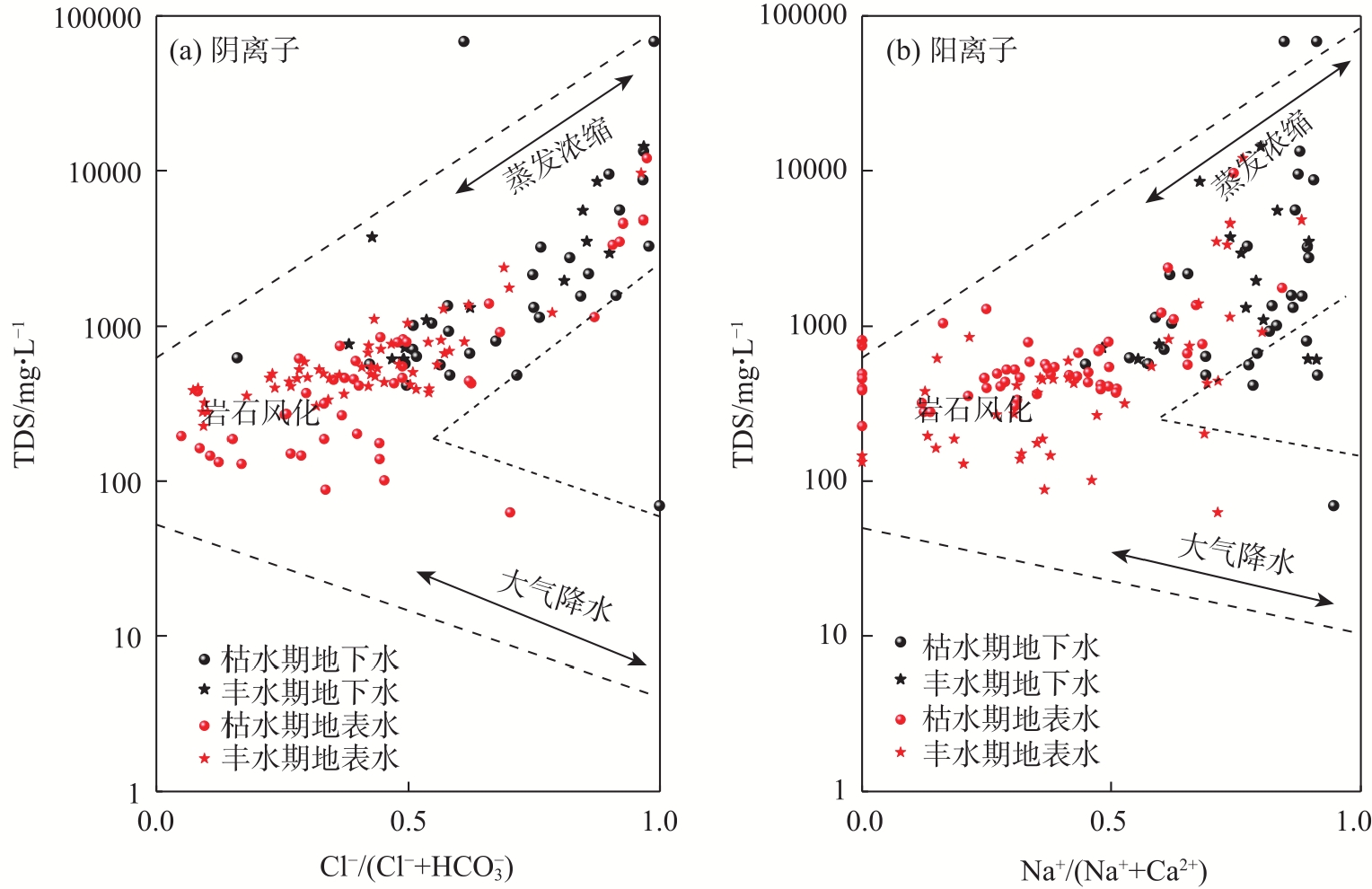
图7
塔里木河流域枯、丰水期的地下水、地表水溶质来源机制"
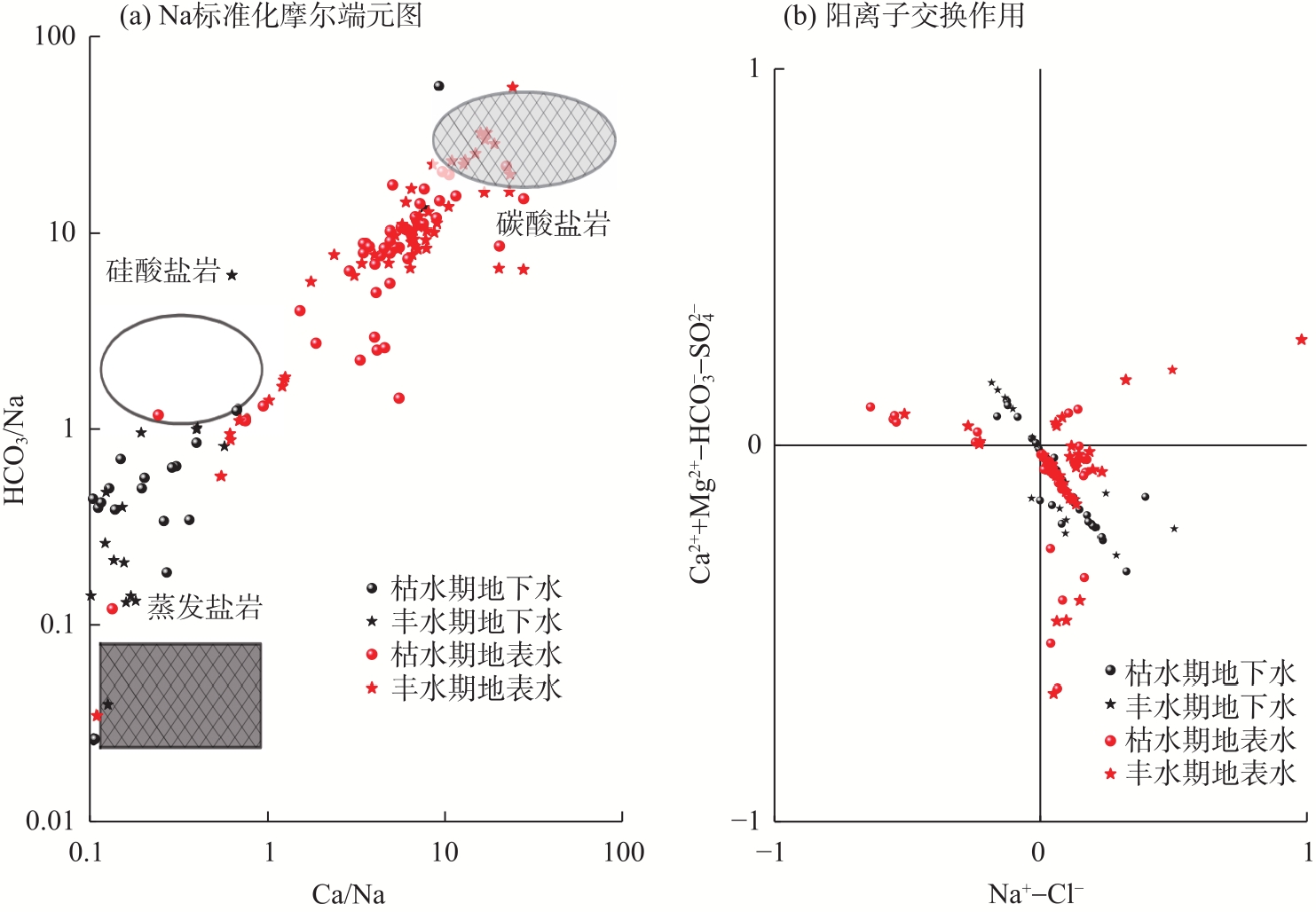
图8
塔里木河流域枯、丰水期的地下水、地表水水化学计量"
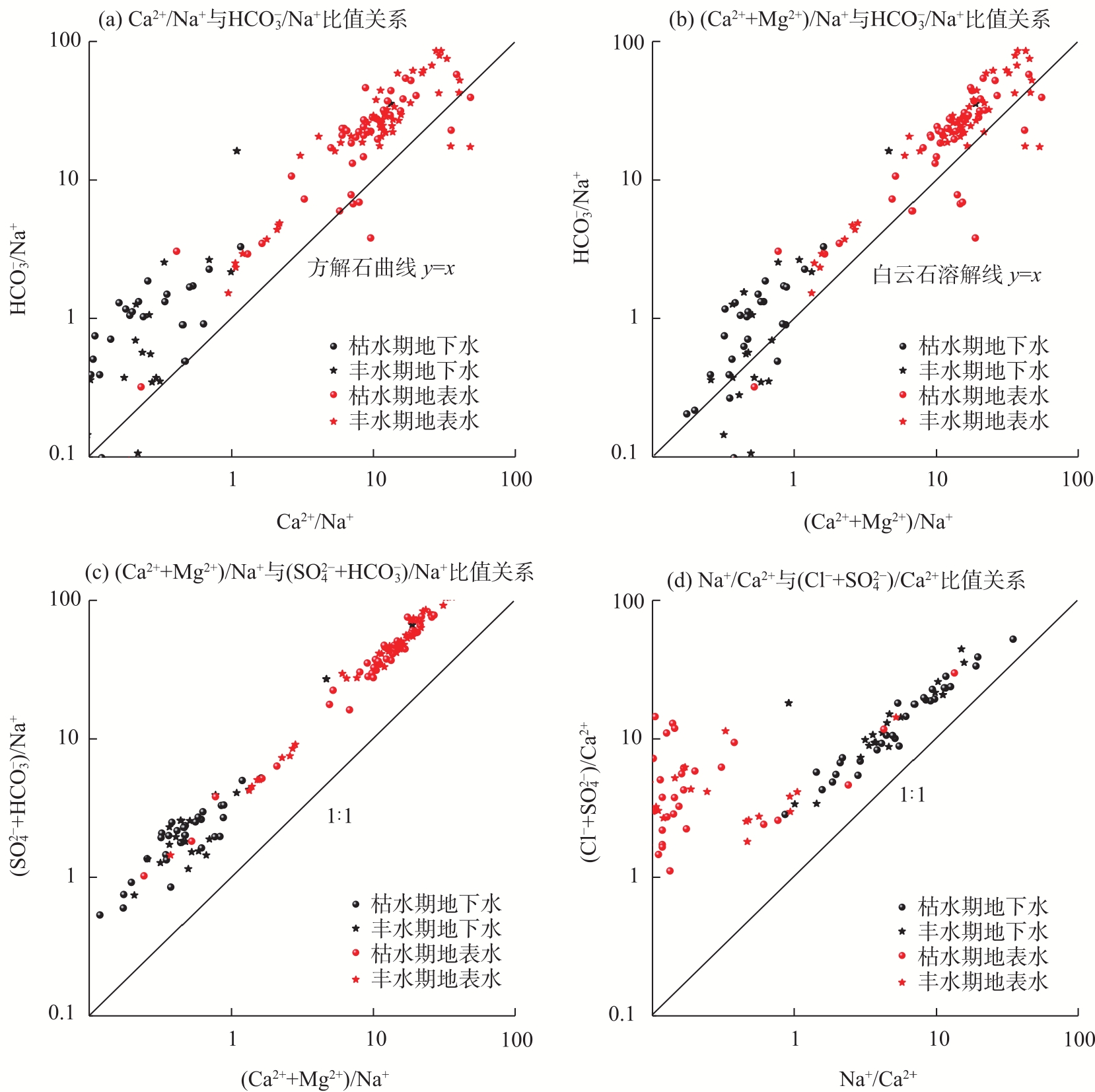
表3
地下水、地表水APCS-MLR总方差解释和旋转后成分矩阵"
| 总方差解释 | 旋转后的成分矩阵 | ||||||
|---|---|---|---|---|---|---|---|
| 成分 | 总计 | 方差百分比 | 累积/% | 水质指标 | 成分1 | 成分2 | |
| 1 | 5.624/5.802 | 70.296/72.528 | 70.296/72.528 | Ca2+ | 0.904/0.847 | 0.286/0.325 | |
| 2 | 1.442/1.090 | 18.025/13.622 | 88.320/86.149 | Mg2+ | 0.881/0.952 | 0.400/0.273 | |
| 3 | 0.581/0.851 | 7.266/10.635 | 95.586/96.784 | Cl- | 0.985/0.954 | -0.022/0.236 | |
| 4 | 0.214/0.238 | 2.679/2.973 | 98.266/99.758 | SO42- | 0.882/0.980 | 0.422/0.176 | |
| 5 | 0.089/0.017 | 1.110/0.207 | 99.376/99.965 | HCO3- | -0.054/0.114 | 0.863/0.675 | |
| 6 | 0.041/0.002 | 0.516/0.021 | 99.892/99.986 | TDS | 0.264/0.963 | 0.775/0.258 | |
| 7 | 0.009/0.001 | 0.107/0.010 | 100.000/99.996 | Na+ | 0.978/0.773 | -0.039/-0.492 | |
| 8 | 0.000/0.000 | 0.000/0.004 | 100.000/100.000 | K+ | 0.962/0.620 | 0.042/0.667 | |
图9
塔里木河流域地下水、地表水APCS-MLR模型"
| [1] | 倪茂飞, 刘睿, 王志康, 等. 典型喀斯特河流汛期溶解性有机质空间变化及其光学参数的耦合关系[J]. 生态学报, 2022, 42(7): 2822-2833. |
| [Ni Maofei, Liu Rui, Wang Zhikang, et al. Spatial pattern and interconnections of optical properties of dissolved organic matter during rainy season in a typical Karst River[J]. Acta Ecologica Sinica, 2022, 42(7): 2822-2833. ] | |
| [2] |
陈亚宁, 李稚, 范煜婷, 等. 西北干旱区气候变化对水文水资源影响研究进展[J]. 地理学报, 2014, 69(9): 1295-1304.
doi: 10.11821/dlxb201409005 |
|
[Chen Yaning, Li Zhi, Fan Yuting, et al. Research progress on the impact of climate change on water resources in the arid region of northwest China[J]. Acta Geographica Sinica, 2014, 69(9): 1295-1304. ]
doi: 10.11821/dlxb201409005 |
|
| [3] | 王涛. 荒漠化治理中生态系统、社会经济系统协调发展问题探析——以中国北方半干旱荒漠区沙漠化防治为例[J]. 生态学报, 2016, 36(22): 7045-7048. |
| [Wang Tao. Study on the coordinated development of ecosystem and socio-economic system in desertification control: A case study of desertification control in semiarid area in north China[J]. Acta Ecologica Sinica, 2016, 36(22): 7045-7048. ] | |
| [4] | 赵品. 塔里木河流域水化学时空特征与演化机制研究[D]. 石家庄: 河北科技大学, 2014. |
| [Zhao Pin. Study on tempal and spatial characteristics and evolutio mechanism of hydrochemistry in Tarim River Basin[D]. Shijiazhuang: Hebei University of Science and Technology, 2014. ] | |
| [5] | Bothe O, Fraedrich K, Zhu X H. Precipitation climate of Central Asia and the large-scale atmospheric circulation[J]. Theoretical & Applied Climatology, 2012, 108(3-4): 345-354. |
| [6] | 陈亚宁, 崔旺诚, 李卫红, 等. 塔里木河的水资源利用与生态保护[J]. 地理学报, 2003, 58(2): 215-222. |
|
[Chen Yaning, Cui Wangcheng, Li Weihong, et al. Utilization of water resources and ecological protection in the Tarim River[J]. Acta Geographica Sinica, 2003, 58(2): 215-222. ]
doi: 10.11821/xb200302008 |
|
| [7] | 郭继凯. 塔里木河流域植被覆盖对气候变化和人类活动的响应[D]. 北京: 北京林业大学, 2016. |
| [Guo Jikai. Responses of vegetation coverage to climate change and human activities in the Tarim River Basin[D]. Beijing: Beijing Forestry University, 2016. ] | |
| [8] | Zhang S N, Wang S, Li F Y, et al. Enhanced assessment of water quality and pollutant source apportionment using APCS-MLR and PMF models in the upper reaches of the Tarim River[J]. Water, 2024, 16(21): 3061, doi: 10.3390/w16213061. |
| [9] | Xiao J, Jin Z D, Wang J, et al. Hydrochemical characteristics, controlling factors and solute sources of groundwater within the Tarim River Basin in the extreme arid region, NW Tibetan Plateau[J]. Quaternary International, 2015, 380: 237-246. |
| [10] |
Sun C J, Li X G, Chen Y N, et al. Spatial and temporal characteristics of stable isotopes in the Tarim River Basin[J]. Isotopes in Environmental and Health Studies, 2016, 52(3): 281-297.
doi: 10.1080/10256016.2016.1125350 pmid: 26862902 |
| [11] |
李小等, 常亮, 段瑞, 等. 和田河中下游流域地下水水化学特征及其演化规律[J]. 干旱区地理, 2024, 47(5): 753-761.
doi: 10.12118/j.issn.1000-6060.2023.481 |
|
[Li Xiaodeng, Chang Liang, Duan Rui, et al. Chemical characteristics and evolution of groundwater in the middle and lower reaches of Hotan River Basin[J]. Arid Land Geography, 2024, 47(5): 753-761. ]
doi: 10.12118/j.issn.1000-6060.2023.481 |
|
| [12] | Liu K, Wu B, Gao F, et al. Dynamic simulation and key influencing factors of carbon storage in the water-depleted zones of an arid Inland River Basin: Insights from the Tarim River mainstream[J]. Ecological Informatics, 2025, 90: 103286, doi: 10.1016/j.ecoinf.2025.103286. |
| [13] | Li W W, Jia S N, He W, et al. Analysis of the consequences of land-use changes and soil types on organic carbon storage in the Tarim River Basin from 2000 to 2020[J]. Agriculture, Ecosystems & Environment, 2022, 327: 107824, doi: 10.1016/j.agee.2021.107824. |
| [14] | Jiao A Y, Xu J, Deng M J, et al. Vegetation net primary productivity variation characteristics and optimization path in inland river basins of arid areas driven by ecological water conveyance: A case study of the mainstream of the Tarim River[J]. Ecological Indicators, 2025, 176: 113676, doi: 10.1016/j.ecolind.2025.113676. |
| [15] | Deng X Y, Wang G Y, Han F F, et al. Groundwater storage anomalies projection by optimized deep learning refines groundwater management in typical arid basins[J]. Journal of Hydrology, 2025, 649: 132452, doi: 10.1016/j.jhydrol.2024.132452. |
| [16] | 韩路, 王海珍. 塔里木荒漠河岸林物种多样性沿地下水埋深梯度的分布格局[J]. 生态学报, 2024, 44(2): 832-843. |
| [Han Lu, Wang Haizhen. Species diversity distribution pattern of desert riparian forest along a groundwater depth gradient in the Tarim Basin[J]. Acta Ecologica Sinica, 2024, 44(2): 832-843. ] | |
| [17] | 张晓宇, 习佳兴, 叶志豪, 等. 依赖地下水生态系统中植物群落特征与地下水埋深生态阈值关系研究[J]. 环境科学研究, 2025, 38(6): 1312-1323. |
| [Zhang Xiaoyu, Xi Jiaxing, Ye Zhihao, et al. Relationship between vegetation community characteristics and ecological threshold of groundwater level in groundwater dependent ecosystems (GDEs)[J]. Environmental Science Research, 2025, 38(6): 1312-1323. ] | |
| [18] | 徐海量, 宋郁东, 陈亚宁. 生态输水后塔里木河下游合理水位探讨[J]. 水土保持通报, 2003, 23(5): 22-25. |
| [Xu Hailiang, Song Yudong, Chen Yaning. Reasonable ground-water level at lower reaches of Tarim River after water transfer[J]. Bulletin of Soil and Water Conservation, 2003, 23(5): 22-25. ] | |
| [19] | Kang Z W, Ling H B, Gong Y M, et al. The precise implementation of the ecological water transfer project effectively promotes the enhancement of desert riparian ecosystem service value in the mainstream of Tarim River[J]. Ecological Indicators, 2024, 169: 112914, doi: 10.1016/j.ecolind.2024.112914. |
| [20] | Hou Y F, Chen Y N, Li Z, et al. Land structure change and ecological effects under future development scenarios in Tarim River Basin, Central Asia[J]. Geography and Sustainability, 2025, 6(4): 100300, doi: 10.1016/j.geosus.2025.100300. |
| [21] | 庞宁. 塔里木河流域“水资源-社会-生态”韧性及时空演化特征研究[D]. 石河子: 石河子大学, 2023. |
| [Pang Ning. Study on the resilience and spatio-temporal evolution of “water resources, society-ecology” in Tarim River Basin[D]. Shihezi: Shihezi University, 2023. ] | |
| [22] | 杨梦凡, 黄磊, 韩萱, 等. 黄河几字弯煤炭集中开采区地表水与地下水化学特征及控制因素[J/OL]. 环境科学. [2026-03-02]. https://doi.org/10.13227/j.hjkx.202502236. |
| [Yang Mengfan, Huang Lei, Han Xuan, et al. Characteristics of surface water and groundwater chemistry and controlling factors in the centralized coal mining area of the Yellow River at several bends in the River[J/OL]. Environmental Science. [2026-03-02]. https://doi.org/10.13227/j.hjkx.202502236. ] | |
| [23] | 赵水金, 周金龙, 姜凤, 等. 新疆托克逊县绿洲区地下水水质控制因素及污染源解析[J]. 环境科学, 2025, 46(4): 2179-2192. |
|
[Zhao Shuijin, Zhou Jinlong, Jiang Feng, et al. Identifying hydrochemical characteristics, control factors, and pollution source of groundwater in the oasis area of Toksun County, Xinjiang[J]. Environmental Science, 2025, 46(4): 2179-2192. ]
doi: 10.1021/es203637e |
|
| [24] | 陆丹, 陈京鹏, 闫燕, 等. 青海省北川河流域孔隙水水化学特征及源贡献解析[J]. 地质论评, 2025, 71(1): 233-244. |
| [Lu Dan, Chen Jingpeng, Yan Yan, et al. Hydrochemical characteristics and source contribution analysis of pore water in Beichuan River Basin, Qinghai Province[J]. Geological Review, 2025, 71(1): 233-244. ] | |
| [25] | 李书鉴, 韩晓, 王文辉, 等. 无定河流域地表水地下水的水化学特征及控制因素[J]. 环境科学, 2022, 43(1): 220-229. |
| [Li Shujian, Han Xiao, Wang Wenhui, et al. Hydrochemical characteristics and controlling factors of surface water and groundwater in Wuding River Basin[J]. Environmental Science, 2022, 43(1): 220-229. ] | |
| [26] | 孔晓乐, 杨永辉, 曹博, 等. 永定河上游地表水-地下水水化学特征及其成因分析[J]. 环境科学, 2021, 42(9): 4202-4210. |
|
[Kong Xiaole, Yang Yonghui, Cao Bo, et al. Hydrochemical characteristics and factors of surface water and groundwater in the upper Yongding River Basin[J]. Environmental Science, 2021, 42(9): 4202-4210. ]
doi: 10.1021/es800044m |
|
| [27] | 寇永朝, 华琨, 李洲, 等. 泾河支流地表水地下水的水化学特征及其控制因素[J]. 环境科学, 2018, 39(7): 3142-3149. |
| [Kou Yongchao, Hua Kun, Li Zhou, et al. Major ionic features and their possible controls in the surface water and groundwater of the Jinghe River[J]. Environmental Science, 2018, 39(7): 3142-3149. ] | |
| [28] | Zhou Y Y, Du S, Liu Y, et al. Source identification and risk assessment of trace metals in surface sediment of China Sea by combining APCA-MLR receptor model and lead isotope analysis[J]. Journal of Hazardous Materials, 2024, 465: 133310, doi: 10.1016/j.jhazmat.2023.133310. |
| [29] | Liu R N, Xie X J, Hou Q X, et al. Spatial distribution, sources, and human health risk assessment of elevated nitrate levels in groundwater of an agriculture-dominant coastal area in Hainan Island, China[J]. Journal of Hydrology, 2024, 634: 131088, doi: 10.1016/j.jhydrol.2024.131088. |
| [30] | Cui X X, Liu L, Li Y T, et al. Chemical characteristics and controlling factors of groundwater in an intensive surface water-groundwater conversion zone: A case study of the Zhengzhou section of the lower Yellow River[J]. Frontiers in Environmental Science, 2025, 131: 580232, doi: 10.3389/fenvs.2025.1580232. |
| [31] | Li Y P, Zhang H, Qu J H, et al. Chemical characterization and source analysis of shallow groundwater in a typical area of Huaihe River Basin[J]. Water, 2025, 17(13): 1959, doi: 10.3390/w17131959. |
| [32] | Cao Z M, Qian H, Gao Y Y, et al. Ecological risk assessment and source identification of heavy metals in the sediments of the Danjiang River Basin: A quantitative method combining multivariate analysis and the APCS-MLR model[J]. Ecological Indicators, 2025, 175: 113518, doi: 10.1016/j.ecolind.2025.113518. |
| [33] |
Wu Y, Zhang Q, Luo Y, et al. Spatial and temporal distribution characteristics and source apportionment of biogenic elements using APCS-MLR model in the main inlet tributary of Danjiangkou Reservoir[J]. Environmental Science and Pollution Research International, 2025, 32(7): 1-17.
doi: 10.1007/s11356-024-35698-1 |
| [34] | Jiang Y Q, Gui H R, Li J, et al. Identification of pollution sources of urban rivers by fluorescence spectroscopy and APCS-MLR and PMF receptor modelling in the Huaibei Plain, China[J]. Journal of Environmental Chemical Engineering, 2025, 13(6): 119790, doi: 10.1016/j.jece.2025.119790. |
| [35] | Jiang X R, Du Y, Li M Z, et al. Determining the source contributions of dissolved organophosphorus compounds in lake water utilizing FT-ICR-MS and PCA-APCS-MLR receptor models[J]. Journal of Hydrology, 2026, 665: 134652, doi: 10.1016/j.jhydrol.2025.134652. |
| [36] | Zhou Z W, Chen M, Li Y. Source apportionment of groundwater contamination using integrated PCA-APCS-MLR modeling: A case study of an industrial zone in southwest China[J]. Environmental Research, 2026, 292: 123628, doi: 10.1016/j.envres.2025.123628. |
| [37] | 李俊, 张小辉, 盛益之, 等. 滇中抚仙湖流域地表-地下水系统水化学特征及形成机制[J/OL]. 地学前缘. [2026-01-24]. https://doi.org/10.13745/j.esf.sf.2025.4.5. |
| [Li Jun, Zhang Xiaohui, Sheng Yizhi, et al. Hydrochemical characteristics and formation mechanisms of the surface-groundwater system in the Fuxian Lake Basin, central Yunnan[J/OL]. Earth Science Frontiers. [2026-01-24]. https://doi.org/10.13745/j.esf.sf.2025.4.5. ] | |
| [38] |
Chen X G, Ye Q, Du J Z, et al. Linking bacterial and archaeal community dynamics to related hydrological, geochemical and environmental characteristics between surface water and groundwater in a karstic estuary[J]. Acta Oceanologica Sinica, 2023, 42(8): 158-170.
doi: 10.1007/s13131-023-2185-7 |
| [39] |
Marandi A, Shand P. Groundwater chemistry and the Gibbs diagram[J]. Applied Geochemistry, 2018, 97: 209-212.
doi: 10.1016/j.apgeochem.2018.07.009 |
| [40] | Psyrillos A, Tziritis E. Groundwater quality and hydrogeochemical processes in the Katerini-Kolindros aquifer system, Central Macedonia, Greece[J]. Environmental Earth Sciences, 2025, 84(5): 127, doi:10.1007/s12665-025-12128-0. |
| [41] | 高宗军, 陈晨. 基于库尔洛夫式和舒卡列夫分类原则的水化学分类表示方法[J]. 地下水, 2018, 40(4): 6-11. |
| [Gao Zongjun, Chen Chen. The classification method of water chemical types based on the principle of Kurllov’s formula and Shoka Lev classification[J]. Groundwater, 2018, 40(4): 6-11. ] | |
| [42] | 蒋小雨, 杜倩雯, 黄萱, 等. 太湖流域江苏片区水质时空特征及其与景观格局的关联机制[J]. 水土保持学报, 2025, 39(3): 361-370. |
|
[Jiang Xiaoyu, Du Qianwen, Huang Xuan, et al. Temporal and spatial characteristics of water quality in the Taihu Basin Jiangsu section linkage with landscape patterns[J]. Journal of Soil and Water Conservation, 2025, 39(3): 361-370. ]
doi: 10.1080/00224561.1984.12455802 |
|
| [43] | Ying B, Liu C L, Jiao P C, et al. Hydrochemical characteristics and controlling factors of surface water in the Tarim River Basin, northwest China[J]. Environmental Science and Pollution Research, 2013, 73(3): 343-356. |
| [44] |
徐海量, 宋郁东, 王强, 等. 塔里木河中下游地区不同地下水位对植被的影响[J]. 植物生态学报, 2004, 28(3): 400-405.
doi: 10.17521/cjpe.2004.0057 |
| [Xu Hailiang, Song Yudong, Wang Qiang, et al. The effect of groundwater level on vegetation in the middle and lower reaches of the Tarim River, Xinjiang, China[J]. Acta Phytoecologica Sinica, 2004, 28(3): 400-405. ] | |
| [45] | 邓铭江. 塔里木河生态输水与生态修复研究与实践[J]. 中国水利, 2022(19): 29-32. |
| [Deng Mingjiang. Ecological water conveyance and ecological restoration research and practice for the Tarim River[J]. China Water Resources, 2022(19): 29-32. ] | |
| [46] | 李康, 田盼盼, 曹智铭, 等. 伊洛河流域地表水-地下水水化学演化特征及其形成机制[J]. 地球科学与环境学报, 2025, 47(3): 537-554. |
| [Li Kang, Tian Panpan, Cao Zhiming, et al. Hydrochemical evolution of surface water and groundwater in Yiluo River Basin, China and its formation mechanisms[J]. Journal of Earth Sciences and Environment, 2025, 47(3): 537-554. ] | |
| [47] | 周忠发, 张结, 潘艳喜, 等. 双河洞洞穴系统岩溶地表水-地下水主要离子化学特征及其来源分析[J]. 科学技术与工程, 2018, 18(6): 5-13. |
| [Zhou Zhongfa, Zhang Jie, Pan Yanxi, et al. Chemical characteristics and source analysis of main ions in Karst surface water and groundwater in Shuanghe Cave System[J]. Science Technology and Engineering, 2018, 18(6): 5-13. ] | |
| [48] | 李子强. 基于主成分分析的舟山水域交通事故成因分析[J]. 物流科技, 2025, 48(9): 89-91. |
| [Li Ziqiang. Analysis of the causes of traffic accidents in Zhoushan Waters based on principal component analysis[J]. Logistics Science and Technology, 2025, 48(9): 89-91. ] | |
| [49] | Li S J, Su H, Han F P, et al. Source identification of trace elements in groundwater combining APCS-MLR with geographical detector[J]. Journal of Hydrology, 2023, 623: 129771, doi: 10.1016/j.jhydrol.2023.129771. |
| [50] | Gu X M, Xiao Y, Yin S Y, et al. Hydrogeochemical characterization and quality assessment of groundwater in a long-term reclaimed water irrigation area, North China Plain[J]. Water, 2018, 10(9): 1209, doi: 10.3390/w10091209. |
| [1] | 李勇, 张福初, 何新林, 李小龙, 宋维浩. 玛纳斯河流域水化学时空分异特征及成因解析[J]. 干旱区地理, 2026, 49(6): 1108-1121. |
| [2] | 曾勇, 毕钰, 张洪彬, 施枫芝, 王鹏. 塔里木河流域生态系统服务价值与土地利用的动态变化[J]. 干旱区地理, 2026, 49(2): 265-274. |
| [3] | 刘伟, 凌红波, 公延明, 陈伏龙, 单钱娟. 基于改进型遥感生态指数的塔里木河干流生态环境质量评价[J]. 干旱区地理, 2025, 48(2): 271-282. |
| [4] | 刘文君, 胡可可, 苏里坦, 金磊. 塔里木河流域农业耗水特征及其影响因素分析[J]. 干旱区地理, 2025, 48(11): 1951-1960. |
| [5] | 高久洲, 李琳. 塔里木河干流英巴扎至乌斯满河道演变对两岸生态引水影响预测[J]. 干旱区地理, 2025, 48(10): 1771-1782. |
| [6] | 艾力克木·司拉音, 安外尔·艾则孜, 塔吉古丽·喀斯木, 史智文, 胥俊宇, 则外日古丽·克比尔, 玉米提·哈力克, 艾里西尔·库尔班. 基于环境质量指数的塔里木河下游生态输水效益评估[J]. 干旱区地理, 2025, 48(1): 31-42. |
| [7] | 李小等, 常亮, 段瑞, 王倩, 杨泽东, 张群慧, 张鹏伟. 和田河中下游流域地下水水化学特征及其演化规律[J]. 干旱区地理, 2024, 47(5): 753-761. |
| [8] | 胡瑞媛, 畅建霞, 郭爱军, 王义民. 塔里木河干流生态系统变化与生态效益分析[J]. 干旱区地理, 2024, 47(4): 622-633. |
| [9] | 付玮, 夏文浩, 樊童生, 邹贞, 霍瑜. 塔里木河流域生态系统碳储量的情景预测分析[J]. 干旱区地理, 2024, 47(4): 634-647. |
| [10] | 蒋晓晴, 郝帅, 叶茂, 何定学, 张子涵, 李国华. 塔里木河下游不同地下水埋深下胡杨水分利用来源研究[J]. 干旱区地理, 2024, 47(12): 2017-2029. |
| [11] | 吕雯改, 江宇威, 马兴羽, 刘蕾, 薛杰, 张波, 黄彩变. 昆仑山北坡车尔臣河流域平原区地表水和地下水水化学特征[J]. 干旱区地理, 2024, 47(10): 1617-1627. |
| [12] | 张齐飞, 陈亚宁, 孙从建, 向燕芸, 郝海超. 塔里木河流域水储量变化及绿洲生态安全评估[J]. 干旱区地理, 2024, 47(1): 1-14. |
| [13] | 邬晓丹, 罗敏, 孟凡浩, 萨楚拉, 董金义, 刘铁. 塔里木河“四源”洪水演变规律及成因分析[J]. 干旱区地理, 2024, 47(1): 15-27. |
| [14] | 穆佳薇, 乔保荣, 余国新. 新疆塔里木河流域县域农业低碳生产率时空格局及影响效应研究[J]. 干旱区地理, 2023, 46(6): 968-981. |
| [15] | 张勇军, 杨余辉, 胡义成, 冯先成, 杨景燕. 新疆喀什河流域水化学时空变化特征及灌溉适应性评价[J]. 干旱区地理, 2023, 46(4): 583-594. |
|
||

