干旱区地理 ›› 2026, Vol. 49 ›› Issue (2): 316-331.doi: 10.12118/j.issn.1000-6060.2025.148 cstr: 32274.14.ALG2025148
高锦涛( ), 张翀, 井静(), 钟春霞, 杨瑞霞
收稿日期:2025-03-20
修回日期:2025-04-24
出版日期:2026-02-25
发布日期:2026-02-27
通讯作者:
井静(1984-),女,博士,讲师,主要从事资源环境遥感应用等方面研究. E-mail: xiaoxin0728@163.com作者简介:高锦涛(2002-),男,本科生,主要从事地理空间分析应用等方面研究. E-mail: gjt1010@163.com
基金资助:
GAO Jintao(), ZHANG Chong, JING Jing(), ZHONG Chunxia, YANG Ruixia
Received:2025-03-20
Revised:2025-04-24
Published:2026-02-25
Online:2026-02-27
摘要:
秦巴山区位于我国南北气候与暖温带-亚热带生态过渡带交汇区,作为气候变化敏感区,研究其植被与气候的耦合关系有助于揭示气候变化下生态系统的演变机制。基于2001—2023年MODIS数据和气候因子数据,利用多元线性回归模型对2024—2100年3种共享社会经济路径(SSPs)气候情景下的核归一化植被指数(kNDVI)进行预测,结合Theil-Sen和Mann-Kendall方法分析植被时空变化趋势,并利用通径分析揭示气候因子驱动机制。结果表明:(1) 气温是植被变化的主导因子,其面积占比67.27%,正效应区域集中于秦岭—大巴山地区,而蒸散发与降水的影响呈显著空间异质性。(2) 2001—2023年植被kNDVI增速呈“先快后慢”特征,退化区集中于低海拔城市化区域及高海拔水热受限区。(3) 未来情景模拟显示,低碳路径(SSP119)情景下植被变化趋于稳定,高碳路径(SSP585)情景则呈现两极分化,蒸散发的直接抑制效应与高温驱动的间接促进效应并存。(4) 降水对植被的补给效能随气候极端化减弱,而气温的直接驱动强度随排放情景升高显著增强。(5) 区域植被响应存在显著空间分异,需针对高海拔脆弱区、低海拔人类活动干扰带及中东部蒸散发敏感区实施差异化生态修复策略。通过揭示秦巴山区植被对气候变化的非线性响应,证实SSP119的生态稳定性优势,为区域碳中和目标下的植被保护与碳汇功能提升提供空间优化路径。
高锦涛, 张翀, 井静, 钟春霞, 杨瑞霞. 气候情景驱动下秦巴山区植被生长动态模拟与气候驱动机制[J]. 干旱区地理, 2026, 49(2): 316-331.
GAO Jintao, ZHANG Chong, JING Jing, ZHONG Chunxia, YANG Ruixia. Simulation of vegetation growth dynamics and climatic driving mechanisms in the Qinling-Daba Mountains under climate scenarios[J]. Arid Land Geography, 2026, 49(2): 316-331.
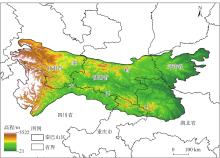
图1
秦巴山区概况 注:基于自然资源部标准地图服务网站审图号为GS(2024)0650号的标准地图制作,底图边界无修改。下同。"
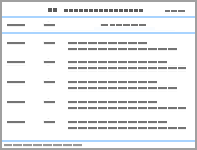
表1
TS-MK趋势分析类型划分"
| β | Z | 趋势特征 |
|---|---|---|
| β>0 | |Z|≥2.58 | 极显著增加 |
| 1.96≤|Z|<2.58 | 显著增加 | |
| |Z|<1.96 | 不显著增加 | |
| β=0 | Z | 无变化 |
| β<0 | |Z|<1.96 | 不显著减少 |
| 1.96≤|Z|<2.58 | 显著减少 | |
| |Z|≥2.58 | 极显著减少 |
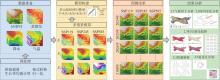
图2
研究流程图 注:kNDVI为核归一化植被指数;SSP119为低碳路径;SSP245为中间路径;SSP585为高碳路径。下同。"
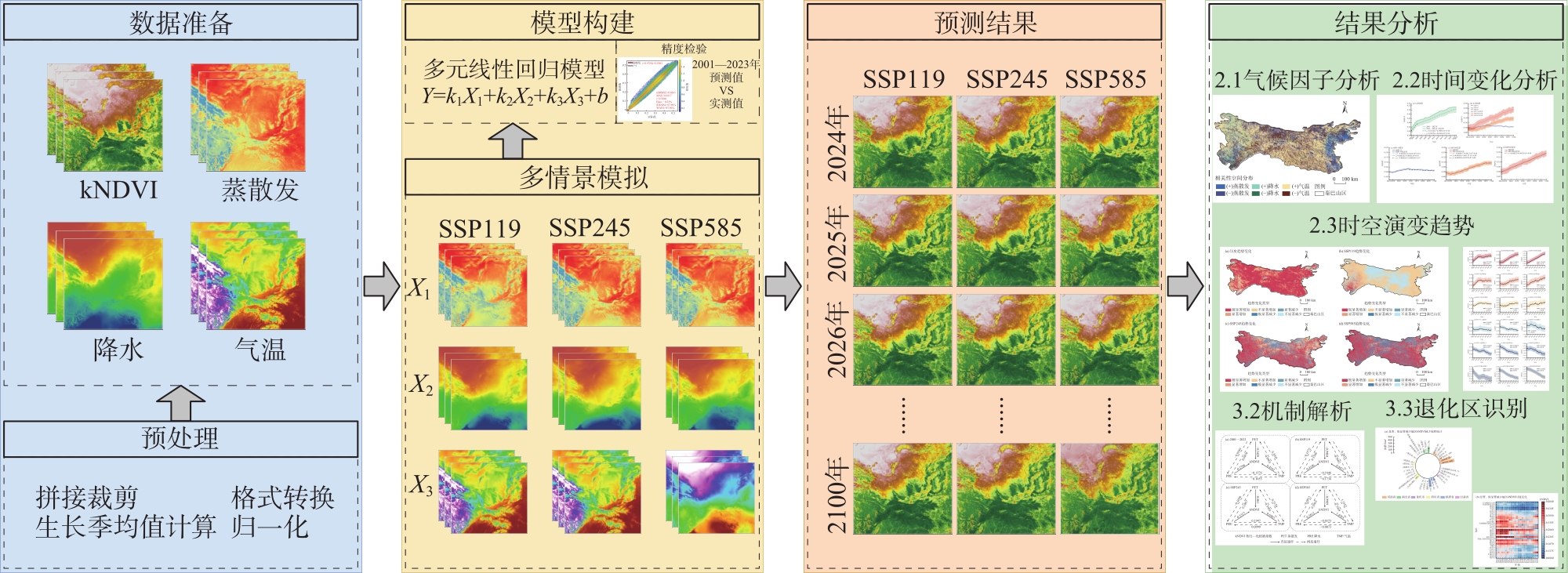
表2
秦巴山区影响因子面积及占比"
| 相关性 | 蒸散发 | 降水 | 气温 | 占比总和/% | |||||
|---|---|---|---|---|---|---|---|---|---|
| 面积/km2 | 占比/% | 面积/km2 | 占比/% | 面积/km2 | 占比/% | ||||
| 正影响 | 31382 | 10.09 | 27922 | 8.98 | 159638 | 51.34 | 70.41 | ||
| 负影响 | 39884 | 12.83 | 2589 | 0.83 | 49551 | 15.93 | 29.59 | ||
| 总和 | 71266 | 22.92 | 30511 | 9.81 | 209189 | 67.27 | 100.00 | ||
图3
秦巴山区影响因子相关性空间分布 注:“+”表示正影响;“-”表示负影响。"
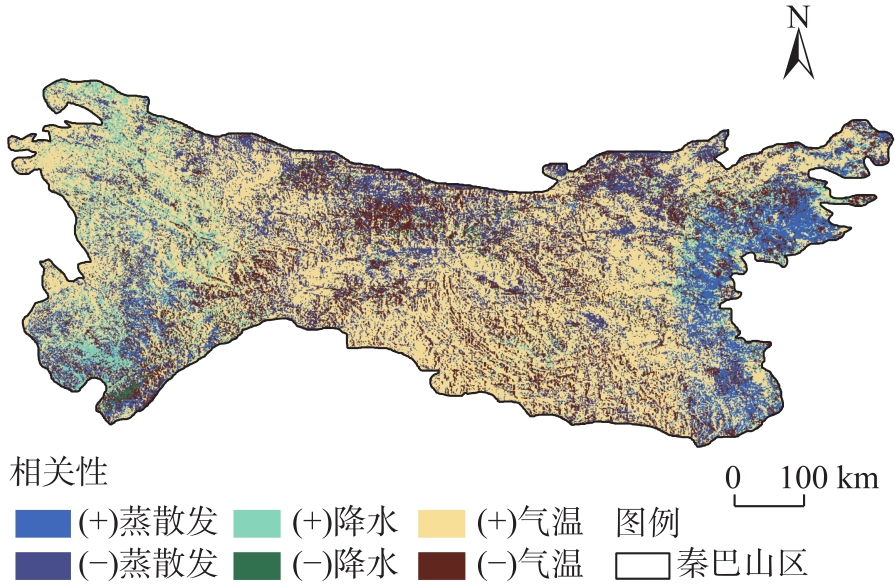
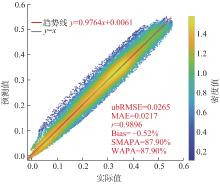
图4
kNDVI预测值精度验证 注:ubRMSE为无偏均方根误差;MAE为平均绝对误差;r为相关系数;Bias为偏差;SMAPA为1-对称平均绝对百分比误差;WAPA为1-加权绝对百分比误差。"

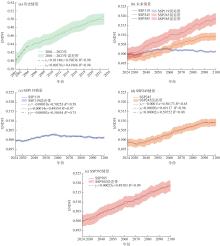
图5
2001—2100年秦巴山区kNDVI时间变化特征"

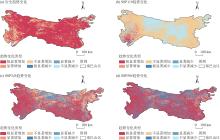
图6
秦巴山区历史和未来多情景空间趋势变化特征"
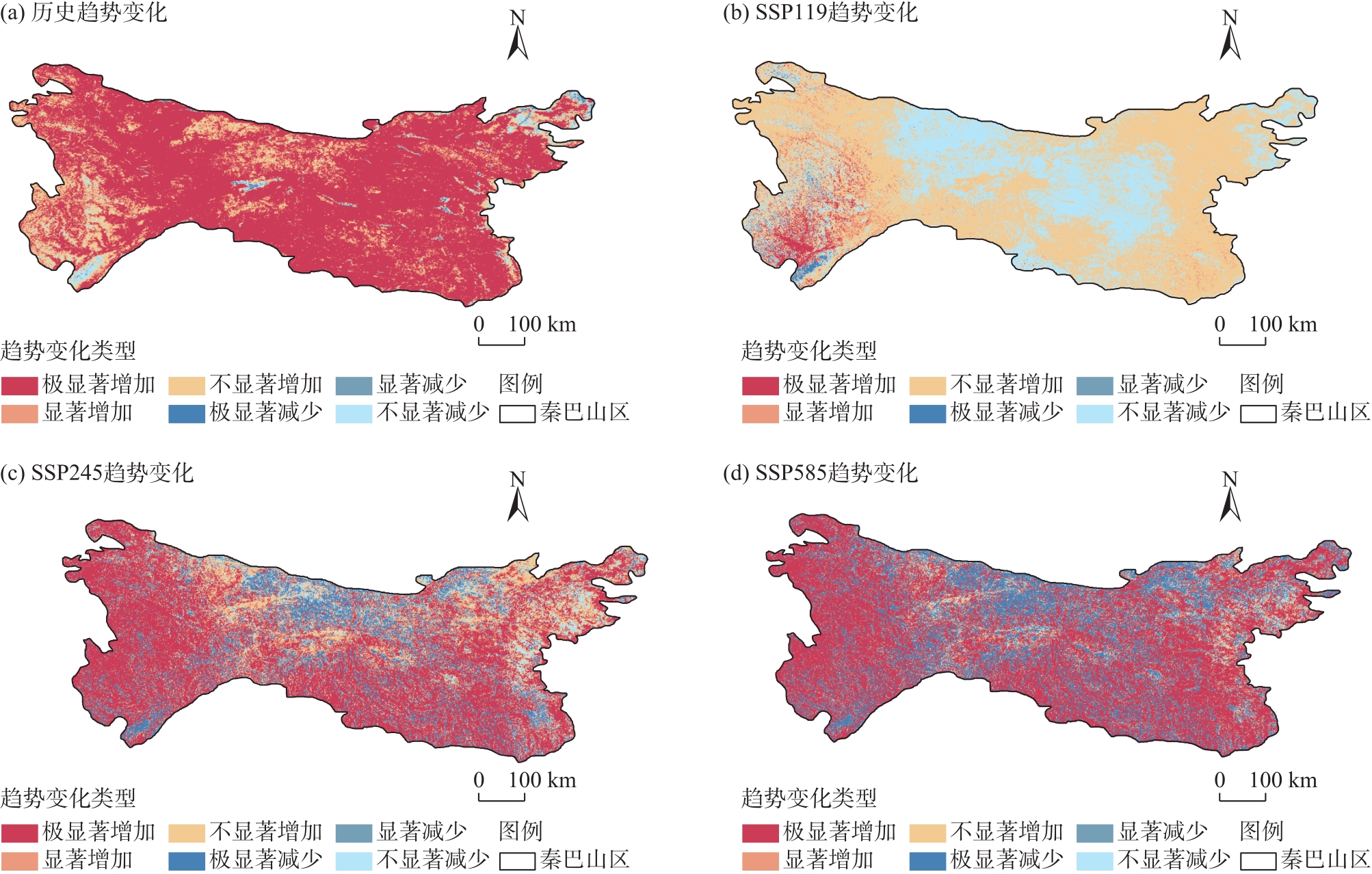
表3
历史和未来不同气候情景下kNDVI变化趋势分类面积及占比"
| 变化类型 | 2001—2023年 | 2024—2100年SSP119 | 2024—2100年SSP245 | 2024—2100年SSP585 | |||||||
|---|---|---|---|---|---|---|---|---|---|---|---|
| 面积/km2 | 占比/% | 面积/km2 | 占比/% | 面积/km2 | 占比/% | 面积/km2 | 占比/% | ||||
| 极显著增加 | 234525 | 75.42 | 9512 | 3.06 | 169609 | 54.54 | 183585 | 59.04 | |||
| 显著增加 | 29988 | 9.64 | 12141 | 3.90 | 16161 | 5.20 | 7610 | 2.45 | |||
| 不显著增加 | 36169 | 11.63 | 188182 | 60.52 | 47201 | 15.18 | 21594 | 6.94 | |||
| 不显著减少 | 8133 | 2.62 | 98003 | 31.52 | 29646 | 9.53 | 18526 | 5.96 | |||
| 显著减少 | 1043 | 0.34 | 1330 | 0.43 | 6257 | 2.01 | 5208 | 1.67 | |||
| 极显著减少 | 1108 | 0.36 | 1798 | 0.58 | 42092 | 13.54 | 74443 | 23.94 | |||
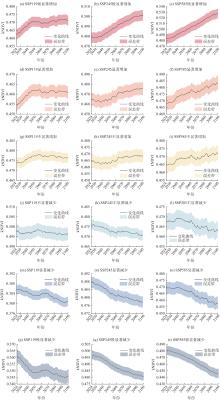
图7
秦巴山区未来多情景下各趋势类型时间变化特征"
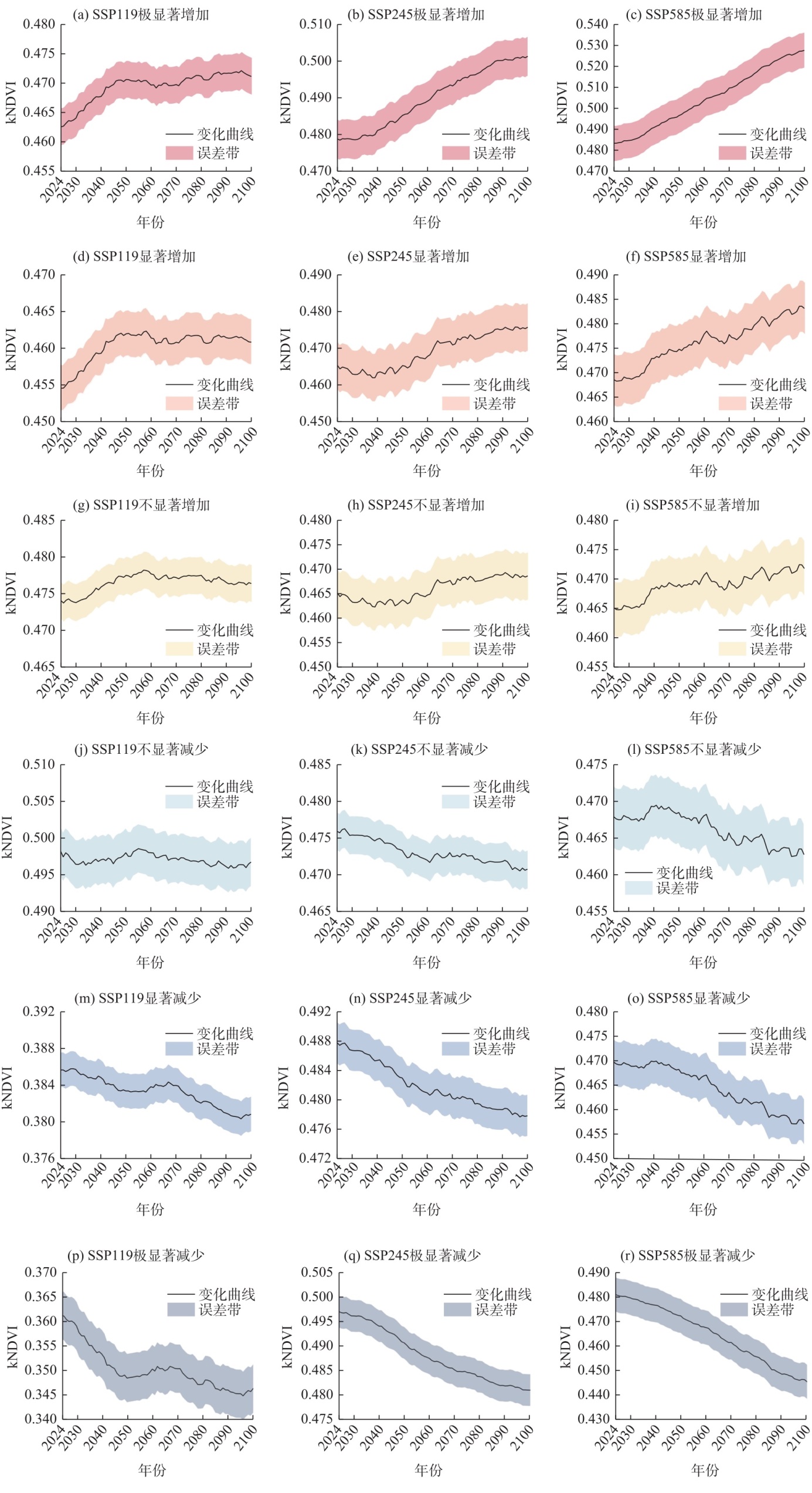
图8
历史和未来多情景通径分析 注:PET为蒸散发;PRE为降水;TMP为气温。"
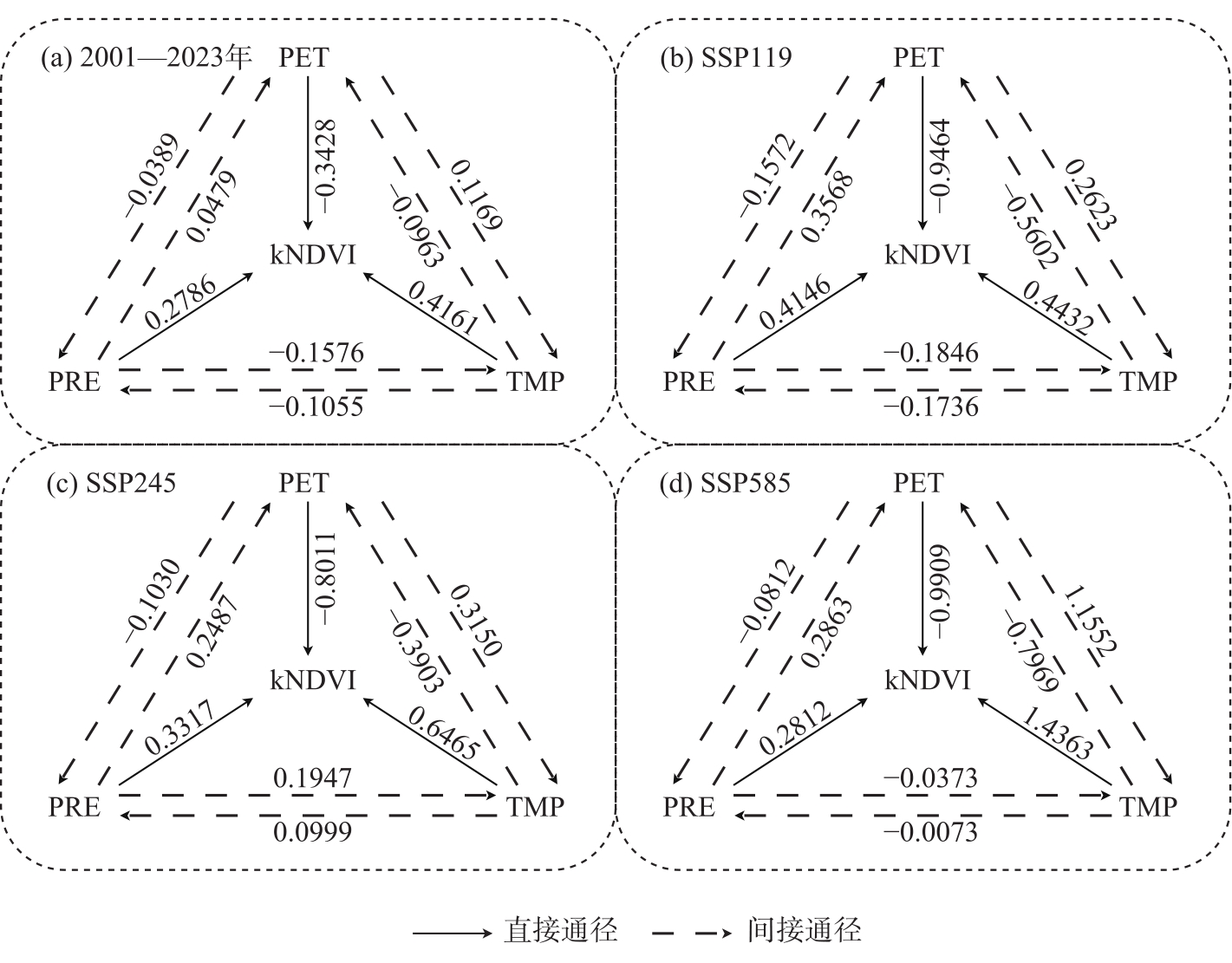
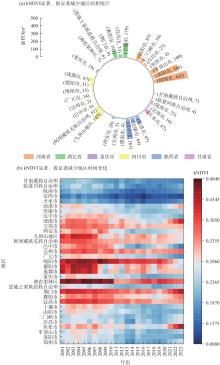
图9
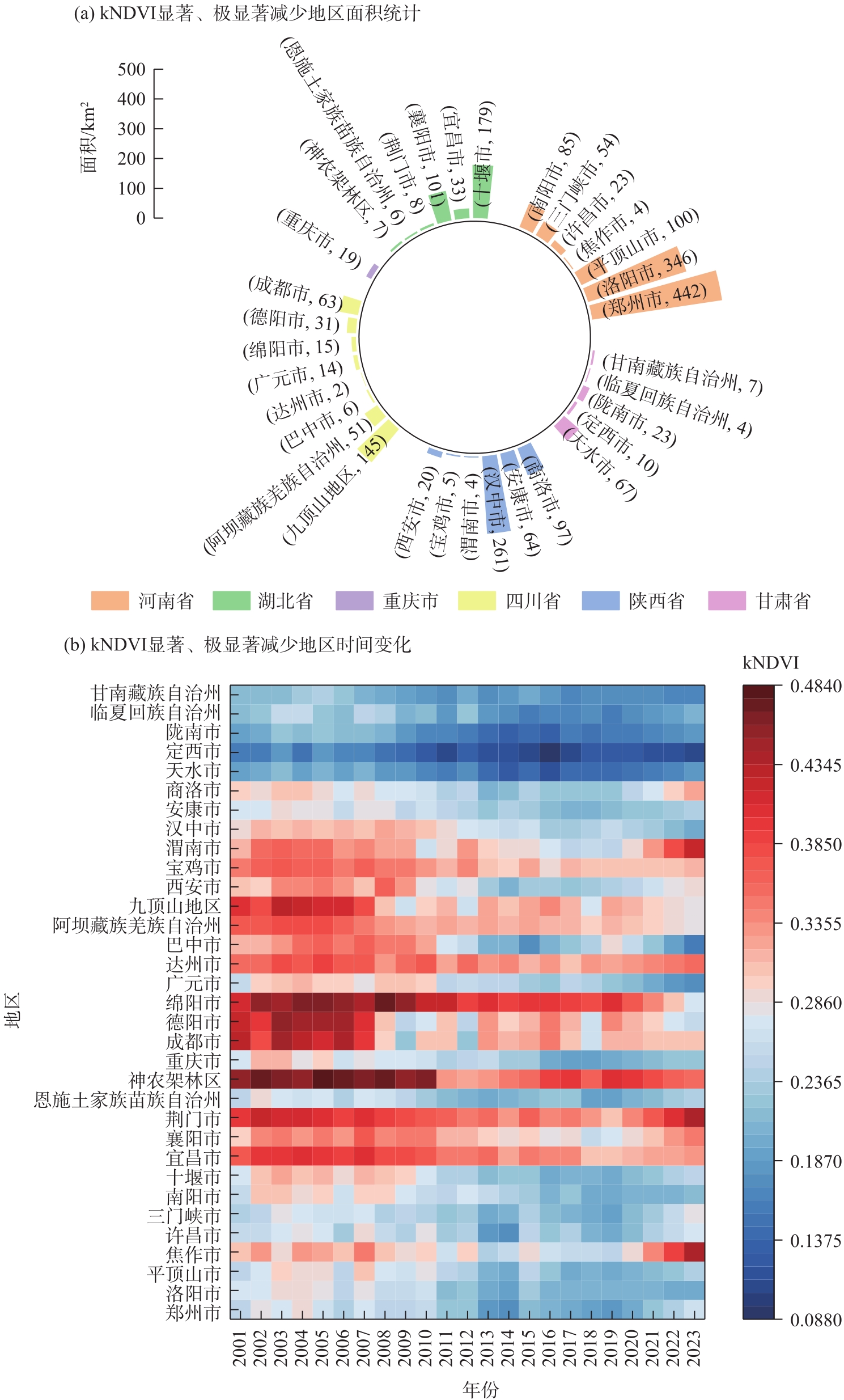
2001—2023年kNDVI显著、极显著减少地区面积统计和时间变化"
| [1] | 朴世龙, 方精云. 1982—1999年我国陆地植被活动对气候变化响应的季节差异[J]. 地理学报, 2003, 58(1): 119-125. |
|
[Piao Shilong, Fang Jingyun. Seasonal changes in vegetation activity in response to climate changes in China between 1982 and 1999[J]. Acta Geographica Sinica, 2003, 58(1): 119-125.]
doi: 10.11821/xb200301014 |
|
| [2] |
孟丹, 李小娟, 宫辉力, 等. 京津冀地区NDVI变化及气候因子驱动分析[J]. 地球信息科学学报, 2015, 17(8): 1001-1007.
doi: 10.3724/SP.J.1047.2015.01001 |
| [Meng Dan, Li Xiaojuan, Gong Huili, et al. Analysis of spatial-temporal change of NDVI and its climatic driving factors in Beijing-Tianjin-Hebei metropolis circle from 2001 to 2013[J]. Journal of Geo-Information Science, 2015, 17(8): 1001-1007.] | |
| [3] |
孙高鹏, 刘宪锋, 王小红, 等. 2001—2020年黄河流域植被覆盖变化及其影响因素[J]. 中国沙漠, 2021, 41(4): 205-212.
doi: 10.7522/j.issn.1000-694X.2021.00076 |
|
[Sun Gaopeng, Liu Xianfeng, Wang Xiaohong, et al. Changes in vegetation coverage and its influencing factors across the Yellow River Basin during 2001—2020[J]. Journal of Desert Research, 2021, 41(4): 205-212.]
doi: 10.7522/j.issn.1000-694X.2021.00076 |
|
| [4] | 黄豪奔, 徐海量, 林涛, 等. 2001—2020年新疆阿勒泰地区归一化植被指数时空变化特征及其对气候变化的响应[J]. 生态学报, 2022, 42(7): 2798-2809. |
| [Huang Haoben, Xu Hailiang, Lin Tao, et al. Spatio-temporal variation characteristics of NDVI and its response to climate change in the Altay region of Xinjiang from 2001 to 2020[J]. Acta Ecologica Sinica, 2022, 42(7): 2798-2809.] | |
| [5] |
Piao S, Liu Q, Chen A, et al. Plant phenology and global climate change: Current progresses and challenges[J]. Global Change Biology, 2019, 25(6): 1922-1940.
doi: 10.1111/gcb.14619 pmid: 30884039 |
| [6] |
周玉科. 青藏高原植被NDVI对气候因子响应的格兰杰效应分析[J]. 地理科学进展, 2019, 38(5): 718-730.
doi: 10.18306/dlkxjz.2019.05.009 |
|
[Zhou Yuke. Detecting Granger effect of vegetation response to climatic factors on the Tibetan Plateau[J]. Progress in Geography, 2019, 38(5): 718-730.]
doi: 10.18306/dlkxjz.2019.05.009 |
|
| [7] | 吕洋, 董国涛, 杨胜天, 等. 雅鲁藏布江流域NDVI时空变化及其与降水和高程的关系[J]. 资源科学, 2014, 36(3): 603-611. |
| [Lü Yang, Dong Guotao, Yang Shengtian, et al. Spatio-temporal variation in NDVI in the Yarlung Zangbo River Basin and its relationship with precipitation and elevation[J]. Resources Science, 2014, 36(3): 603-611.] | |
| [8] |
郑海亮, 房世峰, 刘成程, 等. 青藏高原月NDVI时空动态变化及其对气候变化的响应[J]. 地球信息科学学报, 2019, 21(2): 201-214.
doi: 10.12082/dqxxkx.2019.180458 |
| [Zheng Hailiang, Fang Shifeng, Liu Chengcheng, et al. Dynamics of monthly vegetation activity and its responses to climate change in the Qinghai-Tibet Plateau[J]. Journal of Geo-Information Science, 2019, 21(2): 201-214.] | |
| [9] |
何宝忠, 丁建丽, 张喆, 等. 新疆植被覆盖度趋势演变实验性分析[J]. 地理学报, 2016, 71(11): 1948-1966.
doi: 10.11821/dlxb201611007 |
|
[He Baozhong, Ding Jianli, Zhang Zhe, et al. Experimental analysis of spatial and temporal dynamics of fractional vegetation cover in Xinjiang[J]. Acta Geographica Sinica, 2016, 71(11): 1948-1966.]
doi: 10.11821/dlxb201611007 |
|
| [10] |
张辰华, 李书恒, 白红英, 等. 太白山地区7月NDVI多尺度周期变化及其对气候因子的响应[J]. 资源科学, 2019, 41(11): 2131-2143.
doi: 10.18402/resci.2019.11.15 |
|
[Zhang Chenhua, Li Shuheng, Bai Hongying, et al. Multi-scale periodic variation of NDVI in July and its response to climatic factors in the Taibai Mountain area[J]. Resources Science, 2019, 41(11): 2131-2143.]
doi: 10.18402/resci.2019.11.15 |
|
| [11] |
陈燕丽, 罗永明, 莫伟华, 等. MODIS NDVI与MODIS EVI对气候因子响应差异[J]. 自然资源学报, 2014, 29(10): 1802-1812.
doi: 10.11849/zrzyxb.2014.10.015 |
|
[Chen Yanli, Luo Yongming, Mo Weihua, et al. Differences between MODIS NDVI and MODIS EVI in response to climatic factors[J]. Journal of Natural Resources, 2014, 29(10): 1802-1812.]
doi: 10.11849/zrzyxb.2014.10.015 |
|
| [12] | 周天军, 邹立维, 陈晓龙. 第六次国际耦合模式比较计划(CMIP6)评述[J]. 气候变化研究进展, 2019, 15(5): 445-456. |
| [Zhou Tianjun, Zou Liwei, Chen Xiaolong. Commentary on the coupled model intercomparison project phase 6 (CMIP6)[J]. Advances in Climate Change Research, 2019, 15(5): 445-456.] | |
| [13] | 翁宇威, 蔡闻佳, 王灿. 共享社会经济路径(SSPs)的应用与展望[J]. 气候变化研究进展, 2020, 16(2): 215-222. |
| [Weng Yuwei, Cai Wenjia, Wang Can. The application and future directions of the Shared Socioeconomic Pathways (SSPs)[J]. Advances in Climate Change Research, 2020, 16(2): 215-222.] | |
| [14] | Intergovernmental Panel on Climate Change (IPCC). Climate change 2023:Synthesis report. Contribution of working groups I, II and III to the sixth assessment report of the intergovernmental panel on climate change[R]. Geneva: IPCC, 2023. |
| [15] |
Testa S, Soudani K, Boschetti L, et al. MODIS-derived EVI, NDVI and WDRVI time series to estimate phenological metrics in French deciduous forests[J]. International Journal of Applied Earth Observation and Geoinformation, 2018, 64: 132-144.
doi: 10.1016/j.jag.2017.08.006 |
| [16] |
邹翔, 张雨婷, 徐璐. 2000—2022年呼伦贝尔植被覆盖时空动态及其对气候因子的响应[J]. 干旱区地理, 2025, 48(6): 963-972.
doi: 10.12118/j.issn.1000-6060.2024.456 |
|
[Zou Xiang, Zhang Yuting, Xu Lu. Spatio-temporal patterns of vegetation cover and its responses to climatic factors in Hulun Buir from 2000 to 2022[J]. Arid Land Geography, 2025, 48(6): 963-972.]
doi: 10.12118/j.issn.1000-6060.2024.456 |
|
| [17] |
熊雪婷, 李传华, 陈佳豪. 植被对气候变化响应的地形调控作用[J]. 地理学报, 2023, 78(9): 2256-2270.
doi: 10.11821/dlxb202309009 |
|
[Xiong Xueting, Li Chuanhua, Chen Jiahao. Topographic regulatory role of vegetation response to climate change[J]. Acta Geographica Sinica, 2023, 78(9): 2256-2270.]
doi: 10.11821/dlxb202309009 |
|
| [18] | 崔晓临, 白红英, 王涛. 秦岭地区植被NDVI海拔梯度差异及其气温响应[J]. 资源科学, 2013, 35(3): 618-626. |
| [Cui Xiaolin, Bai Hongying, Wang Tao. Difference in NDVI with altitudinal gradient and temperature in the Qinling area[J]. Resources Science, 2013, 35(3): 618-626.] | |
| [19] |
张飞, 李建, 李慧融, 等. 2001—2024年锡林郭勒盟草原净初级生产力时空特征及对影响因子的响应[J]. 干旱区地理, 2025, 48(9): 1555-1566.
doi: 10.12118/j.issn.1000-6060.2024.759 |
|
[Zhang Fei, Li Jian, Li Huirong, et al. Spatiotemporal characteristics of net primary productivity and its response to influencing factors in Xilin Gol League grassland from 2001 to 2024[J]. Arid Land Geography, 2025, 48(9): 1555-1566.]
doi: 10.12118/j.issn.1000-6060.2024.759 |
|
| [20] |
蔡依霏, 陈琳舒, 吕世轩, 等. 基于Google Earth Engine的黄土高原植被变化对蒸散发分量影响研究[J]. 地理科学, 2023, 43(9): 1649-1658.
doi: 10.13249/j.cnki.sgs.2023.09.015 |
|
[Cai Yifei, Chen Linshu, Lü Shixuan, et al. Impact of vegetation change on evapotranspiration components in the Loess Plateau based on Google Earth Engine[J]. Scientia Geographica Sinica, 2023, 43(9): 1649-1658.]
doi: 10.13249/j.cnki.sgs.2023.09.015 |
|
| [21] | 李佳璇, 李辉鹏, 白璐, 等. 黄土高原粮草复合生态系统蒸散发变化动态及其与干旱的关系[J]. 草业科学, 2024, 41(9): 2025-2034. |
| [Li Jiaxuan, Li Huipeng, Bai Lu, et al. Dynamics of evapotranspiration and its relationship with drought in a grain-forage compound ecosystem on the Loess Plateau[J]. Pratacultural Science, 2024, 41(9): 2025-2034.] | |
| [22] |
江颖慧, 焦利民, 张博恩. 城市地表温度与NDVI空间相关性的尺度效应[J]. 地理科学进展, 2018, 37(10): 1362-1370.
doi: 10.18306/dlkxjz.2018.10.006 |
|
[Jiang Yinghui, Jiao Limin, Zhang Boen. Scale effects of the spatial correlation between urban land surface temperature and NDVI[J]. Progress in Geography, 2018, 37(10): 1362-1370.]
doi: 10.18306/dlkxjz.2018.10.006 |
|
| [23] |
马炳鑫, 和彩霞, 靖娟利, 等. 1982—2019年中国西南地区植被变化归因研究[J]. 地理学报, 2023, 78(3): 714-728.
doi: 10.11821/dlxb202303013 |
|
[Ma Bingxin, He Caixia, Jing Juanli, et al. Attribution of vegetation dynamics in southwest China from 1982 to 2019[J]. Acta Geographica Sinica, 2023, 78(3): 714-728.]
doi: 10.11821/dlxb202303013 |
|
| [24] | 陈春波, 李刚勇, 彭建. 1981—2018年新疆草地归一化植被指数时空特征及其对气候变化的响应[J]. 生态学报, 2023, 43(4): 1537-1552. |
| [Chen Chunbo, Li Gangyong, Peng Jian. Spatio-temporal characteristics of Xinjiang grassland NDVI and its response to climate change from 1981 to 2018[J]. Acta Ecologica Sinica, 2023, 43(4): 1537-1552.] | |
| [25] |
吴万民, 刘涛, 陈鑫. 西北干旱半干旱区NDVI季节性变化及其影响因素[J]. 干旱区研究, 2023, 40(12): 1969-1981.
doi: 10.13866/j.azr.2023.12.10 |
|
[Wu Wanmin, Liu Tao, Chen Xin. Seasonal changes of NDVI in the arid and semi-arid regions of northwest China and its influencing factors[J]. Arid Zone Research, 2023, 40(12): 1969-1981.]
doi: 10.13866/j.azr.2023.12.10 |
|
| [26] |
赵家培, 郭恩亮, 王永芳, 等. 基于核温度植被干旱指数的内蒙古植被生长季生态干旱监测[J]. 应用生态学报, 2023, 34(11): 2929-2937.
doi: 10.13287/j.1001-9332.202311.024 |
|
[Zhao Jiapei, Guo Enliang, Wang Yongfang, et al. Ecological drought monitoring of Inner Mongolia vegetation growing season based on kernel temperature vegetation drought index (kTVDI)[J]. Chinese Journal of Applied Ecology, 2023, 34(11): 2929-2937.]
doi: 10.13287/j.1001-9332.202311.024 |
|
| [27] | 李丹, 庄义琳, 吴秀芹. 基于气候情景的岩溶断陷盆地2020—2050年植被动态变化模拟预测[J]. 地球学报, 2021, 42(3): 435-443. |
| [Li Dan, Zhuang Yilin, Wu Xiuqin. Simulation and prediction of vegetation dynamic in Karst Faulted Basin from 2020 to 2050 in climate scenarios[J]. Acta Geoscientica Sinica, 2021, 42(3): 435-443.] | |
| [28] |
付沙沙, 彭威, 邵爱梅, 等. 秦巴山区夏季NDVI变化特征及其对气候因子的响应[J]. 干旱区研究, 2023, 40(10): 1563-1574.
doi: 10.13866/j.azr.2023.10.03 |
|
[Fu Shasha, Peng Wei, Shao Aimei, et al. Variation in the NDVI characteristics during the summer and the climaticfactor responses in the Qinling-Daba Mountains[J]. Arid Zone Research, 2023, 40(10): 1563-1574.]
doi: 10.13866/j.azr.2023.10.03 |
|
| [29] | 牛统莉, 熊立华, 陈杰, 等. 基于PLUS模型的长江流域土地利用变化模拟与多情景预测[J]. 武汉大学学报(工学版), 2024, 57(2): 129-141, 151. |
| [Niu Tongli, Xiong Lihua, Chen Jie, et al. Land use simulation and multi-scenario prediction of the Yangtze River Basin based on PLUS model[J]. Engineering Journal of Wuhan University, 2024, 57(2): 129-141, 151.] | |
| [30] |
姜筱筱, 李雪梅, 韩惠, 等. 甘肃省土地利用转变对碳储量变化的影响研究[J]. 干旱区地理, 2024, 47(12): 2075-2082.
doi: 10.12118/j.issn.1000-6060.2024.040 |
|
[Jiang Xiaoxiao, Li Xuemei, Han Hui, et al. Influence of land use transformation on carbon storage change in Gansu Province[J]. Arid Land Geography, 2024, 47(12): 2075-2082.]
doi: 10.12118/j.issn.1000-6060.2024.040 |
|
| [31] | 王志远, 吴凡, 万鼎, 等. 多情景模拟区域土地利用变化对碳储量的影响[J]. 中国环境科学, 2023, 43(11): 6063-6078. |
| [Wang Zhiyuan, Wu Fan, Wan Ding, et al. Multi-scenario simulation of the impact of regional land use change on carbon reserve[J]. China Environmental Science, 2023, 43(11): 6063-6078.] | |
| [32] | 胡佶熹, 勒先文, 徐勇. 基于FLUS模型多情景土地利用变化对陆地生态系统碳储量影响——以江西萍乡为例[J]. 水土保持研究, 2024, 31(2): 299-309. |
| [Hu Jixi, Le Xianwen, Xu Yong. Estimating terrestrial eco-system carbon stock changes caused by multi-scenario land-use changesbased on the FLUS model: A case study of Pingxiang, Jiangxi[J]. Research of Soil and Water Conservation, 2024, 31(2): 299-309.] | |
| [33] |
王宏, 杨东, 蓝小玉, 等. 基于SSPs路径下植被气候生产潜力的预测——以陕甘宁为例[J]. 高原气象, 2023, 42(1): 233-243.
doi: 10.7522/j.issn.1000-0534.2022.00033 |
|
[Wang Hong, Yang Dong, Lan Xiaoyu, et al. Prediction of climate productivity of vegetation based on SSPs path: A case study of Shaanxi, Gansu and Ningxia[J]. Plateau Meteorology, 2023, 42(1): 233-243.]
doi: 10.7522/j.issn.1000-0534.2022.00033 |
|
| [34] |
Yang X, Zhou B, Xu Y, et al. CMIP6 evaluation and projection of temperature and precipitation over China[J]. Advances in Atmospheric Sciences, 2021, 38(5): 817-830.
doi: 10.1007/s00376-021-0351-4 |
| [35] |
韩子言, 蒙吉军, 邹易, 等. 1982—2017年黑河流域植被指数动态及其对气候变化与生态建设工程的响应[J]. 中国沙漠, 2023, 43(3): 96-106.
doi: 10.7522/j.issn.1000-694X.2022.00146 |
|
[Han Ziyan, Meng Jijun, Zou Yi, et al. Vegetation dynamics and their response to climate change and ecological protection projects in the Heihe River Basin from 1982 to 2017[J]. Journal of Desert Research, 2023, 43(3): 96-106.]
doi: 10.7522/j.issn.1000-694X.2022.00146 |
|
| [36] | 吴运力, 张钰, 田佳榕. 气候变化和人类活动对内蒙古高原不同植被类型NDVI的影响[J]. 中国农业气象, 2023, 44(12): 1155-1168. |
|
[Wu Yunli, Zhang Yu, Tian Jiarong. Impacts by climate change and human activities on NDVI in different vegetation types across the Inner Mongolia Plateau[J]. Chinese Journal of Agrometeorology, 2023, 44(12): 1155-1168.]
doi: 10.3969/j.issn.1000-6362.2023.12.008 |
|
| [37] | 敖登, 杨佳慧, 丁维婷, 等. 54种植被指数研究进展综述[J]. 安徽农业科学, 2023, 51(1): 13-21, 28. |
| [Ao Deng, Yang Jiahui, Ding Weiting, et al. Review of 54 vegetation indices[J]. Journal of Anhui Agricultural Sciences, 2023, 51(1): 13-21, 28.] | |
| [38] |
Wang Q, Moreno-Martínez Á, Muñoz-Marí J, et al. Estimation of vegetation traits with kernel NDVI[J]. ISPRS Journal of Photogrammetry and Remote Sensing, 2023, 195: 408-417.
doi: 10.1016/j.isprsjprs.2022.12.019 |
| [39] | Camps-Valls G, Campos-Taberner M, Moreno-Martínez L, et al. A unified vegetation index for quantifying the terrestrial biosphere[J]. Science Advances, 2021, 7(9): eabc7447, doi: 10.1126/sciadv.abc7447. |
| [40] | Pabon-Moreno D E, Migliavacca M, Reichstein M, et al. On the potential of Sentinel-2 for estimating gross primary production[J]. IEEE Transactions on Geoscience and Remote Sensing, 2022, 60: 4409412, doi: 10.1109/TGRS.2022.3152272. |
| [41] | Pei Y Y, Dong J W, Zhang Y, et al. Evolution of light use efficiency models: Improvement, uncertainties, and implications[J]. Agricultural and Forest Meteorology, 2022, 317: 108905, doi: 10.1016/j.agrformet.2022.108905. |
| [42] |
姚永慧, 寇志翔, 胡宇凡, 等. 秦巴山区马尾松林和油松林的空间分布及亚热带与暖温带界线划分[J]. 地理学报, 2020, 75(11): 2298-2306.
doi: 10.11821/dlxb202011002 |
|
[Yao Yonghui, Kou Zhixiang, Hu Yufan, et al. Spatial distribution patterns of Pinus tabulaeformis forest and Pinus massoniana forest in Qinling-Daba Mountains and the boundary of subtropical and warm temperate zones[J]. Acta Geographica Sinica, 2020, 75(11): 2298-2306.]
doi: 10.11821/dlxb202011002 |
|
| [43] |
刘宪锋, 潘耀忠, 朱秀芳, 等. 2000—2014年秦巴山区植被覆盖时空变化特征及其归因[J]. 地理学报, 2015, 70(5): 705-716.
doi: 10.11821/dlxb201505003 |
|
[Liu Xianfeng, Pan Yaozhong, Zhu Xiufang, et al. Spatiotemporal variation of vegetation coverage in Qinling-Daba Mountains in relation to environmental factors[J]. Acta Geographica Sinica, 2015, 70(5): 705-716.]
doi: 10.11821/dlxb201505003 |
|
| [44] |
周语夏, 刘海龙, 赵智聪, 等. 秦巴山脉国家公园与自然保护地空间体系研究[J]. 中国工程科学, 2020, 22(1): 86-95.
doi: 10.15302/JSSCAE2020.01.009 |
|
[Zhou Yuxia, Liu Hailong, Zhao Zhicong, et al. Spatial system of national parks and protected areas in the Qinba Mountain area[J]. Strategic Study of CAE, 2020, 22(1): 86-95.]
doi: 10.15302/JSSCAE2020.01.009 |
|
| [45] | 陈超男, 王丽园, 朱文博, 等. 秦巴山地极端气候变化特征及其对植被动态的影响[J]. 水土保持学报, 2024, 38(3): 276-287. |
| [Chen Chaonan, Wang Liyuan, Zhu Wenbo, et al. Characteristics of extreme climate change in the Qinling-Daba Mountains and its impact on vegetation dynamics[J]. Journal of Soil and Water Conservation, 2024, 38(3): 276-287.] | |
| [46] | 王建, 赵牡丹, 李健波, 等. 基于MODIS时序数据的秦巴山区生态环境质量动态监测及驱动力分析[J]. 山地学报, 2021, 39(6): 830-841. |
| [Wang Jian, Zhao Mudan, Li Jianbo, et al. Dynamic monitoring and driving forces analysis of eco-environmenttal quality in the Qinba Mountains based on MODIS time-series data[J]. Mountain Research, 2021, 39(6): 830-841.] | |
| [47] | 李金珂, 杨玉婷, 张会茹, 等. 秦巴山区近15年植被NPP时空演变特征及自然与人为因子解析[J]. 生态学报, 2019, 39(22): 8504-8515. |
| [Li Jinke, Yang Yuting, Zhang Huiru, et al. Spatio-temporal evolution of variations of net primary and its natural and human factors analysis in Qinling-Daba Mountains in the past 15 years[J]. Acta Ecologica Sinica, 2019, 39(22): 8504-8515.] | |
| [48] |
王耀斌, 赵永华, 韩磊, 等. 2000—2015年秦巴山区植被净初级生产力时空变化及其驱动因子[J]. 应用生态学报, 2018, 29(7): 2373-2381.
doi: 10.13287/j.1001-9332.201807.010 |
| [Wang Yaobin, Zhao Yonghua, Han Lei, et al. Spatiotemporal variation of vegetation net primary productivity and its driving factors from 2000 to 2015 in Qinling-Daba Mountains, China[J]. Chinese Journal of Applied Ecology, 2018, 29(7): 2373-2381.] | |
| [49] |
孙锐, 陈少辉, 苏红波. 2000—2016年黄土高原不同土地覆盖类型植被NDVI时空变化[J]. 地理科学进展, 2019, 38(8): 1248-1258.
doi: 10.18306/dlkxjz.2019.08.013 |
|
[Sun Rui, Chen Shaohui, Su Hongbo. Spatiotemporal variation of NDVI for different land cover types on the Loess Plateau from 2000 to 2016[J]. Progress in Geography, 2019, 38(8): 1248-1258.]
doi: 10.18306/dlkxjz.2019.08.013 |
|
| [50] | Wang F, Shao W, Yu H J, et al. Re-evaluation of the power of the Mann-Kendall test for detecting monotonic trends in hydrometeorological time series[J]. Frontiers in Earth Science, Frontiers, 2020, 8: 14, doi: 10.3389/feart.2020.00014. |
| [51] | 王雄, 张翀, 李强. 黄土高原植被覆盖与水热时空通径分析[J]. 生态学报, 2023, 43(2): 719-730. |
| [Wang Xiong, Zhang Chong, Li Qiang. Path analysis between vegetation coverage and climate factors in the the Loess Plateau[J]. Acta Ecologica Sinica, 2023, 43(2): 719-730.] | |
| [52] |
杨达, 易桂花, 张廷斌, 等. 青藏高原植被生长季NDVI时空变化与影响因素[J]. 应用生态学报, 2021, 32(4): 1361-1372.
doi: 10.13287/j.1001-9332.202104.014 |
| [Yang Da, Yi Guihua, Zhang Tingbin, et al. Spatiotemporal variation and driving factors of growing season NDVI in the Tibetan Plateau, China[J]. Chinese Journal of Applied Ecology, 2021, 32(4): 1361-1372.] | |
| [53] |
谢舒笛, 莫兴国, 胡实, 等. 三北防护林工程区植被绿度对温度和降水的响应[J]. 地理研究, 2020, 39(1): 152-165.
doi: 10.11821/dlyj020181071 |
| [Xie Shudi, Mo Xingguo, Hu Shi, et al. Response of vegetation greenness to temperature and precipitation in the Three-North Shelter Forest Program[J]. Geographical Research, 2020, 39(1): 152-165.] | |
| [54] | 樊艺, 赵牡丹, 王建. 秦巴山区增强植被指数长时间序列变化及其自然影响因素分析[J]. 生态与农村环境学报, 2022, 38(6): 733-743. |
| [Fan Yi, Zhao Mudan, Wang Jian. Longtime series changes of vegetation EVI and the influencing factors in Qinling-Daba Mountains area[J]. Journal of Ecology and Rural Environment, 2022, 38(6): 733-743.] | |
| [55] |
Riahi K, van Vuuren D P, Kriegler E, et al. The Shared Socioeconomic Pathways and their energy, land use, and greenhouse gas emissions implications: An overview[J]. Global Environmental Change, 2017, 42: 153-168.
doi: 10.1016/j.gloenvcha.2016.05.009 |
| [56] |
Rogelj J, Popp A, Calvin K V, et al. Scenarios towards limiting global mean temperature increase below 1.5 ℃[J]. Nature Climate Change, 2018, 8(4): 325-332.
doi: 10.1038/s41558-018-0091-3 |
| [57] |
翟雅倩, 张翀, 周旗, 等. 秦巴山区植被覆盖与土壤湿度时空变化特征及其相互关系[J]. 地球信息科学学报, 2018, 20(7): 967-977.
doi: 10.12082/dqxxkx.2018.170597 |
| [Zhai Yaqian, Zhang Chong, Zhou Qi, et al. Spatio-temporal variation and interrelationship of vegetation cover and soil moisture in Qinling-Daba Mountains[J]. Journal of Geo-Information Science, 2018, 20(7): 967-977.] | |
| [58] | 徐海涛. 秦巴山区生态状况与保护成效评估研究[D]. 成都: 成都理工大学, 2021. |
| [Xu Haitao. Study on the assessment of ecological status and protection effectiveness in the Qinba Mountains[D]. Chengdu: Chengdu University of Technology, 2021.] | |
| [59] | 王志杰, 苏嫄. 基于遥感和GIS的陕南地区近20年土地利用时空变化特征[J]. 自然灾害学报, 2017, 26(6): 164-174. |
| [Wang Zhijie, Su Yuan. Spatiotemporal characteristics of land use change in southern Shaanxi Province in recent 20 years based on RS and GIS[J]. Journal of Natural Disasters, 2017, 26(6): 164-174.] | |
| [60] | 张静静, 巴明廷, 陈曦. 2010—2017年郑州市生态系统服务价值时空变化分析[J]. 生态科学, 2023, 42(3): 177-183. |
| [Zhang Jingjing, Ba Mingting, Chen Xi. Analysis on the spatio-temporal changes of ecosystem service value in Zhengzhou from 2010 to 2017[J]. Ecological Science, 2023, 42(3): 177-183.] |
| [1] | 史继清, 罗珍, 益西卓玛, 刘赛, 李积宏, 旦增益嘎, 甘臣龙. 气候变化及新四季划分方法下的西藏季节变化趋势分析[J]. 干旱区地理, 2025, 48(7): 1141-1152. |
| [2] | 宋小龙, 李陇堂, 任婕, 吴月, 王鹏, 米文宝, 马明德. 西北干旱生态地理区NDVI时空变化特征及其驱动力[J]. 干旱区地理, 2025, 48(6): 951-962. |
| [3] | 王瑞芳, 吕宝奇, 张文静. 黄河流域植被动态及其对气候变化的响应——基于气候干湿分区尺度[J]. 干旱区地理, 2025, 48(6): 973-984. |
| [4] | 黄学煜, 修丽娜, 陆志翔. 陇东黄土高原生态系统服务权衡效应及其驱动因素[J]. 干旱区地理, 2025, 48(3): 480-493. |
| [5] | 李康宁, 林伊琳, 赵俊三, 王健, 葛峰. 三江源植被覆盖变化驱动机制及生态脆弱性分析[J]. 干旱区地理, 2025, 48(2): 283-295. |
| [6] | 张海东, 李崇博, 孟李奇, 阿地来·赛提尼亚孜, 巨喜锋. 喀什三角洲NDVI演变特征及其对气候的响应[J]. 干旱区地理, 2025, 48(2): 296-307. |
| [7] | 唐玉倩, 马玉凤, 唐梦迎, 徐战江, 肖雨萱, 夏楠, 马勇刚. 基于归一化植被指数的艾比湖湿地国家级自然保护区自然植被保护恢复成效评估[J]. 干旱区地理, 2025, 48(10): 1828-1840. |
| [8] | 周孝明, 张喆, 张越, 王俣凝. 基于TVDI的近20 a吐鲁番市干旱及影响因素分析[J]. 干旱区地理, 2024, 47(12): 2104-2114. |
| [9] | 罗嘉艳, 张靖, 徐梦冉, 莫宇, 同丽嘎. 浑善达克沙地植被变化定量归因及多情景预测[J]. 干旱区地理, 2023, 46(4): 614-624. |
| [10] | 邓甜甜, 耿广坡, 杨睿, 张保. 1980—2020年渭河流域高温热浪时空变化特征[J]. 干旱区地理, 2023, 46(2): 211-221. |
| [11] | 贺军奇,魏燕,高万德,陈云飞,马延东,刘秀花. 毛乌素沙地东南缘植被NDVI时空变化及其对气候因子的响应[J]. 干旱区地理, 2022, 45(5): 1523-1533. |
| [12] | 陈硕,段伟利,李肖杨. 上游不同开发情景对阿克苏河径流变化影响分析[J]. 干旱区地理, 2021, 44(5): 1365-1372. |
| [13] | 陈雪娇, 周伟, 杨晗. 2001—2017 年三江源区典型草地群落碳源/ 汇模拟及动态变化分析[J]. 干旱区地理, 2020, 43(6): 1583-1592. |
| [14] | 孙国军, 李卫红, 朱成刚, 崔 东, 刘海军 . 2000—2015 年伊犁河谷植被覆盖时空变化特征[J]. 干旱区地理, 2020, 43(6): 1551-1558. |
| [15] | 王晓萌, 延军平, 李双双, 晏德莉, 万佳 . 秦岭南北潜在蒸发与气温响应关系及其影响因素[J]. 干旱区地理, 2020, 43(6): 1435-1445. |
|
||