干旱区地理 ›› 2026, Vol. 49 ›› Issue (6): 1264-1276.doi: 10.12118/j.issn.1000-6060.2025.582 cstr: 32274.14.ALG2025582
朱怡婷1( ), 杜跃1, 周雨乾2, 何雄3, 周春山3(), 陈泓睿1
收稿日期:2025-09-23
修回日期:2025-10-09
出版日期:2026-06-25
发布日期:2026-06-29
通讯作者:
周春山(1964-),男,博士,教授,主要从事城市地理学、区域发展与城乡规划研究. E-mail: zhoucs@mail.sysu.edu.cn作者简介:朱怡婷(1981-),女,博士,教授,主要从事旅游地理、干旱区旅游可持续发展等方面的研究. E-mail: yiting@xju.edu.cn
基金资助:
ZHU Yiting1(), DU Yue1, ZHOU Yuqian2, HE Xiong3, ZHOU Chunshan3(), CHEN Hongrui1
Received:2025-09-23
Revised:2025-10-09
Published:2026-06-25
Online:2026-06-29
摘要:
基于小红书“打卡”笔记数据,将“网红打卡地”划分为商业购物、餐饮美食、旅游名片、休闲娱乐、特色商铺、文艺场馆和历史建筑7大类,运用平均最邻近、核密度法和冷热点分析等ArcGIS空间分析法探究乌鲁木齐市“网红打卡地”空间特征,并结合地理探测器探索其影响因素。结果表明:(1) 乌鲁木齐市“网红打卡地”总体呈“南密北疏,内密外疏”的空间结构特征;空间分布类型为集聚型;空间密度呈“单核多点”分布形态。(2) 乌鲁木齐市“网红打卡地”热点区的空间分布特征与城市发展格局大致相符,包含中山路热点区、红山路热点区、友好路热点区、铁路局热点区、红光山热点区和喀什路热点区6个主要热点区域。(3) 乌鲁木齐市“网红打卡地”受经济规模、消费需求和交通布局因素作用力较强,各指标对“网红打卡地”空间分布的解释力差异明显。
朱怡婷, 杜跃, 周雨乾, 何雄, 周春山, 陈泓睿. 基于社交媒体数据的“网红打卡地”空间特征及影响因素[J]. 干旱区地理, 2026, 49(6): 1264-1276.
ZHU Yiting, DU Yue, ZHOU Yuqian, HE Xiong, ZHOU Chunshan, CHEN Hongrui. Spatial characteristics and influencing factors of “internet celebrity spots punch in” based on social media data[J]. Arid Land Geography, 2026, 49(6): 1264-1276.

表1
“网红打卡地”部分数据信息"
| 笔记标题 | 笔记定位 | 经度/°E | 纬度/°N | 分享数 | 点赞数 | 收藏数 | 评论数 |
|---|---|---|---|---|---|---|---|
| 网红BAURSAK早餐店|乌鲁木齐探店 | BAURSAK包尔萨克早餐屋 | 87.641146 | 43.765429 | 356 | 512 | 656 | 8 |
| 新疆旅行|你必然要去的首站:国际大巴扎 | 新疆国际大巴扎 | 87.618044 | 43.780083 | 254 | 1052 | 267 | 108 |
| 乌鲁木齐最好逛的商场 | 天山万科广场 | 87.627637 | 43.760336 | 277 | 1128 | 542 | 176 |
| 大美新疆乌鲁木齐市水西沟 | 水西沟 | 87.463707 | 43.466908 | 927 | 908 | 770 | 111 |
| 乌鲁木齐探店|超适合自习的复古咖啡馆 | 美瑟达咖啡 | 87.611151 | 43.774278 | 193 | 504 | 550 | 33 |
表2
“网红打卡地”分类情况"
| 地点类型 | 数量/个 | 主要业态 | 案例 |
|---|---|---|---|
| 商业购物 | 203 | 购物中心、商业街、商业广场等 | CCMALL时代广场、美美购物中心、经开万达广场、天山万科广场 |
| 旅游名片 | 59 | 自然风景名胜区、城市公园、城市地标等 | 新疆国际大巴扎、南山牧场、丝绸之路国际滑雪场、红山公园、乌鲁木齐天山大峡谷 |
| 历史建筑 | 8 | 古迹建筑等 | 新疆民街、六馆一心 |
| 餐饮美食 | 653 | 餐厅、奶茶店等 | 米粉阵、海尔巴格餐厅、Eljem爱聚餐厅、茶茶巫 |
| 特色商铺 | 225 | 特色咖啡店、酒吧、民宿等 | 暗livehouse、Koz Coffee、庙邸野行家民宿 |
| 文艺场馆 | 51 | 艺术场馆、图书馆等 | 新疆美术馆、新疆维吾尔自治区图书馆、新疆维吾尔自治区博物馆 |
| 休闲娱乐 | 200 | 游乐园、美容店、剧本杀店等 | 龙吟剧情体验馆、阿唛龙幻想乐园、奈兮诗芮肌肤定制 |
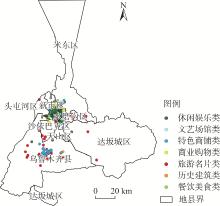
图1
乌鲁木齐市各类型“网红打卡地”空间分布"
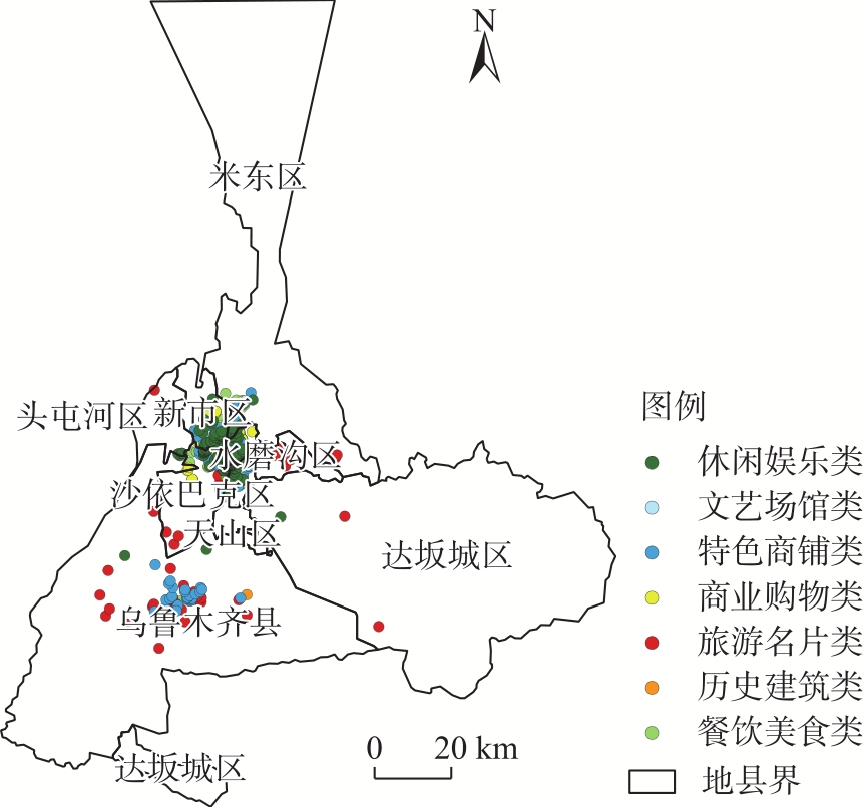
表3
不同类型“网红打卡地”的最近邻指数及空间分布类型"
| 类型 | 最邻近指数 | 置信水平(P值) | 空间分布类型 |
|---|---|---|---|
| 整体 | 0.283 | 0.000 | 集聚型 |
| 商业购物类 | 0.440 | 0.000 | 集聚型 |
| 旅游名片类 | 0.710 | 0.000 | 集聚型 |
| 历史建筑类 | 2.292 | 0.000 | 离散型 |
| 餐饮美食类 | 0.331 | 0.000 | 集聚型 |
| 特色商铺类 | 0.424 | 0.000 | 集聚型 |
| 文艺场馆类 | 0.864 | 0.062 | 集聚型 |
| 休闲娱乐类 | 0.442 | 0.000 | 集聚型 |
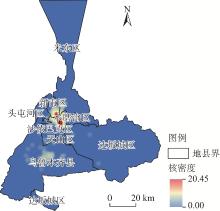
图2
“网红打卡地”整体核密度空间分布"
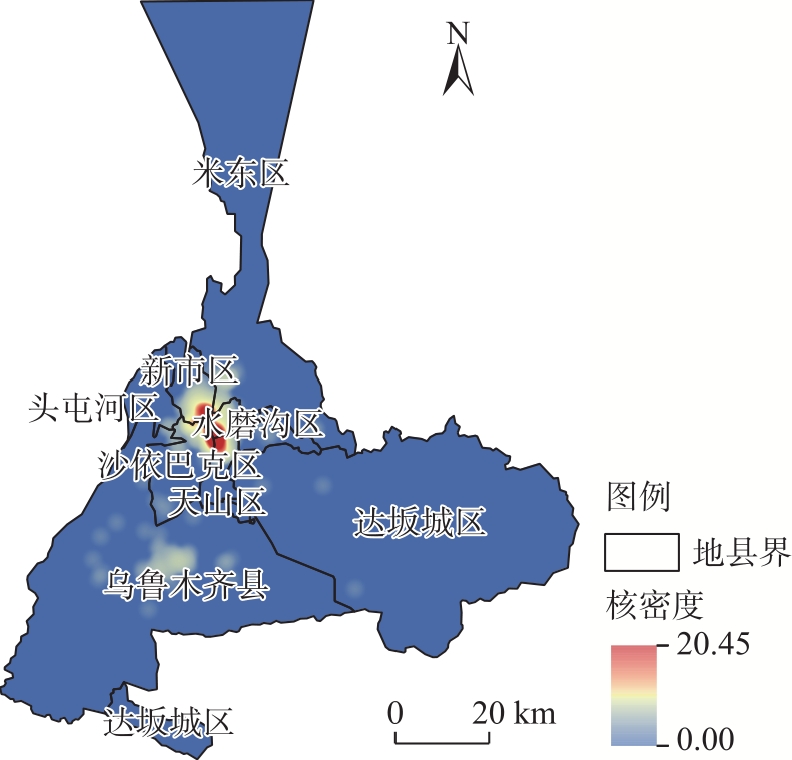
图3
不同类型“网红打卡地”核密度空间分布"
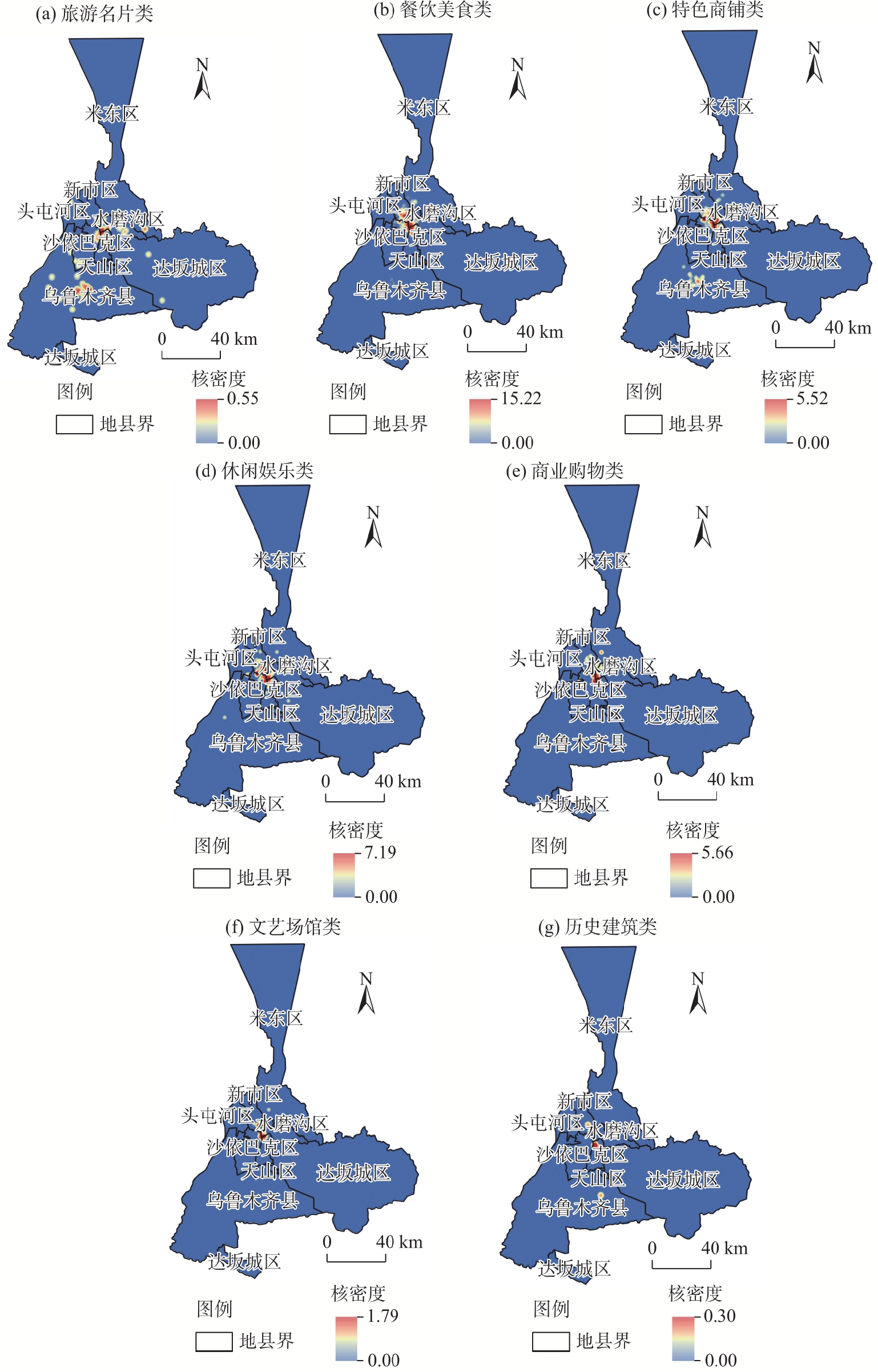
图4
乌鲁木齐市“网红打卡地”热点区域空间分布"
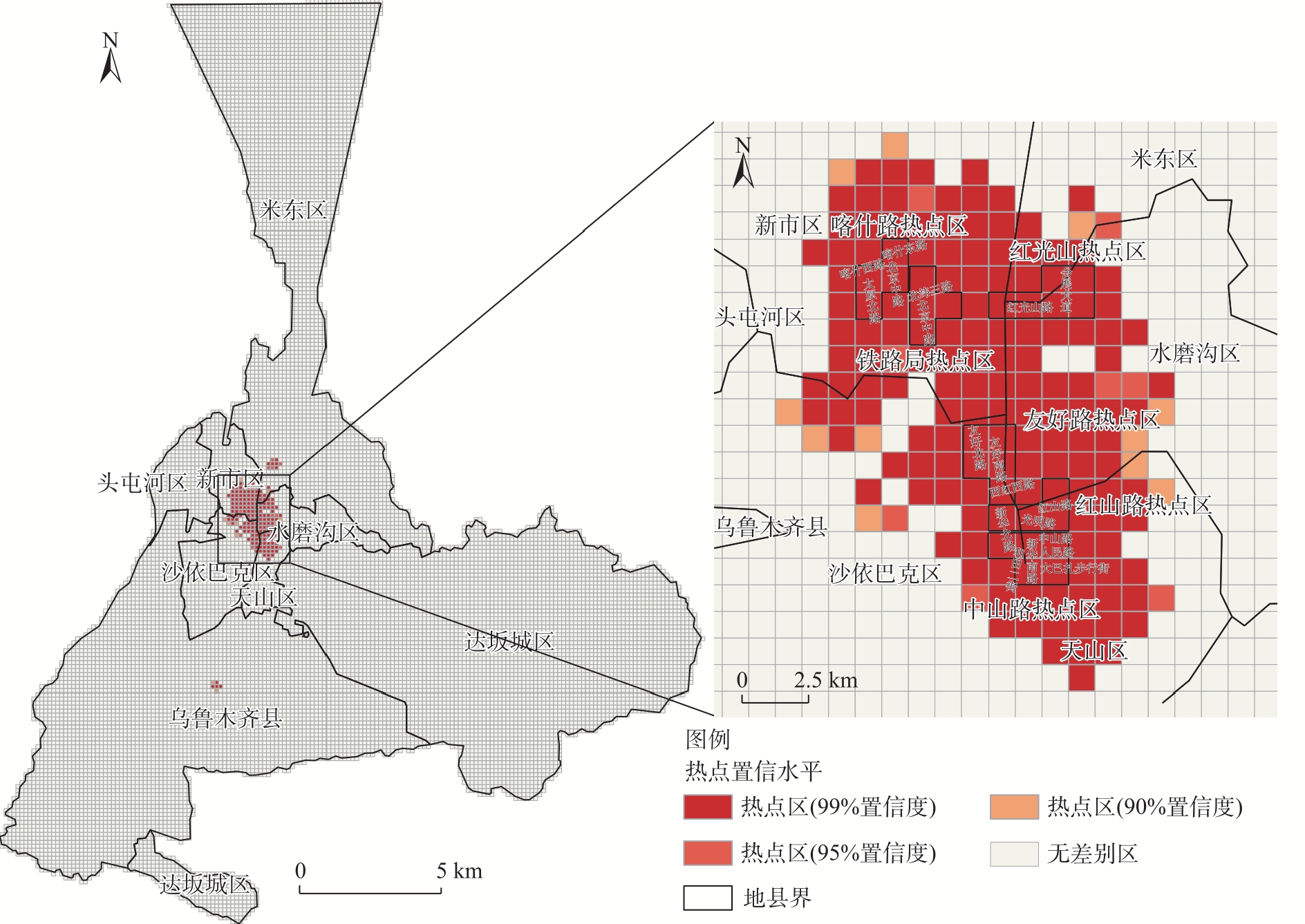
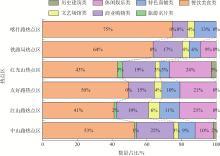
图5
各热点区域内不同类型“网红打卡地”的数量结构"
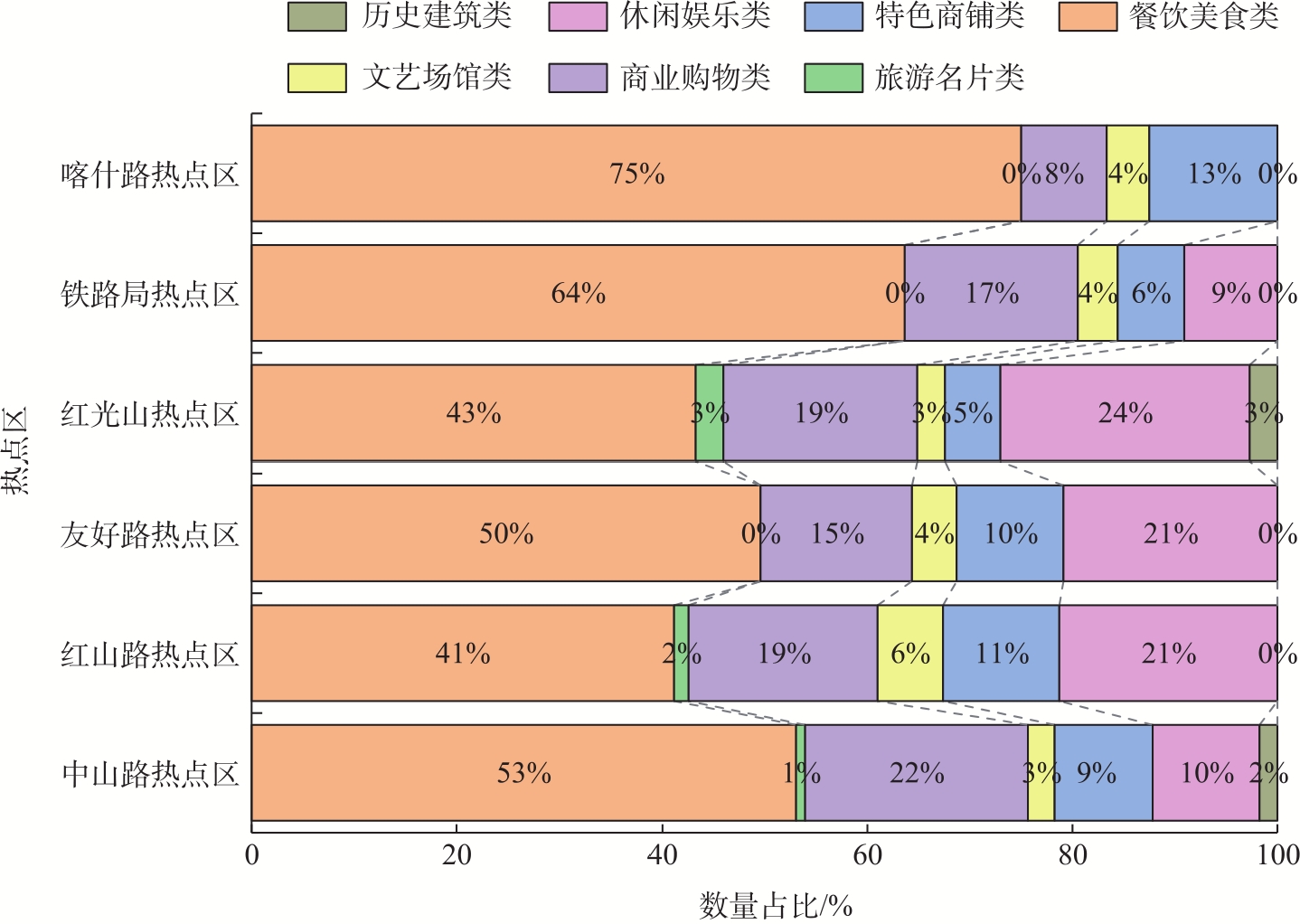
表4
乌鲁木齐市“网红打卡地”空间分布影响因素指标体系"
| 影响因素 | 具体指标 | 单位 | 指标解释 |
|---|---|---|---|
| 经济规模 | GDP(x1) | 104元 | 表征区域经济总量规模 |
| 第三产业增加值(x2) | 104元 | 反映第三产业对区域经济的贡献水平 | |
| 消费供给 | 住宿和餐饮业销售总额(x3) | 104元 | 衡量区域旅游消费市场活跃度 |
| 社会消费品零售总额(x4) | 104元 | 表征区域消费市场活跃水平 | |
| 景区指数(x5) | - | 3A及以上高等级景区在所有景区中的占比 | |
| 文化旅游体育与传媒支出(x6) | 104元 | 体现政府对文旅行业的公共财政投入力度 | |
| 消费需求 | 人均可支配收入(x7) | 元 | 反映居民收入水平及潜在消费能力 |
| 居民人口密度(x8) | 人·km-2 | 表征人口集聚程度 | |
| 打卡地关注度(x9) | - | 基于小红书官方CES评分公式,计算相关帖子的点赞、评论、收藏数加权总和 | |
| 土地价格 | 商铺租用价格(x10) | 元·d-1·m-2 | 反映商业区位租金成本水平 |
| 交通布局 | 路网密度(x11) | km·km-2 | 衡量交通基础设施的空间覆盖密度 |
表5
乌鲁木齐市“网红打卡地”空间分布影响因素探测结果"
| 因素 | 指标 | 整体 | 商业购物类 | 餐饮美食类 | 旅游名片类 | 休闲娱乐类 | 特色商铺类 | 文艺场馆类 | 历史建筑类 |
|---|---|---|---|---|---|---|---|---|---|
| 经济规模 | x1 | 0.9154** | 0.9611** | 0.9892** | 0.1767** | 0.9882** | 0.4807** | 0.9803** | 0.3771** |
| x2 | 0.8187** | 0.8416** | 0.9132** | 0.1809** | 0.9097** | 0.4346** | 0.8646** | 0.3274** | |
| 消费供给 | x3 | 0.3884** | 0.6382** | 0.4040** | 0.1816** | 0.5534** | 0.2036* | 0.6130** | 0.1951** |
| x4 | 0.6720** | 0.7767** | 0.8092** | 0.1692** | 0.7520** | 0.2680** | 0.7853** | 0.3539** | |
| x5 | 0.7533** | 0.5826** | 0.8235** | 0.9391** | 0.6087** | 0.8022** | 0.7270** | 0.9186** | |
| x6 | 0.8168** | 0.8726** | 0.8695** | 0.9872** | 0.7550** | 0.7932** | 0.8747** | 0.8676** | |
| 消费需求 | x7 | 0.5374** | 0.6205** | 0.5592** | 0.9873** | 0.5809** | 0.6584** | 0.6404** | 0.4409** |
| x8 | 0.8990** | 0.9643** | 0.9759** | 0.1798** | 0.9630** | 0.4680** | 0.9723** | 0.5458** | |
| x9 | 0.9579** | 0.9789** | 0.9140** | 0.9900** | 0.9608** | 0.9808** | 0.9774** | 0.8213** | |
| 土地价格 | x10 | 0.2994** | 0.3776** | 0.2930** | 0.9983** | 0.3292** | 0.5693** | 0.3414** | 0.7782** |
| 交通布局 | x11 | 0.8178** | 0.8619** | 0.9346** | 0.1745** | 0.8888** | 0.3905** | 0.8655** | 0.6153** |
| [1] | 梁璐, 焦瑛, 李九全, 等. 媒介地理学视角下的城市网红消费空间感知与建构——以长安十二时辰主题街区为例[J]. 经济地理, 2024, 44(10): 205-213, 223. |
| [Liang Lu, Jiao Ying, Li Jiuquan, et al. Perception and construction of urban net celebrity consumption space from the perspective of media geography: A case study of Chang’an theme street of twelve double-hour periods[J]. Economic Geography, 2024, 44(10): 205-213, 223. ] | |
| [2] | 汪劲柏, 穆艳霞, 王治元. 互联网时代城市空间运营热点地区的分布与发展特征研究——以上海“网红打卡地”为例[J]. 城市发展研究, 2022, 29(10): 19-26. |
| [Wang Jingbai, Mu Yanxia, Wang Zhiyuan. Distribution and development of urban hot spots in the internet era: A cace study of Shanghai[J]. Urban Development Studies, 2022, 29(10): 19-26. ] | |
| [3] |
Sajjadian F, Sheikh R, Souri M E, et al. Application of rough set and netnography in tourism marketing analysis[J]. Journal of Modelling in Management, 2018, 13(4): 1025-1036.
doi: 10.1108/JM2-02-2018-0029 |
| [4] | Karyatun S, Efendi S, Demolingo R H, et al. Between instagrammable attraction and selfie tourist: Characteristic and behavior[J]. South Asian Journal of Social Studies and Economics, 2021, 12(4): 314-324. |
| [5] |
Deng N, Qu Y J, Cheng X B, et al. Seeing is visiting: Discerning tourists’ behavior from landmarks in ordinary photos[J]. Current Issues in Tourism, 2023, 26(15): 2494-2512.
doi: 10.1080/13683500.2022.2089547 |
| [6] | Yi K, Wang Q Q, Xu J, et al. Attribution model of travel intention to internet celebrity spots: A systematic exploration based on psychological perspective[J]. Frontiers in Psychology, 2021, 12: 797482, doi: 10.3389/fpsyg.2021.797482. |
| [7] | Encalada L, Boavida-Portugal I, Ferreira C C, et al. Identifying tourist places of interest based on gigital imprints: Towards a sustainable smart city[J]. Sustainability, 2017, 9(12): 2317, doi: 10.3390/su9122317. |
| [8] |
Milner M. Is celebrity a new kind of status system[J]. Society, 2010, 47(5): 379-387.
doi: 10.1007/s12115-010-9347-x |
| [9] | 王昀, 徐睿. 打卡景点的网红化生成: 基于短视频环境下用户日常实践之分析[J]. 中国青年研究, 2021, 221(2): 105-112. |
| [Wang Yun, Xu Rui. The generation of net red of punch card attractions: Analysis of users’ daily practice based on short video environment[J]. China Youth Study, 2021, 221(2): 105-112. ] | |
| [10] | 柳莹. 青年网红打卡文化的符号消费及反思[J]. 江西社会科学, 2021, 41(9): 238-245. |
| [Liu Ying. On the youth culture of snap at an internet-famous site: Symbol consumption and reflection[J]. Jiangxi Social Sciences, 2021, 41(9): 238-245. ] | |
| [11] | 丁俊杰, 刘搦辰. 社交媒体如何构建“网红城市”的空间意象[J]. 新闻与写作, 2021(9): 87-91. |
| [Ding Junjie, Liu Nuochen. How social media constructs the spatial imagery of “internet-famous cities”[J]. News and Writing, 2021(9): 87-91. ] | |
| [12] | 张高洁, 骆蓓娟. 消费社会视域下“网红打卡地”的媒体奇观及其批判[J]. 东南传播, 2019(10): 11-13. |
| [Zhang Gaojie, Luo Beijuan. From the perspective of consumer society: The media spectacle of “internet celebrity spots punch in” and its critique[J]. Southeast Communication, 2019(10): 11-13. ] | |
| [13] | 郑雅馨, 罗秋菊. 可供性理论视角下网红城市地方营造研究——以长沙为例[J]. 旅游学刊, 2026, 41(1): 82-96. |
| [Zheng Yaxin, Luo Qiuju. Understanding internet-famous city place making from the perspective of affordance theory: A case of Changsha, China[J]. Tourism Tribune, 2026, 41(1): 82-96. ] | |
| [14] | 项婧怡, 罗震东, 张吉玉, 等. 移动互联网时代“网红空间”分布特征研究——以杭州市主城区为例[J]. 现代城市研究, 2021(9): 11-19. |
| [Xiang Jingyi, Luo Zhendong, Zhang Jiyu, et al. Research on the distribution characteristics of “net celebrity space” in the mobile internet era: A case study in main area of Hangzhou, China[J]. Modern Urban Research, 2021(9): 11-19. ] | |
| [15] | 凡来, 张大玉. 新社交媒体下城市意象热点空间感知研究——以北京小红书笔记数据为例[J]. 城市发展研究, 2022, 29(10): 1-8. |
| [Fan Lai, Zhang Dayu. Research on spatial perception of urban lmage hotspotsunder new social media: Take the note data of Beijing Xiaohongshu as an example[J]. Urban Development Studies, 2022, 29(10): 1-8. ] | |
| [16] | 周恺, 张海涛, 夏依宁, 等. 社交媒体影响下的城市消费空间新特征: 以小红书长沙“网红打卡地”为例[J]. 现代城市研究, 2021(9): 20-27. |
| [Zhou Kai, Zhang Haitao, Xia Yining, et al. New urban consumption space shaped by social media: A case study of the geo-tagging places of Changsha on Xiaohongshu[J]. Modern Urban Research, 2021(9): 20-27. ] | |
| [17] | Jin H L, Zhang P F, Yang L Y, et al. Understanding the internet-famous tourist city: Interaction within digital technology in an accelerated society[J]. Cities, 2025, 167: 106294, doi: 10.1016/j.cities.2025.106294. |
| [18] | Wu J, Zhang C J, Huang G Q I, et al. Taste, trend, and turmoil: Tracking the life cycle of internet-famous restaurants through customer satisfaction[J]. International Journal of Hospitality Management, 2024, 126: 104071, doi: 10.1016/j.ijhm.2024.104071. |
| [19] | Alaily-Mattar N, Baptist V, Legner L, et al. Visuality peaks, function lasts: An empirical investigation into the performance of iconic architecture on instagram[J]. Archnet-IJAR: International Journal of Architectural Research, 2025(2): 351-371. |
| [20] | 曾一果, 凡婷婷. 重识“地方”: 网红空间与媒介地方感的形成——以短视频打卡“西安城墙”为考察中心[J]. 新闻与传播研究, 2022, 29(11): 71-89, 128. |
| [Zeng Yiguo, Fan Tingting. Re-understanding “place”: The formation of Wanghong space and media sense of place: A study of “da ka” activities of the wall of Xi’an City[J]. Journal of Journalism & Communication Studies, 2022, 29(11): 71-89, 128. ] | |
| [21] | 吴红焱, 杨晓霞. 网红景区投射形象与感知形象的对比研究——以重庆万盛奥陶纪景区为例[J]. 资源开发与市场, 2019, 35(12): 1556-1560. |
| [Wu Hongyan, Yang Xiaoxia. Comparative study on projected and perceived lmage in online scenic spot: Taking ordovician scenic spot of Wansheng as a case[J]. Resource Development & Market, 2019, 35(12): 1556-1560. ] | |
| [22] |
Marpaung B O Y, Tania F. Visitor satisfaction and tourist attraction image[J]. International Journal of Psychological Studies, 2021, 13(2): 33-48.
doi: 10.5539/ijps.v13n2p33 |
| [23] |
曾晓茵, 高俊. 网红旅游街区建构的话语研究——清迈宁曼路街区案例[J]. 中国生态旅游, 2023, 13(4): 555-569.
doi: 10.12342/zgstly.20230058 |
|
[Zeng Xiaoyin, Gao Jun. Discourse analysis on the construction of internet-famous tourist street: The case of Nimman Road in Chiang Mai[J]. Journal of Chinese Ecotourism, 2023, 13(4): 555-569. ]
doi: 10.12342/zgstly.20230058 |
|
| [24] |
舒小林, 陈洋, 王美玲, 等. 乡村体育赛事型网红旅游地长红机制研究——以贵州“村超”为例[J]. 经济地理, 2025, 45(9): 249-259.
doi: 10.15957/j.cnki.jjdl.2025.09.025 |
|
[Shu Xiaolin, Chen Yang, Wang Meiling, et al. Long-term popularity mechanism of rural sports-themed internet-famous tourism destinations: A case study of “village super league” in Guizhou[J]. Economic Geography, 2025, 45(9): 249-259. ]
doi: 10.15957/j.cnki.jjdl.2025.09.025 |
|
| [25] | 文捷敏, 余颖, 刘学伟, 等. 基于网络文本分析的“网红”旅游目的地形象感知研究——以重庆洪崖洞景区为例[J]. 旅游研究, 2019, 11(2): 44-57. |
| [Wen Jiemin, Yu Ying, Liu Xuewei, et al. A research on lmage perception of online-popular tourist destinations based on content analysis of web texts from travelers: A case study in Hongyadong scenic spot in Chongqing[J]. Tourism Research, 2019, 11(2): 44-57. ] | |
| [26] | 殷紫燕, 黄安民. 网红旅游打卡地属性及口碑传播机制研究[J]. 资源开发与市场, 2023, 39(10): 1400-1408. |
| [Yin Ziyan, Huang Anmin. Study on the attributes and word-of-mouth mechanism of internet celebrity travel punch point[J]. Resource Development & Market, 2023, 39(10): 1400-1408. ] | |
| [27] |
唐承财, 金天姿, 肖小月, 等. 基于POI的冰雪旅游地业态时空演化及影响因素——以崇礼为例[J]. 地理科学进展, 2025, 44(9): 1864-1882.
doi: 10.18306/dlkxjz.2025.09.008 |
|
[Tang Chengcai, Jin Tianzi, Xiao Xiaoyue, et al. Spatiotemporal change and influencing factors of business formats in ice and snow tourism destinations based on POI: Taking Chongli as an example[J]. Progress in Geography, 2025, 44(9): 1864-1882. ]
doi: 10.18306/dlkxjz.2025.09.008 |
|
| [28] |
唐承财, 王希羽, 韩莹, 等. 黑龙江省中俄边境城市旅游网络关注度时空特征及影响因素[J]. 中国生态旅游, 2024, 14(5): 1118-1128.
doi: 10.12342/zgstly.20240201 |
|
[Tang Chengcai, Wang Xiyu, Han Ying, et al. Spatial and temporal characteristics and influencing factors of network attention totourism in China-Russia border cities in Heilongjiang Province[J]. Journal of Chinese Ecotourism, 2024, 14(5): 1118-1128. ]
doi: 10.12342/zgstly.20240201 |
|
| [29] |
顾晋源, 杨东峰. 社交媒体影响下城市休闲空间分布新特征: 基于小红书打卡地与POI的对比分析[J]. 地球信息科学学报, 2024, 26(2): 332-351.
doi: 10.12082/dqxxkx.2024.230136 |
| [Gu Jinyuan, Yang Dongfeng. New features of urban leisure space distribution under the influence of social media: A comparison between Xiaohongshu check-ins and POI[J]. Journal of Geo-Information Science, 2024, 26(2): 332-351. ] | |
| [30] | Caruana S, Caruana J. Instagram:The travelogue for Generation Z’s travellers. The impact that influencers and content creators leave through their generated content[C]// Transcending Borders in Tourism Through Innovation and Cultural Heritage: 8th International Conference, IACuDiT, Hydra, Greece, 2021. Cham: Springer International Publishing, 2022: 879-896. |
| [31] | Sánchez-Amboage E, Castellanos-García P, Crespo-Pereira V. Traveler segmentation through instagram fashion influencers. Mirror tourist as a new segment consumer group[J]. Journal of Retailing and Consumer Services, 2024, 78: 6969-6989. |
| [32] | 张琳, 朱文一. 抖音短视频空间意象初探——以三处重庆“网红打卡地”为例[J]. 城市设计, 2020(1): 36-45. |
| [Zhang Lin, Zhu Wenyi. A study on spatial images in Tik-Tok short videos: Three internet-famous sites in Chongqing City[J]. Urban Design, 2020(1): 36-45. ] | |
| [33] | 国务院. 国务院关于乌鲁木齐市城市总体规划的批复[J]. 中华人民共和国国务院公报, 2017, 4: 34-35. |
| [The State Council. Reply of the State Council on the overall urban planning of Urumqi City[J]. Gazette of the State Council of the People’s Republic of China, 2017, 4: 34-35. ] | |
| [34] |
黄微, 孙悦. 社交媒体平台用户参与行为强度测定与预判[J]. 现代情报, 2022, 42(11): 97-110, 177.
doi: 10.3969/j.issn.1008-0821.2022.11.009 |
| [Huang Wei, Sun Yue. Intensity analysis and prediction of user participation behavior on social media platform[J]. Journal of Modern Information, 2022, 42(11): 97-110, 177. ] | |
| [35] | 江积海, 庞瑶涵. “生意是生活的意义”吗? 内容平台价值创造与价值捕获的对齐——小红书2013—2023年纵向案例研究[J]. 外国经济与管理, 2025, 47(9): 24-46. |
| [Jiang Jihai, Pang Yaohan. “Is the sense of business the same as that of life”? Alignment of value creation and value capture in content platforms: A longitudinal case study of Xiaohongshu from 2013 to 2023[J]. Foreign Economics & Management, 2025, 47(9): 24-46. ] | |
| [36] | 冯羽. 小红书买手到底是什么“神秘组织”?[J]. 商业文化, 2024(2): 16-21. |
| [Feng Yu. What on earth is the “mysterious organization” of Xiaohongshu buyers?[J]. Business Culture, 2024(2): 16-21. ] | |
| [37] | 郭全中, 王映骅, 司茗嘉. “TikTok难民”现象透视: 用户—平台的情感驱动与游戏实践[J]. 新闻爱好者, 2025(4): 32-35. |
| [Guo Quanzhong, Wang Yinghua, Si Mingjia. An insight into the phenomenon of TikTok “refugees”: User-platform emotional drivers and gaming practices[J]. Journalism Lover, 2025(4): 32-35. ] | |
| [38] | 千瓜数据. 2025年活跃用户研究报告(小红书平台)[EB/OL]. [2025-04-24]. https://www.qian-gua.com/blog/detail/3149.html. |
| [Qian-gua. 2025 research report on active users (Xiaohongshu platform)[EB/OL]. [2025-04-24]. https://www.qian-gua.com/blog/detail/3149.html.] | |
| [39] | 黄震方, 祝晔, 袁林旺, 等. 休闲旅游资源的内涵、分类与评价——以江苏省常州市为例[J]. 地理研究, 2011, 30(9): 1543-1553. |
| [Huang Zhenfang, Zhu Ye, Yuan Linwang, et al. The intention, classification and evaluation of leisure tourism resources: A case study of Changzhou, Jiangsu Province[J]. Geographical Research, 2011, 30(9): 1543-1553. ] | |
| [40] | 贾晓婷, 雷军, 武荣伟, 等. 基于POI的城市休闲空间格局分析——以乌鲁木齐市为例[J]. 干旱区地理, 2019, 42(4): 943-952. |
| [Jia Xiaoting, Lei Jun, Wu Rongwei, et al. Urban recreation space pattern based on POI data: A case of Urumqi City[J]. Arid Land Geography, 2019, 42(4): 943-952. ] | |
| [41] | 王兆峰, 李琴. 长征沿线红色文化遗产空间分布特征及旅游高质量发展[J]. 山地学报, 2022, 40(4): 581-596. |
| [Wang Zhaofeng, Li Qin. Spatial distribution of red cultural heritageand high-quality tourism development along the Long March[J]. Mountain Research, 2022, 40(4): 581-596. ] | |
| [42] | 赵艳楠, 杨德刚, 张新焕, 等. 乌鲁木齐住宿业空间分布及热点区模式研究[J]. 干旱区地理, 2016, 39(5): 1143-1152. |
| [Zhao Yannan, Yang Degang, Zhang Xinhuan, et al. Spatial distribution characteristics and hot zone patterns of lodging industry in Urumqi[J]. Arid Land Geography, 2016, 39(5): 1143-1152. ] | |
| [43] |
方远平, 陆莲芯, 毕斗斗, 等. 珠江三角洲港资服务业企业的空间格局及影响因素研究[J]. 地理科学, 2020, 40(9): 1421-1428.
doi: 10.13249/j.cnki.sgs.2020.09.003 |
| [Fang Yuanping, Lu Lianxin, Bi Doudou, et al. The distribution and influencing factors of Hong Kong-funded service companies in the Pearl River Delta[J]. Geographical Science, 2020, 40(9): 1421-1428. ] | |
| [44] |
王兆峰, 刘庆芳. 产业融合背景下运动休闲特色小镇的空间分异及形成因素[J]. 地理科学, 2020, 40(8): 1310-1318.
doi: 10.13249/j.cnki.sgs.2020.08.010 |
|
[Wang Zhaofeng, Liu Qingfang. Spatial differentiation and the forming factors of sports and leisure characteristic towns under the background of industry convergence[J]. Scientia Geographica Sinica, 2020, 40(8): 1310-1318. ]
doi: 10.13249/j.cnki.sgs.2020.08.010 |
|
| [45] |
陈蔚珊, 柳林, 梁育填. 基于POI数据的广州零售商业中心热点识别与业态集聚特征分析[J]. 地理研究, 2016, 35(4): 703-716.
doi: 10.11821/dlyj201604009 |
| [Chen Weishan, Liu Lin, Liang Yutian. Retail center recognition and spatial aggregating feature analysis of retail formats in Guangzhou based on POI data[J]. Geographical Research, 2016, 35(4): 703-716. ] | |
| [46] |
王劲峰, 徐成东. 地理探测器: 原理与展望[J]. 地理学报, 2017, 72(1): 116-134.
doi: 10.11821/dlxb201701010 |
|
[Wang Jinfeng, Xu Chengdong. Geodetector: Principle and prospective[J]. Acta Geographica Sinica, 2017, 72(1): 116-134. ]
doi: 10.11821/dlxb201701010 |
|
| [47] |
石天戈, 时卉. 基于地理探测器的乌鲁木齐城市扩张特征与时空驱动因素分析[J]. 干旱区地理, 2021, 44(3): 867-876.
doi: 10.12118/j.issn.1000–6060.2021.03.29 |
|
[Shi Tiange, Shi Hui. Urban expansion and its temporal andspatial driving forces of Urumqi based ongeo-detector method[J]. Arid Land Geography, 2021, 44(3): 867-876. ]
doi: 10.12118/j.issn.1000–6060.2021.03.29 |
|
| [48] | 周满意, 王承武. 基于PLUS模型的乌鲁木齐市“三生”空间多情景模拟[J]. 中国环境科学, 2024, 44(7): 4021-4030. |
| [Zhou Manyi, Wang Chengwu. Multi-scenario simulation of “production-livelihood-ecological” space in Urumqi based on PLUS[J]. China Environmental Science, 2024, 44(7): 4021-4030. ] | |
| [49] | 舒天衡, 任一田, 申立银, 等. 大型城市消费活力的空间异质性及其驱动因素研究——以成都市为例[J]. 城市发展研究, 2020, 27(1): 16-21. |
| [Shu Tianheng, Ren Yitian, Shen Liyin, et al. Study on spatial heterogeneity of consumption vibrancy and its driving factors in large city: A case of Chengdu City[J]. Urban Development Studies, 2020, 27(1): 16-21. ] | |
| [50] | 吕飞, 王帅. 城市空间网红化现象测度及影响因素研究[J]. 城市问题, 2023(12): 50-59. |
| [Lü Fei, Wang Shuai. Research on the measurement and influencing factors of internet celebrity phenomenon in urban space[J]. Urban Problems, 2023(12): 50-59. ] | |
| [51] |
唐宇, 薛东前, 宋永永, 等. 中国夜间文旅消费集聚区空间格局及影响机理[J]. 干旱区地理, 2024, 47(3): 485-495.
doi: 10.12118/j.issn.1000-6060.2023.183 |
|
[Tang Yu, Xue Dongqian, Song Yongyong, et al. Spatial pattern and influence mechanism of night-time cultural tourism consumption agglomeration areas in China[J]. Arid Land Geography, 2024, 47(3): 485-495. ]
doi: 10.12118/j.issn.1000-6060.2023.183 |
|
| [52] | 聂昀秋, 马晓君, 刘楷琳. 城市更新与居民消费率——基于市际面板数据的实证研究[J]. 社会科学研究, 2025(4): 23-35. |
| [Nie Yunqiu, Ma Xiaojun, Liu Kailin. Urban renewal and resident consumption rate: An empirical study based on inter-city panel data[J]. Social Science Research, 2025(4): 23-35. ] | |
| [53] |
李一曼, 修春亮, 孔翔. 浙江陆路交通对区域旅游空间结构及发展的影响研究[J]. 地理科学, 2018, 38(12): 2066-2073.
doi: 10.13249/j.cnki.sgs.2018.12.015 |
| [Li Yiman, Xiu Chunliang, Kong Xiang. Influence of land transportation network evolution on spatial structure and development of regional tourism in Zhejiang Province[J]. Geographical Science, 2018, 38(12): 2066-2073. ] | |
| [54] |
张淑萍, 冯一帆, 苏晓峰, 等. 昙花一现还是乘风而上: 网红打卡地类型对消费者持续打卡意愿的影响[J]. 中国生态旅游, 2024, 14(5): 1042-1056.
doi: 10.12342/zgstly.20240039 |
|
[Zhang Shuping, Feng Yifan, Su Xiaofeng, et al. Passing fad or riding the wind: The impact of the type of internet celebrity places on consumers’ willingness to continue clocking in[J]. Journal of Chinese Ecotourism, 2024, 14(5): 1042-1056. ]
doi: 10.12342/zgstly.20240039 |
| [1] | 吕宛青, 宋志高, 肖钊富. 中国新型城镇化与旅游业高质量发展耦合协调、障碍诊断及驱动因素[J]. 干旱区地理, 2026, 49(5): 1063-1073. |
| [2] | 贾亚娟, 高君, 张新奇. 关中平原耕地利用生态效率时空演化及驱动因素分析[J]. 干旱区地理, 2026, 49(4): 830-840. |
| [3] | 曹浩然, 孟梅, 刘红光. 2000—2024年甘肃省土地生态脆弱性时空变化特征及模拟预测研究[J]. 干旱区地理, 2026, 49(4): 841-855. |
| [4] | 张志秀, 马彩虹. 链谱视角下干旱海湾国家土地利用变化特征及驱动因子分析——以卡塔尔为例[J]. 干旱区地理, 2026, 49(4): 868-879. |
| [5] | 裴若颖, 曹生奎, 侯瑶芳, 雷义珍, 王江, 刘振梅, 丁辰深. 青海湖流域草地植被生物量空间分布格局研究[J]. 干旱区地理, 2026, 49(2): 301-315. |
| [6] | 李骞国, 孙龙凯, 惠蕃艳, 朱宗斌. 甘肃省县域乡村韧性时空演变特征及驱动机制研究[J]. 干旱区地理, 2026, 49(2): 393-403. |
| [7] | 杨迪, 邹进, 马晓飞, 张珣, 周锐, 刘艳春, 石金莲. 体育旅游资源空间分布特征及可持续发展研究——以新疆为例[J]. 干旱区地理, 2026, 49(1): 140-150. |
| [8] | 王晓菲, 邳华伟, 李思思. 青藏高原土壤风蚀潜力时空特征及驱动因素分析[J]. 干旱区地理, 2025, 48(9): 1589-1599. |
| [9] | 张少华, 关海玲. 创新集聚空间分布模式对中国城市经济韧性的影响机制研究[J]. 干旱区地理, 2025, 48(9): 1636-1647. |
| [10] | 张毅明, 汤宇磊, 冯俊波. 基于随机森林模型的青藏高原冰川预测及分析[J]. 干旱区地理, 2025, 48(8): 1342-1352. |
| [11] | 赵建文, 李金麟, 王圣杰. 祁连山土壤水分时空变化特征及主要驱动因素分析[J]. 干旱区地理, 2025, 48(8): 1480-1491. |
| [12] | 张晓明, 宿星, 张军, 贾静. 基于PLUS-InVEST模型的甘肃通渭滑坡区生境质量时空变化及预测[J]. 干旱区地理, 2025, 48(7): 1220-1232. |
| [13] | 夏梓洋, 夏云帆, 王宁, 林伟, 马丽娜, 谭晓平, 张艳珍, 焦瑞. 基于POI的天山北坡城市群旅游要素空间格局及影响因素[J]. 干旱区地理, 2025, 48(7): 1243-1254. |
| [14] | 田志馥, 于亚娟, 黄辰宇. 基于POI数据挖掘的内蒙古县域旅游要素空间分布特征及影响因素[J]. 干旱区地理, 2025, 48(7): 1255-1266. |
| [15] | 武志平, 姜民, 付建新. 黄河“几”字弯都市圈城镇化高质量发展时空分异及驱动力[J]. 干旱区地理, 2025, 48(7): 1279-1292. |
|
||