干旱区地理 ›› 2026, Vol. 49 ›› Issue (4): 656-668.doi: 10.12118/j.issn.1000-6060.2025.774 cstr: 32274.14.ALG2025774
王生霞( ), 武芯如()
收稿日期:2025-11-28
修回日期:2025-12-19
出版日期:2026-04-25
发布日期:2026-04-28
通讯作者:
武芯如(2002-),女,硕士研究生,主要从事旅游管理等方面的研究. E-mail: 19893162684@163.com作者简介:王生霞(1983-),女,博士,副教授,主要从事旅游地理等方面的研究. E-mail: wangshx@lzufe.edu.cn
基金资助:
WANG Shengxia(), WU Xinru()
Received:2025-11-28
Revised:2025-12-19
Published:2026-04-25
Online:2026-04-28
摘要:
新质生产力与文旅融合的良性互动是推动区域发展协调与产业结构升级的重要路径。以2011—2023年中国30个省域为研究对象,综合运用哈肯模型、Dagum基尼系数及探索性空间分析方法,揭示了新质生产力与文旅融合协同演化的内在机制与时空分异。结果表明:(1) 新质生产力与文旅融合复合系统的协同值呈“培育期-临界跃迁期-高质量跃升期”三阶段演进特征。(2) 空间上,协同水平呈“东部>中部>西部”的梯度分布,并表现出显著的空间集聚,逐步形成“高-高”与“低-低”协同极并存的极化格局,区域联动与分化态势并存,且区域间差异是总体差异的主要来源。(3) 文旅融合子系统主导新质生产力与文旅融合复合系统协同演化过程,新质生产力在短期内对文旅融合存在微弱的挤出效应,而文旅融合对新质生产力提升表现出持续的驱动作用。为此,研究结果提出优化技术适配机制,实施区域差异化政策,加强跨区域协作等建议以提升复合系统整体协同水平。
王生霞, 武芯如. 新质生产力与文旅融合发展的协同演进及空间效应[J]. 干旱区地理, 2026, 49(4): 656-668.
WANG Shengxia, WU Xinru. Synergistic evolution and spatial effects of new quality productive forces and cultural-tourism integration[J]. Arid Land Geography, 2026, 49(4): 656-668.
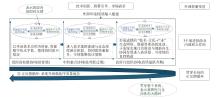
图1
新质生产力与文旅融合复合系统协同演进的理论框架"
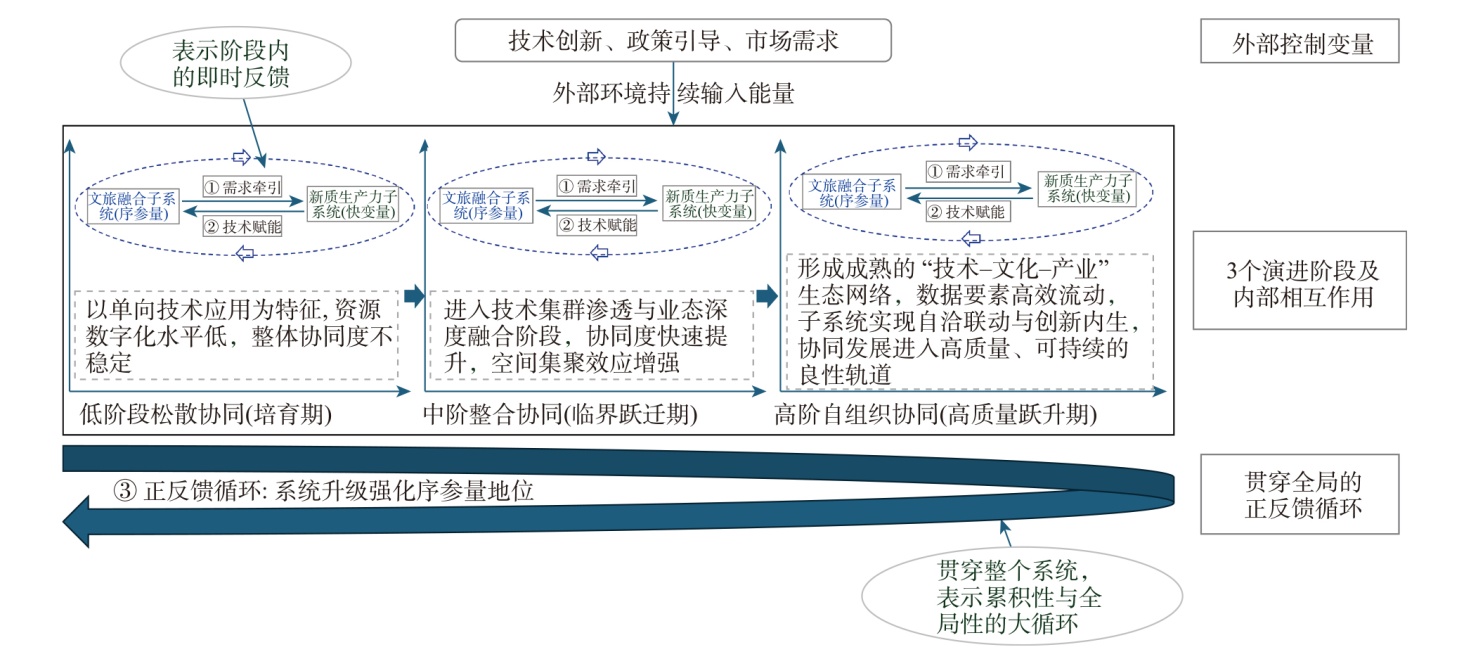

表1
新质生产力评价指标体系"
| 评价目标 | 一级指标 | 二级指标 | 指标说明 | 单位 | 属性 |
|---|---|---|---|---|---|
| 新质生产力 | 创新驱动 | R&D经费投入强度 | 研究与试验发展经费内部支出/地区生产总值 | % | + |
| 高技术产业营业收入 | 直接数据 | 108元 | + | ||
| 每万人口R&D人员全时当量 | R&D人员全时当量/常住人口 | 人年·(104人)-1 | + | ||
| 数字赋能 | 互联网宽带接入率 | 互联网宽带接入端口/地区常住人口 | % | + | |
| 域名数 | 直接数据 | 104个 | + | ||
| 每百家企业拥有网站数 | 直接数据 | 个·(100家)-1 | + | ||
| 要素供给 | 高等教育学校数 | 直接数据 | 所 | + | |
| 信息软件业就业人员占比 | 信息传输、软件和信息技术服务业城镇单位就业人员/总城镇单位就业人员 | % | + | ||
| 绿色高效 | 单位GDP能耗 | 能源消耗总量/GDP | tce·(104元)-1 | - | |
| 全员劳动生产率 | 地区生产总值/全社会就业人员数 | 104元·人-1 | + |
表2
文旅融合发展评价指标体系"
| 评价目标 | 一级指标 | 二级指标 | 指标说明 | 单位 | 属性 |
|---|---|---|---|---|---|
| 文旅融合发展 | 融合基础力 | 文旅资源丰度 | A级景区总数 | 个 | + |
| 公共文化服务设施覆盖率 | (博物馆+公共图书馆+文化馆)机构数/常住人口 | 个·(104人)-1 | + | ||
| 融合驱动力 | 文旅融合财政投入强度 | 文化与旅游事业费 | 108元 | + | |
| 文旅消费需求潜力 | 居民人均教育文化娱乐消费支出/人均消费支出 | % | + | ||
| 融合彰显力 | 第三产业发展 | 第三产业增加值/GDP | % | + | |
| 文化体验活动参与度 | (博物馆+演艺+非遗体验)参观人数/游客总人数×100% | % | + | ||
| 在线旅游收入占比 | 在线旅游交易额/旅游总收入 | % | + | ||
| 文旅带动就业系数 | (文化、体育、娱乐业+住宿餐饮业)/总从业人数 | % | + |
表3
哈肯模型回归结果"
| 假设序量 | 运动方程 | 控制参量 | 结论 |
|---|---|---|---|
| q1=N q2=I | λ1=-0.072 λ2=-0.049 a=0.044 b=-0.005 | 不满足绝热近似假设,即原假设不成立 | |
| q1=I q2=N | λ1=-0.048 λ2=0.155 a=0.020 b=0.009 | 满足绝热近似假设,即原假设成立 | |
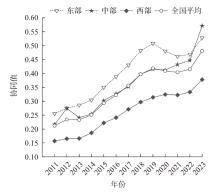
图2
新质生产力与文旅融合复合系统协同值变化趋势"
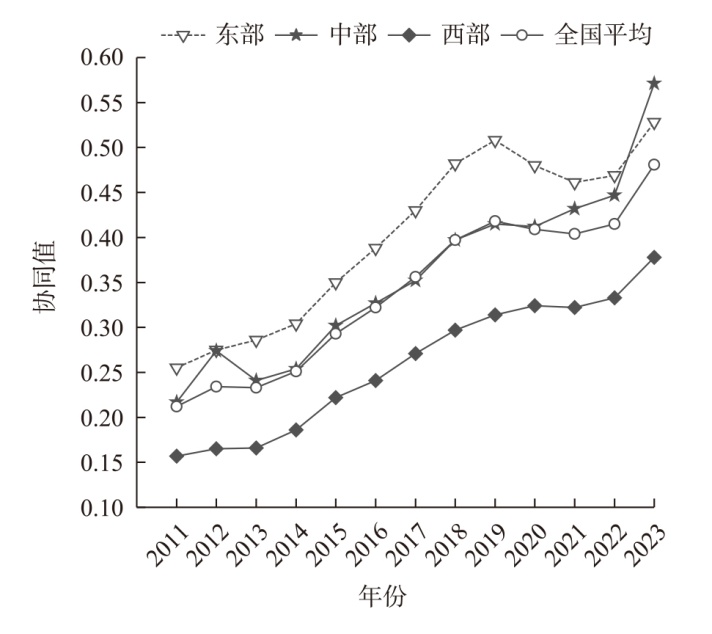
图3
新质生产力与文旅融合复合系统协同类型划分 注:基于自然资源部标准地图服务网站审图号为GS(2024)0650的标准地图绘制,底图边界无修改。"
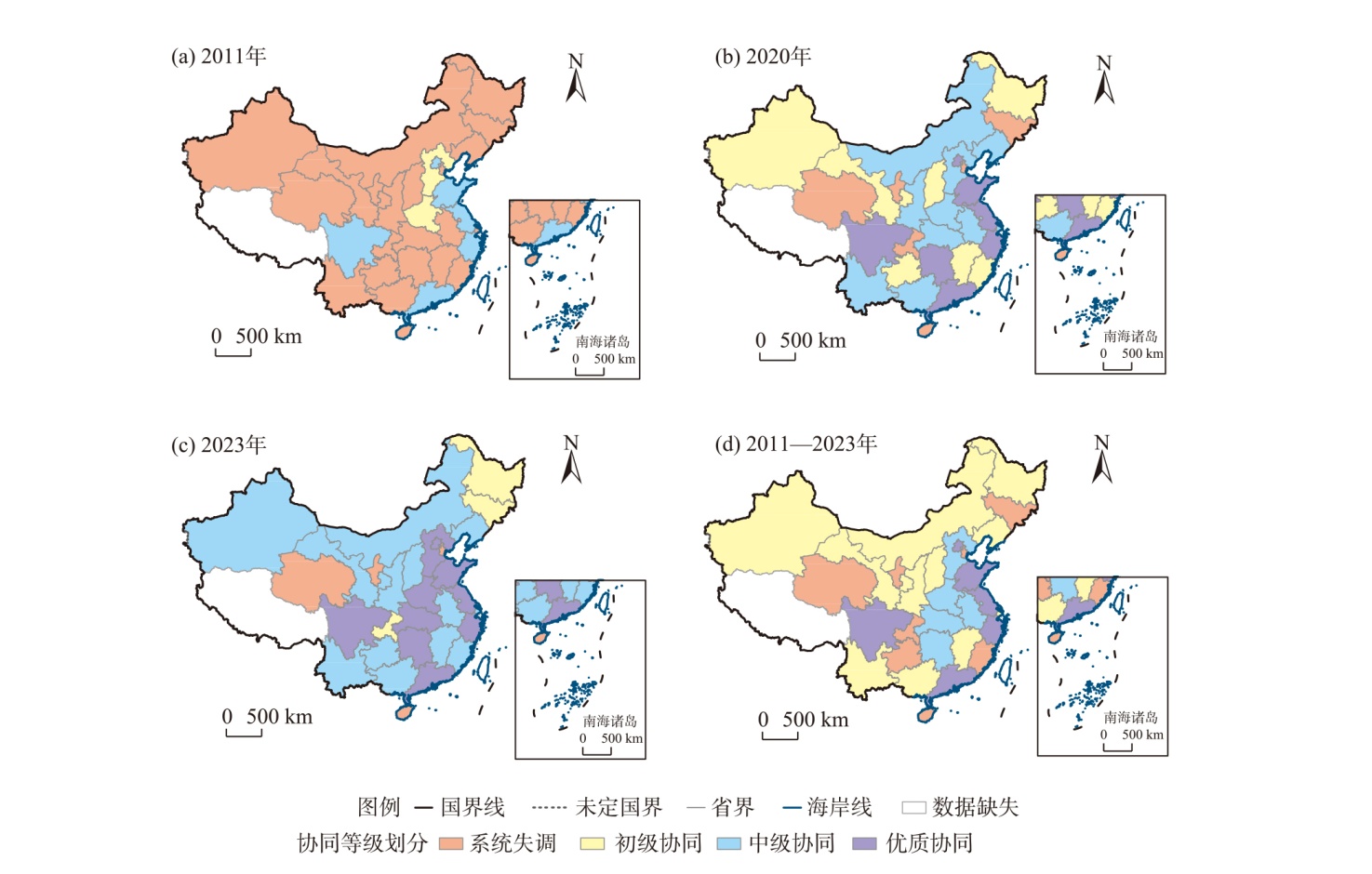
图4
基尼系数、区域差异及贡献率分解"
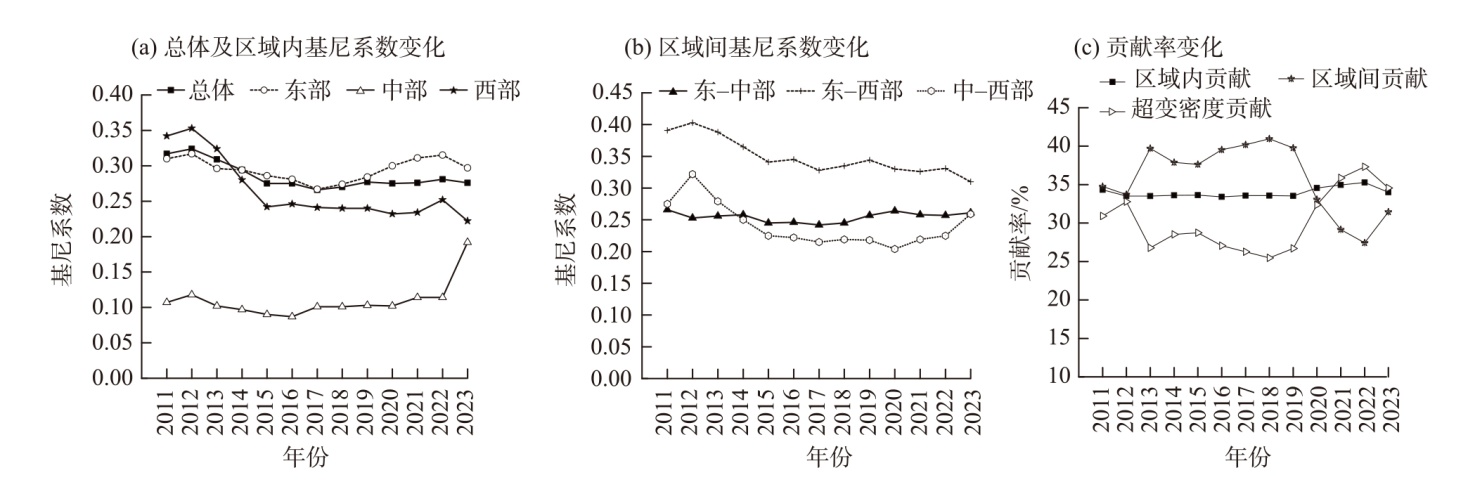
表4
2011—2023年新质生产力与文旅融合协同度的空间相关性检验结果"
| 年份 | 全局Moran’s I | E(I) | Sd(I) | Z |
|---|---|---|---|---|
| 2011 | 0.176** | -0.034 | 0.115 | 1.822 |
| 2012 | 0.179** | -0.034 | 0.116 | 1.847 |
| 2013 | 0.196** | -0.034 | 0.116 | 1.988 |
| 2014 | 0.190** | -0.034 | 0.116 | 1.932 |
| 2015 | 0.198** | -0.034 | 0.116 | 2.009 |
| 2016 | 0.240*** | -0.034 | 0.115 | 2.379 |
| 2017 | 0.242*** | -0.034 | 0.116 | 2.395 |
| 2018 | 0.238*** | -0.034 | 0.116 | 2.354 |
| 2019 | 0.195** | -0.034 | 0.115 | 1.992 |
| 2020 | 0.174** | -0.034 | 0.116 | 1.804 |
| 2021 | 0.226*** | -0.034 | 0.116 | 2.254 |
| 2022 | 0.276*** | -0.034 | 0.116 | 2.689 |
| 2023 | 0.257*** | -0.034 | 0.116 | 2.518 |
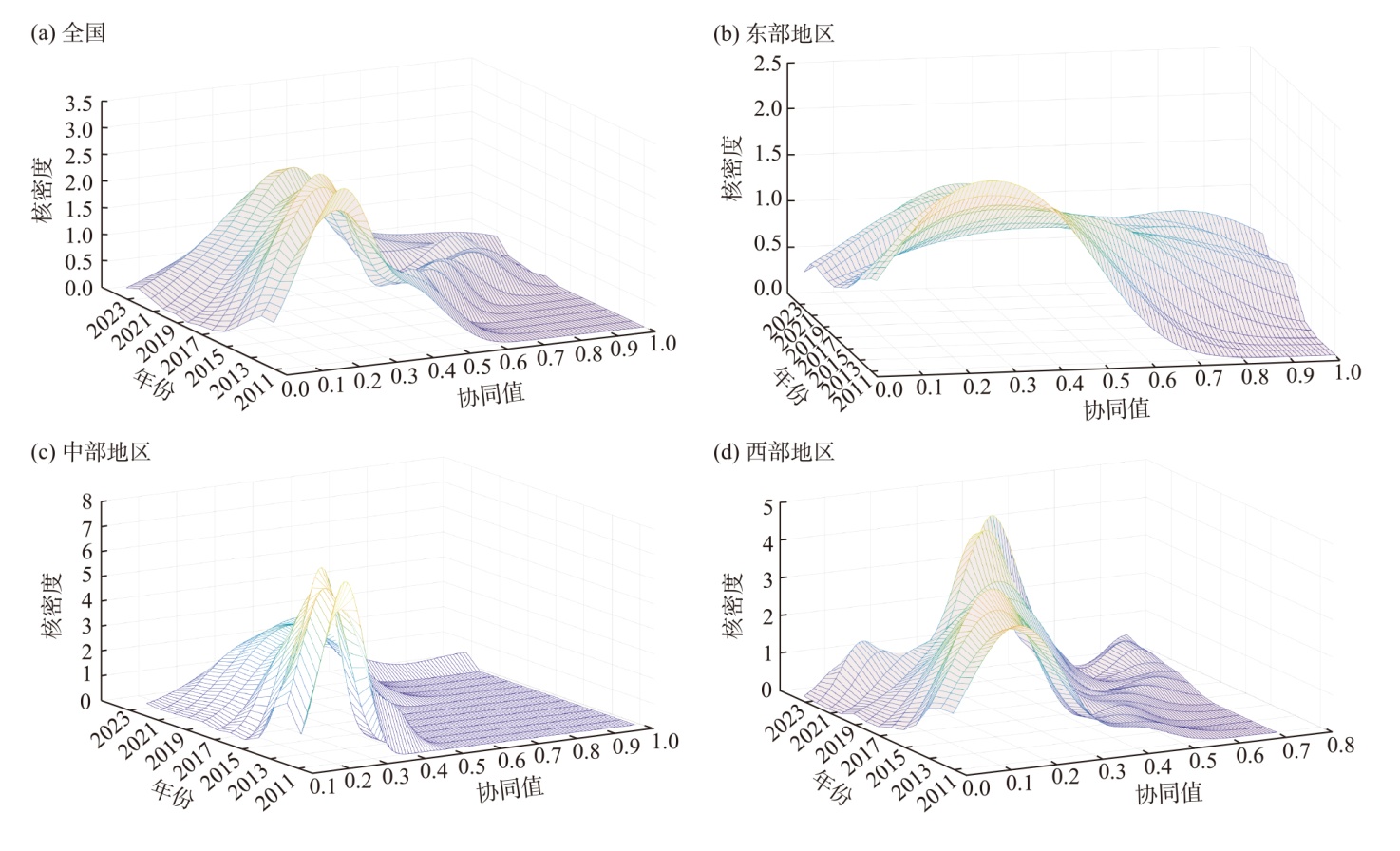
图5
全国及三大地区协同值核密度曲线"
| [1] | 韩文龙, 张瑞生, 赵峰. 新质生产力水平测算与中国经济增长新动能[J]. 数量经济技术经济研究, 2024, 41(6): 5-25. |
| [Han Wenlong, Zhang Ruisheng, Zhao Feng. The measurement of new quality productivity and new driving force of the Chinese economy[J]. Journal of Quantitative & Technical Economics, 2024, 41(6): 5-25.] | |
| [2] |
高帅, 张务伟. 中国新质生产力与新型城镇化的协同演化研究[J]. 干旱区地理, 2025, 48(8): 1445-1456.
doi: 10.12118/j.issn.1000-6060.2025.150 |
|
[Gao Shuai, Zhang Wuwei. Synergistic evolution of new quality productivity and new urbanization in China’s provinces[J]. Arid Land Geography, 2025, 48(8): 1445-1456.]
doi: 10.12118/j.issn.1000-6060.2025.150 |
|
| [3] |
张玉玲, 方玉婷. 中国文旅融合与经济韧性时空特征及互动关系研究[J]. 热带地理, 2024, 44(7): 1329-1340.
doi: 10.13284/j.cnki.rddl.20230676 |
|
[Zhang Yuling, Fang Yuting. Spatial-temporal characteristics and interaction between integration of culture and tourism and economic resilience in China[J]. Tropical Geography, 2024, 44(7): 1329-1340.]
doi: 10.13284/j.cnki.rddl.20230676 |
|
| [4] | 周在霞, 张玉明, 吕强. 中国数字技术创新效率测度与区域差异分析[J]. 科技管理研究, 2025, 45(3): 48-59. |
| [Zhou Zaixia, Zhang Yuming, Lü Qiang. Efficiency measurement and regional difference analysis of digital technology innovation in China[J]. Science and Technology Management Research, 2025, 45(3): 48-59.] | |
| [5] | 肖旭, 洪祥镇. 中国资源错配演化动态、区域差异及收敛特征[J]. 统计与决策, 2024, 40(3): 112-117. |
| [Xiao Xu, Hong Xiangzhen. Evolution dynamics, regional difference and convergence characteristics of resource misallocation in China[J]. Statistics & Decision, 2024, 40(3): 112-117.] | |
| [6] | 张高军, 石碧洋, 刘淑仪. 新质生产力促进旅游业高质量发展的理论框架与实施路径[J/OL]. 旅游科学. [2026-02-10]. https://doi.org/10.16323/j.cnki.lykx.20250610.001. |
| [Zhang Gaojun, Shi Biyang, Liu Shuyi. Theoretical framework and implementation path for promoting high-quality development of the tourism industry through new quality productivity[J/OL]. Tourism Science. [2026-02-10]. https://doi.org/10.16323/j.cnki.lykx.20250610.001.] | |
| [7] | 李柏桐, 李健, 唐燕, 等. 数字经济对工业碳排放绩效的影响——基于异质型环境规制的门槛效应[J]. 中国环境科学, 2024, 44(9): 5263-5274. |
| [Li Baitong, Li Jian, Tang Yan, et al. The impact of digital economy on industrial carbon emission performance: Threshold effect analysis of heterogeneous environmental regulations[J]. China Environmental Science, 2024, 44(9): 5263-5274.] | |
| [8] | 周文, 许凌云. 论新质生产力: 内涵特征与重要着力点[J]. 改革, 2023(10): 1-13. |
| [Zhou Wen, Xu Lingyun. On new quality productivity: Connotative characteristics and important focus[J]. Reform, 2023(10): 1-13.] | |
| [9] | 方敏, 杨虎涛. 政治经济学视域下的新质生产力及其形成发展[J]. 经济研究, 2024, 59(3): 20-28. |
| [Fang Min, Yang Hutao. New quality productive forces and their formation and development from the perspective of political economy[J]. Economic Research Journal, 2024, 59(3): 20-28.] | |
| [10] | 王凯, 刘美伦. 新质生产力与旅游业高质量发展耦合协调关系及影响因素[J]. 湖北民族大学学报(哲学社会科学版), 2025, 43(1): 125-137. |
| [Wang Kai, Liu Meilun. Coupling coordination relationship and influencing factors of new quality productive forces and high quality development of tourism[J]. Journal of Hubei Minzu University (Philosophy and Social Sciences Edition), 2025, 43(1): 125-137.] | |
| [11] | 张劲. 数字基础设施、新质生产力与城乡共同富裕[J]. 技术经济与管理研究, 2024(10): 128-133. |
| [Zhang Jin. Digital infrastructure, new quality productivity and common prosperity of urban and rural areas[J]. Journal of Technical Economics & Management, 2024(10): 128-133.] | |
| [12] | 黄月玲, 汤新怡. 数字新质生产力赋能文旅融合的影响与作用机制研究——基于长三角地区41个城市的实证研究[J]. 大连大学学报, 2025, 46(3): 70-81. |
| [Huang Yueling, Tang Xinyi. On the influence and mechanism of the integration of digital new quality productivity and cultural tourism: An empirical study based on 41 cities in the Yangtze River Delta[J]. Journal of Dalian University, 2025, 46(3): 70-81.] | |
| [13] |
杨丽华, 王伟, 毛伟, 等. 中国海洋新质生产力空间关联网络结构及驱动因素[J]. 经济地理, 2025, 45(4): 13-25.
doi: 10.15957/j.cnki.jjdl.2025.04.002 |
|
[Yang Lihua, Wang Wei, Mao Wei, et al. Structure and driving factors of spatial correlation network of marine new quality productive forces in China[J]. Economic Geography, 2025, 45(4): 13-25.]
doi: 10.15957/j.cnki.jjdl.2025.04.002 |
|
| [14] |
江剑平, 李祎, 何召鹏. 中国新质生产力与高质量就业耦合协调度变化特征[J]. 经济地理, 2025, 45(2): 144-152.
doi: 10.15957/j.cnki.jjdl.2025.02.014 |
|
[Jiang Jianping, Li Yi, He Zhaopeng. Change characteristics of coupling coordination degree between new quality productive forces and high-quality employment in China[J]. Economic Geography, 2025, 45(2): 144-152.]
doi: 10.15957/j.cnki.jjdl.2025.02.014 |
|
| [15] | 杜传忠, 李钰葳. 强化科技创新能力加快形成新质生产力的机理研究[J]. 湖南科技大学学报(社会科学版), 2024, 27(1): 100-109. |
| [Du Chuanzhong, Li Yuwei. Mechanism of strengthening the ability of scientific and technological innovation to accelerate the formation of new quality productivity[J]. Journal of Hunan University of Science and Technology (Social Sciences Edition), 2024, 27(1): 100-109.] | |
| [16] | 魏崇辉. 新质生产力的基本意涵、历史演进与实践路径[J]. 理论与改革, 2023(6): 25-38. |
| [Wei Chonghui. The basic connotation, historical evolution and practical path of new quality productive forces[J]. Theory and Reform, 2023(6): 25-38.] | |
| [17] | 任保平. 以新质生产力赋能中国式现代化的重点与任务[J]. 经济问题, 2024(5): 1-6. |
| [Ren Baoping. Empowering Chinese path to modernization with new quality productivity: Priorities and tasks[J]. Economic Issues, 2024(5): 1-6.] | |
| [18] | 洪银兴. 发展新质生产力建设现代化产业体系[J]. 当代经济研究, 2024(2): 7-9. |
| [Hong Yinxing. Developing new quality productive forces and building a modern industrial system[J]. Contemporary Economic Research, 2024(2): 7-9.] | |
| [19] |
Cheer J M, Reeves K J, Laing J H. Tourism and traditional culture: Land diving in Vanuatu[J]. Annals of Tourism Research, 2013, 43: 435-455.
doi: 10.1016/j.annals.2013.06.005 |
| [20] | Jung T H, Lee H, Chung N, et al. Cross-cultural differences in adopting mobile augmented reality at cultural heritage tourism sites[J]. International Journal of Contemporary Hospitality Management, 2018(3): 1621-1645. |
| [21] | Lexagen M, Ziakas V, Lundberg C. Popular culture tourism: Conceptual foundations and state of play[J]. Journal of Travel Research, 2023(7): 1391-1410. |
| [22] | 钟声宏. 广西民俗文化与民俗旅游开发研究[D]. 桂林: 广西师范大学, 2000. |
| [Zhong Shenghong. A research on the folklore culture and the development of folklore tourismin in Guangxi[D]. Guilin: Guangxi Normal University, 2000.] | |
| [23] | 田志奇. 文旅融合下旅游目的地互联网思维的产品营销及创新[J]. 旅游学刊, 2019, 34(8): 8-10. |
| [Tian Zhiqi. Product marketing and innovation of internet thinking for tourist destinations under the integration of culture and tourism[J]. Tourism Tribune, 2019, 34(8): 8-10.] | |
| [24] | 李任. 深度融合与协同发展: 文旅融合的理论逻辑与实践路径[J]. 理论月刊, 2022, 481(1): 88-96. |
| [Li Ren. Deep integration and coordinated development: Theoretical logic and practical path of cultural and tourism integration[J]. Theory Monthly, 2022, 481(1): 88-96.] | |
| [25] |
龙井然, 杜姗姗, 张景秋. 文旅融合导向下的乡村振兴发展机制与模式[J]. 经济地理, 2021, 41(7): 222-230.
doi: 10.15957/j.cnki.jjdl.2021.07.024 |
|
[Long Jingran, Du Shanshan, Zhang Jingqiu. Mechanism and model of rural vitalization guided by culture-tourism integration[J]. Economic Geography, 2021, 41(7): 222-230.]
doi: 10.15957/j.cnki.jjdl.2021.07.024 |
|
| [26] |
Zimmerhackel J S, Kragt M E, Rogers A A, et al. Evidence of increased economic benefits from shark-diving tourism in the Maldives[J]. Marine Policy, 2019, 100: 21-26.
doi: 10.1016/j.marpol.2018.11.004 |
| [27] |
谢佳亮, 王兆峰. 中国文旅融合发展效率动态演化及影响因素[J]. 经济地理, 2024, 44(5): 212-221.
doi: 10.15957/j.cnki.jjdl.2024.05.022 |
|
[Xie Jialiang, Wang Zhaofeng. Dynamic evolution and influencing factors of culture and tourism integration development efficiency in China[J]. Economic Geography, 2024, 44(5): 212-221.]
doi: 10.15957/j.cnki.jjdl.2024.05.022 |
|
| [28] |
刘安乐, 杨承玥, 明庆忠, 等. 中国文化产业与旅游产业协调态势及其驱动力[J]. 经济地理, 2020, 40(6): 203-213.
doi: 10.15957/j.cnki.jjdl.2020.06.022 |
|
[Liu Anle, Yang Chengyue, Ming Qingzhong, et al. Spatial-temporal coordination and driving forces of provincial culture industryand tourism industry in China[J]. Economic Geography, 2020, 40(6): 203-213.]
doi: 10.15957/j.cnki.jjdl.2020.06.022 |
|
| [29] | 马鑫艺. 文旅融合背景下城市品牌形象传播探究[J]. 当代旅游, 2020, 6: 69-70. |
| [Ma Xinyi. Research on the communication of urban brand image under the background of cultural and tourism integration[J]. Tourism Today, 2020, 6: 69-70.] | |
| [30] | 周彬, 张梦瑶, 钟林生, 等. 内蒙古旅游经济与文化产业耦合协调度测评[J]. 干旱区资源与环境, 2020, 33(4): 203-208. |
| [Zhou Bin, Zhang Mengyao, Zhong Linsheng, et al. Assessment of coupling coordination degree of tourism economy and cultural industry in Inner Mongolia[J]. Journal of Arid Land Resources and Environment, 2020, 33(4): 203-208.] | |
| [31] | 翁钢民, 李凌雁. 中国旅游与文化产业融合发展的耦合协调度及空间相关分析[J]. 经济地理, 2016, 36(1): 178-185. |
| [Weng Gangmin, Li Lingyan. The coupling coordination degree and spatial correlation analysis on integrational development of tourism industry and cultural industry in China[J]. Economic Geography, 2016, 36(1): 178-185.] | |
| [32] | 甘畅, 王凯. 中国文旅融合对碳排放绩效的作用机制与空间效应[J]. 环境科学研究, 2025, 38(4): 736-745. |
| [Gan Chang, Wang Kai. Influence mechanism and spatial effect of culture and tourism integration on carbon emission performance in China[J]. Research of Environmental Science, 2025, 38(4): 736-745.] | |
| [33] | 韩景旺, 李瑞晶. 基于哈肯模型的绿色金融与绿色经济协同演化机制研究[J]. 甘肃社会科学, 2024(6): 218-227. |
| [Han Jingwang, Li Ruijing. Research on the co-evolution mechanism of green finance and green economy based on Haken model[J]. Gansu Social Sciences, 2024(6): 218-227.] | |
| [34] |
杨莎莎, 胡隆. 数字赋能背景下中国城市文旅融合水平测度及其时空特征[J]. 经济地理, 2024, 44(5): 202-211.
doi: 10.15957/j.cnki.jjdl.2024.05.021 |
|
[Yang Shasha, Hu Long. Measurement and spatiotemporal characteristics of cultural and tourism integration level at the prefecture level in the context of digital empowerment[J]. Economic Geography, 2024, 44(5): 202-211.]
doi: 10.15957/j.cnki.jjdl.2024.05.021 |
|
| [35] |
贺小荣, 陈文灏. 中国数字经济与文旅产业融合的协同关系及其影响因素[J]. 热带地理, 2024, 44(7): 1314-1328.
doi: 10.13284/j.cnki.rddl.20230368 |
|
[He Xiaorong, Chen Wenhao. The coordinated relationship between digital economy and culture-tourism industry integration and its influencing factors of China[J]. Tropical Geography, 2024, 44(7): 1314-1328.]
doi: 10.13284/j.cnki.rddl.20230368 |
|
| [36] | 唐健雄, 何庆, 刘雨婧. 长三角城市群城镇化质量与规模的时空错位及影响因素分析[J]. 华中师范大学学报(自然科学版), 2022, 56(4): 703-716. |
| [Tang Jianxiong, He Qing, Liu Yujing. Spatiotemporal dislocation and influencing factors of urbanization quality and scale in the Yangtze River Delta urban agglomeration[J]. Journal of Central China Normal University (Natural Sciences), 2022, 56(4): 703-716.] | |
| [37] | 王生霞, 武芯如. 中国西北地区数字经济与旅游经济韧性的协同演化[J/OL]. 干旱区地理. [2026-02-10]. https://link.cnki.net/urlid/65.1103.X.20251107.1537.003. |
| [Wang Shengxia, Wu Xinru. Synergistic evolution of digital economy and tourism economic resilience in northwest China[J/OL]. Arid Land Geography. [2026-02-10]. https://link.cnki.net/urlid/65.1103.X.20251107.1537.003. ] | |
| [38] | 白芙蓉, 陈楠. 城市创新与低碳发展耦合协调及预测[J]. 生态经济, 2025, 41(6): 87-94, 102. |
| [Bai Furong, Chen Nan. Coupled coordination and forecasting of urban innovation and low carbon development[J]. Ecological Economy, 2025, 41(6): 87-94, 102.] | |
| [39] |
邹易, 蒙吉军. 干旱区绿洲-城镇-荒漠景观演变及生态环境效应[J]. 干旱区研究, 2023, 40(6): 988-1001.
doi: 10.13866/j.azr.2023.06.14 |
|
[Zou Yi, Meng Jijun. Evaluation of an oasis-urban-desert landscape and the related eco-environmental effects in an arid area[J]. Arid Zone Research, 2023, 40(6): 988-1001.]
doi: 10.13866/j.azr.2023.06.14 |
| [1] | 吴佩隆, 谢雪梅, 白凯. 新质生产力对中国省域旅游全要素生产率的影响研究[J]. 干旱区地理, 2026, 49(4): 669-682. |
| [2] | 卢雅焱, 封甜, 杨兆萍, 韩芳, 贾莹莹. 中国省域新质生产力与旅游高质量发展适配度时空演变及障碍因子研究[J]. 干旱区地理, 2026, 49(4): 643-655. |
| [3] | 卢昭东, 秦璐, 马燕. 新质生产力对中国旅游经济高质量发展的影响[J]. 干旱区地理, 2026, 49(3): 451-461. |
| [4] | 石卓达, 杨宏伟. 新质生产力对中国生态旅游高质量发展的影响[J]. 干旱区地理, 2026, 49(3): 440-450. |
| [5] | 刘法建, 梁婉欣, 黄超群, 李松渊, 张博涵. 中国旅游新质生产力发展时空演化特征与驱动因素[J]. 干旱区地理, 2026, 49(3): 429-439. |
| [6] | 周文丽, 武珊珊, 苏鹏. 新质生产力对旅游业高质量发展的影响效应研究——基于黄河流域9省区的实证[J]. 干旱区地理, 2026, 49(2): 224-234. |
| [7] | 白洋, 陈明珠, 周春山, 李亚茹, 唐诚. 中国旅游新质生产力的演化测度与障碍识别[J]. 干旱区地理, 2026, 49(2): 211-223. |
| [8] | 朱怡婷, 梁桂仙, 周春山, 辛龙, 李金雪. 新疆文旅新质生产力发展时空演变特征与驱动因素[J]. 干旱区地理, 2026, 49(1): 128-139. |
| [9] | 彭文英, 赵爽, 单子溢, 陈泽宇. 黄河流域新质生产力生态化水平测度与障碍因子[J]. 干旱区地理, 2025, 48(9): 1648-1659. |
| [10] | 高帅, 张务伟. 中国新质生产力与新型城镇化的协同演化研究[J]. 干旱区地理, 2025, 48(8): 1445-1456. |
| [11] | 徐晓亮, 刘旭义, 关靖云, 杨晶晶, 王明辰, 暴龙飞. 中国西部边疆民族地区文旅融合高质量发展时空演化及驱动因素分析[J]. 干旱区地理, 2024, 47(9): 1596-1605. |
| [12] | 雷振仙, 王坤, 赵松欣. “一带一路”沿线国家交通基础设施对入境旅游的空间效应研究——基于多重距离权重的考察[J]. 干旱区地理, 2023, 46(11): 1915-1926. |
| [13] | 石天戈,张小雷,杜宏茹,蒋小凤. 天山北坡经济带固定资产投资特征及其对城镇集聚的影响[J]. 干旱区地理, 2013, 36(1): 176-185. |
|
||

