干旱区地理 ›› 2026, Vol. 49 ›› Issue (3): 474-483.doi: 10.12118/j.issn.1000-6060.2025.695 cstr: 32274.14.ALG2025695
张博1,2( ), 徐红罡1,3()
收稿日期:2025-10-28
修回日期:2025-12-15
出版日期:2026-03-25
发布日期:2026-03-24
通讯作者:
徐红罡(1967-),女,博士,教授,主要从事旅游地理、旅游可持续发展研究. E-mail: xuhongg@mail.sysu.edu.cn作者简介:张博(1996-),男,博士研究生,主要从事旅游和气候变化研究. E-mail: zhangb335@mail2.sysu.edu.cn
基金资助:
ZHANG Bo1,2(), XU Honggang1,3()
Received:2025-10-28
Revised:2025-12-15
Published:2026-03-25
Online:2026-03-24
摘要:
全球气候变暖形势下,冰川旅游的可持续性正面临严峻挑战。特别是在贫困的高寒地区,目的地旅游业高度嵌入地方经济发展结构,其经济依赖性与生态脆弱性相互叠加,气候变化对其影响更为显著。现有研究多停留于冰川消融对旅游资源影响的表层描述,尚未深入揭示气候变化对冰川旅游中的影响如何演化为风险。通过回顾与综述气候变化对冰川旅游影响和风险的相关科学文献,旨在梳理冰川旅游研究的主要脉络与知识演进,力求对今后研究有所启发。结果表明:(1)现有研究大多聚焦于气候变化对旅游目的地的影响,较少探讨气候变化对客源地与旅游活动之间的影响和互动关系。(2)气候变化不仅会威胁旅游活动的安全性,改变游客行为模式,还对依赖冰川旅游的自然生态、地方经济和社会系统产生不可逆影响。尤其在高山地区,基础设施受损和游客流失加剧了地方系统的脆弱性。(3)通过提出影响-风险分析路径,首先揭示气候变化对旅游条件的改变,再据此探讨风险的形成与演化,以实现从影响识别到风险评估的逻辑递进。(4)未来有必要从旅游系统的客源地视角出发,将游客、目的地管理者与地方社区等不同主体纳入同一分析框架,系统比较其差异化脆弱性与适应能力。同时,通过融合地理学、旅游学和气候科学等多学科交叉方法,进一步揭示气候变化对旅游业供给与需求双侧及其相互作用的复杂影响。
张博, 徐红罡. 气候变化对山地冰川旅游的影响与风险综述[J]. 干旱区地理, 2026, 49(3): 474-483.
ZHANG Bo, XU Honggang. A review of the impacts and risks of climate change on mountain glacier tourism[J]. Arid Land Geography, 2026, 49(3): 474-483.
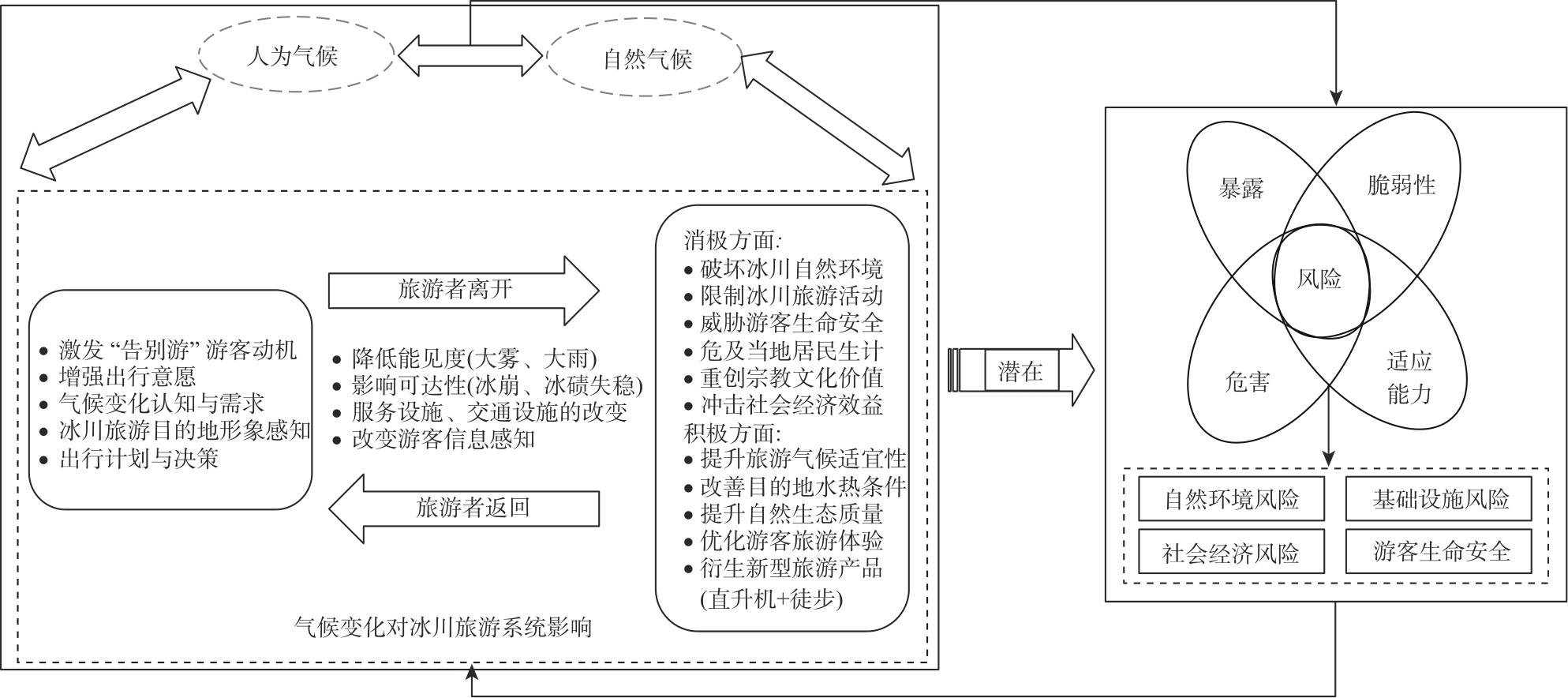
图1
气候变化对冰川旅游的影响和风险"
| [1] |
Emmanuel S, Laura M, Ludovic R, et al. A history of tourism at the Mer de Glace: Adaptations of glacier tourism to glacier fluctuations since 1741[J]. Journal of Mountain Science, 2021, 18(8): 1977-1994.
doi: 10.1007/s11629-021-6723-5 |
| [2] | Yang J P, Wang Y X, Tang F, et al. Ice-and-snow tourism in China: Trends and influencing factors[J]. Humanities and Social Sciences Communications, 2023, 10(1): 826, doi: 10.1057/s41599-023-02288-4. |
| [3] |
杨建平, 哈琳, 康韵婕, 等. “美丽冰冻圈”融入区域发展的途径与模式[J]. 地理学报, 2021, 76(10): 2379-2390.
doi: 10.11821/dlxb202110004 |
|
[Yang Jianping, Ha Lin, Kang Yunjie, et al. Approaches and models of ‘beautiful cryosphere’integration into regional development, China[J]. Acta Geographica Sinica, 2021, 76(10): 2379-2390.]
doi: 10.11821/dlxb202110004 |
|
| [4] |
周蓝月, 王世金, 孙振亓. 世界冰川旅游发展进程及其研究述评[J]. 冰川冻土, 2020, 42(1): 243-253.
doi: 10.7522/j.issn.1000-0240.2019.0040 |
|
[Zhou Lanyue, Wang Shijin, Sun Zhenqi. World’s glacier tourism: Development history and research progress[J]. Journal of Glaciology and Geocryology, 2020, 42(1): 243-253.]
doi: 10.7522/j.issn.1000-0240.2019.0040 |
|
| [5] | Council A. Arctic marine shipping assessment 2009 report[R]. Norway: Arctic Council’s Protection of the Arctic Marine Environment, 2009. |
| [6] | Tang F, Yang J P, Wang Y X, et al. Analysis of the image of global glacier tourism destinations from the perspective of tourists[J]. Land, 2022, 11(10): 1853, doi: 10.3390/land11101853. |
| [7] | Seneviratne S I, Zhang X, Adnan M, et al. Weather and climate extreme events in a changing climate[C]//Masson-Delmotte V, Zhai P, Pirani A, et al. Climate change 2021: The physical science basis. Cambridge: Cambridge University Press, 2021: 1514-1765. |
| [8] |
Roe G H, Baker M B, Herla F. Centennial glacier retreat as categorical evidence of regional climate change[J]. Nature Geoscience, 2017, 10(2): 95-99.
doi: 10.1038/ngeo2863 |
| [9] | 环球网. 冰川消融损失巨大新疆取缔冰川旅游[EB/OL]. [2016-08-30]. https://finance.huanqiu.com/article/9CaKrnJXtmp. |
| [Global Network. Huge losses from glacier melt: Xinjiang bans glacier tourism[EB/OL].[2016-08-30]. https://finance.huanqiu.com/article/9CaKrnJXtmp.] | |
| [10] |
Nepal S K. Mountain tourism and climate change: Implications for the Nepal Himalaya[J]. Nepal Tourism and Development Review, 2013, 1(1): 1-14.
doi: 10.3126/ntdr.v1i1.7367 |
| [11] |
Welling J T, Árnason Þ, Ólafsdottír R. Glacier tourism: A scoping review[J]. Tourism Geographies, 2015, 17(5): 635-662.
doi: 10.1080/14616688.2015.1084529 |
| [12] |
Wang S J, Zhou L Y. Integrated impacts of climate change on glacier tourism[J]. Advances in Climate Change Research, 2019, 10(2): 71-79.
doi: 10.1016/j.accre.2019.06.006 |
| [13] |
刘丽敏, 钟林生, 虞虎. 冰川旅游研究进展与启示[J]. 地理科学进展, 2019, 38(4): 533-545.
doi: 10.18306/dlkxjz.2019.04.006 |
|
[Liu Limin, Zhong Linsheng, Yu Hu. Progress of glacier tourism research and implications[J]. Progress in Geography, 2019, 38(4): 533-545.]
doi: 10.18306/dlkxjz.2019.04.006 |
|
| [14] |
Emmanuel S, Ludovic R, Philip D, et al. A review of melting ice adaptation strategies in the glacier tourism context[J]. Scandinavian Journal of Hospitality and Tourism, 2021, 21(2): 229-246.
doi: 10.1080/15022250.2021.1879670 |
| [15] | 姜彤, 翟建青, 罗勇, 等. 气候变化影响适应和脆弱性评估报告进展: IPCC AR5到AR6的新认知[J]. 大气科学学报, 2022, 45(4): 502-511. |
| [Jiang Tong, Zhai Jianqing, Luo Yong, et al. Understandings of assessment reports on climate changeimpacts, adaptation and vulnerability: Progress from IPCC AR5 to AR6[J]. Acta Meteorologica Sinica, 2022, 45(4): 502-511.] | |
| [16] | Intergovernmental Panel on Climate Change. Climate change 2007: Synthesis report:Contribution of Working Groups I, II and III to the Fourth Assessment Report of the intergovernmental panel on climate change[M]. Geneva: IPCC, 2007: 1-104. |
| [17] |
Liu X L, Yang Z P, Xie T. Development and conservation of glacier tourist resources: A case study of Bogda Glacier Park[J]. Chinese Geographical Science, 2006, 16(4): 365-370.
doi: 10.1007/s11769-006-0365-y |
| [18] |
Furunes T, Mykletun R J. Frozen adventure at risk? A 7-year follow-up study of Norwegian glacier tourism[J]. Scandinavian Journal of Hospitality and Tourism, 2012, 12(4): 324-348.
doi: 10.1080/15022250.2012.748507 |
| [19] | 王世金. 中国冰川旅游资源空间开发与规划[M]. 北京: 科学出版社, 2015. |
| [Wang Shijin. Spatial development and planning of glacier tourism resources in China[M]. Beijing: Science Press, 2015.] | |
| [20] |
Emmanuel S, Mayer M, Sacher P, et al. Visitors’ motivations to engage in glacier tourism in the European Alps: comparison of six sites in France, Switzerland, and Austria[J]. Journal of Sustainable Tourism, 2023, 31(6): 1373-1393.
doi: 10.1080/09669582.2022.2044833 |
| [21] |
Abrahams Z, Hoogendoorn G, Fitchett J M. Glacier tourism and tourist reviews: An experiential engagement with the concept of “last chance tourism”[J]. Scandinavian Journal of Hospitality and Tourism, 2022, 22(1): 1-14.
doi: 10.1080/15022250.2021.1974545 |
| [22] |
Bury J T, Mark B G, Mckenzie J M, et al. Glacier recession and human vulnerability in the Yanamarey Watershed of the Cordillera Blanca, Peru[J]. Climatic Change, 2011, 105(1-2): 179-206.
doi: 10.1007/s10584-010-9870-1 |
| [23] |
Hall C M, Scott D, Gössling S. Pandemics, transformations and tourism: Be careful what you wish for[J]. Tourism Geographies, 2020, 22(3): 577-598.
doi: 10.1080/14616688.2020.1759131 |
| [24] |
Espiner S, Becken S. Tourist towns on the edge: Conceptualising vulnerability and resilience in a protected area tourism system[J]. Journal of Sustainable Tourism, 2014, 22(4): 646-665.
doi: 10.1080/09669582.2013.855222 |
| [25] |
王世金, 焦世泰, 牛贺文. 中国冰川旅游资源开发模式与对策研究[J]. 自然资源学报, 2012, 27(8): 1276-1285.
doi: 10.11849/zrzyxb.2012.08.002 |
|
[Wang Shijin, Jiao Shitai, Niu Hewen. Patterns and strategies of glacier tourism resources development in China[J]. Journal of Natural Resources, 2012, 27(8): 1276-1285.]
doi: 10.11849/zrzyxb.2012.08.002 |
|
| [26] |
Garavaglia V, Diolaiuti G, Smiraglia C, et al. Evaluating tourist perception of environmental changes as a contribution to managing natural resources in glacierized areas: A case study of the Forni glacier (Stelvio National Park, Italian Alps)[J]. Environmental Management, 2012, 50(6): 1125-1138.
doi: 10.1007/s00267-012-9948-9 pmid: 23052477 |
| [27] |
Bollati I, Smiraglia C, Pelfini M. Assessment and selection of geomorphosites and trails in the miage glacier area (western Italian Alps)[J]. Environmental Management, 2013, 51(4): 951-967.
doi: 10.1007/s00267-012-9995-2 pmid: 23275148 |
| [28] | Pralong J. A proposal for a classification of geomorphological sites depending on their tourist value[J]. Jean-Pierre Pralong, 2005, 1(18): 315-321. |
| [29] |
Navarro-Drazich D, Christel L G, Gerique A, et al. Climate change and tourism in south and central America[J]. Journal of Sustainable Tourism, 2023, 32(9): 1876-1892.
doi: 10.1080/09669582.2023.2210783 |
| [30] |
Wang S J, He Y Q, Song X D. Impacts of climate warming on alpine glacier tourism and adaptive measures: A case study of Baishui Glacier No. 1 in Yulong Snow Mountain, southwestern China[J]. Journal of Earth Science, 2010, 21(2): 166-178.
doi: 10.1007/s12583-010-0015-2 |
| [31] | 崔之久. 退缩的冰川[J]. 大自然探索, 2005(3): 12-14. |
| [Cui Zhijiu. Retreating glaciers[J]. Exploration of Nature, 2005(3): 12-14.] | |
| [32] | 王世金, 何元庆, 和献中, 等. 我国海洋型冰川旅游资源的保护性开发研究——以丽江市玉龙雪山景区为例[J]. 云南师范大学学报(哲学社会科学版), 2008(6): 38-43. |
| [Wang Shijin, He Yuanqing, He Xianzhong, et al. Tourism-resource protection and development in a typical temperate glacier region in China: A case study of Yulong Snow Mountain scenic region[J]. Journal of Yunnan Normal University (Philosophy and Social Sciences Edition), 2008(6): 38-43.] | |
| [33] |
Beza B B. The aesthetic value of a mountain landscape: A study of the Mt. Everest Trek[J]. Landscape and Urban Planning, 2010, 97(4): 306-317.
doi: 10.1016/j.landurbplan.2010.07.003 |
| [34] |
Tinti S, Maramai A, Cerutti A V, et al. The Miage glacier in the Valley of Aosta (western Alps, Italy) and the extraordinary detachment which occurred on August 9, 1996[J]. Physics and Chemistry of the Earth, Part A: Solid Earth and Geodesy, 1999, 24(2): 157-161.
doi: 10.1016/S1464-1895(99)00012-5 |
| [35] |
Ritter F, Fiebig M, Muhar A. Impacts of global warming on mountaineering: A classification of phenomena affecting the alpine trail network[J]. Mountain Research and Development, 2012, 32(1): 4-15.
doi: 10.1659/MRD-JOURNAL-D-11-00036.1 |
| [36] |
Purdie H, Gomez C, Espiner S. Glacier recession and the changing rockfall hazard: Implications for glacier tourism[J]. New Zealand Geographer, 2015, 71(3): 189-202.
doi: 10.1111/nzg.2015.71.issue-3 |
| [37] |
Aspinall A, Cukier J, Doberstein B. Quality of life assessments and social sustainability: Ski tourism development in Invermere, British Columbia[J]. Journal of Environmental Assessment Policy and Management, 2011, 13(2): 179-201.
doi: 10.1142/S1464333211003845 |
| [38] | Scott D, Hall C M, Gössling S. Tourism and climate change: Impacts, adaptation and mitigation[M]. New York: Routledge, 2012:1-464. |
| [39] |
Adger W N. Vulnerability[J]. Global Environmental Change, 2006, 16(3): 268-281.
doi: 10.1016/j.gloenvcha.2006.02.006 |
| [40] |
Souza D J, Dawson J, Groulx M. Last chance tourism: A decade review of a case study on Churchill, Manitoba’s polar bear viewing industry[J]. Journal of Sustainable Tourism, 2023, 31(1): 14-31.
doi: 10.1080/09669582.2021.1910828 |
| [41] | Emmanuel S. Glacier tourism without ice: Envisioning future adaptations in a melting world[J]. Frontiers in Human Dynamics, 2023, 5: 1137551, doi: 10.3389/fhumd.2023.1137551. |
| [42] |
Emmanuel S, Ravanel L. Last chance to see the ice: Visitor motivation at Montenvers-Mer-de-Glace, French Alps[J]. Tourism Geographies, 2023, 25(1): 72-94.
doi: 10.1080/14616688.2020.1833971 |
| [43] |
Emmanuel S, Ravanel L, Deline P. Does witnessing the effects of climate change on glacial landscapes increase pro-environmental behaviour intentions? An empirical study of a last-chance destination[J]. Current Issues in Tourism, 2023, 26(6): 922-940.
doi: 10.1080/13683500.2022.2044291 |
| [44] |
Stewart E J, Wilson J, Espiner S, et al. Implications of climate change for glacier tourism[J]. Tourism Geographies, 2016, 18(4): 377-398.
doi: 10.1080/14616688.2016.1198416 |
| [45] |
Purdie H. Glacier retreat and tourism: Insights from New Zealand[J]. Mountain Research and Development, 2013, 33(4): 463-472.
doi: 10.1659/MRD-JOURNAL-D-12-00073.1 |
| [46] |
王灵恩, 韩禹文, 高俊, 等. 气候变化背景下青藏高原地区游客决策与体验分析[J]. 地理研究, 2019, 38(9): 2314-2329.
doi: 10.11821/dlyj020180665 |
| [Wang Lingen, Han Yuwen, Gao Jun, et al. Tourists’ decision-making and experience in the Qinghai-Tibet Plateau in the context of climate change[J]. Geographical Research, 2019, 38(9): 2314-2329.] | |
| [47] |
石磊, 黄晓清, 尼玛吉, 等. 西藏自治区旅游气候适应性分析[J]. 冰川冻土, 2015, 37(5): 1412-1419.
doi: 10.7522/j.isnn.1000-0240.2015.0156 |
| [Shi Lei, Huang Xiaoqing, Nima Ji, et al. Study of the tourism climate adaptability in Xizang Autonomous Region[J]. Journal of Glaciology and Geocryology, 2015, 37(5): 1412-1419.] | |
| [48] | 李磊磊, 范建容, 张茜彧, 等. 西藏自治区植被与气候变化的关系[J]. 山地学报, 2017, 35(1): 9-15. |
| [Li Leilei, Fan Jianrong, Zhang Qianyu, et al. Study of the tourism climate adaptability in Tibet Autonomous Region[J]. Journal of Mountain Science, 2017, 35(1): 9-15.] | |
| [49] |
Allen S K, Cox S C, Owens I F. Rock avalanches and other landslides in the central southern Alps of New Zealand: A regional study considering possible climate change impacts[J]. Landslides, 2011, 8(1): 33-48.
doi: 10.1007/s10346-010-0222-z |
| [50] |
Allen S K, Gruber S, Owens I F. Exploring steep bedrock permafrost and its relationship with recent slope failures in the southern Alps of New Zealand[J]. Permafrost and Periglacial Processes, 2009, 20(4): 345-356.
doi: 10.1002/ppp.v20:4 |
| [51] |
Elsasser H, Bürki R. Climate change as a threat to tourism in the Alps[J]. Climate Research, 2005, 20: 253-257.
doi: 10.3354/cr020253 |
| [52] |
Purdie H L, Brook M S, Fuller I C, et al. Seasonal variability in velocity and ablation of Te Moeka o Tuawe/Fox glacier, south westland, New Zealand[J]. New Zealand Geographer, 2008, 64(1): 5-19.
doi: 10.1111/nzg.2008.64.issue-1 |
| [53] |
Denstadli J M, Jacobsen J K S, Lohmann M. Tourist perceptions of summer weather in Scandinavia[J]. Annals of Tourism Research, 2011, 38(3): 920-940.
doi: 10.1016/j.annals.2011.01.005 |
| [54] | Scott D. Sustainable tourism and the grand challenge of climate change[J]. Sustainability, 2021, 13(4): 1966, doi: 10.3390/su130-41966. |
| [55] | Thomas G. Landslide hazard and risk: Issues, concepts and approach[M]. England: Wiley, 2006: 1-40. |
| [56] | 高江波, 焦珂伟, 吴绍洪, 等. 气候变化影响与风险研究的理论范式和方法体系[J]. 生态学报, 2017, 37(7): 2169-2178. |
| [Gao Jiangbo, Jiao Kewei, Wu Shaohong, et al. Theory paradigm and a methods system for research on climate change impacts and risks[J]. Acta Ecologica Sinica, 2017, 37(7): 2169-2178.] | |
| [57] |
Pröbstl-Haider U, Dabrowska K, Haider W. Risk perception and preferences of mountain tourists in light of glacial retreat and permafrost degradation in the Austrian Alps[J]. Journal of Outdoor Recreation and Tourism, 2016, 13: 66-78.
doi: 10.1016/j.jort.2016.02.002 |
| [58] |
Emmanuel S, Ludovic R, Philippe B, et al. Glacier tourism and climate change: Effects, adaptations, and perspectives in the Alps[J]. Regional Environmental Change, 2021, 21: 120, doi: 10.1007/s10113-021-01849-0.
pmid: 34776785 |
| [59] | Kane M J, Tucker H. Adventure tourism the freedom to play with reality[J]. Tourist studies, 2004, 3(4): 217-234. |
| [60] |
蔡兴冉, 李忠勤, 张慧, 等. 中国天山冰川变化脆弱性研究[J]. 地理学报, 2021, 76(9): 2253-2268.
doi: 10.11821/dlxb202109015 |
|
[Cai Xingran, Li Zhongqin, Zhang Hui, et al. Vulnerability of glacier change in Chinese Tianshan Mountains[J]. Acta Geographica Sinica, 2021, 76(9): 2253-2268.]
doi: 10.11821/dlxb202109015 |
|
| [61] |
Barnes M L, Wang P, Cinner J E, et al. Social determinants of adaptive and transformative responses to climate change[J]. Nature Climate Change, 2020, 10(9): 823-828.
doi: 10.1038/s41558-020-0871-4 |
| [62] | Welling J. Glacier tourism and climate change adaptation in Iceland[D]. Iceland: School of Engineering and Natural Sciences University of Iceland, 2020. |
| [63] | 丁杰, 曹左男, 胡国铮, 等. IPCC第七次评估报告第二工作组气候变化影响、适应与脆弱性大纲解读及启示[J]. 气候变化研究进展, 2025, 21(4): 484-493. |
| [Ding Jie, Cao Zuonan, Hu Guozheng, et al. Climate change impacts, adaptation and vulnerability and implications in Working Group Ⅱ of the IPCC Seventh Assessment Report[J]. Advances in Climate Change Research, 2025, 21(4): 484-493.] | |
| [64] | Ngxongo N A. The impact of climate change on visitor destination selection: A case study of the central Drakensberg Region in KwaZulu-Natal[J]. Journal of Disaster Risk Studies, 2021, 13(1): 1161, doi: 10.4102/jamba.v13i1.1161. |
| [65] | Selje T, Schmid L A, Heinz B. Community-based adaptation to climate change: Core issues and implications for practical implementations[J]. Climate, 2024, 12(10): 155, doi: 10.3390/cli12100155. |
| [66] |
冀琴, 张翠兰, 丁悦凯, 等. 基于多源遥感数据的珠峰自然保护区冰川监测研究[J]. 干旱区地理, 2023, 46(10): 1591-1601.
doi: 10.12118/j.issn.1000-6060.2022.624 |
|
[Ji Qin, Zhang Cuilan, Ding Yuekai, et al. Glacier monitoring in Qomolangma Nature Reserve based on multi-source remote sensing data[J]. Arid Land Geography, 2023, 46(10): 1591-1601.]
doi: 10.12118/j.issn.1000-6060.2022.624 |
| [1] | 周灵敏, 伊木然·库鲁万, 玉素甫江·如素力, 吴海智, 娜扎开提·尼加提. 中国西北干旱区大型湖泊湖冰物候时空差异及影响因素[J]. 干旱区地理, 2026, 49(3): 484-495. |
| [2] | 陈兵, 王福涛, 王世新, 顾星光, 朱金峰. 中国和不丹跨境流域冰湖变化特征及驱动因素[J]. 干旱区地理, 2026, 49(3): 496-507. |
| [3] | 屠正伟, 张沛, 张中华. 银川都市圈乡村“三生空间”冲突格局演变特征及影响因素[J]. 干旱区地理, 2026, 49(3): 594-606. |
| [4] | 张嘉伟, 裴婷婷, 陈英, 谢保鹏. 大食物观下甘肃省粮食和重要农产品供给安全评价及影响因素[J]. 干旱区地理, 2026, 49(3): 619-630. |
| [5] | 魏丽蓉, 程占红, 石烨, 张玉尧, 王紫彦, 牛莉芹. 黄河流域旅游生态安全的演化特征和影响因素分析——基于社会网络分析视角[J]. 干旱区地理, 2026, 49(2): 245-254. |
| [6] | 曹晓云, 周秉荣, 雷春苗, 刘致远, 史飞飞, 颜玉倩. 基于遥感监测的1980—2020年三江源雪深时空变化与气候归因研究[J]. 干旱区地理, 2026, 49(2): 356-368. |
| [7] | 刘昊, 李福莲, 汪圣. 中国居家社区养老与机构养老耦合协调格局及影响因素研究[J]. 干旱区地理, 2026, 49(2): 381-392. |
| [8] | 杨迪, 邹进, 马晓飞, 张珣, 周锐, 刘艳春, 石金莲. 体育旅游资源空间分布特征及可持续发展研究——以新疆为例[J]. 干旱区地理, 2026, 49(1): 140-150. |
| [9] | 戢晓峰, 李子歆, 曹瑞, 李武, 陈方. 地级市尺度下中国物流企业空间格局演化特征及影响因素[J]. 干旱区地理, 2026, 49(1): 176-185. |
| [10] | 王雅俊, 王一峰. 宁夏易地扶贫搬迁安置区融入新型城镇化效果评价及影响因素[J]. 干旱区地理, 2026, 49(1): 186-197. |
| [11] | 李佳琳, 李新虎, 王弘超, 崔萌萌, 郭语博, 靳浩东, 任萧萧. 不同影响因素下盐结皮蒸发阻力定量模拟研究[J]. 干旱区地理, 2026, 49(1): 80-93. |
| [12] | 白洋, 唐诚, 陈明珠, 彭利, 赵平. 中国“生态-旅游-文化”系统协调发展与影响路径[J]. 干旱区地理, 2026, 49(1): 94-105. |
| [13] | 黄静, 李婷, 李朋飞, Altansukh OCHIR, 杨梅焕, 王涛, 李莎. 2000—2020年蒙古国植被净初级生产力时空演变特征及其影响因素[J]. 干旱区地理, 2025, 48(9): 1541-1554. |
| [14] | 张飞, 李建, 李慧融, 谢涛, 张雪红, 王超, 白淑英, 宋正姗. 2001—2024年锡林郭勒盟草原净初级生产力时空特征及对影响因子的响应[J]. 干旱区地理, 2025, 48(9): 1555-1566. |
| [15] | 李文华, 李生宇, 徐新文, 苗佳敏, 吕振涛. 基于MaxEnt模型预测气候变化下准噶尔沙蒿(Artemisia songarica)在新疆的潜在分布[J]. 干旱区地理, 2025, 48(9): 1578-1588. |
|
||

