干旱区地理 ›› 2026, Vol. 49 ›› Issue (11): 2361-2375.doi: 10.12118/j.issn.1000-6060.2025.755 cstr: 32274.14.ALG2025755
李雨涵( ), 周忠学(), 王妍, 如克亚·热合曼
收稿日期:2025-12-09
修回日期:2026-02-01
出版日期:2026-11-25
发布日期:2026-11-13
通讯作者:
周忠学(1972-),男,博士,教授,主要从事区域发展、城市化与生态系统服务等方面的研究. E-mail: zhouzhx@snnu.edu.cn作者简介:李雨涵(2000-),女,硕士研究生,主要从事生态系统服务与人类福祉等方面的研究. E-mail: lyhan@snnu.edu.cn论文构思:李雨涵、周忠学;数据管理:李雨涵;规范分析:李雨涵;获取资助:周忠学;调查研究:李雨涵;方法设计:周忠学、如克亚・热合曼;项目管理:周忠学;提供资源:周忠学;软件编程:李雨涵、王妍;监督指导:周忠学;验证复核:周忠学;可视化:李雨涵、王妍;初稿撰写:李雨涵;修订编辑:周忠学。
基金资助:
LI Yuhan(), ZHOU Zhongxue(), WANG Yan, Rukeya REHEMAN
Received:2025-12-09
Revised:2026-02-01
Published:2026-11-25
Online:2026-11-13
摘要:
人类福祉的实现与生态系统服务供需匹配程度密切相关。探究生态系统服务供需关系对人类福祉的影响路径,可为区域生态保护与民生改善的协同推进提供理论依据与科学支撑。以关中平原城市群区县为研究单元,采用生物物理模型量化生境质量、食物生产、产水、固碳、PM2.5净化、休闲娱乐等生态系统服务供需状况,构建人类福祉评价体系,基于偏最小二乘结构方程模型(PLS-SEM),分析了生态系统服务供需对人类福祉的影响路径。结果表明:(1)生态系统服务供需时空分异特征显著,除生境质量供给下降外,其余服务供给整体提升;需求层面除PM2.5净化外普遍增长。平原区与谷地区成为供给退化与需求增加的集中区域。(2)生态系统服务供需空间错配显著,呈现“中心-外围”格局,平原区、谷地区的城市建成区为服务赤字区,山地区及黄土丘陵沟壑区为多类服务盈余区。(3)人类福祉总体显著提升但空间差异明显,平原区形成核心优势区,西安的中心辐射效应突出。(4)生态系统服务对人类福祉的影响路径存在层级特征,支持服务是各类服务供给的重要基础。(5)不同区域主导人类福祉的生态系统服务类型及其作用方向存在显著差异,在谷地区、黄土丘陵沟壑区和山地区,供给与调节服务供需匹配对人类福祉具有正向驱动作用,而在谷地区和平原区的支持服务供需匹配关系,以及在平原区和山地区的支持与供给服务的供给水平等则对人类福祉表现出一定抑制效应。研究结果为关中平原城市群生态系统服务供需调控与人类福祉协同提升提供科学依据。
李雨涵, 周忠学, 王妍, 如克亚·热合曼. 关中平原城市群生态系统服务供需对人类福祉的影响路径研究[J]. 干旱区地理, 2026, 49(11): 2361-2375.
LI Yuhan, ZHOU Zhongxue, WANG Yan, Rukeya REHEMAN. Impact pathways of ecosystem service supply and demand on human well-being in the Guanzhong Plain urban agglomeration[J]. Arid Land Geography, 2026, 49(11): 2361-2375.
图1
研究区概况"
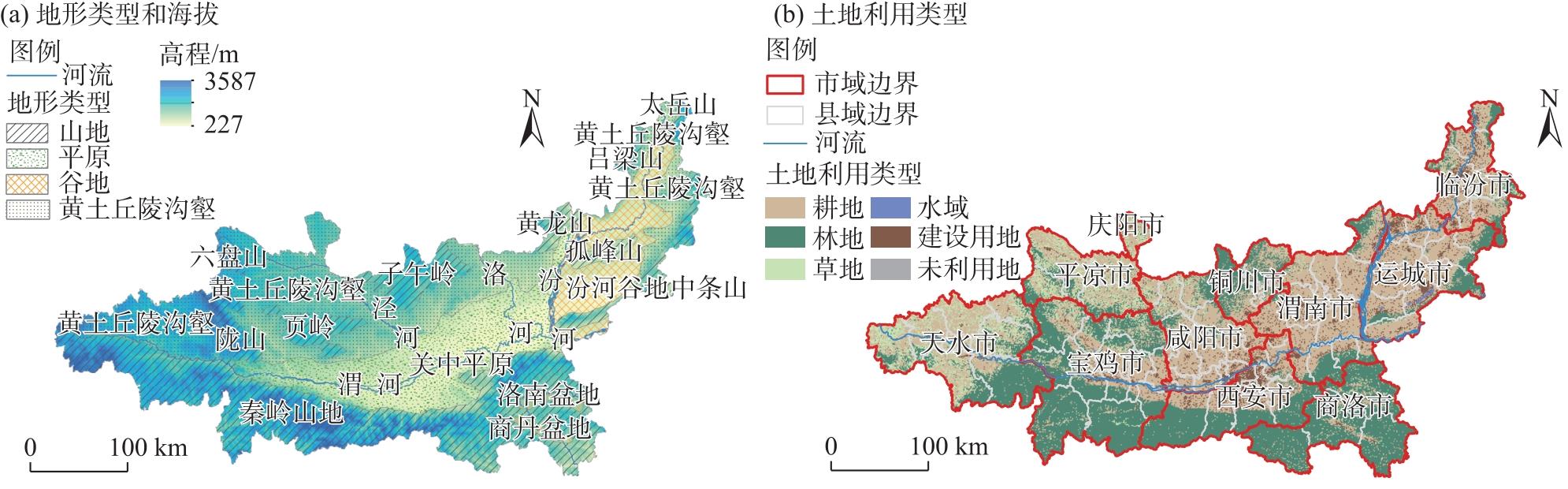

表1
数据来源"
| 数据类型 | 数据名称 | 分辨率 | 年份 | 数据源 |
|---|---|---|---|---|
| 环境数据 | 土地利用数据 | 30 m | 2000—2022 | 遥感信息处理研究所( |
| 数字高程模型(DEM) | 1 km | 2000—2022 | 地理空间数据云( | |
| 行政边界 | - | 2022 | 资源环境科学与数据平台( | |
| CO2排放量 | 1 km | 2000—2022 | 全球环境研究中心( 全球大气研究排放数据库( | |
| PM2.5浓度 | 1 km | 2000—2022 | 广域环境智能实验室( | |
| 气象数据(年平均降水量、年平均气温、年平均蒸散发量) | 1 km | 2000—2022 | 国家地理系统科学数据中心( | |
| 叶面积指数(LAI) | 500 m | 2003—2022 | 美国国家航空航天局( | |
| 归一化植被指数(NDVI) | 1 km | 2000—2022 | 美国国家航空航天局( | |
| 净初级生产力(NPP) | 1 km | 2000—2022 | 美国国家航空航天局( | |
| 土壤类型 | 1 km | 2000—2022 | 国际应用系统分析研究所( | |
| 路网 | - | 2000—2022 | 全国地理信息资源目录服务系统( | |
| 人口数据 | 人口密度 | 1 km | 2000—2022 | 美国橡树岭国家实验室( |
| 社会经济数据 | 农业、医疗、教育等数据 | 区县 | 2000—2022 | 各市、区县级逐年统计年鉴、国民经济和社会发展统计公报、水资源公报 |
表2
城市群人类福祉评估体系"
| 维度层 | 功能层 | 功能层权重 | 对应可持续发展目标 | 本地化指标 | 指标性质 | 指标层权重 |
|---|---|---|---|---|---|---|
| 收入与物质福祉 | 基本收入 | 0.340 | SDG1.1 | 城镇居民人均可支配收入/元·人-1 | + | 0.226 |
| SDG1.1 | 农村居民人均可支配收入/元·人-1 | + | 0.293 | |||
| SDG8.1 | 人均GDP/元·人-1 | + | 0.482 | |||
| 基本物质 | 0.660 | SDG2.1 | 人均粮食产量/t·人-1 | + | 0.029 | |
| SDG2.1 | 人均水果产量/t·人-1 | + | 0.112 | |||
| SDG2.1 | 人均蔬菜总产量/t·人-1 | + | 0.113 | |||
| SDG2.1 | 人均肉类总产量/t·人-1 | + | 0.050 | |||
| SDG11.1 | 综合人均居住面积/m2·人-1 | + | 0.020 | |||
| SDG2.a | 每公顷农业机械平均功率/kW·hm-2 | + | 0.384 | |||
| SDG7.1 | 燃气普及率/% | + | 0.013 | |||
| SDG6.1 | 用水普及率/% | + | 0.005 | |||
| SDG6.1 | 人均生活用水量/t·人-1 | + | 0.017 | |||
| SDG9.1 | 铁路密度/m·km-2 | + | 0.155 | |||
| SDG9.1 | 高速公路密度/m·km-2 | + | 0.102 | |||
| 安全与健康福祉 | 安全 | 0.623 | SDG2.4 | 人均耕地面积/hm2·人-1 | + | 0.121 |
| SDG6.2 | 人均水资源供给量/t·人-1 | + | 0.344 | |||
| SDG6.3 | 污水处理率/% | + | 0.075 | |||
| SDG12.5 | 生活垃圾无害化处理率/% | + | 0.034 | |||
| SDG11.6 | PM2.5浓度/μg·m-3 | - | 0.061 | |||
| SDG15.1 | 森林覆盖率/% | + | 0.332 | |||
| SDG3.6 | 交通事故数/起 | - | 0.033 | |||
| 健康 | 0.377 | SDG3.b | 万人拥有床位数/床 | + | 0.433 | |
| SDG3.c | 万人拥有卫生技术人员数/人 | + | 0.567 | |||
| 社会与文化福祉 | 社会关系 | 0.098 | SDG8.5 | 城镇登记失业率/% | - | 0.068 |
| SDG10.4 | 城乡收入差距 | - | 0.002 | |||
| SDG1.3 | 社会保障和就业支出占比/% | + | 0.354 | |||
| SDG11.7 | 万人拥有公园数/个 | + | 0.464 | |||
| SDG11.7 | 人均公园绿地面积/m2·人-1 | + | 0.067 | |||
| SDG15.1 | 建城区绿化覆盖率/% | + | 0.045 | |||
| 文化 | 0.338 | SDG4.c | 普通小学每位教师负担学生数/人 | - | 0.007 | |
| SDG4.c | 普通中学每位教师负担学生数/人 | - | 0.001 | |||
| SDG4.1 | 初中升高中升学率/% | + | 0.044 | |||
| SDG4.3 | 每万人拥有高等学校在校学生数/人 | + | 0.411 | |||
| SDG4.7 | 万人拥有公共图书馆数量/个 | + | 0.363 | |||
| SDG4.7 | 每百人公共图书馆藏书/册 | + | 0.175 | |||
| 科技 | 0.564 | SDG9.5 | 研究人员数/人 | + | 0.234 | |
| SDG9.5 | R&D经费支出/103元 | + | 0.366 | |||
| SDG9.5 | 专利授权数/个 | + | 0.400 |
表3
2000—2022年单位面积生态系统服务供给"
| 生态系统服务 | 2000年 | 2005年 | 2010年 | 2015年 | 2022年 |
|---|---|---|---|---|---|
| 生境质量 | 0.60 | 0.59 | 0.59 | 0.59 | 0.59 |
| 产水/102 mm | 3.8 | 4.0 | 4.3 | 3.9 | 4.2 |
| 食物生产/102 t | 1.7 | 2.1 | 3.1 | 3.9 | 3.8 |
| 固碳/106 t | 5.4 | 6.9 | 7.7 | 8.8 | 8.8 |
| PM2.5净化/103 kg | 3.4 | 4.6 | 4.8 | 4.6 | 3.7 |
| 休闲娱乐/105 m2 | 4.6 | 4.5 | 4.7 | 4.7 | 4.7 |
图2
2000—2022年关中平原城市群生态系统服务供给时空动态"
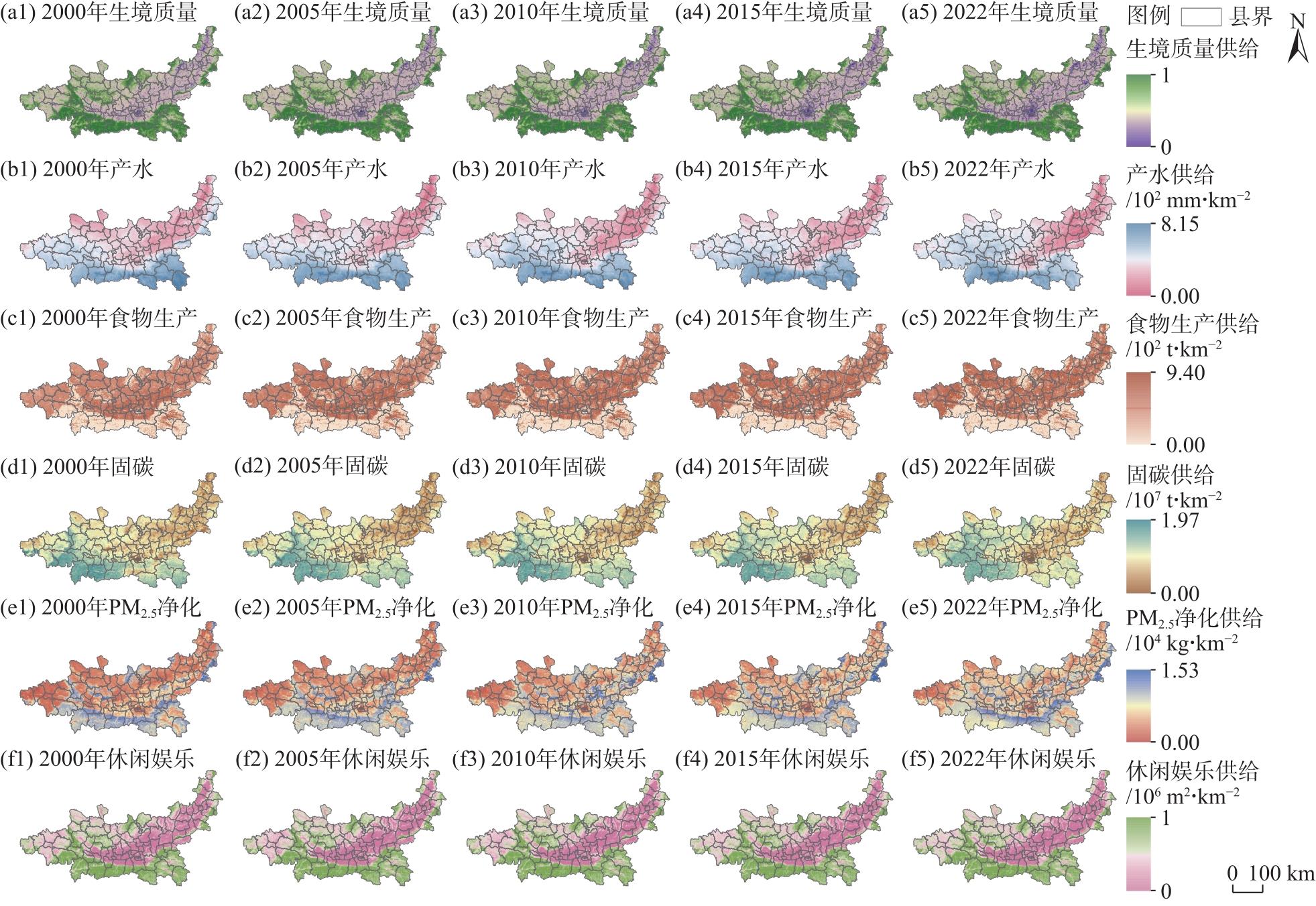
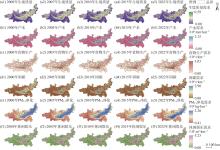
图3
2000—2022年关中平原城市群生态系统服务需求时空动态"
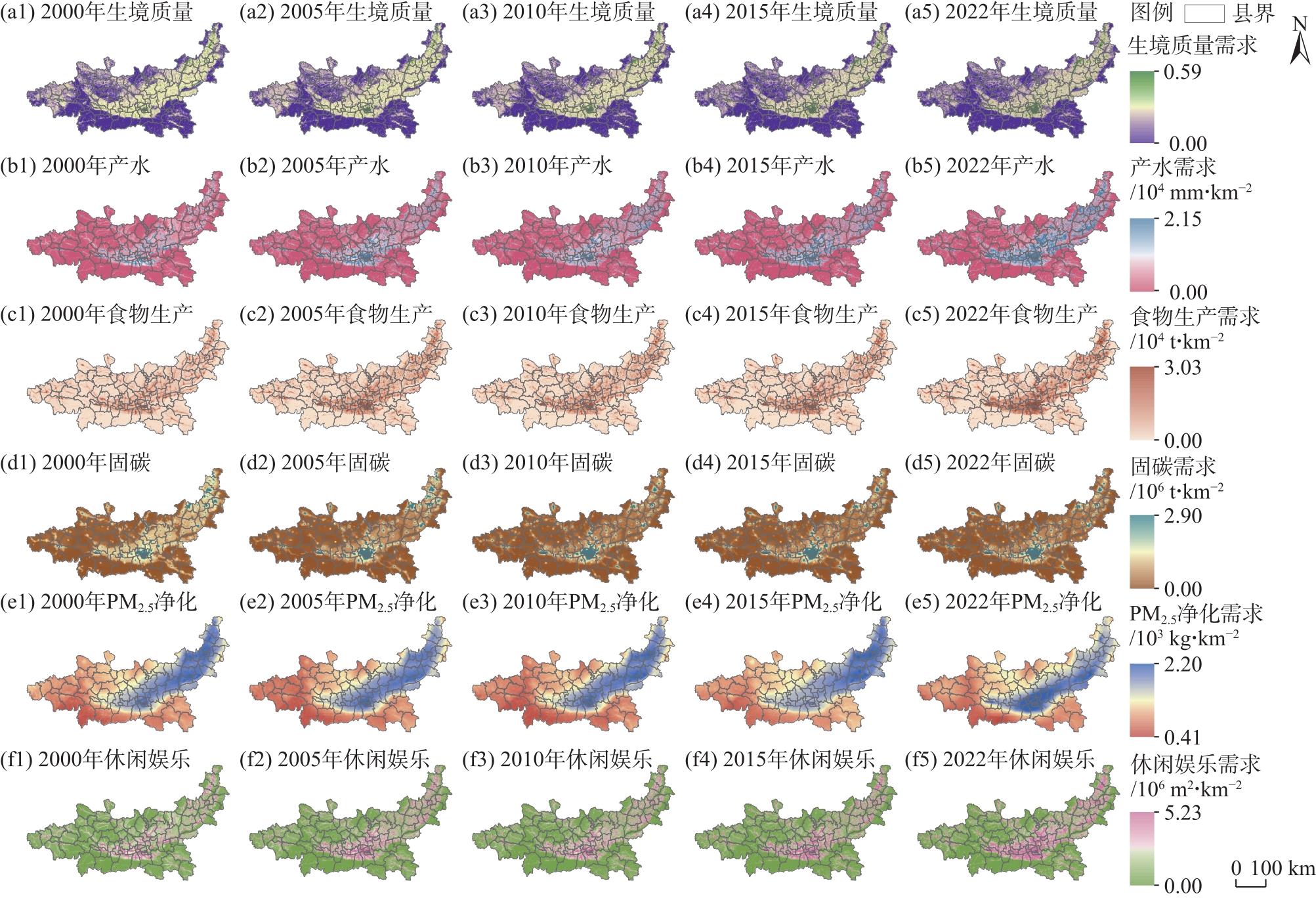
表4
2000—2022年单位面积生态系统服务需求"
| 生态系统服务 | 2000年 | 2005年 | 2010年 | 2015年 | 2022年 |
|---|---|---|---|---|---|
| 生境质量 | 0.13 | 0.13 | 0.14 | 0.14 | 0.14 |
| 产水/10 mm | 4.3 | 4.4 | 5.2 | 5.5 | 5.8 |
| 食物生产/10 t | 8.1 | 7.7 | 7.3 | 7.6 | 8.8 |
| 固碳/102 t | 2.6 | 3.8 | 5.2 | 6.0 | 7.2 |
| PM2.5净化/103 kg | 1.1 | 1.3 | 1.2 | 1.1 | 0.7 |
| 休闲娱乐/104 m2 | 1.4 | 1.5 | 1.5 | 1.5 | 1.6 |
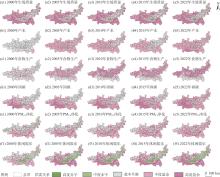
图4
2000—2022年关中平原城市群生态系统服务供需关系时空动态"
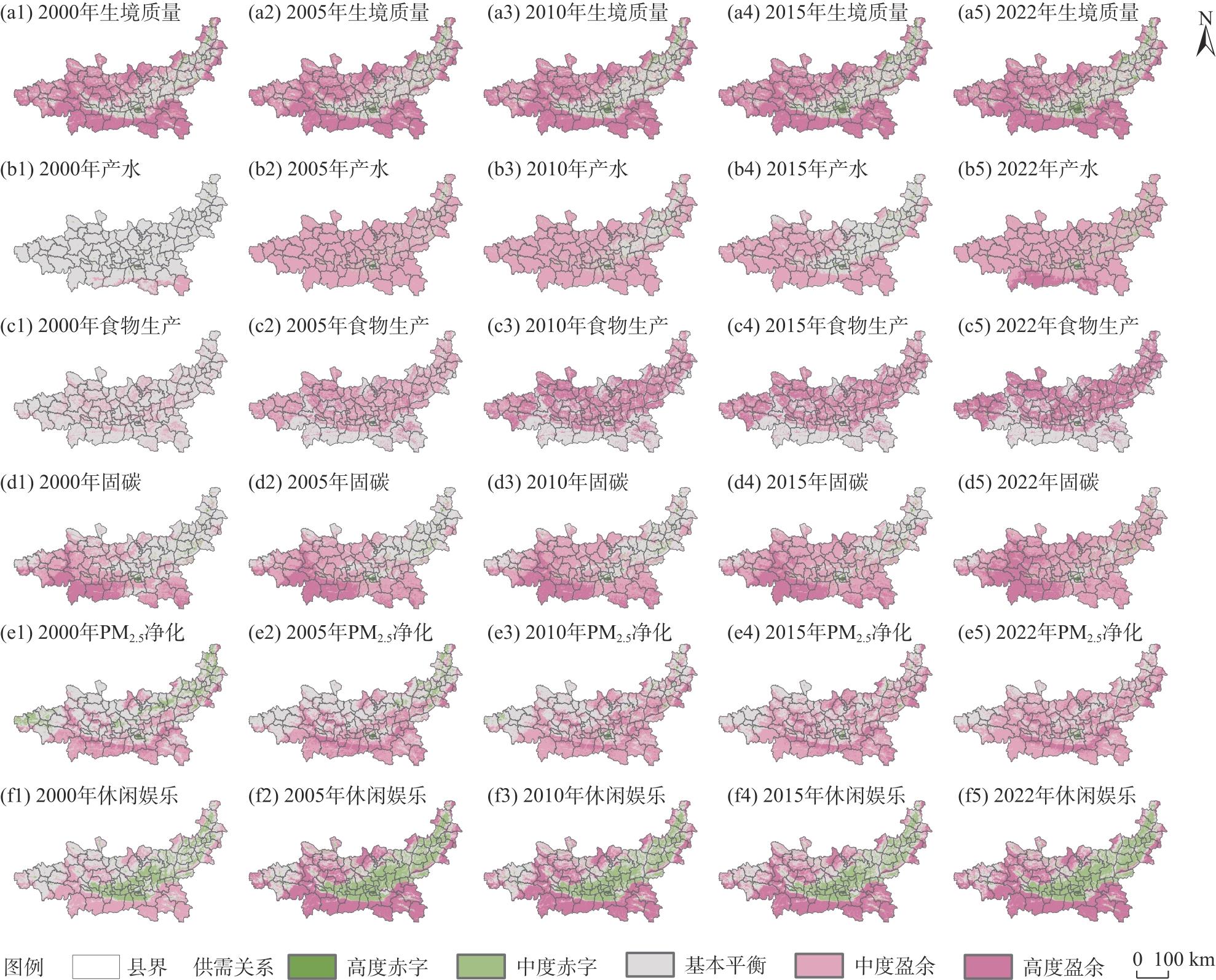
表5
关中平原城市群生态系统服务供需匹配类型面积占比"
| 生态系统服务 | 2000年 | 2022年 | |||||
|---|---|---|---|---|---|---|---|
| 赤字比例 | 平衡比例 | 盈余比例 | 赤字比例 | 平衡比例 | 盈余比例 | ||
| 生境质量 | 3.50 | 25.41 | 71.09 | 6.41 | 25.46 | 68.13 | |
| 产水 | 1.52 | 92.98 | 5.50 | 3.82 | 5.57 | 90.61 | |
| 食物生产 | 0.23 | 78.88 | 20.89 | 0.44 | 44.71 | 54.85 | |
| 固碳 | 3.20 | 43.78 | 53.02 | 3.03 | 11.60 | 85.37 | |
| PM2.5净化 | 9.95 | 47.63 | 42.42 | 1.33 | 24.83 | 73.84 | |
| 休闲娱乐 | 17.57 | 43.82 | 38.61 | 25.40 | 21.61 | 52.99 | |
图5
2000—2022年关中平原城市群人类福祉水平变化"
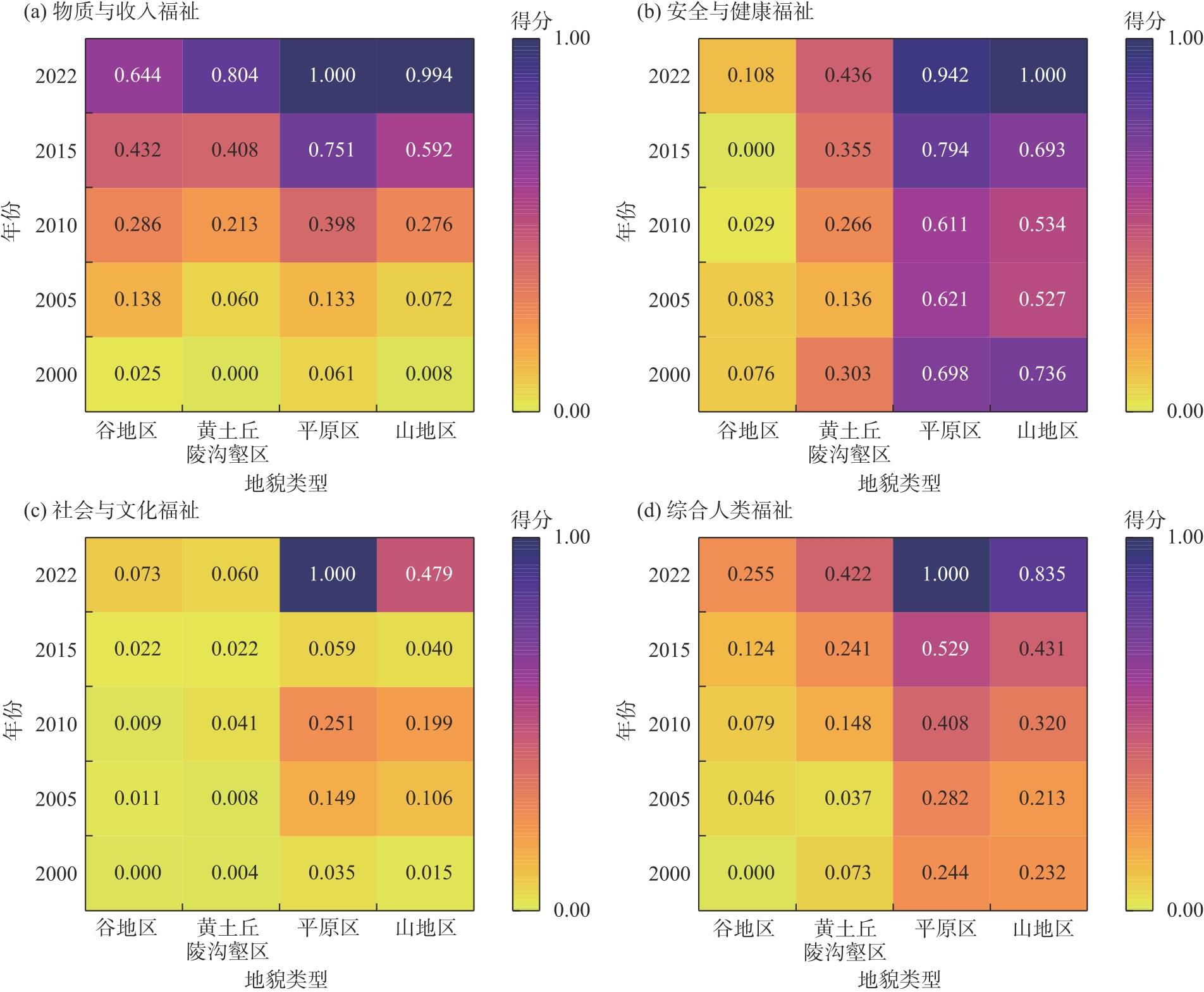
图6
基于偏最小二乘结构方程(PLS-SEM)模型的关中平原城市群生态系统服务供需对人类福祉的影响 注:HQ、FP、WY、CS、PM2.5、LE分别为生境质量、食物生产、产水、固碳、PM2.5净化与休闲娱乐;ESDR HQ、ESDR FP、ESDR WY、ESDR CS、ESDR PM2.5、ESDR LE分别为生境质量、食物生产、产水、固碳、PM2.5净化与休闲娱乐的供需比。黑色和红色箭头分别为正向和负向影响;箭头宽度与效应的强度成正比。*、**、***分别表示在0.05、0.01、0.001水平上显著。"
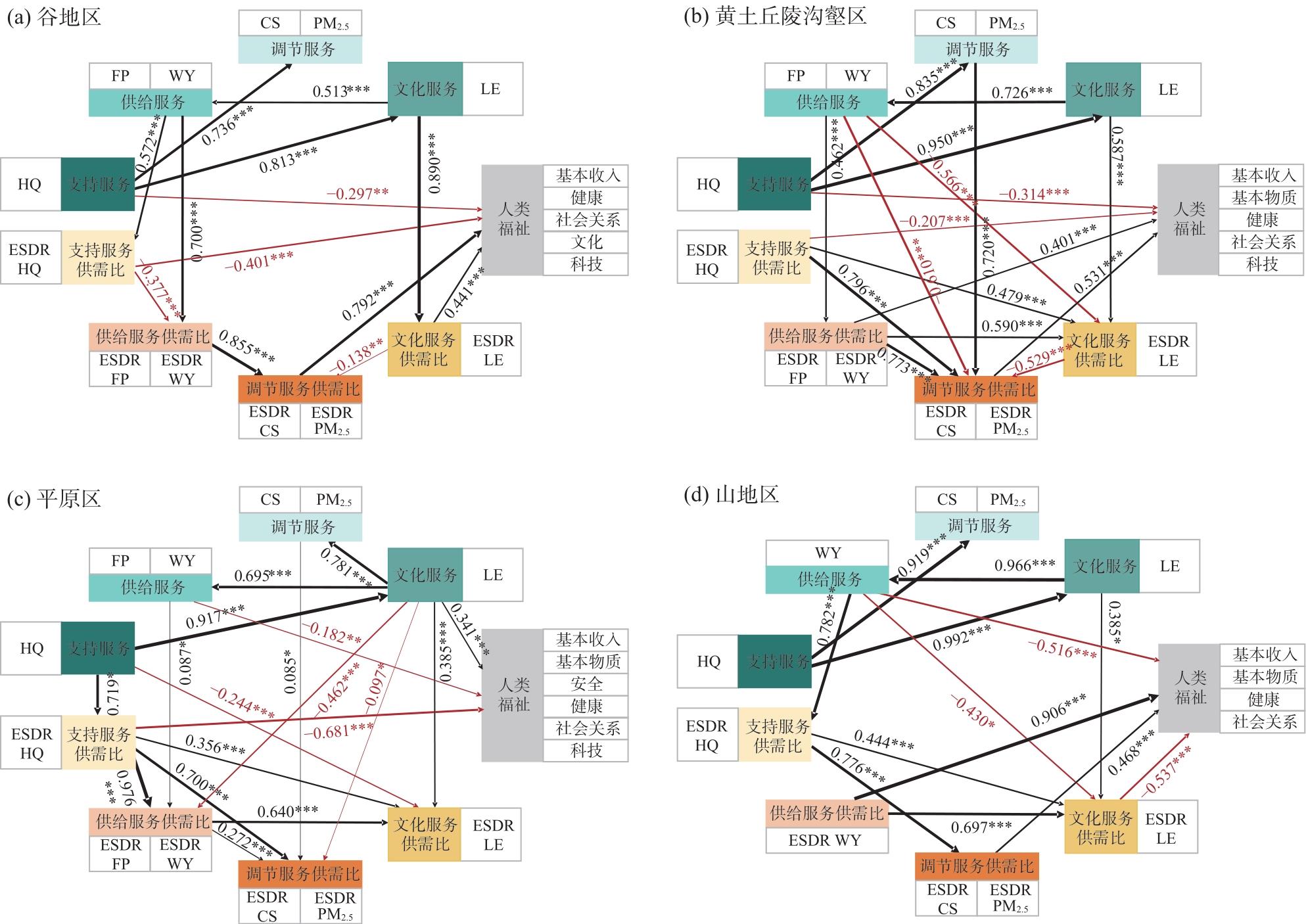
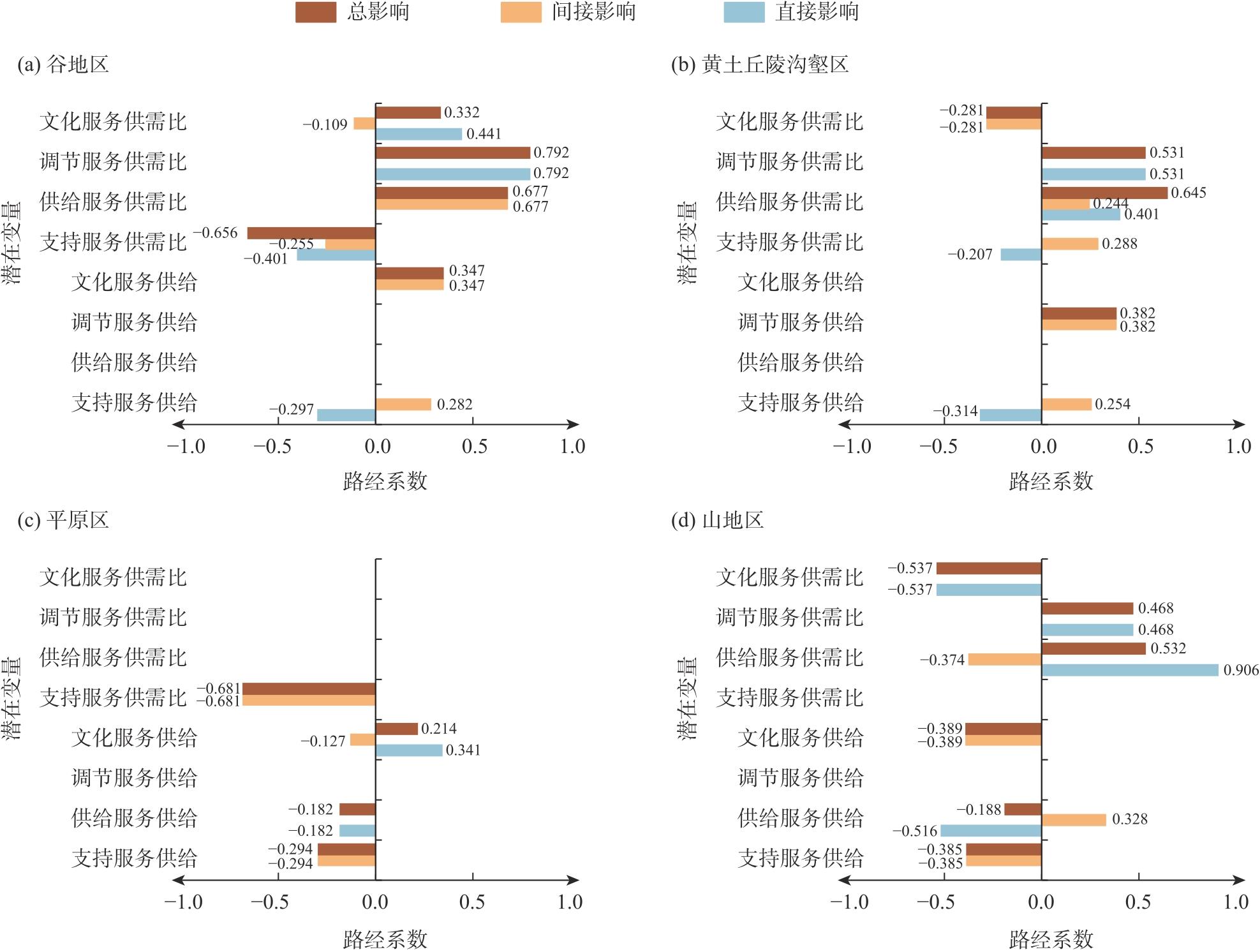
图7
PLS-SEM模型中潜在变量的直接和间接影响"
| [1] | Khor N, Arimah B, Otieno R O, et al. World cities report 2022: Envisaging the future of cities[R]. Nairobi: United Nations Human Settlements Programme, 2022: 41-44. |
| [2] | Pukowiec-Kurda K. The urban ecosystem services index as a new indicator for sustainable urban planning and human well-being in cities[J]. Ecological Indicators, 2022, 144: 109532, doi: 10.1016/j.ecolind.2022.109532. |
| [3] | Güneralp B, Seto K C. Futures of global urban expansion: Uncertainties and implications for biodiversity conservation[J]. Environmental Research Letters, 2013, 8(1): 014025, doi: 10.1088/1748-9326/8/1/014025. |
| [4] | Vindigni G, Mosca A, Bartoloni T, et al. Shedding light on peri-urban ecosystem services using automated content analysis[J]. Sustainability, 2021, 13(16): 9182, doi: 10.3390/su13169182. |
| [5] |
Smidt S J, Tayyebi A, Kendall A D, et al. Agricultural implications of providing soil-based constraints on urban expansion: Land use forecasts to 2050[J]. Journal of Environmental Management, 2018, 217: 677-689.
doi: S0301-4797(18)30269-X pmid: 29654971 |
| [6] | Schwarz N, Manceur A M. Analyzing the influence of urban forms on surface urban heat islands in Europe[J]. Journal of Urban Planning and Development, 2015, 141(3): A4014003, doi: 10.1061/(asce)up.1943-5444.0000263. |
| [7] | Lu X Y, Chen X, Zhao X L, et al. Assessing the impact of land surface temperature on urban net primary productivity increment based on geographically weighted regression model[J]. Scientific Reports, 2021, 11(1): 22282, doi: 10.1038/s41598-021-01757-7. |
| [8] | Bi J, Lu M H, Liu F C, et al. Multi-scale urban ecosystem service changes and their impact mechanisms on human well-being[J]. Journal of Environmental Management, 2025, 374: 124117, doi: 10.1016/j.jenvman.2025.124117. |
| [9] |
刘芦萌, 邬建国. 生态系统服务与人类福祉关系的研究框架、途径与方法[J]. 自然资源学报, 2024, 39(9): 2044-2065.
doi: 10.31497/zrzyxb.20240903 |
|
[Liu Lumeng, Wu Jianguo. Frameworks, approaches, and methods for studying the relationship between ecosystem services and human wellbeing[J]. Journal of Natural Resources, 2024, 39(9): 2044-2065.]
doi: 10.31497/zrzyxb.20240903 |
|
| [10] | Qiu J Q, Yu D Y, Huang T. Influential paths of ecosystem services on human well-being in the context of the sustainable development goals[J]. Science of the Total Environment, 2022, 852: 158443, doi: 10.1016/j.scitotenv.2022.158443. |
| [11] |
Felipe-Lucia M R, Comín F A. Ecosystem services-biodiversity relationships depend on land use type in floodplain agroecosystems[J]. Land Use Policy, 2015, 46: 201-210.
doi: 10.1016/j.landusepol.2015.02.003 |
| [12] |
Wu J G. Landscape sustainability science: Ecosystem services and human well-being in changing landscapes[J]. Landscape Ecology, 2013, 28(6): 999-1023.
doi: 10.1007/s10980-013-9894-9 |
| [13] | Luo Z J, Luo S K, Zhang F C, et al. Spatial and temporal matching measurement of ecosystem service supply, demand and human well-being and its coordination in the great rivers economic belt: Evidence from China’s Yangtze River Economic Belt[J]. Sustainability, 2024, 16(17): 7487, doi: 10.3390/su16177487. |
| [14] |
Daily G C, Matson P A. Ecosystem services: From theory to implementation[J]. Proceedings of the National Academy of Sciences, 2008, 105(28): 9455-9456.
doi: 10.1073/pnas.0804960105 |
| [15] |
Reid W V, Mooney H A. The millennium ecosystem assessment: Testing the limits of interdisciplinary and multi-scale science[J]. Current Opinion in Environmental Sustainability, 2016, 19: 40-46.
doi: 10.1016/j.cosust.2015.11.009 |
| [16] |
Burkhard B, Petrosillo I, Costanza R. Ecosystem services-bridging ecology, economy and social sciences[J]. Ecological Complexity, 2010, 7(3): 257-259.
doi: 10.1016/j.ecocom.2010.07.001 |
| [17] |
Mancini M S, Galli A, Coscieme L, et al. Exploring ecosystem services assessment through ecological footprint accounting[J]. Ecosystem Services, 2018, 30: 228-235.
doi: 10.1016/j.ecoser.2018.01.010 |
| [18] | 赵娜, 王辉, 论宇超, 等. 旅游型海岛生态系统服务供需与岛民福祉研究——以长山群岛为例[J]. 旅游科学, 2025, 39(1): 135-159. |
| [Zhao Na, Wang Hui, Lun Yuchao, et al. Study on supply and demand of ecosystem services and islanders well-being in tourism islands: A case of Changshan archipelago[J]. Tourism Science, 2025, 39(1): 135-159.] | |
| [19] | 董文卓, 苏维词, 罗小毛, 等. 西南地区生态系统服务供需与人类福祉的时空匹配测度及其耦合协调分析[J]. 环境科学, 2026, 47(5): 3362-3377. |
|
[Dong Wenzhuo, Su Weici, Luo Xiaomao, et al. Spatiotemporal matching measurement and coupling coordination analysis between ecosystem service supply-demand and human well-being in southwest China[J]. Environmental Science, 2026, 47(5): 3362-3377.]
doi: 10.1021/es304676x |
|
| [20] | Li Y G, Liu W, Zhu M, et al. Influencing factors and paths of the coupling relationship between ecosystem services supply-demand and human well-being in the Hexi regions, northwest China[J]. Remote Sensing, 2025, 17(10): 1787, doi: 10.3390/rs17101787. |
| [21] | 张超正, 杨钢桥, 陈丹玲, 等. 长江中游生态系统服务供需平衡与居民福祉耦合的时空特征[J]. 农业工程学报, 2024, 40(2): 356-368. |
| [Zhang Chaozheng, Yang Gangqiao, Chen Danling, et al. Spatiotemporal coupling relationship between supply-demand balance of ecosystem services and welfare of residents in the middle reaches of the Yangtze River[J]. Transactions of the Chinese Society of Agricultural Engineering, 2024, 40(2): 356-368.] | |
| [22] | Ketema H, Wei W, Legesse A, et al. Quantifying ecosystem service supply-demand relationship and its link with smallholder farmers’ well-being in contrasting agro-ecological zones of the East African rift[J]. Global Ecology and Conservation, 2021, 31: e01829, doi: 10.1016/j.gecco.2021.e01829. |
| [23] |
Wei H J, Liu H M, Xu Z H, et al. Linking ecosystem services supply, social demand and human well-being in a typical mountain-oasis-desert area, Xinjiang, China[J]. Ecosystem Services, 2018, 31: 44-57.
doi: 10.1016/j.ecoser.2018.03.012 |
| [24] | Wang B J, Tang H P, Zhang Q, et al. Exploring connections among ecosystem services supply, demand and human well-being in a mountain-basin system, China[J]. International Journal of Environmental Research and Public Health, 2020, 17(15): 5309, doi: 10.3390/ijerph17155309. |
| [25] |
Raudsepp-Hearne C, Peterson G D, Bennett E M. Ecosystem service bundles for analyzing tradeoffs in diverse landscapes[J]. Proceedings of the National Academy of Sciences, 2010, 107(11): 5242-5247.
doi: 10.1073/pnas.0907284107 |
| [26] | 董孝斌, 刘梦雪. 土地利用/覆盖变化-生态系统服务-人类福祉关系研究进展[J]. 北京师范大学学报(自然科学版), 2022, 58(3): 465-475. |
| [Dong Xiaobin, Liu Mengxue. Relationships among LUCC, ecosystem services and human well-being[J]. Journal of Beijing Normal University (Natural Science Edition), 2022, 58(3): 465-475.] | |
| [27] | Gao Y S, Zhang P, Xu Y Q, et al. A study on the spatiotemporal characteristics of the Xi’an metropolitan area based on the coupling and coordination of ecosystem services and human well-being[J]. Land, 2025, 14(3): 500, doi: 10.3390/land14030500. |
| [28] | 周新宇, 孟士婷, 黄庆旭, 等. 结合生态系统服务供需和人类福祉的区域规划[J]. 生态学报, 2022, 42(14): 5748-5760. |
| [Zhou Xinyu, Meng Shiting, Huang Qingxu, et al. Combining supply and demand of ecosystem services and human well-being for regional planning[J]. Acta Ecologica Sinica, 2022, 42(14): 5748-5760.] | |
| [29] | Xia Z Y, Wang Y, Lu Q L, et al. Understanding residents’ perspectives on cultural ecosystem service supply, demand and subjective well-being in rapidly urbanizing landscapes: A case study of peri-urban Shanghai[J]. Landscape Ecology, 2024, 39(2): 22, doi: 10.1007/s10980-024-01820-4. |
| [30] | Zhao Y, Feng Q, Lu A G. Spatiotemporal variation in vegetation coverage and its driving factors in the Guanzhong Basin, NW China[J]. Ecological Informatics, 2021, 64: 101371, doi: 10.1016/j.ecoinf.2021.101371. |
| [31] | Yang Y, Cai Z X. Ecological security assessment of the Guanzhong Plain urban agglomeration based on an adapted ecological footprint model[J]. Journal of Cleaner Production, 2020, 260: 120973, doi: 10.1016/j.jclepro.2020.120973. |
| [32] | Wang Y, Zhou Z X, Reheman R, et al. Simulation and spatiotemporal dynamic analysis of air-mediated ecosystem service flows: A case study of Guanzhong Plain urban agglomeration[J]. Ecological Indicators, 2025, 178: 113892, doi: 10.1016/j.ecolind.2025.113892. |
| [33] |
张鑫, 张丹, 张广森, 等. 关中平原城市群生态系统服务时空特征及生态功能区划分[J]. 干旱区地理, 2024, 47(9): 1587-1595.
doi: 10.12118/j.issn.1000-6060.2023.555 |
|
[Zhang Xin, Zhang Dan, Zhang Guangsen, et al. Spatiotemporal characteristics of ecosystem services and ecological function areas in Guanzhong Plain urban agglomeration[J]. Arid Land Geography, 2024, 47(9): 1587-1595.]
doi: 10.12118/j.issn.1000-6060.2023.555 |
|
| [34] | Shifaw E, Sha J M, Li X M, et al. Ecosystem services dynamics and their influencing factors: Synergies/tradeoffs interactions and implications, the case of upper Blue Nile Basin, Ethiopia[J]. Science of the Total Environment, 2024, 938: 173524, doi: 10.1016/j.scitotenv.2024.173524. |
| [35] | Shi Y S, Shi D H, Zhou L L, et al. Identification of ecosystem services supply and demand areas and simulation of ecosystem service flows in Shanghai[J]. Ecological Indicators, 2020, 115: 106418, doi: 10.1016/j.ecolind.2020.106418. |
| [36] |
杨宜男, 李敬, 王立, 等. 长三角地区城市化对典型生态系统服务供需的影响[J]. 自然资源学报, 2022, 37(6): 1555-1571.
doi: 10.31497/zrzyxb.20220613 |
|
[Yang Yinan, Li Jing, Wang Li, et al. Impact of urbanization on supply and demand of typical ecosystem services in Yangtze River Delta[J]. Journal of Natural Resources, 2022, 37(6): 1555-1571.]
doi: 10.31497/zrzyxb.20220613 |
|
| [37] | Yu H J, Xie W, Sun L, et al. Identifying the regional disparities of ecosystem services from a supply-demand perspective[J]. Resources, Conservation and Recycling, 2021, 169: 105557, doi: 10.1016/j.resconrec.2021.105557. |
| [38] | Su R, Duan C C, Chen B. The shift in the spatiotemporal relationship between supply and demand of ecosystem services and its drivers in China[J]. Journal of Environmental Management, 2024, 365: 121698, doi: 10.1016/j.jenvman.2024.121698. |
| [39] | Zhang X R, Wang Y S, Yuan X F, et al. Identifying ecosystem service supply-demand imbalance for sustainable land management in China’s Loess Plateau[J]. Land Use Policy, 2022, 123: 106423, doi: 10.1016/j.landusepol.2022.106423. |
| [40] | Wang X M, Qiu X L, Wang Z N, et al. Construction of a social ecological security pattern based on the supply and demand of ecosystem services[J]. Journal for Nature Conservation, 2025, 86: 126962, doi: 10.1016/j.jnc.2025.126962. |
| [41] | Meng F D, Zhou Z, Zhang G J, et al. Land space ecological restoration zoning based on ecosystem service supply and demand and ecological resilience: A case study in the Beijing-Tianjin-Hebei region[J]. Chinese Journal of Eco-Agriculture, 2023, 31(9): 1496-1510. |
| [42] | Zhai T L, Ma Y B, Huang L Y, et al. Research on the spatiotemporal evolution characteristics and driving mechanisms of supply-demand risks of ecosystem services in the Yellow River Basin integrating the hierarchy of needs theory[J]. Ecological Indicators, 2025, 171: 113229, doi: 10.1016/j.ecolind.2025.113229. |
| [43] | 陶芹, 陶宇, 欧维新. 长三角地区休闲游憩服务供需关系研究[J]. 生态学报, 2021, 41(5): 1777-1785. |
| [Tao Qin, Tao Yu, Ou Weixin. Spatial variation of supply and demand relationships of recreational service in the Yangtze River Delta[J]. Acta Ecologica Sinica, 2021, 41(5): 1777-1785.] | |
| [44] | González-García A, Palomo I, González J A, et al. Quantifying spatial supply-demand mismatches in ecosystem services provides insights for land-use planning[J]. Land Use Policy, 2020, 94: 104493, doi: 10.1016/j.landusepol.2020.104493. |
| [45] |
Li J H, Jiang H W, Bai Y, et al. Indicators for spatial-temporal comparisons of ecosystem service status between regions: A case study of the Taihu River Basin, China[J]. Ecological Indicators, 2016, 60: 1008-1016.
doi: 10.1016/j.ecolind.2015.09.002 |
| [46] | Zhang S Y, Hu W Y, Li M R, et al. Multiscale research on spatial supply-demand mismatches and synergic strategies of multifunctional cultivated land[J]. Journal of Environmental Management, 2021, 299: 113605, doi: 10.1016/j.jenvman.2021.113605. |
| [47] | Hu Z N, Yang X, Yang J J, et al. Linking landscape pattern, ecosystem service value, and human well-being in Xishuangbanna, southwest China: Insights from a coupling coordination model[J]. Global Ecology and Conservation, 2021, 27: e1583, doi: 10.1016/j.gecco.2021.e01583. |
| [48] |
Okada M. A method for clinical data reduction based on “weighted entropy”[J]. IEEE Transactions on Biomedical Engineering, 1978, 25(5): 462-467.
pmid: 359452 |
| [49] |
Liu X X, Yu D Y, Li X Y. Identifying ecological compensation standard and influencing factors based on ecosystem service externality[J]. Ecological Frontiers, 2025, 45(4): 1029-1041.
doi: 10.1016/j.ecofro.2025.03.011 |
| [50] | Bollen K A. Structural equations with latent variables[M]. New York: John Wiley & Sons, 1989. |
| [51] | Wang C, Ma L, Zhang Y, et al. Spatiotemporal dynamics of wetlands and their driving factors based on PLS-SEM: A case study in Wuhan[J]. Science of the Total Environment, 2022, 806: 151310, doi: 10.1016/j.scitotenv.2021.151310. |
| [52] | Shi J H, Zhang P, Liu Y, et al. Study on spatiotemporal changes of wetlands based on PLS-SEM and PLUS model: The case of the Sanjiang Plain[J]. Ecological Indicators, 2024, 169: 112812, doi: 10.1016/j.ecolind.2024.112812. |
| [53] | Reid W V, Mooney H A, Cropper A, et al. Ecosystems and human well-being: Synthesis[M]. Washington: Island Press, 2005: 137. |
| [54] |
刘迪, 陈海, 张行, 等. 黄土丘陵沟壑区生态系统服务对人类福祉的影响及其群体差异[J]. 地理研究, 2022, 41(5): 1298-1310.
doi: 10.11821/dlyj020210558 |
| [Liu Di, Chen Hai, Zhang Hang, et al. The impact of ecosystem services on human well-being and its group differences in the loess hilly and gully region[J]. Geographical Research, 2022, 41(5): 1298-1310.] | |
| [55] | 刘迪, 陈海, 王麒菲, 等. 黄土丘陵沟壑区村庄生态系统服务对人类福祉的影响机理——以陕西省米脂县为例[J]. 水土保持研究, 2024, 31(3): 69-78. |
| [Liu Di, Chen Hai, Wang Qifei, et al. Mechanisms of the impact of village ecosystem services on human well-being in the loess hilly and gully region: Case study of Mizhi County, Shaanxi Province[J]. Research of Soil and Water Conservation, 2024, 31(3): 69-78.] | |
| [56] | 邓丽明, 杨骥, 尹小玲, 等. 粤港澳大湾区生态系统服务供需关系及其对城市化多空间尺度的响应[J]. 生态学报, 2024, 44(20): 9094-9107. |
| [Deng Liming, Yang Ji, Yin Xiaoling, et al. Supply and demand of ecosystem services and its multi-spatial scale response to urbanization in Guangdong-Hong Kong-Macao Greater Bay Area[J]. Acta Ecologica Sinica, 2024, 44(20): 9094-9107.] | |
| [57] | 徐茜, 卢芷欣, 许莹杰, 等. 基于供需关系的广东省生态系统服务空间流动研究[J]. 生态学报, 2025, 45(12): 5753-5768. |
| [Xu Qian, Lu Zhixin, Xu Yingjie, et al. Study on spatial flow of ecosystem services in Guangdong Province based on supply-demand relationship[J]. Acta Ecologica Sinica, 2025, 45(12): 5753-5768.] | |
| [58] | Han L J, Zhou Z X. Identifying the changes in ecosystem services and human well-being under agricultural transformation contexts in peri-urban areas: A case study of the Xi’an metropolitan zone, China[J]. Land, 2024, 13(2): 193, doi: 10.3390/land13020193. |
| [59] | Reheman R, Zhou Z X, Wang Y, et al. Response of agroecosystem services to urbanization based on social-ecological networks: A case study of the Guanzhong Plain urban agglomeration[J]. Journal of Environmental Management, 2025, 385: 125712, doi: 10.1016/j.jenvman.2025.125712. |
| [60] |
徐省超, 赵雪雁, 宋晓谕. 退耕还林(草)工程对渭河流域生态系统服务的影响[J]. 应用生态学报, 2021, 32(11): 3893-3904.
doi: 10.13287/j.1001-9332.202111.005 |
|
[Xu Xingchao, Zhao Xueyan, Song Xiaoyu. Impacts of the returning farmland to forest (grassland) project on ecosystem services in the Weihe River Basin, China[J]. Chinese Journal of Applied Ecology, 2021, 32(11): 3893-3904.]
doi: 10.13287/j.1001-9332.202111.005 |
|
| [61] | 赵铭, 周振宏, 智菲, 等. 城市扩张对安徽省马鞍山市生境质量的影响[J]. 水土保持通报, 2024, 44(6): 288-297. |
| [Zhao Ming, Zhou Zhenhong, Zhi Fei, et al. Influence of urban expansion on habitat quality in Ma’anshan City of Anhui Province[J]. Bulletin of Soil and Water Conservation, 2024, 44(6): 288-297.] | |
| [62] | 耿甜伟, 陈海, 刘迪, 等. 县域尺度下生态系统服务供需匹配及生态建设——以陕西省为例[J]. 地域研究与开发, 2021, 40(2): 140-144. |
| [Geng Tianwei, Chen Hai, Liu Di, et al. Matching supply and demand of ecosystem services and ecological construction at county scale: Take Shaanxi Province as an example[J]. Areal Research and Development, 2021, 40(2): 140-144.] | |
| [63] |
徐茜, 许莹杰, 卢芷欣, 等. 生态系统服务与人类福祉的耦合协调关系及其影响因素识别——以广东省为例[J]. 热带地理, 2025, 45(10): 1851-1865.
doi: 10.13284/j.cnki.rddl.20250032 |
|
[Xu Qian, Xu Yingjie, Lu Zhixin, et al. Coupling coordination relationship between ecosystem services and human well-being and the identification of its influencing factors: A case study of Guangdong Province[J]. Tropical Geography, 2025, 45(10): 1851-1865.]
doi: 10.13284/j.cnki.rddl.20250032 |
|
| [64] |
刘焱序, 傅伯杰, 王帅, 等. 旱区人地耦合系统水-粮食-生态关联研究述评[J]. 地理研究, 2021, 40(2): 541-555.
doi: 10.11821/dlyj020191013 |
| [Liu Yanxu, Fu Bojie, Wang Shuai, et al. Review and prospect of the water-food-ecosystem nexus in dryland’s coupled human-earth system[J]. Geographical Research, 2021, 40(2): 541-555.] | |
| [65] |
吴孔森, 芮旸, 陈佳, 等. 旅游驱动下乡村转型发展的微尺度研究——以西安市上王村为例[J]. 地理科学进展, 2020, 39(6): 1047-1059.
doi: 10.18306/dlkxjz.2020.06.014 |
|
[Wu Kongsen, Rui Yang, Chen Jia, et al. Micro-scale study on rural transformation and development driven by tourism: Taking Shangwang Village in Xi’an City as an example[J]. Progress in Geography, 2020, 39(6): 1047-1059.]
doi: 10.18306/dlkxjz.2020.06.014 |
|
| [66] | 刘滨谊, 张德顺, 刘晖, 等. 城市绿色基础设施的研究与实践[J]. 中国园林, 2013, 29(3): 6-10. |
| [Liu Binyi, Zhang Deshun, Liu Hui, et al. Studies and practices on urban green infrastructure[J]. Chinese Landscape Architecture, 2013, 29(3): 6-10.] | |
| [67] | 杨雪婷, 邱孝枰, 徐云, 等. 典型山区生态系统服务对居民福祉影响的空间差异及动态特征——以川西山区为例[J]. 生态学报, 2021, 41(19): 7555-7567. |
| [Yang Xueting, Qiu Xiaoping, Xu Yun, et al. Spatial heterogeneity and dynamic features of the ecosystem services influence on human wellbeing in the west Sichuan Mountain areas[J]. Acta Ecologica Sinica, 2021, 41(19): 7555-7567.] | |
| [68] | 汪鑫, 张宇翔, 赵俊威, 等. 城市公园生态系统文化服务感知满意度评价与提升策略——以成都市成华区为例[J]. 城市发展研究, 2024, 31(11): 120-127. |
| [Wang Xin, Zhang Yuxiang, Zhao Junwei, et al. Evaluation of perceived satisfaction with cultural services in urban park ecosystems and improvement strategies: A case study of Chenghua District, Chengdu City[J]. Urban Development Studies, 2024, 31(11): 120-127.] |
| [1] | 史玉芳, 赵妍, 刘欣悦. 关中平原城市群新质生产力空间关联网络及影响因素研究[J]. 干旱区地理, 2026, 49(6): 1215-1225. |
| [2] | 杨蓉欣, 原野, 袁媛, 杨雨青, 武艺超. 陕北黄土高原生态系统服务与人类福祉关系的尺度依赖性——基于生态恢复与社会发展双重驱动[J]. 干旱区地理, 2026, 49(5): 949-962. |
| [3] | 贾亚娟, 高君, 张新奇. 关中平原耕地利用生态效率时空演化及驱动因素分析[J]. 干旱区地理, 2026, 49(4): 830-840. |
| [4] | 文明星, 贾卓, 郑承翊, 郝燕. 兰西城市群工业集聚对城乡收入差距的影响及空间效应[J]. 干旱区地理, 2026, 49(11): 2376-2388. |
| [5] | 石天戈, 杨晨亮, 时卉, 仝雁军. 基于PLUS-InVEST-GeoDetector模型的天山北坡城市群生境质量演化与模拟[J]. 干旱区地理, 2026, 49(10): 2042-2053. |
| [6] | 于志翔, 于晓晶, 陈诗永, 李霞, 梅桢. 2000—2023年天山北坡城市群冬季大气污染事件时空演变特征[J]. 干旱区地理, 2026, 49(1): 35-46. |
| [7] | 周涛, 王亚娟, 刘小鹏. 宁夏沿黄城市群新型城镇化与低碳发展的耦合交互研究[J]. 干旱区地理, 2025, 48(8): 1457-1468. |
| [8] | 夏梓洋, 夏云帆, 王宁, 林伟, 马丽娜, 谭晓平, 张艳珍, 焦瑞. 基于POI的天山北坡城市群旅游要素空间格局及影响因素[J]. 干旱区地理, 2025, 48(7): 1243-1254. |
| [9] | 王逸菲, 孔德臻, 罗宇煊, 毛锦凰, 王梅梅. 人口增减分化对兰西城市群城市经济韧性的影响与作用路径[J]. 干旱区地理, 2025, 48(6): 1020-1030. |
| [10] | 黄思源, 周书航, 董晔. 天山北坡城市群城市韧性时空演变特征及发展趋势预测[J]. 干旱区地理, 2025, 48(4): 559-570. |
| [11] | 侯彩霞, 张宇宙, 杨建平. 关中平原城市群水资源-社会-生态系统耦合协调及障碍因子分析[J]. 干旱区地理, 2025, 48(4): 717-727. |
| [12] | 闫劲烨, 马正权, 孙萱萱, 阿力木·阿巴斯, 帕丽达·牙合甫. 2015—2023年“乌-昌-石”城市群PM2.5与PM10时空变化及潜在源分析[J]. 干旱区地理, 2025, 48(3): 405-420. |
| [13] | 楚文溪, 杨新军, 李润阳. 关中平原城市群城市韧性与生态系统服务耦合协调关系及影响因素[J]. 干旱区地理, 2025, 48(11): 2005-2018. |
| [14] | 张鑫, 张丹, 张广森, 宋玫. 关中平原城市群生态系统服务时空特征及生态功能区划分[J]. 干旱区地理, 2024, 47(9): 1587-1595. |
| [15] | 夏子龙, 杜培军, 郭山川, 方宏, 张伟, 潘小全. 呼包鄂榆城市群遥感土地覆被产品评估分析与集成学习[J]. 干旱区地理, 2024, 47(8): 1367-1379. |
|
||