干旱区地理 ›› 2026, Vol. 49 ›› Issue (11): 2376-2388.doi: 10.12118/j.issn.1000-6060.2026.037 cstr: 32274.14.ALG2026037
文明星( ), 贾卓(), 郑承翊, 郝燕
收稿日期:2026-01-15
修回日期:2026-03-03
出版日期:2026-11-25
发布日期:2026-11-13
通讯作者:
贾卓(1984-),男,博士,副教授,主要从事生态经济与区域空间规划等方面的研究. E-mail: jiazhuo@lzu.edu.cn作者简介:文明星(2001-),男,硕士研究生,主要从事城乡关系与产业规划等方面的研究. E-mail: wenmx2024@lzu.edu.cn论文构思:贾卓、文明星;数据管理:文明星;规范分析:文明星;获取资助:贾卓;调查研究:文明星、郑承翊;方法设计:文明星、贾卓、郑承翊;项目管理:文明星、贾卓;提供资源:贾卓、文明星;软件编程:文明星;监督指导:贾卓;验证复核:文明星、贾卓、郑承翊、郝燕;可视化:文明星、郑承翊、郝燕;初稿撰写:文明星;修订编辑:文明星、贾卓、郑承翊、郝燕。
基金资助:
WEN Mingxing(), JIA Zhuo(), ZHENG Chengyi, HAO Yan
Received:2026-01-15
Revised:2026-03-03
Published:2026-11-25
Online:2026-11-13
摘要:
工业集聚通过极化效应和扩散效应的均衡作用影响城乡收入差距,而工业集聚对城乡收入差距的非线性影响尚未明确。基于2013—2023年兰西城市群县域数据,在分析工业集聚与城乡收入差距的时空特征基础上,利用空间杜宾模型揭示工业集聚对城乡收入差距的非线性影响及空间溢出效应。结果表明:(1)兰西城市群工业集聚呈上升趋势,呈现“双核集聚、路径依赖”与“沿轴发展、扩散提升”的格局;城乡收入差距呈逐步缩小趋势,呈现空间梯度缩小及低值区与工业集聚高值区空间趋同的格局。(2)工业集聚对城乡收入差距的影响存在倒“U”型关系,现阶段主要表现为缩小作用;工业集聚能缩小本县域城乡收入差距,但通过空间溢出效应扩大周边县域城乡收入差距;技术密集型工业集聚缩小城乡收入差距的作用最强,资本密集型次之,劳动密集型最弱。(3)经济发展水平、路网密度、农业机械化水平和政府调控能力对本县域城乡收入差距有缩小作用,城镇化率、路网密度、农业机械化水平对周边县域亦有缩小作用,经济发展水平、产业结构高级化、政府调控能力对周边县域城乡收入差距存在扩大作用。
文明星, 贾卓, 郑承翊, 郝燕. 兰西城市群工业集聚对城乡收入差距的影响及空间效应[J]. 干旱区地理, 2026, 49(11): 2376-2388.
WEN Mingxing, JIA Zhuo, ZHENG Chengyi, HAO Yan. Impact and spatial effects of industrial agglomeration on the urban-rural income gap in the Lanzhou-Xining urban agglomeration[J]. Arid Land Geography, 2026, 49(11): 2376-2388.
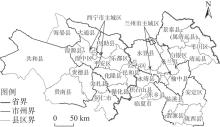
图1
研究区示意图 注:基于自然资源部标准地图服务网站审图号为GS(2019)4347号的标准地图制作,底图边界无修改。东乡县、积石山县、大通县、民和县、互助县、化隆县、循化县分别为东乡族自治县、积石山保安族东乡族撒拉族自治县、大通回族土族自治县、民和回族土族自治县、互助土族自治县、化隆回族自治县、循化撒拉族自治县的简称。西宁市主城区包括城东区、城中区、城西区、城北区;兰州市主城区包括城关区、七里河区、西固区、安宁区。下同。"
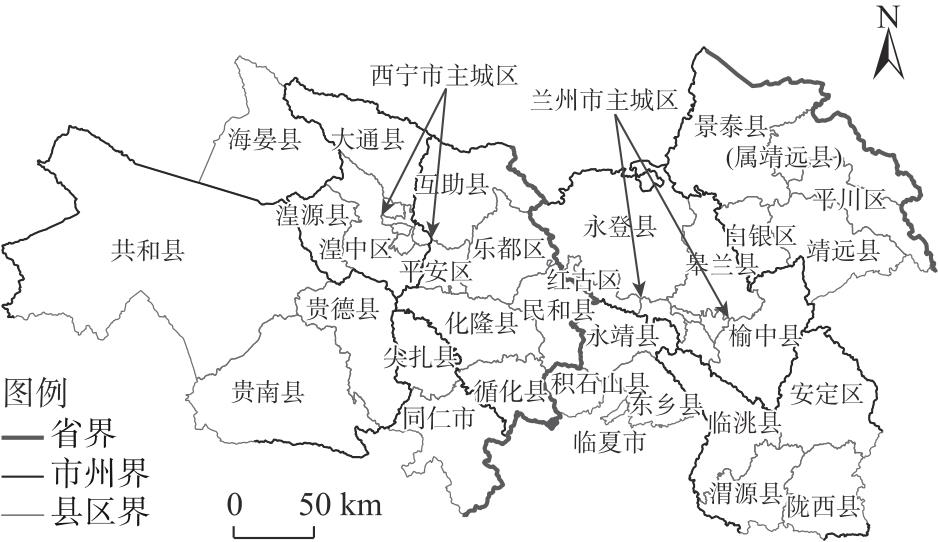
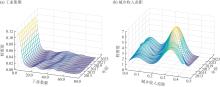
图2
兰西城市群工业集聚与城乡收入差距核密度特征"
图3
兰西城市群工业集聚空间格局"
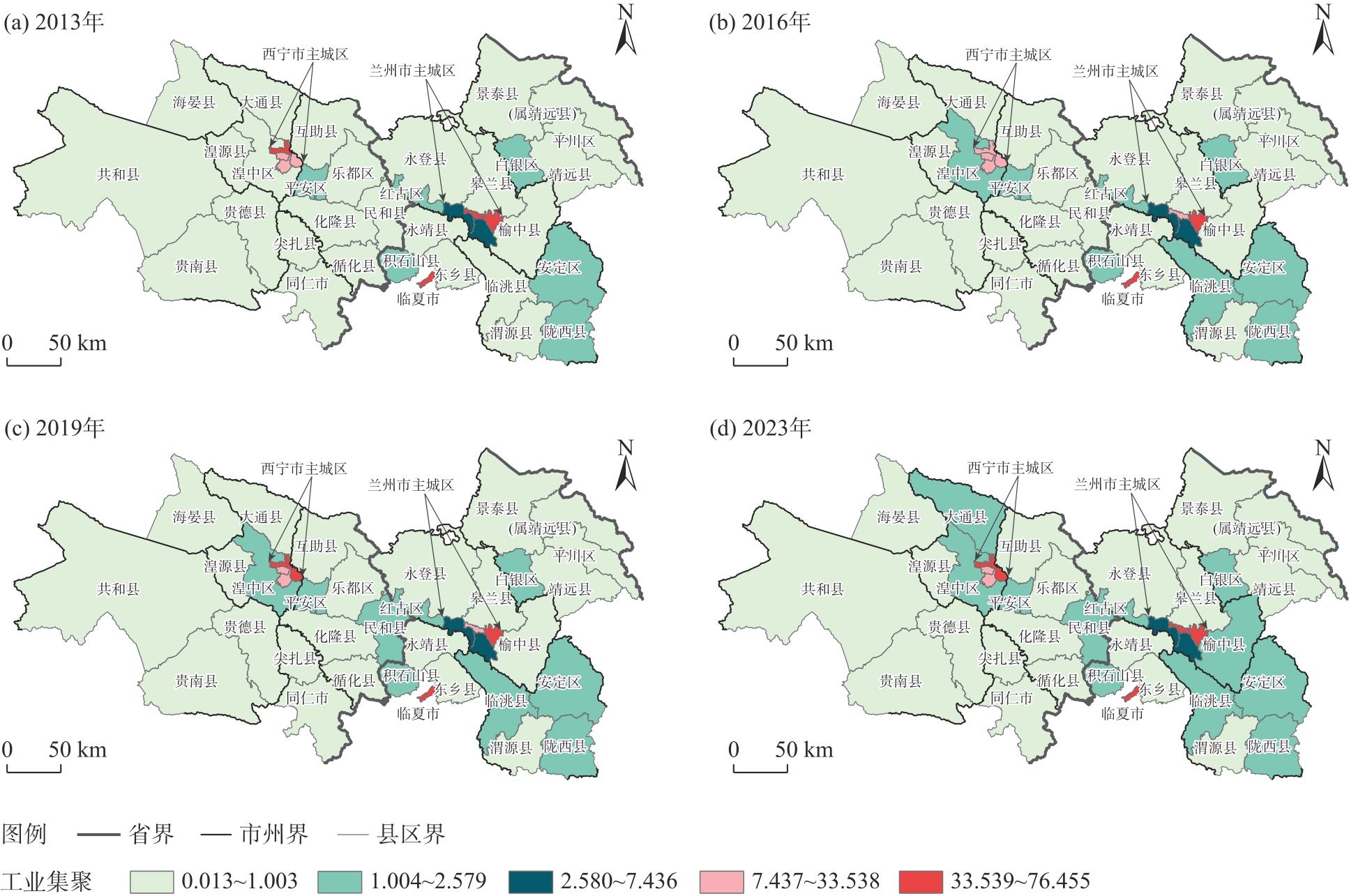
图4
兰西城市群城乡收入差距空间格局"
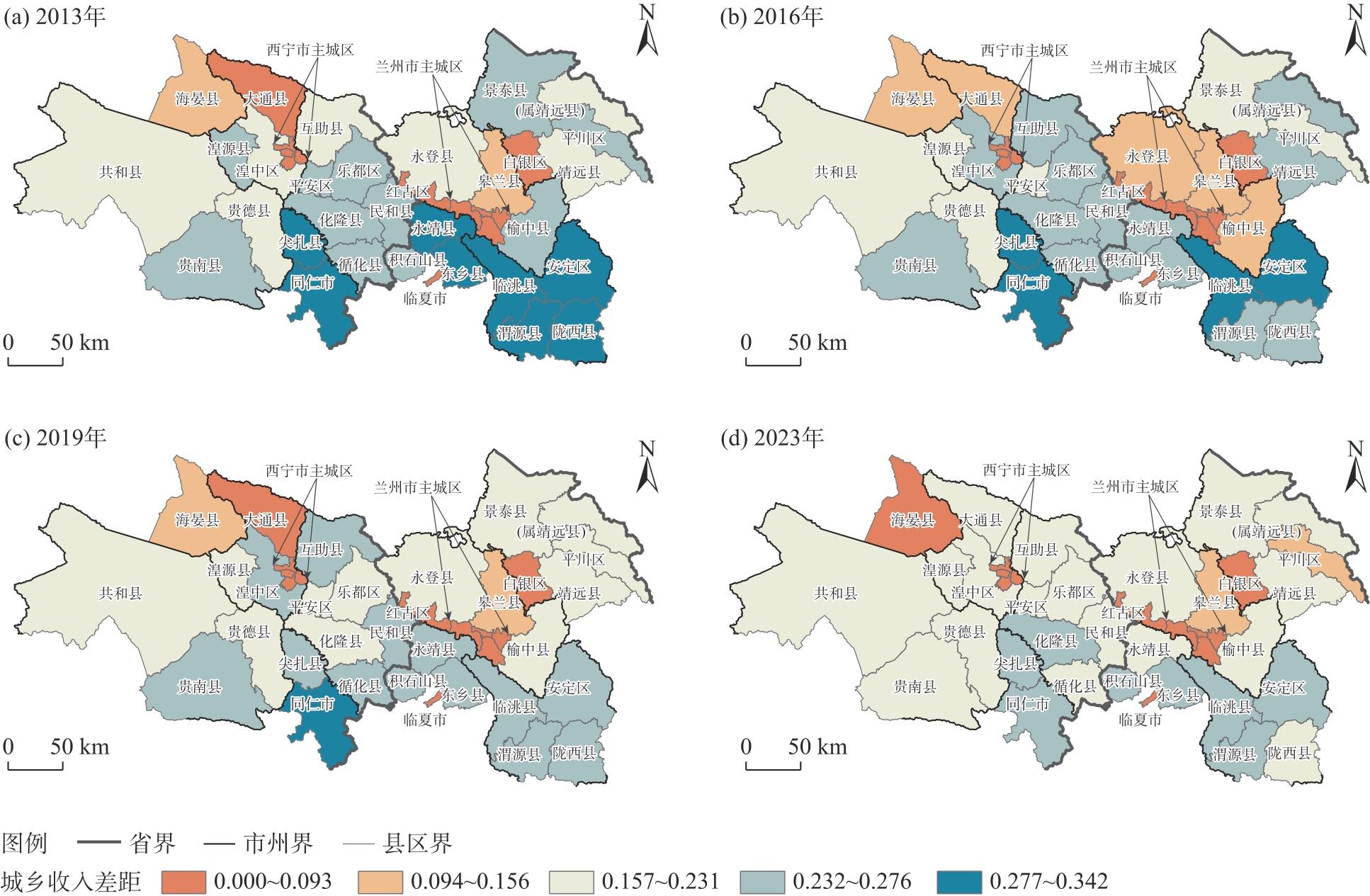
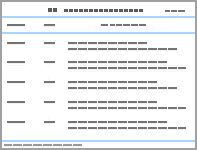
表1
2013—2023年兰西城市群工业集聚和城乡收入差距的全局莫兰指数结果"
| 年份 | 工业集聚 | 城乡收入差距 | |||
|---|---|---|---|---|---|
| 全局莫兰指数 | P值 | 全局莫兰指数 | P值 | ||
| 2013 | 0.196 | 0.020 | 0.431 | 0.001 | |
| 2014 | 0.209 | 0.015 | 0.419 | 0.001 | |
| 2015 | 0.214 | 0.014 | 0.420 | 0.001 | |
| 2016 | 0.207 | 0.016 | 0.414 | 0.001 | |
| 2017 | 0.218 | 0.013 | 0.413 | 0.001 | |
| 2018 | 0.234 | 0.009 | 0.358 | 0.002 | |
| 2019 | 0.237 | 0.008 | 0.384 | 0.001 | |
| 2020 | 0.234 | 0.009 | 0.380 | 0.001 | |
| 2021 | 0.233 | 0.010 | 0.378 | 0.001 | |
| 2022 | 0.228 | 0.010 | 0.362 | 0.002 | |
| 2023 | 0.228 | 0.027 | 0.395 | 0.001 | |
表2
影响因素的筛选结果"
| 解释变量 | 2013年 | 2016年 | 2019年 | 2023年 | |||||||
|---|---|---|---|---|---|---|---|---|---|---|---|
| q值 | P值 | q值 | P值 | q值 | P值 | q值 | P值 | ||||
| 工业集聚 | 0.679 | 0.000 | 0.586 | 0.000 | 0.628 | 0.000 | 0.652 | 0.000 | |||
| 经济发展水平 | 0.228 | 0.116 | 0.421 | 0.008 | 0.513 | 0.001 | 0.375 | 0.001 | |||
| 产业结构高级化 | 0.538 | 0.003 | 0.404 | 0.147 | 0.538 | 0.000 | 0.538 | 0.001 | |||
| 城镇化率 | 0.469 | 0.001 | 0.519 | 0.000 | 0.539 | 0.000 | 0.610 | 0.000 | |||
| 人口密度 | 0.229 | 0.074 | 0.182 | 0.147 | 0.149 | 0.161 | 0.173 | 0.556 | |||
| 人口增长率 | 0.225 | 0.273 | 0.187 | 0.547 | 0.282 | 0.479 | 0.259 | 0.005 | |||
| 路网密度 | 0.497 | 0.001 | 0.580 | 0.000 | 0.605 | 0.001 | 0.593 | 0.002 | |||
| 农业机械化水平 | 0.460 | 0.008 | 0.390 | 0.070 | 0.414 | 0.077 | 0.473 | 0.028 | |||
| 政府调控能力 | 0.420 | 0.011 | 0.476 | 0.002 | 0.524 | 0.006 | 0.535 | 0.001 | |||
表3
空间计量模型检验结果"
| 空间计量模型选择检验 | 统计量 | P值 |
|---|---|---|
| LM-error | 83.738 | 0.000 |
| Robust LM-error | 8.394 | 0.004 |
| LM-lag | 100.749 | 0.000 |
| Robust LM-lag | 25.405 | 0.000 |
| LR-spatial error | 52.150 | 0.000 |
| LR-spatial lag | 40.270 | 0.000 |
| Wald-spatial error | 50.490 | 0.000 |
| Wald-spatial lag | 41.250 | 0.000 |
| Hausman | 1098.970 | 0.000 |
| LR-ind | -228.560 | 1.000 |
| LR-time | 515.610 | 0.000 |
表4
空间杜宾模型回归结果"
| 变量 | 系数 | 变量 | 系数 | |
|---|---|---|---|---|
| lnI | -0.039***(-3.337) | W*lnI | 0.110***(3.102) | |
| (lnI)2 | -0.024***(-10.255) | |||
| lnG | -0.279***(-7.672) | W*lnG | 0.158(1.537) | |
| lnS | -0.009(-0.704) | W*lnS | 0.184***(4.354) | |
| lnU | -0.030(-0.798) | W*lnU | -0.420***(-4.449) | |
| lnR | -0.123***(-5.747) | W*lnR | -0.199***(-3.089) | |
| lnA | -0.086***(-6.899) | W*lnA | -0.112***(-2.709) | |
| lnF | -0.088***(-3.474) | W*lnF | 0.146**(2.201) | |
| ρ | 0.314***(2.836) | R2 | 0.752 |
表5
空间杜宾模型的空间效应分解结果"
| 变量 | 直接效应 | 间接效应 | 总效应 |
|---|---|---|---|
| lnI | -0.044***(-3.512) | 0.100***(3.525) | 0.056*(1.916) |
| lnG | -0.284***(-8.351) | 0.195**(2.338) | -0.089(-0.917) |
| lnS | -0.015(-1.170) | 0.151***(4.247) | 0.136***(3.617) |
| lnU | -0.017(-0.486) | -0.334***(-4.466) | -0.351***(-4.206) |
| lnR | -0.116***(-5.213) | -0.132***(-2.626) | -0.248***(-5.149) |
| lnA | -0.082***(-6.333) | -0.068**(-2.192) | -0.150***(-4.699) |
| lnF | -0.092***(-3.668) | 0.139***(2.676) | 0.046(0.898) |
表6
稳健性检验结果"
| 变量 | 更换被解释变量 | 更换空间权重矩阵 | 缩短样本时间 |
|---|---|---|---|
| lnI | -0.256*** (-5.746) | -0.136*** (-11.489) | -0.148*** (-10.566) |
| W*lnI | 0.570*** (6.776) | 0.123*** (5.587) | 0.102*** (3.833) |
| (lnI)2 | -0.065*** (-6.617) | -0.029*** (-11.018) | -0.031*** (-9.552) |
| lnI直接效应 | -0.355*** (-6.020) | -0.144*** (-10.754) | -0.156*** (-9.790) |
| lnI间接效应 | 0.554*** (7.400) | 0.136*** (6.748) | 0.121*** (4.937) |
| lnI总效应 | 0.199*** (4.233) | -0.009 (-0.554) | -0.035* (-1.797) |
| 控制变量 | 是 | 是 | 是 |
| 固定效应 | 时间固定 | 时间固定 | 时间固定 |
| R2 | 0.309 | 0.697 | 0.683 |
表7
行业异质性分析结果"
| 变量 | 技术密集型 | 资本密集型 | 劳动密集型 |
|---|---|---|---|
| lnI | -0.110*** (-6.177) | -0.100*** (-5.762) | -0.040** (-2.207) |
| W*lnI | 0.169*** (5.263) | 0.133*** (4.857) | 0.111*** (4.059) |
| (lnI)2 | -0.019*** (-7.259) | -0.020*** (-7.375) | -0.018*** (-6.616) |
| 控制变量 | 是 | 是 | 是 |
| 固定效应 | 时间固定 | 时间固定 | 时间固定 |
| R2 | 0.663 | 0.650 | 0.655 |
| [1] |
张亚丽, 陈杨洋, 项本武. 长三角城市群城乡融合发展格局演变及其影响因素[J]. 地理科学, 2024, 44(11): 1955-1965.
doi: 10.13249/j.cnki.sgs.20230345 |
|
[Zhang Yali, Chen Yangyang, Xiang Benwu. Evolution of integrated urban-rural development pattern and its influencing factors in the Yangtze River Delta urban agglomeration[J]. Scientia Geographica Sinica, 2024, 44(11): 1955-1965.]
doi: 10.13249/j.cnki.sgs.20230345 |
|
| [2] | Yan D S, Sun W, Li P X, et al. Effects of economic growth target on the urban-rural income gap in China: An empirical study based on the urban bias theory[J]. Cities, 2025, 156: 105518, doi: 10.1016/j.cities.2024.105518. |
| [3] | Chen X, Wu R. How can rural industrial revitalization and rural education level reduce the urban-rural income gap?[J]. Finance Research Letters, 2025, 73: 106592, doi: 10.1016/j.frl.2024.106592. |
| [4] |
郝智娟, 文琦, 施琳娜, 等. 黄河流域城市群社会经济与生态环境耦合协调空间网络分析[J]. 经济地理, 2023, 43(12): 181-191.
doi: 10.15957/j.cnki.jjdl.2023.12.018 |
|
[Hao Zhijuan, Wen Qi, Shi Linna, et al. Spatial network analysis of coupling coordination between social economy and eco-environment in Yellow River Basin urban agglomerations[J]. Economic Geography, 2023, 43(12): 181-191.]
doi: 10.15957/j.cnki.jjdl.2023.12.018 |
|
| [5] |
贾卓, 赵锦瑶, 杨永春, 等. 黄河流域兰西城市群环境规制效率的空间格局及其空间收敛性[J]. 地理科学, 2022, 42(4): 568-578.
doi: 10.13249/j.cnki.sgs.2022.04.002 |
|
[Jia Zhuo, Zhao Jinyao, Yang Yongchun, et al. Spatial pattern and spatial convergence of environmental regulation efficiency of Lanzhou-Xining urban agglomeration in the Yellow River Basin[J]. Scientia Geographica Sinica, 2022, 42(4): 568-578.]
doi: 10.13249/j.cnki.sgs.2022.04.002 |
|
| [6] |
李涛, 薛领, 李国平. 产业集聚空间格局演变及其对经济高质量发展的影响——基于中国278个城市数据的实证分析[J]. 地理研究, 2022, 41(4): 1092-1106.
doi: 10.11821/dlyj020210226 |
| [Li Tao, Xue Ling, Li Guoping. The evolution of spatial pattern of industrial agglomeration and its impact on the high-quality economic development: Empirical analysis based on the data of 278 cities in China[J]. Geographical Research, 2022, 41(4): 1092-1106.] | |
| [7] | 蔡武, 吴国兵, 朱荃. 集聚空间外部性、城乡劳动力流动对收入差距的影响[J]. 产业经济研究, 2013, 63(2): 21-30. |
| [Cai Wu, Wu Guobing, Zhu Quan. Affection of agglomeration spatial externality, urban-rural labor mobility on income gap[J]. Industrial Economics Research, 2013, 63(2): 21-30.] | |
| [8] | Zhong S J, Wang M S, Zhu Y, et al. Urban expansion and the urban-rural income gap: Empirical evidence from China[J]. Cities, 2022, 129: 103831, doi: 10.1016/j.cities.2022.103831. |
| [9] |
Chen D D, Ma Y. Effect of industrial structure on urban-rural income inequality in China[J]. China Agricultural Economic Review, 2022, 14(3): 547-566.
doi: 10.1108/CAER-05-2021-0096 |
| [10] | Tang K, Li Z S, He C. Spatial distribution pattern and influencing factors of relative poverty in rural China[J]. Innovation and Green Development, 2023, 2(1): 100030, doi: 10.1016/j.igd.2022.100030. |
| [11] |
Murshed M. Can income inequality reduction policies limit the disparity between urban and rural clean cooking fuel access rates?[J]. Sustainable Development, 2025, 33(1): 1104-1123.
doi: 10.1002/sd.v33.1 |
| [12] |
唐承丽, 刘彬, 周国华, 等. 乡村创新系统的内涵特征与形成机制[J]. 地理研究, 2025, 44(1): 166-187.
doi: 10.11821/dlyj020240189 |
| [Tang Chengli, Liu Bin, Zhou Guohua, et al. The connotation, characteristics, and formation mechanism of rural innovation systems[J]. Geographical Research, 2025, 44(1): 166-187.] | |
| [13] |
Wang Y, Wang X Y, Zhou H J, et al. Industrial digitalization and urban-rural income gap: An empirical analysis based on data from 30 provinces in China[J]. Economic Analysis and Policy, 2025, 87: 2023-2042.
doi: 10.1016/j.eap.2025.08.001 |
| [14] |
Li Q, Chen W, Zhang S, et al. Achieving sustainable development by reducing income inequality: The differential impact of industrial land expansion in urban agglomerations[J]. Sustainable Development, 2023, 31(4): 2770-2783.
doi: 10.1002/sd.v31.4 |
| [15] | Jia Z, Chen Q, Na H Y, et al. Impacts of industrial agglomeration on industrial pollutant emissions: Evidence found in the Lanzhou-Xining urban agglomeration in western China[J]. Frontiers in Public Health, 2023, 10: 1109139, doi: 10.3389/fpubh.2022.1109139. |
| [16] |
江岳坤, 石鹏娟. 中国市域城乡收入差距时空演化及影响因素[J]. 干旱区地理, 2024, 47(1): 147-157.
doi: 10.12118/j.issn.1000-6060.2023.257 |
|
[Jiang Yuekun, Shi Pengjuan. Spatiotemporal evolution and its affecting factors of urban-rural income gap at the city-level scale in China[J]. Arid Land Geography, 2024, 47(1): 147-157.]
doi: 10.12118/j.issn.1000-6060.2023.257 |
|
| [17] |
赵学伟, 张志斌, 公维民, 等. 环境公正视角下欠发达地区污染企业分布与人口社会特征的时空关联研究——以兰西城市群为例[J]. 地理研究, 2025, 44(11): 3047-3068.
doi: 10.11821/dlyj020240869 |
| [Zhao Xuewei, Zhang Zhibin, Gong Weimin, et al. Spatio-temporal correlation between polluting enterprises and sociodemographic characteristics in an underdeveloped region of China: An environmental justice case study of the Lanzhou-Xining urban agglomeration[J]. Geographical Research, 2025, 44(11): 3047-3068.] | |
| [18] | Wen X A, Li Y R, Zhou M X, et al. Rural digitization and the urban-rural income gap: A perspective of factor flow[J]. Frontiers in Sustainable Food Systems, 2025, 9: 1647632, doi: 10.3389/fsufs.2025.1647632. |
| [19] | 李菁. 西部地区农业产业集聚对农民收入的影响——基于地区工业化水平的调节效应[J]. 经济经纬, 2023, 40(2): 45-54. |
| [Li Jing. Impact of agricultural industrial agglomeration on farmers’ income in western China: A moderating effect based on regional industrialization level[J]. Economic Survey, 2023, 40(2): 45-54.] | |
| [20] |
Huang X Y, Kang C C, Yin C, et al. Influence of transportation accessibility on urban-rural income disparity and its spatial heterogeneity[J]. Chinese Geographical Science, 2024, 34(3): 453-467.
doi: 10.1007/s11769-024-1427-8 |
| [21] |
Kim Y, Orazem P F. What increases the urban-rural gap in firm entry rates?[J]. Small Business Economics, 2025, 65(2): 1141-1158.
doi: 10.1007/s11187-025-01044-z |
| [22] |
陈勇, 程钰, 张悦, 等. 黄河流域数字经济产业集聚演化及其对绿色技术创新的影响[J]. 地理科学进展, 2025, 44(12): 2584-2599.
doi: 10.18306/dlkxjz.2025.12.012 |
|
[Chen Yong, Cheng Yu, Zhang Yue, et al. Evolution of digital economy industry agglomeration in the Yellow River Basin and its impact on green technology innovation[J]. Progress in Geography, 2025, 44(12): 2584-2599.]
doi: 10.18306/dlkxjz.2025.12.012 |
|
| [23] |
刘夏婧, 王士君, 谢铭堁. 中国新质生产力发展对城乡收入差距的影响[J]. 地理科学进展, 2025, 44(4): 684-698.
doi: 10.18306/dlkxjz.2025.04.003 |
|
[Liu Xiajing, Wang Shijun, Xie Mingke. The impacts of new quality productive forces on the urban-rural income gap in China[J]. Progress in Geography, 2025, 44(4): 684-698.]
doi: 10.18306/dlkxjz.2025.04.003 |
|
| [24] | Chen J, Li X J, Zhou X Q, et al. Skill capabilities behind the scenes: The role of occupational portfolio in regional industrial evolution[J]. Regional Studies, 2025, 59(1): 2416535, doi: 10.1080/00343404.2024.2416535. |
| [25] |
Gornig M, Schiersch A. Agglomeration economies: Different effects on TFP in high-tech and low-tech industries[J]. Regional Studies, 2024, 58(11): 1999-2010.
doi: 10.1080/00343404.2024.2318454 |
| [26] | Xu W, Zhou S D, Lei H F. Agro-industrial clusters, spatial effects and agricultural total factor productivity: An empirical analysis based on county-level panel data from China[J]. International Review of Economics & Finance, 2025, 102: 104395, doi: 10.1016/j.iref.2025.104395. |
| [27] |
李佳洺, 张文忠, 李业锦, 等. 基于微观企业数据的产业空间集聚特征分析——以杭州市区为例[J]. 地理研究, 2016, 35(1): 95-107.
doi: 10.11821/dlyj201601009 |
| [Li Jiaming, Zhang Wenzhong, Li Yejin, et al. The characteristics of industrial agglomeration based on micro-geographic data[J]. Geographical Research, 2016, 35(1): 95-107.] | |
| [28] | 赵鸿潇, 程钰, 王丹. 黄河流域高技术产业集聚对绿色创新合作的影响研究[J]. 地理研究, 2025, 44(9): 2554-2570. |
| [Zhao Hongxiao, Cheng Yu, Wang Dan. The impact of high-tech industry agglomeration on green innovation cooperation in the Yellow River Basin[J]. Geographical Research, 2025, 44(9): 2554-2570.] | |
| [29] |
贾卓, 杨永春, 赵锦瑶, 等. 黄河流域兰西城市群工业集聚与污染集聚的空间交互影响[J]. 地理研究, 2021, 40(10): 2897-2913.
doi: 10.11821/dlyj020201097 |
| [Jia Zhuo, Yang Yongchun, Zhao Jinyao, et al. The spatial correlation and interaction between industrial agglomeration and pollution agglomeration of Lanzhou-Xining urban agglomeration in the Yellow River Basin[J]. Geographical Research, 2021, 40(10): 2897-2913.] | |
| [30] | Sun B D, Li W, Zhang Z Q, et al. Is polycentricity a promising tool to reduce regional economic disparities? Evidence from China’s prefectural regions[J]. Landscape and Urban Planning, 2019, 192: 103667, doi: 10.1016/j.landurbplan.2019.103667. |
| [31] |
魏建飞, 袁悠燃, 李强, 等. 黄河流域国土空间效率时空变化及障碍因子分析[J]. 干旱区地理, 2025, 48(6): 1055-1066.
doi: 10.12118/j.issn.1000-6060.2024.654 |
|
[Wei Jianfei, Yuan Youran, Li Qiang, et al. Spatio-temporal variation and obstacle factors of territorial spatial efficiency in the Yellow River Basin[J]. Arid Land Geography, 2025, 48(6): 1055-1066.]
doi: 10.12118/j.issn.1000-6060.2024.654 |
|
| [32] | 贾卓, 强文丽, 王月菊, 等. 兰州-西宁城市群工业污染集聚格局及其空间效应[J]. 经济地理, 2020, 40(1): 68-75, 84. |
|
[Jia Zhuo, Qiang Wenli, Wang Yueju, et al. The spatial characteristics and spatial effect of industrial pollution agglomeration in Lanzhou-Xining urban agglomeration[J]. Economic Geography, 2020, 40(1): 68-75, 84.]
doi: 10.15957/j.cnki.jjdl.2020.01.008 |
|
| [33] |
王金伟, 王启翔, 冯凌. 旅游业发展对共同富裕的直接影响及空间溢出效应[J]. 地理学报, 2024, 79(4): 1045-1067.
doi: 10.11821/dlxb202404013 |
|
[Wang Jinwei, Wang Qixiang, Feng Ling. Direct and spillover effects of tourism development on common prosperity[J]. Acta Geographica Sinica, 2024, 79(4): 1045-1067.]
doi: 10.11821/dlxb202404013 |
|
| [34] | 贾卓, 赵锦瑶, 娜赫雅, 等. 兰州-西宁城市群工业集聚格局及其影响因素空间溢出[J]. 兰州大学学报(自然科学版), 2022, 58(2): 143-150, 156. |
| [Jia Zhuo, Zhao Jinyao, Na Heya, et al. The spatial pattern and spatial spillover of its influencing factors in the industrial aspects of Lanzhou-Xining urban agglomeration[J]. Journal of Lanzhou University (Natural Sciences), 2022, 58(2): 143-150, 156.] | |
| [35] |
Zhang T Y. Bridging the urban-rural gap: The influence mechanism of digital platform development on the urban-rural income gap[J]. Frontiers in Business, Economics and Management, 2024, 16(1): 285-293.
doi: 10.54097/yee2wq29 |
| [36] | 邓明艳. 乡村振兴背景下光伏扶贫政策能否降低城乡收入差距——基于县域数据的分析[J]. 农业技术经济, 2025(6): 25-48. |
| [Deng Mingyan. Can photovoltaic poverty alleviation policy reduce the urban-rural income gap under rural revitalization: An analysis based on county data[J]. Journal of Agrotechnical Economics, 2025(6): 25-48.] | |
| [37] | Zhao X M, Liu L. The impact of urbanization level on urban-rural income gap in China based on spatial econometric model[J]. Sustainability, 2022, 14(21): 13795, doi: 10.3390/su142113795. |
| [38] |
路海艳, 赵鹏军, 董亚宁, 等. 高铁站可达性与城乡居民收入差异空间分异研究[J]. 地理科学进展, 2022, 41(1): 131-142.
doi: 10.18306/dlkxjz.2022.01.012 |
|
[Lu Haiyan, Zhao Pengjun, Dong Yaning, et al. Accessibility of high-speed rail stations and spatial disparity of urban-rural income gaps[J]. Progress in Geography, 2022, 41(1): 131-142.]
doi: 10.18306/dlkxjz.2022.01.012 |
|
| [39] | 朱琳. 信息基础设施对城乡收入差距的影响机理及检验[J]. 南开经济研究, 2023(11): 210-229. |
| [Zhu Lin. How information infrastructure affects urban-rural income gap: Influence mechanisms and empirical study[J]. Nankai Economic Studies, 2023(11): 210-229.] | |
| [40] |
曾福生, 郭楚月. 交通基础设施建设对城乡收入差距的影响及其空间效应[J]. 经济地理, 2025, 45(1): 145-152.
doi: 10.15957/j.cnki.jjdl.2025.01.015 |
|
[Zeng Fusheng, Guo Chuyue. Impact and spatial effects of transportation infrastructure construction on urban-rural income gap[J]. Economic Geography, 2025, 45(1): 145-152.]
doi: 10.15957/j.cnki.jjdl.2025.01.015 |
|
| [41] | 史新杰, 崔柳, 宋文豪, 等. 返乡创业可以缩小城乡收入差距吗——来自国家返乡创业试点县的经验证据[J]. 农业技术经济, 2025(4): 4-22. |
| [Shi Xinjie, Cui Liu, Song Wenhao, et al. Can returning home for entrepreneurship narrow the urban-rural income gap: Empirical evidence from national pilot counties of returning home entrepreneurship[J]. Journal of Agrotechnical Economics, 2025(4): 4-22.] | |
| [42] |
田俊, 李旭东, 陈璇, 等. 黔中城市群新型城镇化与农业现代化耦合协调对城乡收入差距的影响[J]. 地理科学进展, 2024, 43(7): 1355-1371.
doi: 10.18306/dlkxjz.2024.07.007 |
|
[Tian Jun, Li Xudong, Chen Xuan, et al. Impact of coupling and coordination of new urbanization and agricultural modernization on the urban-rural income gap in the central Guizhou urban agglomeration[J]. Progress in Geography, 2024, 43(7): 1355-1371.]
doi: 10.18306/dlkxjz.2024.07.007 |
|
| [43] |
史海金, 赵新正, 李香香, 等. 黄河流域城乡收入差距时空格局及其对城镇化的响应[J]. 干旱区地理, 2024, 47(10): 1781-1793.
doi: 10.12118/j.issn.1000-6060.2024.050 |
|
[Shi Haijin, Zhao Xinzheng, Li Xiangxiang, et al. Spatio-temporal pattern of urban-rural income gap in the Yellow River Basin and its response to urbanization[J]. Arid Land Geography, 2024, 47(10): 1781-1793.]
doi: 10.12118/j.issn.1000-6060.2024.050 |
|
| [44] |
郑玉. 人力资本集聚对产业链现代化的影响机理探究——兼论人才政策的调节效应[J]. 地理研究, 2025, 44(1): 129-148.
doi: 10.11821/dlyj020240354 |
| [Zheng Yu. Impact mechanism of human capital agglomeration on industrial chain modernization: The moderating effect of talent policies[J]. Geographical Research, 2025, 44(1): 129-148.] | |
| [45] |
桂淳文, 刘嘉川, 李佳洺. 京津冀地区制造业空间扩散的差异化特征及其关键因素[J]. 经济地理, 2025, 45(3): 229-237, 255.
doi: 10.15957/j.cnki.jjdl.2025.03.023 |
|
[Gui Chunwen, Liu Jiachuan, Li Jiaming. Differentiated characteristics and key factors of spatial diffusion of manufacturing industry in Beijing-Tianjin-Hebei region[J]. Economic Geography, 2025, 45(3): 229-237, 255.]
doi: 10.15957/j.cnki.jjdl.2025.03.023 |
|
| [46] | 张丽君, 梁怡萱, 巩蓉蓉. 数字经济对城乡收入差距的动态影响研究——来自中国31个省(区、市)的证据[J]. 经济问题探索, 2023(3): 18-40. |
| [Zhang Lijun, Liang Yixuan, Gong Rongrong. Research on the dynamic influence of digital economy on urban-rural income gap: Evidence from 31 provinces (municipalities and autonomous regions) in China[J]. Inquiry into Economic Issues, 2023(3): 18-40.] | |
| [47] | Zhong S J, Huang X J, Mao X Y. Deciphering China’s urban-rural income gap: A multi-level analysis, 2006—2020[J]. Cities, 2026, 168: 106488, doi: 10.1016/j.cities.2025.106488. |
| [1] | 杨晴, 张金茹, 郝嘉怡, 邹绍辉, 张磊. 数字经济如何提升全要素碳效率——基于市场扭曲视角研究[J]. 干旱区地理, 2026, 49(9): 1977-1994. |
| [2] | 欧开航, 方世巧, 程乾, 周徐帆. 农村公共服务与乡村旅游耦合协调度及其乡村振兴影响效应——基于西部地区的实证[J]. 干旱区地理, 2026, 49(2): 404-415. |
| [3] | 苏飞, 陈秀碧, 吴宝锐. 数字乡村建设与农民共同富裕耦合协调的时空演进及驱动机制[J]. 干旱区地理, 2026, 49(10): 2030-2041. |
| [4] | 李晓柯, 陈强强. 数字经济对甘肃省城乡收入差距的影响机制与空间效应[J]. 干旱区地理, 2026, 49(1): 198-210. |
| [5] | 王逸菲, 孔德臻, 罗宇煊, 毛锦凰, 王梅梅. 人口增减分化对兰西城市群城市经济韧性的影响与作用路径[J]. 干旱区地理, 2025, 48(6): 1020-1030. |
| [6] | 夏文浩, 霍瑜, 逯渊, 王超毅. 新疆农业碳排放的时空差异与空间溢出效应分析[J]. 干旱区地理, 2024, 47(6): 1084-1096. |
| [7] | 江岳坤, 石鹏娟. 中国市域城乡收入差距时空演化及影响因素[J]. 干旱区地理, 2024, 47(1): 147-157. |
| [8] | 鲁滋道, 宋婉怡, 王钺, 潘海泽, 孟小琳, 闫玉强. 黄河流域文化产业集群时空格局与空间溢出效应研究[J]. 干旱区地理, 2023, 46(11): 1927-1937. |
| [9] | 雒占福,李晓慧,雷德宏,杨卓龙. 兰西城市群品质城市建设水平的时空变化及其影响因素研究[J]. 干旱区地理, 2022, 45(1): 237-250. |
|
||