干旱区地理 ›› 2026, Vol. 49 ›› Issue (7): 1430-1444.doi: 10.12118/j.issn.1000-6060.2025.473 cstr: 32274.14.ALG2025473
党玲芝1,2( ), 王宏卫1,2(), 王灿1,2, 吴晋华1,2, 郭瑞杰3, 张馨元1,2
收稿日期:2025-08-07
修回日期:2025-09-07
出版日期:2026-07-25
发布日期:2026-07-07
通讯作者:
王宏卫(1967-),男,博士,教授,主要从事国土空间生态保护等方面的研究. E-mail: wanghw_777@xju.edu.cn作者简介:党玲芝(2000-),女,硕士研究生,主要从事干旱区人居环境等方面的研究. E-mail: 107552301157@stu.xju.edu.cn
基金资助:
DANG Lingzhi1,2(), WANG Hongwei1,2(), WANG Can1,2, WU Jinhua1,2, GUO Ruijie3, ZHANG Xinyuan1,2
Received:2025-08-07
Revised:2025-09-07
Published:2026-07-25
Online:2026-07-07
摘要:
人居环境是人类生存和进步的基本空间,改善人居环境质量有助于促进人地关系协调,进而推动伊犁河谷高质量发展。基于生产功能、生活功能和生态功能视角,构建伊犁河谷人居环境质量评价指标体系,运用CRITIC赋权法、耦合协调度模型和综合影响因素分析模型,分析2013—2023年伊犁河谷人居环境质量的时空演变特征及影响机制。结果表明:(1) 伊犁河谷各县(市)人居环境质量整体稳步提升,呈多核心、非对称的分布特征,区域差异逐渐缩小,空间均衡性不断增强。(2) 人居环境子系统质量协同提升,其中生态维度质量指数始终居高;各子系统空间重心均呈西北向迁移趋势;各子系统耦合水平显著提升,由磨合期迈向高水平耦合阶段,但协调度仍处于失调状态,系统间协同机制亟待完善。(3) 购物服务、工业经济、通信服务、生态植被与空气质量是人居环境质量的主要影响因子,生产功能、生活功能与生态功能分别在人居环境系统中起着保障、主导与本底作用。研究结果可为干旱半干旱地区绿洲人居环境优化提供科学依据。
党玲芝, 王宏卫, 王灿, 吴晋华, 郭瑞杰, 张馨元. 伊犁河谷人居环境质量时空演变及影响机制研究[J]. 干旱区地理, 2026, 49(7): 1430-1444.
DANG Lingzhi, WANG Hongwei, WANG Can, WU Jinhua, GUO Ruijie, ZHANG Xinyuan. Spatiotemporal evolution and influencing mechanism of human settlements quality in the Ili River Valley[J]. Arid Land Geography, 2026, 49(7): 1430-1444.
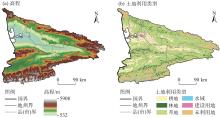
图1
研究区示意图 注:基于自然资源部标准地图服务网站审图号为GS(2024)0650号的标准地图制作,底图边界无修改。空白处为可克达拉市,因该市相关数据缺少,不在本研究范围内。下同。"
表1
数据来源"
| 数据名称 | 年份 | 来源 |
|---|---|---|
| CO2年排放量 | 2013—2023 | 全球大气研究排放数据库( |
| 逐日平均气温 | 2013—2023 | 美国国家环境信息中心( |
| 逐日日照时长 | 2013—2023 | 2013—2019年源自中国国家气象信息中心( |
| 逐年年降水量、蒸发量 | 2013—2023 | 中国国家气象信息中心( |
| SO2、NO2、PM2.5年排放量、植被覆盖度 | 2013—2023 | 国家青藏高原科学数据中心( |
| 逐年数字金融普惠指数 | 2013—2023 | 北京大学数字金融研究中心( |
| 逐年路网、河流水系面积 | 2013—2023 | 开放街道地图( |
| 逐年公司企业数量 | 2013—2023 | 企查查( |
| 逐年兴趣点(POI)数量 | 2013—2023 | 高德开放平台( |
| 地质灾害点数量 | 2019 | 中国科学院资源环境科学与数据平台( |
| 归一化植被指数(NDVI) | 2023 | 美国国家航空航天局( |
| 统计数据 | 2013—2023 | 《中国城市建设统计年鉴》《中国县域统计年鉴》《中国县城建设统计年鉴》《新疆统计年鉴》《伊犁哈萨克自治州统计年鉴》以及各县(市)国民经济和社会发展统计公报、政府财政决算报告 |
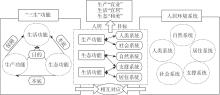
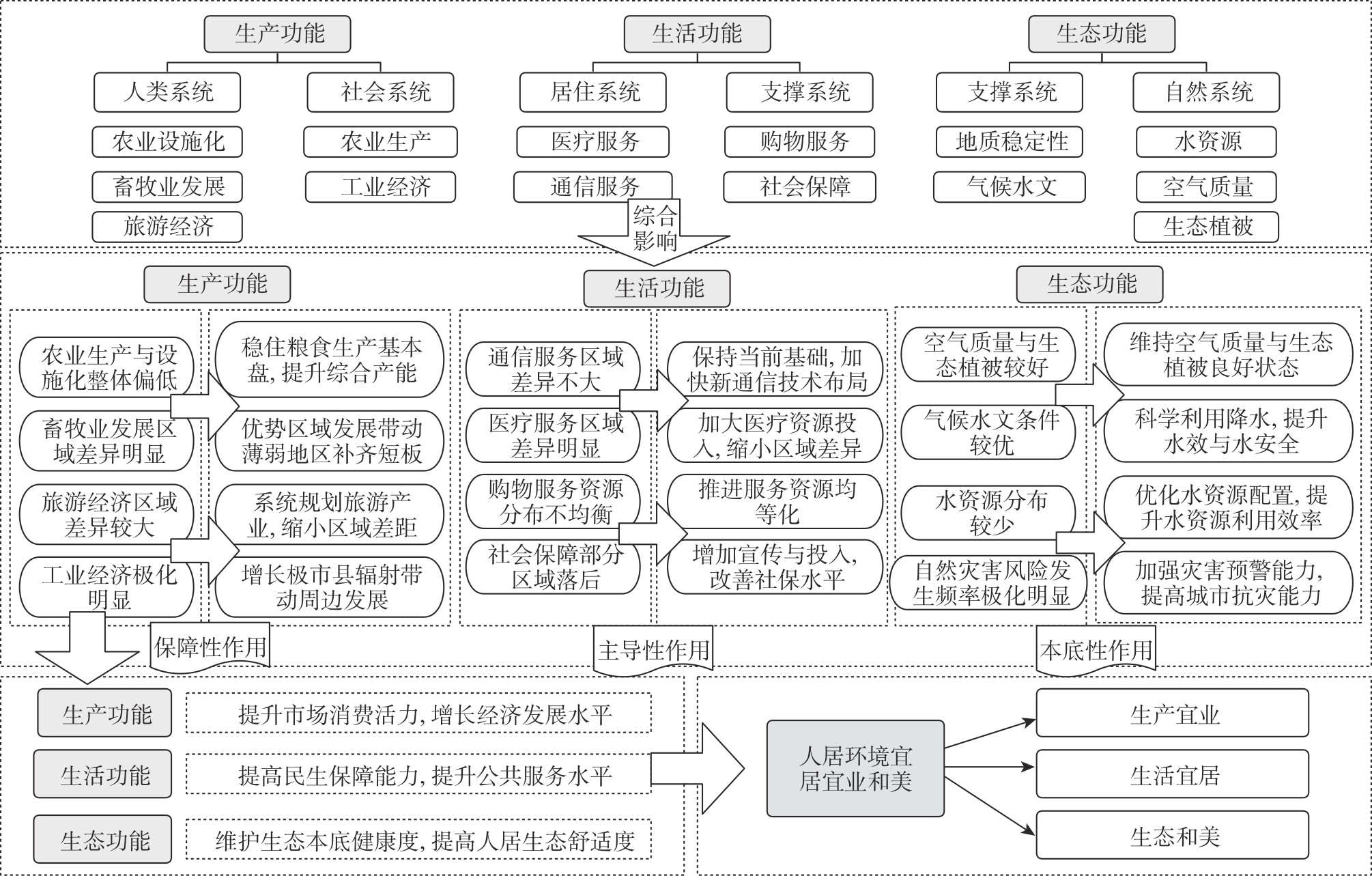
图2
“三生”功能视角下的伊犁河谷人居环境理论研究框架"
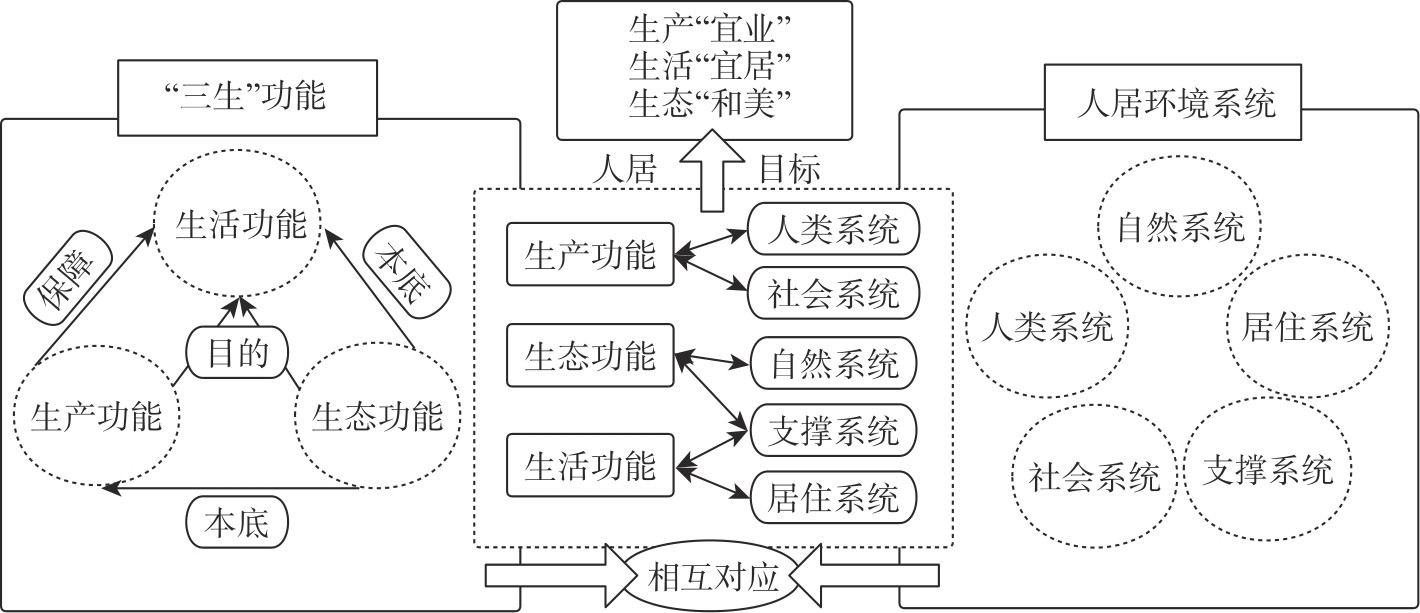
表2
伊犁河谷人居环境质量评价指标体系及权重"
| 目标层 | 准则层 | 指标层 | 指标权重 | 指标属性 | 参考依据 |
|---|---|---|---|---|---|
| 生产宜业 | 经济发展水平 | 人均居民储蓄存款余额/元·人-1 | 0.0238 | 正向 | [ |
| 人均农业机械总动力/kW·人-1 | 0.0464 | 正向 | [ | ||
| 公司企业密度/个·(104人)-1 | 0.0236 | 正向 | [ | ||
| 人均GDP/元·人-1 | 0.0406 | 正向 | [ | ||
| 市场消费活力 | 人均社会消费品零售总额/元·人-1 | 0.0238 | 正向 | [ | |
| 数字普惠金融指数 | 0.0450 | 正向 | [ | ||
| 第三产业比重/% | 0.0299 | 正向 | [ | ||
| 生活宜居 | 民生保障能力 | 中小学每生教育财政支出/元·人-1 | 0.0433 | 正向 | [ |
| 社会保障和就业支出比重/% | 0.0482 | 正向 | [ | ||
| 每万人床位数/张·(104人)-1 | 0.0406 | 正向 | [ | ||
| 公共服务水平 | 路网密度/km·km-2 | 0.0421 | 正向 | [ | |
| 每万人科教文化机构数/个·(104人)-1 | 0.0364 | 正向 | [ | ||
| 每万人体育休闲机构数/个·(104人)-1 | 0.0491 | 正向 | [ | ||
| 每万人餐饮机构数/个·(104人)-1 | 0.0453 | 正向 | [ | ||
| 生态和美 | 生态本底健康度 | 人均CO2排放量/t·人-1 | 0.0565 | 负向 | [ |
| PM2.5年平均浓度/μg·m-3 | 0.0574 | 负向 | [ | ||
| SO2年平均浓度/μg·m-3 | 0.0250 | 负向 | [ | ||
| 人居生态舒适度 | 植被覆盖面积比重/% | 0.0591 | 正向 | [ | |
| 人均公园绿地面积/m2·人-1 | 0.0384 | 正向 | [ | ||
| 温度(15~25 ℃)适宜日占全年比/% | 0.0578 | 正向 | [ | ||
| 日照(8~16 h)适宜日占全年比/% | 0.0704 | 正向 | [ | ||
| 风景名胜数量/个 | 0.0357 | 正向 | [ | ||
| 湿润系数 | 0.0514 | 正向 | [ |
表3
伊犁河谷人居环境质量影响因素指标体系"
| 准则层 | 表征层 | 指标层 | 指标属性 | 参考依据 |
|---|---|---|---|---|
| 生产功能 | 旅游经济 | 人均旅游收入/104元·人-1 | 正向 | [ |
| 农业设施化 | 设施农业种植比/% | 正向 | [ | |
| 畜牧业发展 | 人均牲畜出栏量/头·人-1 | 正向 | [ | |
| 农业生产 | 人均粮食产量/t·人-1 | 正向 | [ | |
| 工业经济 | 规模以上工业企业密度/个·(104人)-1 | 正向 | [ | |
| 生活功能 | 医疗服务 | 各类医疗卫生机构密度/个·(104人)-1 | 正向 | [ |
| 购物服务 | 购物服务机构密度/个·(104人)-1 | 正向 | [ | |
| 社会保障 | 城乡居民基本养老保险参保率/% | 正向 | [ | |
| 通信服务 | 通信工具(固定电话)使用率/个·(104人)-1 | 正向 | [ | |
| 生态功能 | 空气质量 | NO2年平均排放量/μg·m-3 | 负向 | [ |
| 生态植被 | NDVI | 正向 | [ | |
| 气候水文 | 年降水量/mm | 正向 | [ | |
| 水资源 | 水域面积比/% | 正向 | [ | |
| 地质稳定性 | 地质灾害发生次数/次 | 负向 | [ |
表4
人居环境耦合度发展阶段与协调度等级标准"
| 耦合度(C) | 发展阶段 | 耦合协调度(D) | 等级 |
|---|---|---|---|
| 0.0<C≤0.3 | 低水平耦合阶段 | 0.0<D≤0.1 | 极度失调 |
| 0.1<D≤0.2 | 严重失调 | ||
| 0.2<D≤0.3 | 中度失调 | ||
| 0.3<C≤0.5 | 拮抗阶段 | 0.3<D≤0.4 | 轻度失调 |
| 0.4<D≤0.5 | 濒临失调 | ||
| 0.5<C≤0.8 | 磨合阶段 | 0.5<D≤0.6 | 勉强协调 |
| 0.6<D≤0.7 | 初级协调 | ||
| 0.7<D≤0.8 | 中级协调 | ||
| 0.8<C≤1.0 | 高水平耦合阶段 | 0.8<D≤0.9 | 良好协调 |
| 0.9<D≤1.0 | 优质协调 |
图3
伊犁河谷各县(市)人居环境质量指数 注:霍尔果斯市于2014年成立,该区域人居环境质量评价从2014年开始。下同。"
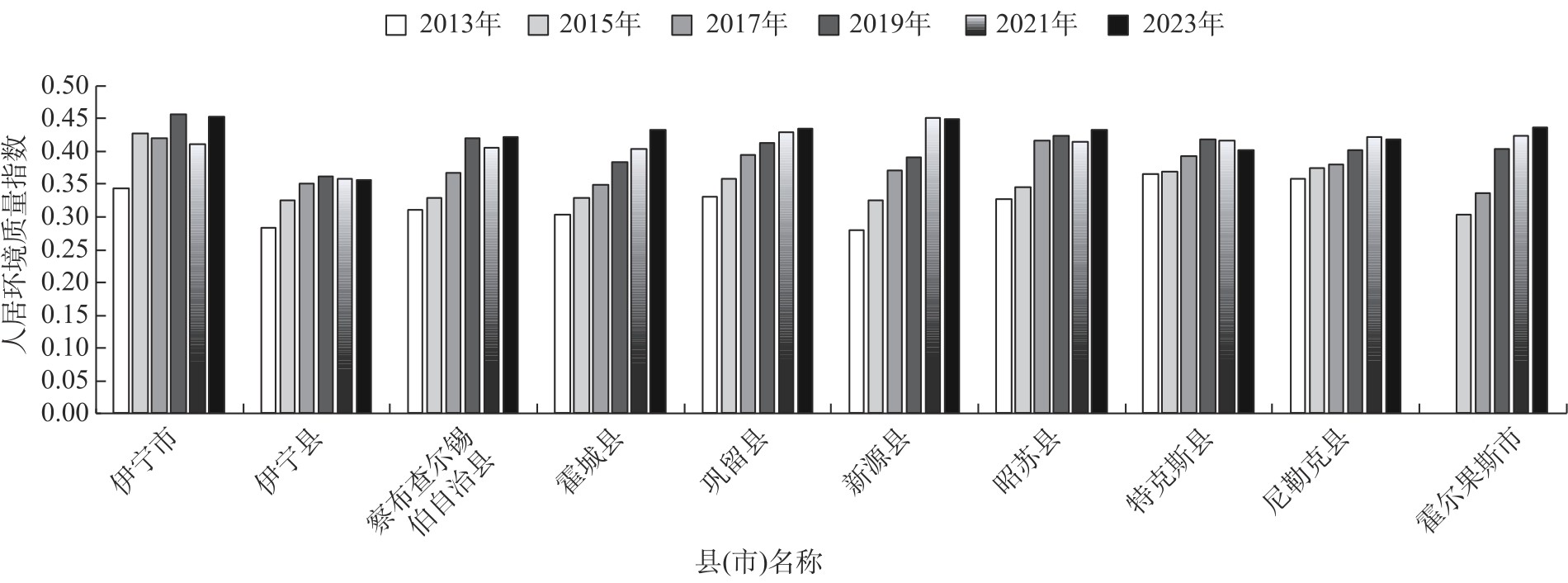
图4
伊犁河谷人居环境质量指数趋势"
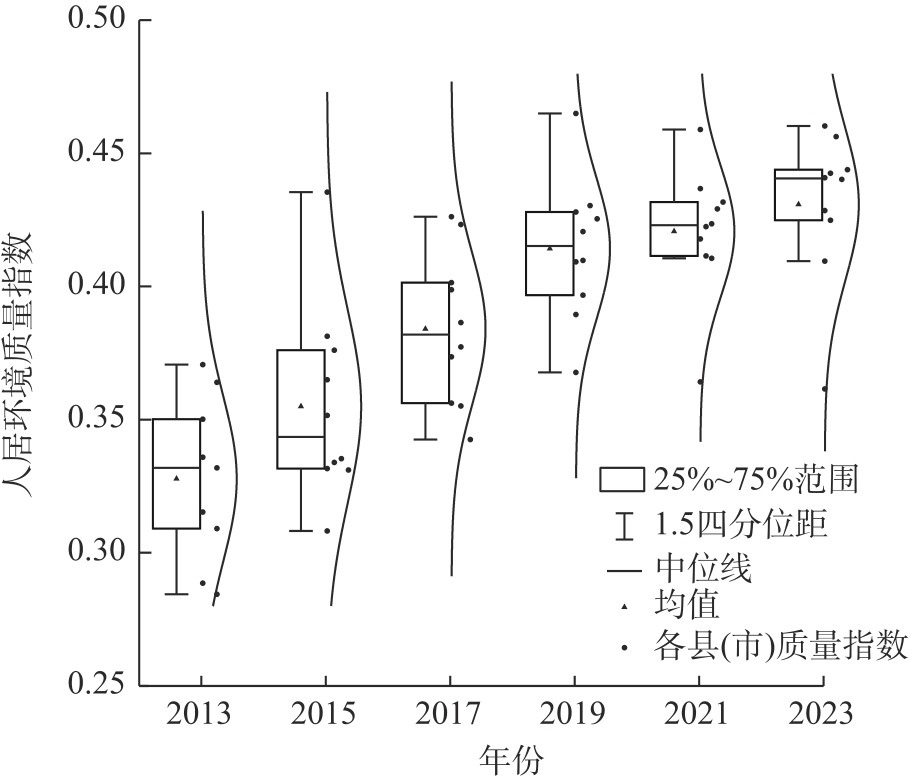
图5
伊犁河谷人居环境质量空间演变"
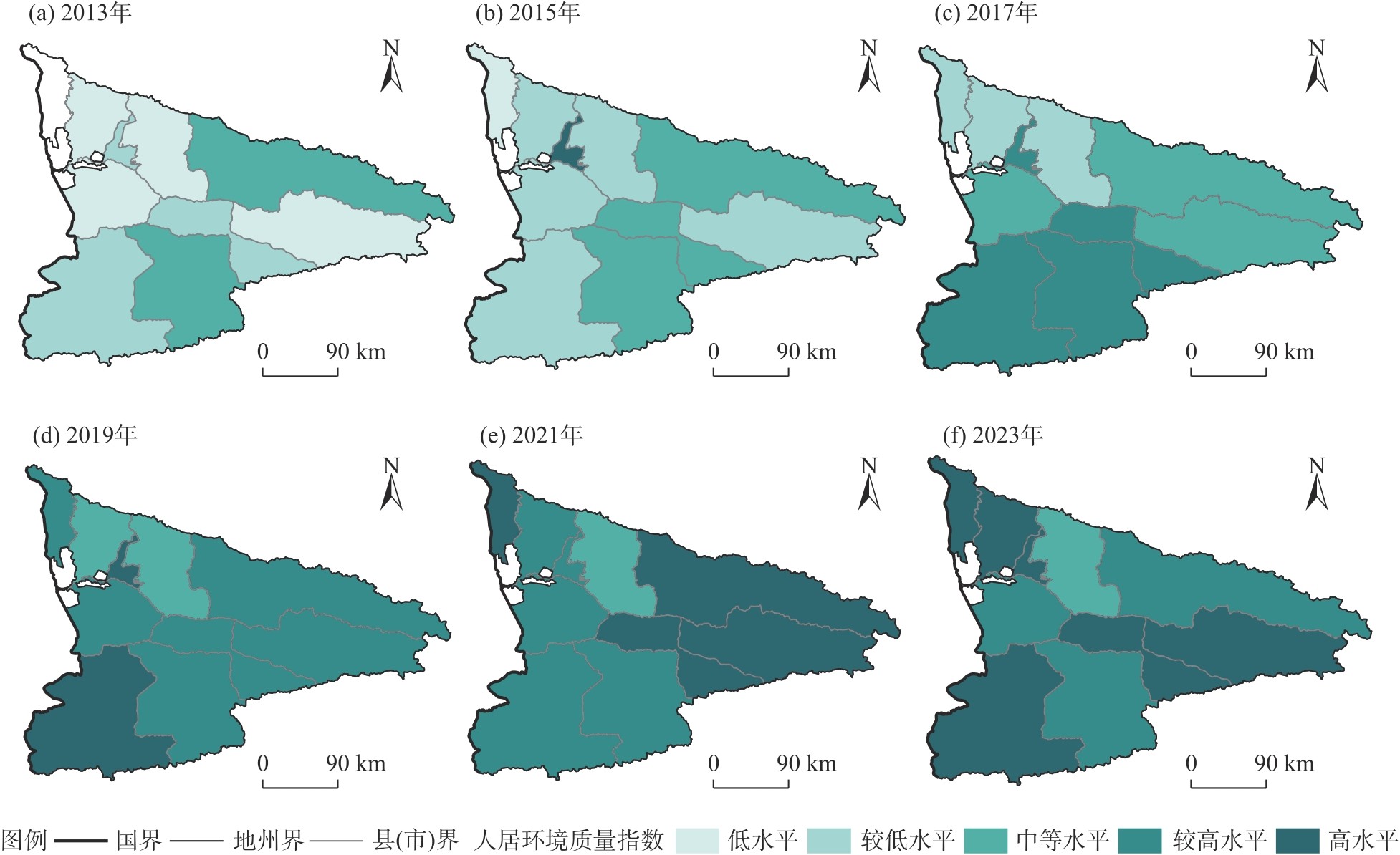
图6
伊犁河谷人居环境质量趋势面分析 注:X与Y表示研究区域内样点的平面坐标,通常为经度与纬度的投影值;Z表示人居环境质量指数。"
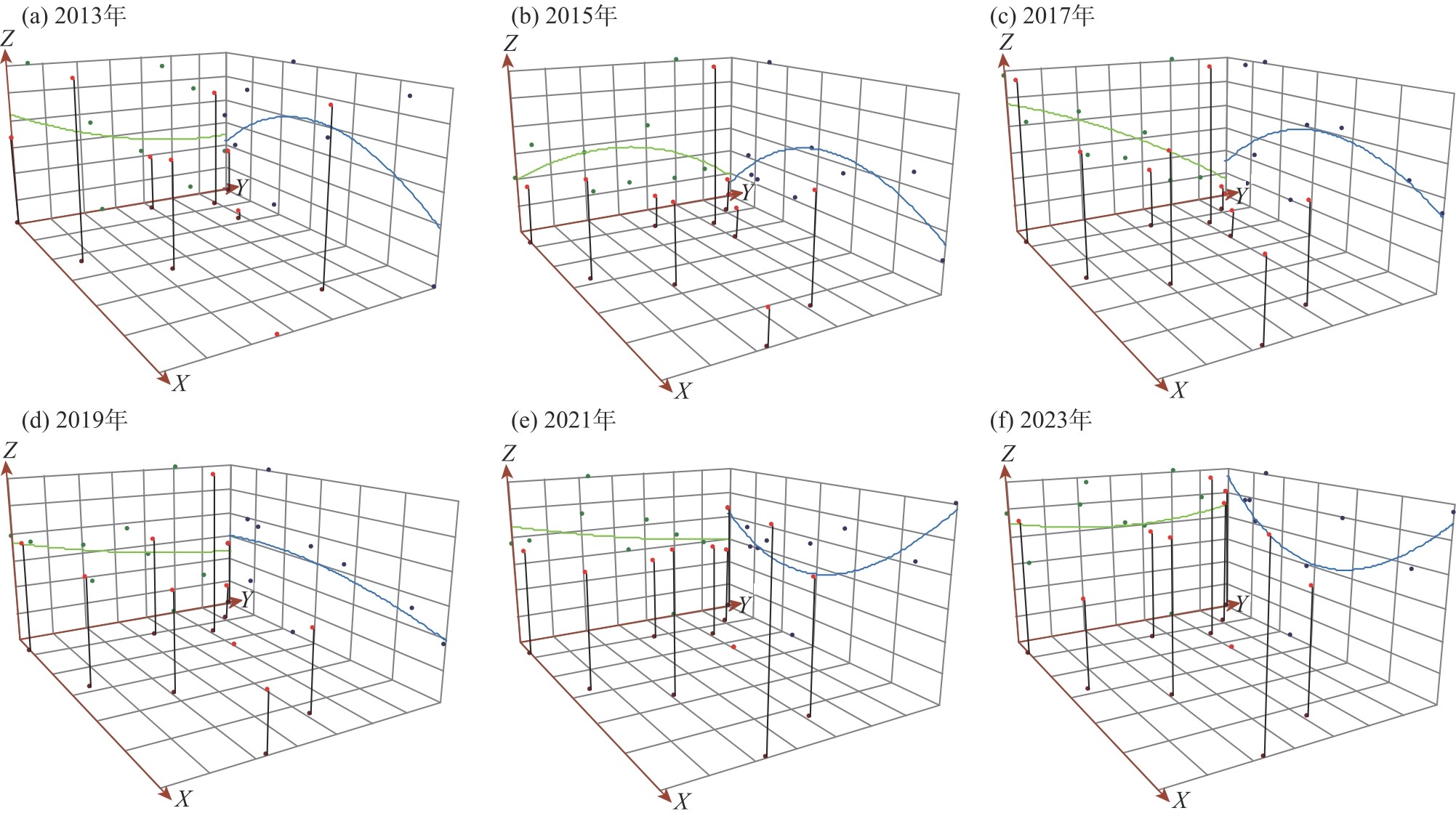
图7
伊犁河谷人居环境质量子系统历年变化统计"
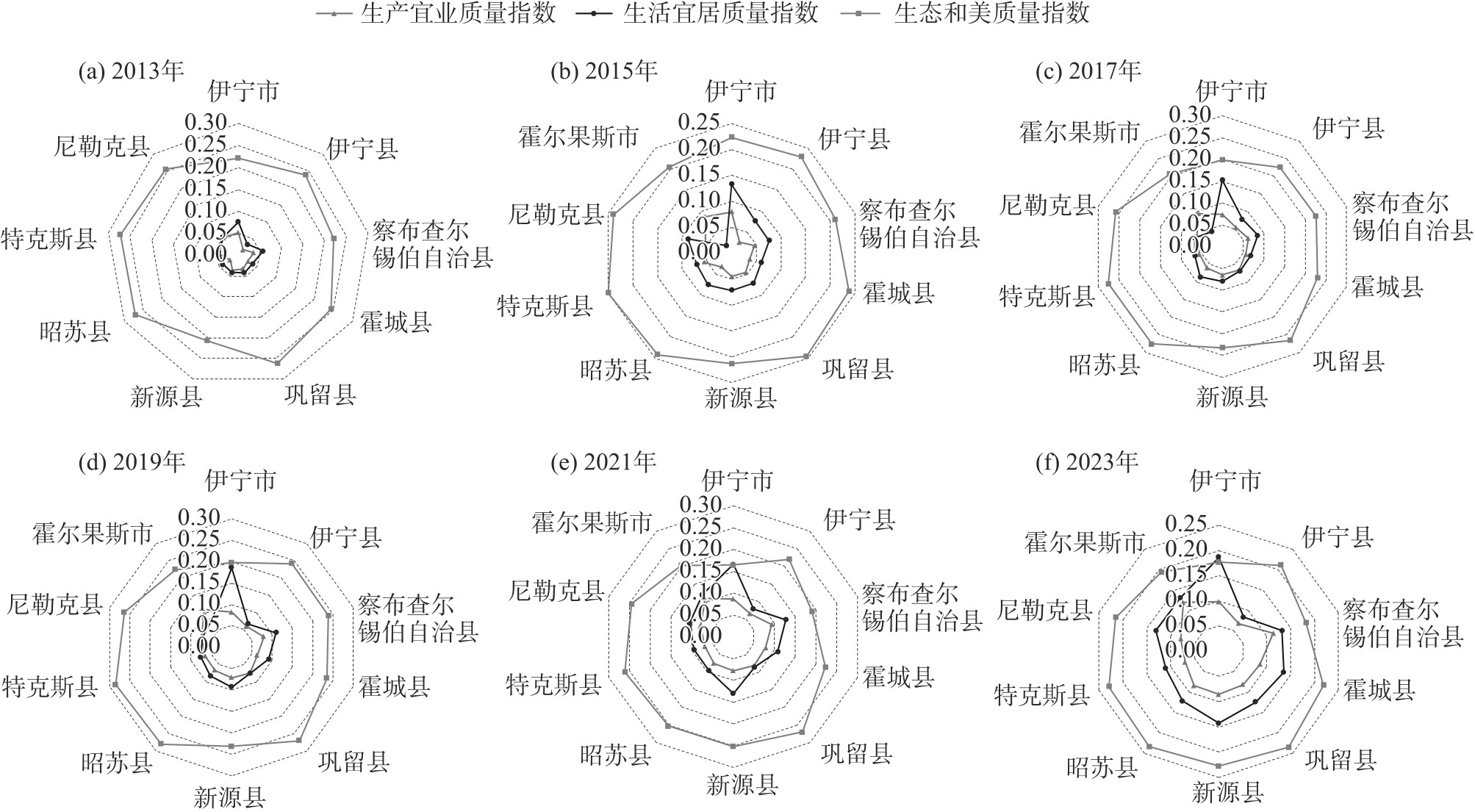
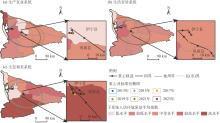
图8
伊犁河谷人居环境质量子系统重心迁移轨迹"
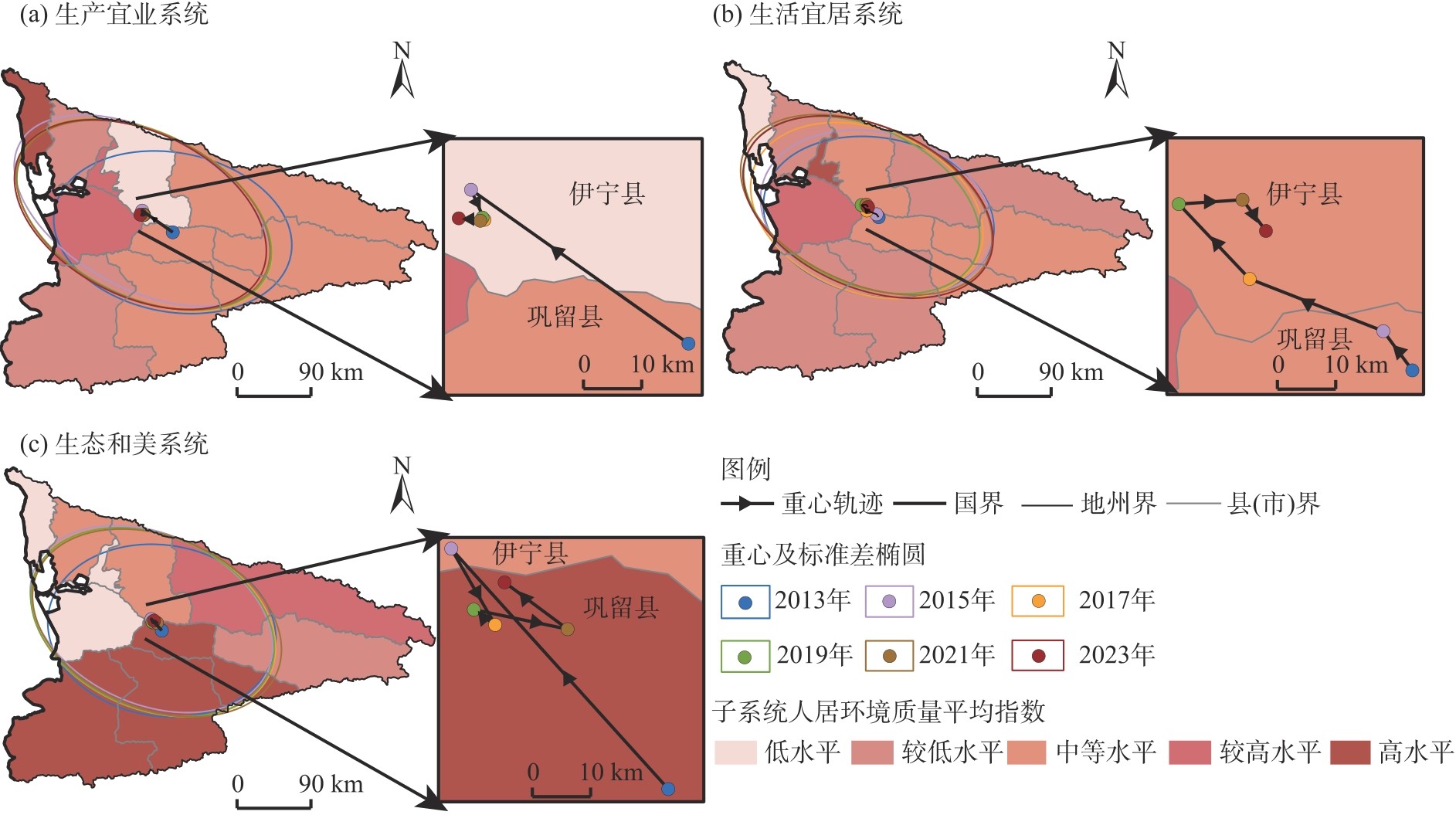
图9
伊犁河谷各县(市)人居环境质量子系统耦合度"
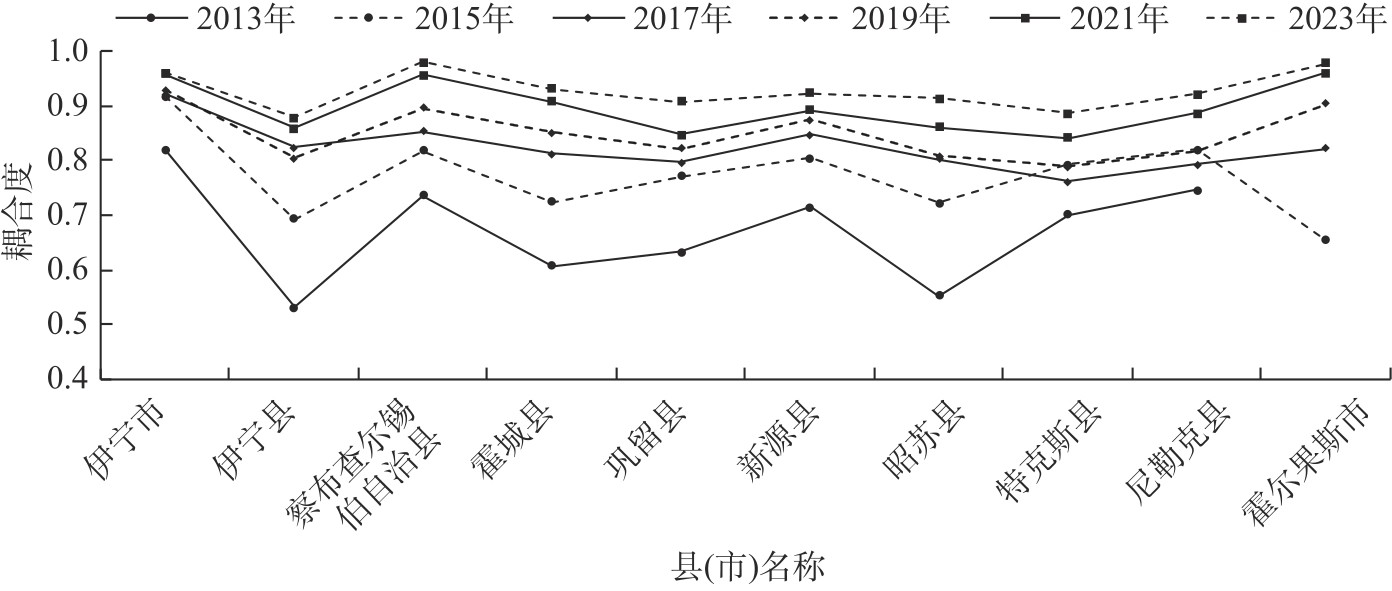
图10
伊犁河谷各县(市)人居环境质量子系统耦合协调度"
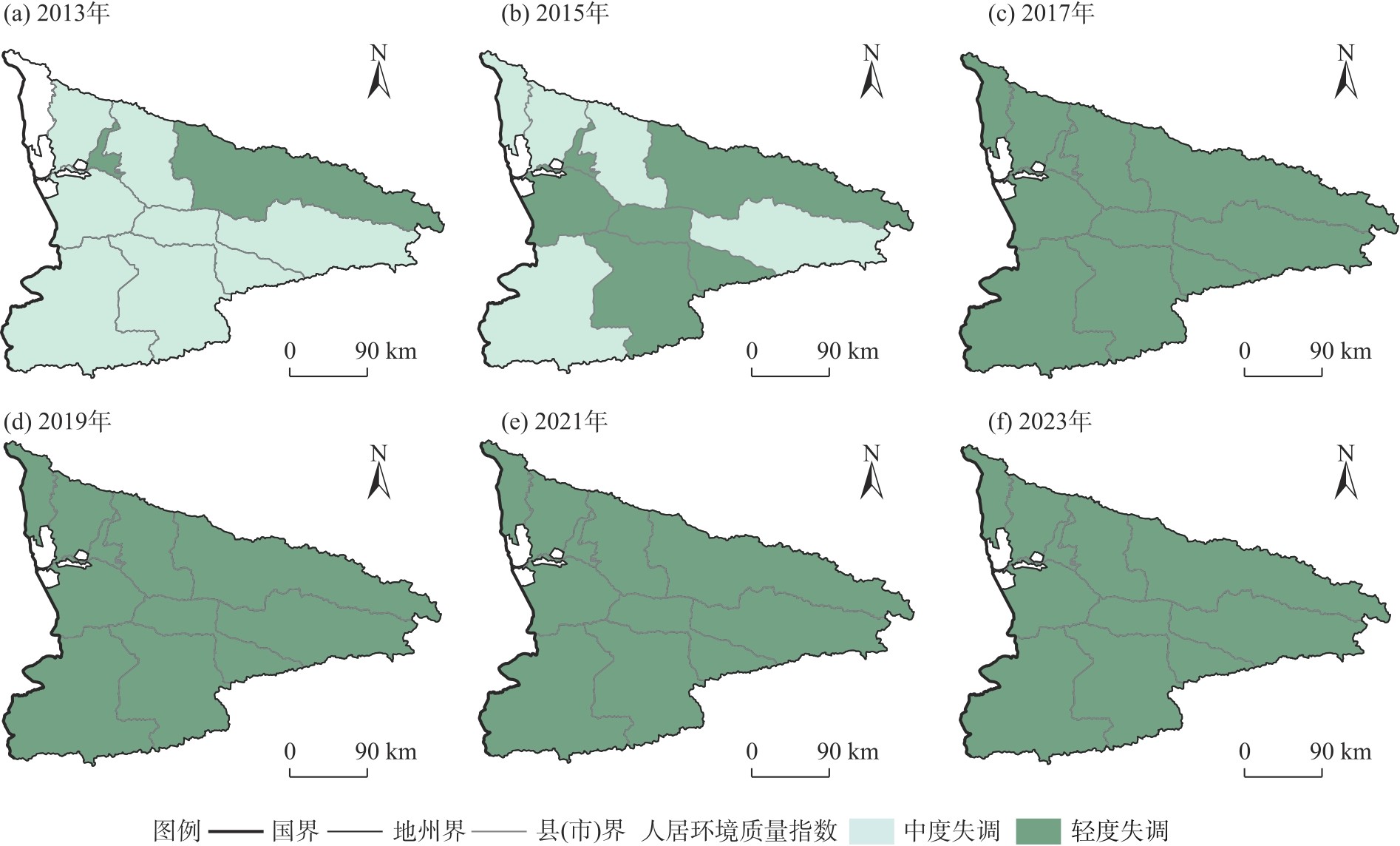
表5
模型可行性检验"
| 模型 | 均方误差 | 均方误差根 | 平均绝对误差值 | 平均绝对百分误差 | 中位数绝对误差 | 可解释方差分 | 决定系数 |
|---|---|---|---|---|---|---|---|
| XGBoost模型 | 0.000 | 0.001 | 0.000 | 0.000 | 0.000 | 1.000 | 1.000 |
| 随机森林模型 | 0.000 | 0.014 | 0.012 | 0.002 | 0.012 | 0.795 | 0.792 |
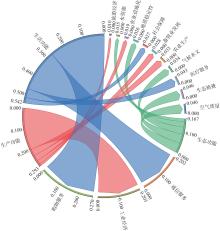
图11
伊犁河谷人居环境质量影响因素准则层与表征层重要性比较"
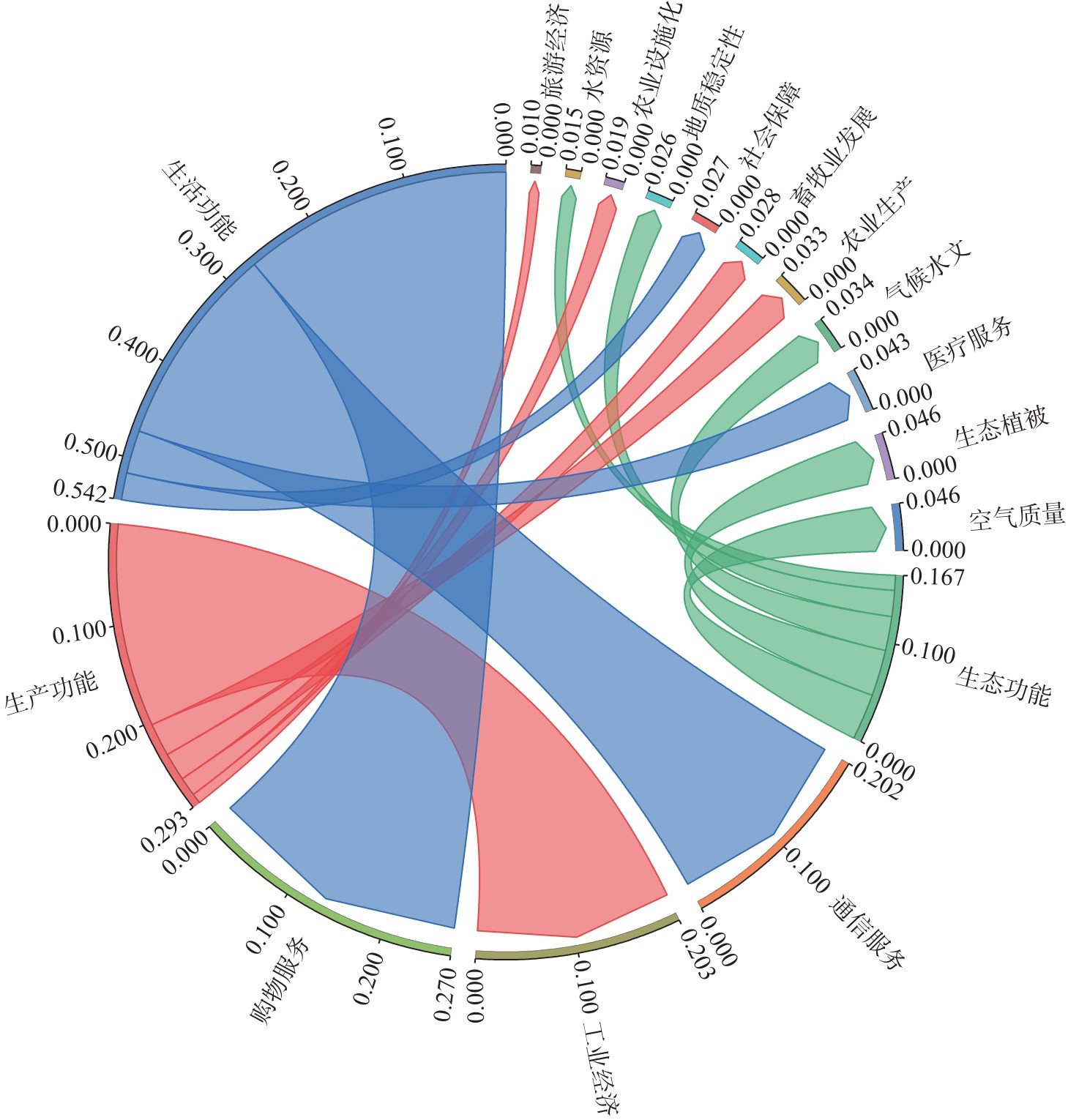
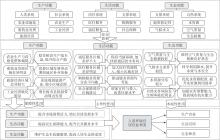
图12
伊犁河谷人居环境质量影响机制"
| [1] | 吴良镛. 人居环境科学导论[M]. 北京: 中国建筑工业出版社, 2001: 35-40. |
| [Wu Liangyong. Introduction to sciences of human settlements[M]. Beijing: China Architecture & Building Press, 2001: 35-40.] | |
| [2] |
李伯华, 曾灿, 窦银娣, 等. 基于“三生”空间的传统村落人居环境演变及驱动机制: 以湖南江永县兰溪村为例[J]. 地理科学进展, 2018, 37(5): 677-687.
doi: 10.18306/dlkxjz.2018.05.011 |
|
[Li Bohua, Zeng Can, Dou Yindi, et al. Change of human settlement environment and driving mechanism in traditional villages based on living-production-ecological space: A case study of Lanxi Village, Jiangyong County, Hunan Province[J]. Progress in Geography, 2018, 37(5): 677-687.]
doi: 10.18306/dlkxjz.2018.05.011 |
|
| [3] |
Doxiadis C A. Ekistics, the science of human settlements: Ekistics starts with the premise that human settlements are susceptible of systematic investigation[J]. Science, 1970, 170(3956): 393-404.
pmid: 5460051 |
| [4] |
Kim G, Kim J T. Healthy-daylighting design for the living environment in apartments in Korea[J]. Building and Environment, 2010, 45(2): 287-294.
doi: 10.1016/j.buildenv.2009.07.018 |
| [5] | Qin Y J, Wang L Z, Yu M, et al. The spatio-temporal evolution and transformation mode of human settlement quality from the perspective of “production-living-ecological” spaces: A case study of Jilin Province[J]. Habitat International, 2024, 145: 103021, doi: 10.1016/j.habitatint.2024.103021. |
| [6] | 王晓学, 林田苗, 吴秀芹. 土地利用时空变化对宁夏盐池县沙区人居环境的影响[J]. 浙江农林大学学报, 2014, 31(1): 111-116. |
| [Wang Xiaoxue, Lin Tianmiao, Wu Xiuqin. The impact of land use/land cover changes on human settlements in sandylands[J]. Journal of Zhejiang A & F University, 2014, 31(1): 111-116.] | |
| [7] | 潘丹, 张仪月, 陈苏. 财政分权、金融分权与农村人居环境治理[J]. 中国农业大学学报, 2025, 30(5): 248-261. |
| [Pan Dan, Zhang Yiyue, Chen Su. Fiscal decentralization, financial decentralization and rural habitat management[J]. Journal of China Agricultural University, 2025, 30(5): 248-261.] | |
| [8] | 徐冰鑫, 王鹏龙, 王勤花, 等. 面向SDGs的城市人居环境可持续发展评价研究进展与展望[J]. 西部人居环境学刊, 2025, 40(1): 41-50. |
| [Xu Bingxin, Wang Penglong, Wang Qinhua, et al. Progress and prospect of sustainable development evaluation of urban human settlement environment for SDGs[J]. Journal of Human Settlements in West China, 2025, 40(1): 41-50.] | |
| [9] | 樊亚明, 罗天佑, 李康明. 广西县域乡村人居环境质量评价及时空分异特征[J]. 中国农业资源与区划, 2023, 44(10): 167-178. |
| [Fan Yaming, Luo Tianyou, Li Kangming. Quality evaluation of rural human settlements and its spatio-temporal distribution characteristics at county level in Guangxi Province[J]. Chinese Journal of Agricultural Resources and Regional Planning, 2023, 44(10): 167-178.] | |
| [10] | 王蕾, 陈媛媛, 翟雅琳, 等. 乡村三生宜居性测度与多情景模拟预测——以泰来县为例[J]. 农业资源与环境学报, 2025, 42(2): 482-493. |
| [Wang Lei, Chen Yuanyuan, Zhai Yalin, et al. Measurement and multi-scenario simulation prediction of rural “production-living-ecological” livability: A case study of Tailai County[J]. Journal of Agricultural Resources and Environment, 2025, 42(2): 482-493.] | |
| [11] |
赵宏波, 谷天顺, 孙东琪, 等. “三生”功能视角下黄河流域城市人居环境动态演变与机制[J]. 地理学报, 2023, 78(12): 2973-2999.
doi: 10.11821/dlxb202312005 |
|
[Zhao Hongbo, Gu Tianshun, Sun Dongqi, et al. Dynamic evolution and influencing mechanism of urban human settlements in the Yellow River Basin from the perspective of “production-living-ecological” function[J]. Acta Geographica Sinica, 2023, 78(12): 2973-2999.]
doi: 10.11821/dlxb202312005 |
|
| [12] | Huang Y F, Li Z, Wu X H, et al. Mapping the stage-specific interactions in rural human settlements: A pathway to understanding rural objective well-being[J]. Applied Geography, 2025, 182: 103713, doi: 10.1016/j.apgeog.2025.103713. |
| [13] | 林峰, 信忠保, 彭钟彝. 青藏高原人居环境评估指标、评估框架及其时空变化[J]. 生态学报, 2024, 44(20): 9011-9028. |
| [Lin Feng, Xin Zhongbao, Peng Zhongyi. Human settlements on the Qinghai-Xizang Plateau assessment indicators, assessment framework and spatiotemporal changes[J]. Acta Ecologica Sinica, 2024, 44(20): 9011-9028.] | |
| [14] | Hu Q Y, Wang C. Quality evaluation and division of regional types of rural human settlements in China[J]. Habitat International, 2020, 105: 102278, doi: 10.1016/j.habitatint.2020.102278. |
| [15] |
朱媛媛, 孙璇, 揭毅, 等. 基于乡村振兴战略的人居文化环境质量测度与优化——以长江中游地区为例[J]. 经济地理, 2018, 38(9): 176-182.
doi: 10.15957/j.cnki.jjdl.2018.09.020 |
|
[Zhu Yuanyuan, Sun Xuan, Jie Yi, et al. Measurement and optimization of human cultural environment quality based on rural revitalization strategy: A case of the middle reaches of Yangtze River[J]. Economic Geography, 2018, 38(9): 176-182.]
doi: 10.15957/j.cnki.jjdl.2018.09.020 |
|
| [16] |
李广东, 方创琳. 城市生态-生产-生活空间功能定量识别与分析[J]. 地理学报, 2016, 71(1): 49-65.
doi: 10.11821/dlxb201601004 |
|
[Li Guangdong, Fang Chuanglin. Quantitative function identification and analysis of urban ecological-production-living spaces[J]. Acta Geographica Sinica, 2016, 71(1): 49-65.]
doi: 10.11821/dlxb201601004 |
|
| [17] | 李雪铭, 高梦珂, 田深圳, 等. 基于“三生”功能的人居环境耦合协调时空演变分析——以成渝城市群为例[J]. 辽宁师范大学学报(自然科学版), 2024, 47(4): 518-526. |
| [Li Xueming, Gao Mengke, Tian Shenzhen, et al. Spatiotemporal evolution coupling and coordination of human settlements based on the “production-living-ecological” functions in the Chengdu-Chongqing urban agglomeration in China[J]. Journal of Liaoning Normal University (Natural Science Edition), 2024, 47(4): 518-526.] | |
| [18] |
姚岚博, 冶建明, 王芸, 等. 干旱区人居环境系统耦合协调的时空演变及作用机制研究——以新疆为例[J]. 干旱区地理, 2023, 46(6): 1013-1023.
doi: 10.12118/j.issn.1000-6060.2022.262 |
|
[Yao Lanbo, Ye Jianming, Wang Yun, et al. Spatiotemporal evolution and mechanism of coupling coordination of human settlements system in arid area: A case of Xinjiang[J]. Arid Land Geography, 2023, 46(6): 1013-1023.]
doi: 10.12118/j.issn.1000-6060.2022.262 |
|
| [19] | Wang C, Wang H W, Wu J H, et al. Identifying and warning against spatial conflicts of land use from an ecological environment perspective: A case study of the Ili River Valley, China[J]. Journal of Environmental Management, 2024, 351: 119757, doi: 10.1016/j.jenvman.2023.119757. |
| [20] | 郭峰, 王靖一, 王芳, 等. 测度中国数字普惠金融发展: 指数编制与空间特征[J]. 经济学(季刊), 2020, 19(4): 1401-1418. |
| [Guo Feng, Wang Jingyi, Wang Fang, et al. Measuring China’s digital financial inclusion: Index compilation and spatial characteristics[J]. China Economic Quarterly, 2020, 19(4): 1401-1418.] | |
| [21] | 胡杨, 张紫昭, 林世河. 基于证据权与逻辑回归耦合的新疆伊犁河谷地区滑坡易发性评价[J]. 工程地质学报, 2023, 31(4): 1350-1363. |
| [Hu Yang, Zhang Zizhao, Lin Shihe. Evaluation of landslide susceptibility in Ili Valley, Xinjiang based on the coupling of WOE model and logistic regression[J]. Journal of Engineering Geology, 2023, 31(4): 1350-1363.] | |
| [22] |
黄安, 许月卿, 卢龙辉, 等. “生产-生活-生态”空间识别与优化研究进展[J]. 地理科学进展, 2020, 39(3): 503-518.
doi: 10.18306/dlkxjz.2020.03.014 |
|
[Huang An, Xu Yueqing, Lu Longhui, et al. Research progress of the identification and optimization of production-living-ecological spaces[J]. Progress in Geography, 2020, 39(3): 503-518.]
doi: 10.18306/dlkxjz.2020.03.014 |
|
| [23] |
黄金川, 林浩曦, 漆潇潇. 面向国土空间优化的三生空间研究进展[J]. 地理科学进展, 2017, 36(3): 378-391.
doi: 10.18306/dlkxjz.2017.03.014 |
|
[Huang Jinchuan, Lin Haoxi, Qi Xiaoxiao. A literature review on optimization of spatial development pattern based on ecological-production-living space[J]. Progress in Geography, 2017, 36(3): 378-391.]
doi: 10.18306/dlkxjz.2017.03.014 |
|
| [24] | 杨丹丽, 孙建伟, 张勇, 等. 基于“三生”功能的喀斯特山区农村居民点整治类型划分——以七星关区为例[J]. 中国土地科学, 2021, 35(11): 80-89. |
| [Yang Danli, Sun Jianwei, Zhang Yong, et al. Classification of consolidation type of rural settlements in Karst mountainous areas based on “production-living-ecological” functions: Taking Qixingguan District as an example[J]. China Land Science, 2021, 35(11): 80-89.] | |
| [25] | 钟洋, 查海焱, 吴智朋. 长株潭城市群人居环境质量评价及空间分异研究[J]. 水土保持研究, 2024, 31(5): 365-375. |
| [Zhong Yang, Zha Haiyan, Wu Zhipeng. Research on the quality evaluation and spatial differentiation of human settlement environment in the Changsha Zhuzhou Xiangtan urban agglomeration[J]. Research of Soil and Water Conservation, 2024, 31(5): 365-375.] | |
| [26] |
王艳飞, 李婷婷, 孟祥涛. 2010—2020年中国乡村人居环境质量评价及其演变特征[J]. 地理研究, 2022, 41(12): 3245-3258.
doi: 10.11821/dlyj020220131 |
| [Wang Yanfei, Li Tingting, Meng Xiangtao. Evaluation of China’s rural human settlements quality and its spatiotemporal change characteristics from 2010 to 2020[J]. Geographical Research, 2022, 41(12): 3245-3258.] | |
| [27] | 健康住宅建设技术要点(摘发)[J]. 城市开发, 2004(12): 46-50. |
| [Key technical points for healthy housing construction (excerpt)[J]. Urban Development, 2004(12): 46-50.] | |
| [28] | 李悦, 毛政元, 柯文岚. 福州市人居环境质量综合评价[J]. 华中师范大学学报(自然科学版), 2024, 58(4): 433-442. |
| [Li Yue, Mao Zhengyuan, Ke Wenlan. A comprehensive quality assessment of the human settlement environment in Fuzhou[J]. Journal of Central China Normal University (Natural Science Edition), 2024, 58(4): 433-442.] | |
| [29] | 谢鑫, 李和平, 李聪聪, 等. 基于BP神经网络的城乡融合发展动力识别与路径研究——以我国东、中、西部共72个典型区县为例[J]. 规划师, 2022, 38(10): 109-116. |
| [Xie Xin, Li Heping, Li Congcong, et al. Research on dynamics identification and development path of urban-rural integration based on BP neural network: A study of 72 typical counties in the east, middle, and west of China[J]. Planners, 2022, 38(10): 109-116.] | |
| [30] | 任历, 董欣, 徐琰雨, 等. 生态脆弱区乡村人居环境系统韧性特征及影响因素分析——以陕北黄土高原为例[J]. 中国农业资源与区划, 2025, 46(12): 24-41. |
| [Ren Li, Dong Xin, Xu Yanyu, et al. Study on the spatial and temporal evolution characteristics of the resilience of rural habitat system in ecologically fragile areas and mechanism of influence: Taking the Loses Plateau of northern Shaanxi as an example[J]. Chinese Journal of Agricultural Resources and Regional Planning, 2025, 46(12): 24-41.] | |
| [31] |
Wang Y, Zhu Y M, Yu M J. Evaluation and determinants of satisfaction with rural livability in China’s less-developed eastern areas: A case study of Xianju County in Zhejiang Province[J]. Ecological Indicators, 2019, 104: 711-722.
doi: 10.1016/j.ecolind.2019.05.054 |
| [32] | 林峰, 信忠保, 袁瑜贵, 等. 藏东南人居环境高质量发展模式及其实现路径[J]. 北京师范大学学报(自然科学版), 2024, 60(4): 583-593. |
| [Lin Feng, Xin Zhongbao, Yuan Yugui, et al. High quality development mode and realization path of human settlements in southeast of Xizang[J]. Journal of Beijing Normal University (Natural Science Edition), 2024, 60(4): 583-593.] | |
| [33] |
田深圳, 李雪铭, 杨俊, 等. 东北三省城市拟态与现实人居环境时空耦合协调特征与机制[J]. 地理学报, 2021, 76(4): 781-798.
doi: 10.11821/dlxb202104002 |
|
[Tian Shenzhen, Li Xueming, Yang Jun, et al. Spatio-temporal coupling coordination and driving mechanism of urban pseudo and reality human settlements in the three provinces of northeast China[J]. Acta Geographica Sinica, 2021, 76(4): 781-798.]
doi: 10.11821/dlxb202104002 |
|
| [34] |
Becker T, Rousseau A J, Geubbelmans M, et al. Decision trees and random forests[J]. American Journal of Orthodontics and Dentofacial Orthopedics, 2023, 164(6): 894-897.
doi: 10.1016/j.ajodo.2023.09.011 pmid: 38008491 |
| [35] | Dong F J, Hao J, Luo R M, et al. Identification of the proximate geographical origin of wolfberries by two-dimensional correlation spectroscopy combined with deep learning[J]. Computers and Electronics in Agriculture, 2022, 198: 107027, doi: 10.1016/j.compag.2022.107027. |
| [36] | 樊艳翔, 贺灿飞, 胡文伯, 等. 入境旅游与旅游碳排放耦合协调关系及影响机制——以云南省为例[J]. 生态学报, 2025, 45(11): 5147-5163. |
| [Fan Yanxiang, He Canfei, Hu Wenbo, et al. Coupling and coordination relationship and influencing mechanism of inbound tourism and tourism carbon emissions: A case study of Yunnan Province[J]. Acta Ecologica Sinica, 2025, 45(11): 5147-5163.] | |
| [37] | 余文梦, 张婷婷, 沈大军. 基于随机森林模型的我国县域碳排放强度格局与影响因素演进分析[J]. 中国环境科学, 2022, 42(6): 2788-2798. |
| [Yu Wenmeng, Zhang Tingting, Shen Dajun. County-level spatial pattern and influencing factors evolution of carbon emission intensity in China: A random forest model analysis[J]. China Environmental Science, 2022, 42(6): 2788-2798.] | |
| [38] |
李雅倩, 杨建华, 夏皓斌, 等. 2000—2022年伊犁河流域植被时空变化特征[J]. 干旱区地理, 2024, 47(5): 741-752.
doi: 10.12118/j.issn.1000-6060.2023.480 |
|
[Li Yaqian, Yang Jianhua, Xia Haobin, et al. Spatiotemporal variations of vegetation in the Ili River Basin from 2000 to 2022[J]. Arid Land Geography, 2024, 47(5): 741-752.]
doi: 10.12118/j.issn.1000-6060.2023.480 |
| [1] | 伍蕊, 孙慧兰, 叶茂, 金晓亮, 周玫玲, 杨涵, 吴芳. 新疆伊犁河谷植被覆盖度时空变化特征及驱动力分析[J]. 干旱区地理, 2026, 49(6): 1157-1167. |
| [2] | 包玉斌, 张慧娟, 杨雪茹, 王耀宗, 李樵民, 王科, 胡胜. 宁夏生态系统碳汇时空变化及潜力诊断分区[J]. 干旱区地理, 2026, 49(4): 740-755. |
| [3] | 杨嘉晖, 刘晓煌, 时鹏, 李鹏, 刘润, 祝萍, 马敏, 吴广杰. “三生”功能视角下额尔齐斯河流域空间优化调控研究[J]. 干旱区地理, 2026, 49(3): 581-593. |
| [4] | 张毅明, 汤宇磊, 冯俊波. 基于随机森林模型的青藏高原冰川预测及分析[J]. 干旱区地理, 2025, 48(8): 1342-1352. |
| [5] | 牟欢, 陈春艳, 杨霞, 赵丽. CMA-MESO模式暖季小时及日降水预报性能评估——以伊犁河谷为例[J]. 干旱区地理, 2025, 48(2): 179-189. |
| [6] | 马晓敏, 张志斌, 郭倩倩, 赵学伟, 张宁. 2000—2020年兰州市人口时空格局演变及驱动因素分析[J]. 干旱区地理, 2025, 48(1): 168-178. |
| [7] | 隋露, 闫志明, 李开放, 何佩恩, 马英杰, 张汝萃. 人类活动及气候变化影响下伊犁河谷生境质量预测研究[J]. 干旱区地理, 2024, 47(1): 104-116. |
| [8] | 潘群,施海洋,张文强,罗格平,陈春波. 基于Cubist模型的天山北坡草地鼠群密度时空分布特征[J]. 干旱区地理, 2022, 45(4): 1200-1211. |
| [9] | 姜丽,魏天兴,李亦然,魏安琪. 地形因子对陕北黄土丘陵区防护林树种分布的影响[J]. 干旱区地理, 2021, 44(6): 1763-1771. |
| [10] | 孙国军, 李卫红, 朱成刚, 崔 东, 刘海军 . 2000—2015 年伊犁河谷植被覆盖时空变化特征[J]. 干旱区地理, 2020, 43(6): 1551-1558. |
| [11] | 魏献花, 白永平, 车磊, 王栋, 效瑞, 张文娴. 基于栅格的关中平原城市群人居环境质量综合评价[J]. 干旱区地理, 2019, 42(5): 1176-1184. |
| [12] | 栾福明, 王芳, 熊黑钢. 伊犁河谷文化遗址时空分布及地理背景研究[J]. 干旱区地理, 2017, 40(1): 211-221. |
| [13] | 闫俊杰,乔木,周宏飞,周生斌,卢磊,宋鹏. 基于MODIS/NDVI的新疆伊犁河谷植被变化[J]. 干旱区地理, 2013, 36(3): 512-519. |
| [14] | 钱云. 伊犁河谷农用土地资源开发利用的若干问题[J]. 干旱区地理, 1995, 18(3): 8-14. |
|
||