干旱区地理 ›› 2026, Vol. 49 ›› Issue (11): 2318-2330.doi: 10.12118/j.issn.1000-6060.2025.865 cstr: 32274.14.ALG2025865
斯日吉模楞1( ), 李东亮1(), 曹明磊1,2
收稿日期:2025-12-30
修回日期:2026-03-11
出版日期:2026-11-25
发布日期:2026-11-13
通讯作者:
李东亮(1996-),男,硕士研究生,主要从事新质生产力研究. E-mail: 15054368601@163.com作者简介:斯日吉模楞(1989-),女,博士,主要从事资源型地区经济转型升级、自然资源与经济增长等方面的研究. E-mail: 13011806337@126.com论文构思:斯日吉模楞;数据管理:李东亮;规范分析:李东亮;获取资助:斯日吉模楞;调查研究:李东亮、曹明磊;方法设计:斯日吉模楞;项目管理:斯日吉模楞;提供资源:斯日吉模楞;软件编程:李东亮;监督指导:斯日吉模楞;验证复核:斯日吉模楞;可视化:李东亮;初稿撰写:斯日吉模楞、李东亮、曹明磊;修订编辑:李东亮。
基金资助:
SI Rijimoleng1(), LI Dongliang1(), CAO Minglei1,2
Received:2025-12-30
Revised:2026-03-11
Published:2026-11-25
Online:2026-11-13
摘要:
新质生产力是资源型城市顺应产业变革趋势的创新引领力量,能够在传统要素驱动的转型困境中注入发展新动能。解析其多维驱动机制,对探索资源型城市高质量发展的实现路径具有重要价值。构建资源型城市新质生产力与高质量发展水平的指标体系,利用2009—2023年中国103个资源型城市的面板数据测算综合指数,实证分析新质生产力与资源型城市高质量发展的作用机制,并考察其空间效应。结果表明:(1)空间分布上,资源型城市新质生产力整体呈现“东部较高、中部次之、西部和东北较低”的格局,高质量发展水平则呈现显著的集聚特征。(2)新质生产力对资源型城市高质量发展具有显著提升作用,基准回归系数为0.2。促进作用在生命周期阶段和区域位置上存在差异,但总体以正向影响为主。(3)新质生产力分别通过强化环境规制、推动产业结构转型升级、激发创业活力和发展数字技术赋能成长型、成熟型、衰退型和再生型4类资源型城市。(4)新质生产力对资源型城市高质量发展存在正向空间溢出效应。
斯日吉模楞, 李东亮, 曹明磊. 新质生产力助推中国资源型城市高质量发展机制研究[J]. 干旱区地理, 2026, 49(11): 2318-2330.
SI Rijimoleng, LI Dongliang, CAO Minglei. Mechanism of new quality productive forces promoting high-quality development of resource-based cities in China[J]. Arid Land Geography, 2026, 49(11): 2318-2330.

表1
资源型城市高质量发展水平评价指标体系"
| 目标层 | 准则层 | 指标层 | 指标说明 | 单位 | 属性 |
|---|---|---|---|---|---|
| 资源型城市高质量发展 | 资源 | 资源产业 | 规模以上工业总产值/地区生产总值 | % | 负 |
| 资源利用 | 规模以上工业总产值/工业用电量 | 104元·(104 kWh)-1 | 正 | ||
| 资源依赖 | 采掘业从业人员/总就业人口 | % | 负 | ||
| 创新 | 人才创新素养 | 高等学校在校生人数/年末总人口 | % | 正 | |
| 创新培养环境 | 教育支出/财政支出 | % | 正 | ||
| 开放 | 交通基础设施 | 公路里程数/年末总人口数 | km·(104人)-1 | 正 | |
| 对外开放环境 | 市场化指数 | - | 正 | ||
| 协调 | 产业结构高级化 | 第三产业增加值/第二产业增加值 | - | 正 | |
| 城乡收入差距 | 城镇居民人均可支配收入/农村居民人均可支配收入 | - | 负 | ||
| 经济增长率 | GDP增长率 | % | 正 | ||
| 绿色 | 单位工业二氧化硫排放产出 | 规模以上工业总产值/工业二氧化硫排放量 | 104元·t-1 | 正 | |
| 单位工业废水排放产出 | 规模以上工业总产值/工业废水排放量 | 104元·t-1 | 正 | ||
| 单位工业粉尘排放产出 | 规模以上工业总产值/工业粉尘排放量 | 104元·t-1 | 正 | ||
| 共享 | 人均教育支出 | 教育总支出/年末总人口数 | 104元·(104人)-1 | 正 | |
| 人均医疗资源 | 医院、卫生院床位/年末总人口数 | 张·(104人)-1 | 正 | ||
| 人均产出 | 人均GDP | 元·人-1 | 正 |
表2
资源型城市新质生产力测算指标体系"
| 目标层 | 准则层 | 指标层 | 指标说明 | 单位 | 属性 |
|---|---|---|---|---|---|
| 新质生产力 | 新质劳动力 | 新兴产业员工数量 | 战略新兴行业从业人数 | 人 | 正 |
| 员工个人能力 | 职工平均工资 | 元 | 正 | ||
| 员工高素质水平 | 普通高等学校数 | 个 | 正 | ||
| 新质劳动资料 | 新生产工具 | 机器人安装密度 | - | 正 | |
| 新基础设施 | 互联网宽带接入用户 | 103户 | 正 | ||
| 电信业务总量 | 108元 | 正 | |||
| 新质劳动对象 | 环境改善 | 碳交易、用能权交易和排污权交易 | 108元 | 正 | |
| 生活垃圾无害化处理率 | % | 正 | |||
| 新技术 | 科学技术支出 | 科学支出/财政支出 | % | 正 | |
| 创新产出 | 当年申请的发明专利数量 | 个 | 正 | ||
| 当年申请的实用新型专利数量 | 个 | 正 | |||
| 生产组织 | 智能化 | 人工智能企业数量 | 个 | 正 | |
| 绿色化 | 当年申请的绿色发明专利数量 | 个 | 正 | ||
| 当年申请的绿色实用新型专利数量 | 个 | 正 | |||
| 环境污染治理投资 | 108元 | 正 | |||
| 数据要素 | 大数据利用 | 上市公司数据资产相关词频数+1取对数 | - | 正 | |
| 大数据交易 | 有无数据交易平台(有=1,无=0) | - | 正 |
表3
变量描述性分析"
| 变量类型 | 变量 | 样本数 | 均值 | 标准差 | 最小值 | 最大值 |
|---|---|---|---|---|---|---|
| 被解释变量 | 资源型城市高质量发展(HQDL) | 1545 | 0.071 | 0.038 | 0.029 | 0.524 |
| 解释变量 | 新质生产力(NQP) | 1545 | 0.056 | 0.068 | 0.004 | 0.620 |
| 控制变量 | 财政分权度(FINADP) | 1545 | 0.397 | 0.179 | 0.055 | 1.116 |
| 开放水平(OPEN) | 1545 | 0.079 | 0.118 | 0.000 | 1.458 | |
| 金融发展水平(FINANCE) | 1545 | 2.195 | 0.789 | 0.588 | 8.777 | |
| 城镇化水平(URBAN) | 1545 | 0.345 | 0.201 | 0.075 | 1.000 | |
| 中介变量 | 环境规制(ER) | 180 | 0.030 | 0.011 | 0.000 | 0.071 |
| 产业结构转型升级(UIS) | 855 | 0.389 | 0.088 | 0.098 | 0.595 | |
| 创业活力(EN) | 315 | 110.099 | 58.284 | 27.267 | 473.848 | |
| 数字技术(DIG) | 195 | 1.991 | 2.137 | 0.008 | 10.189 |
图1
资源型城市新质生产力发展水平空间演变"
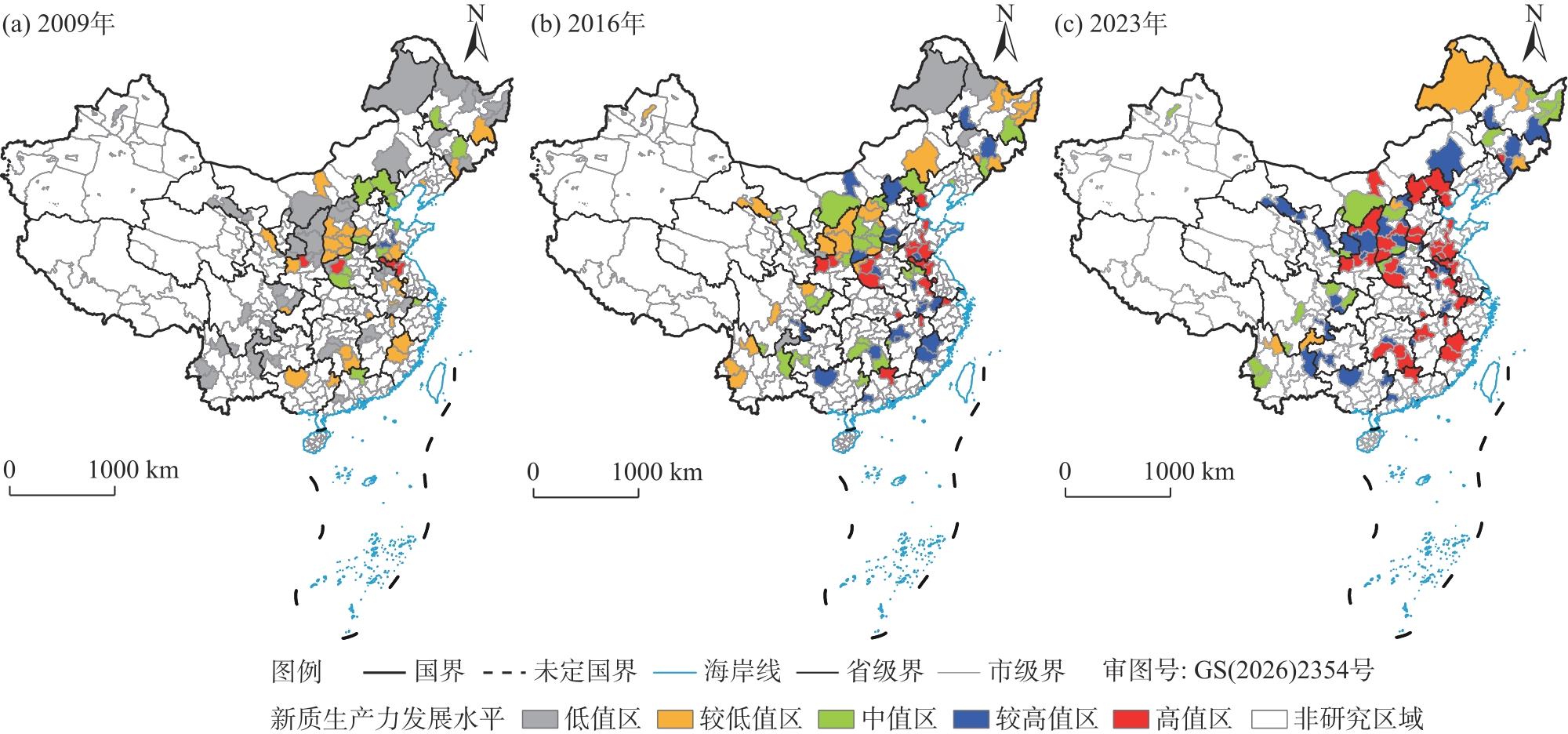
图2
资源型城市高质量发展水平空间演变"
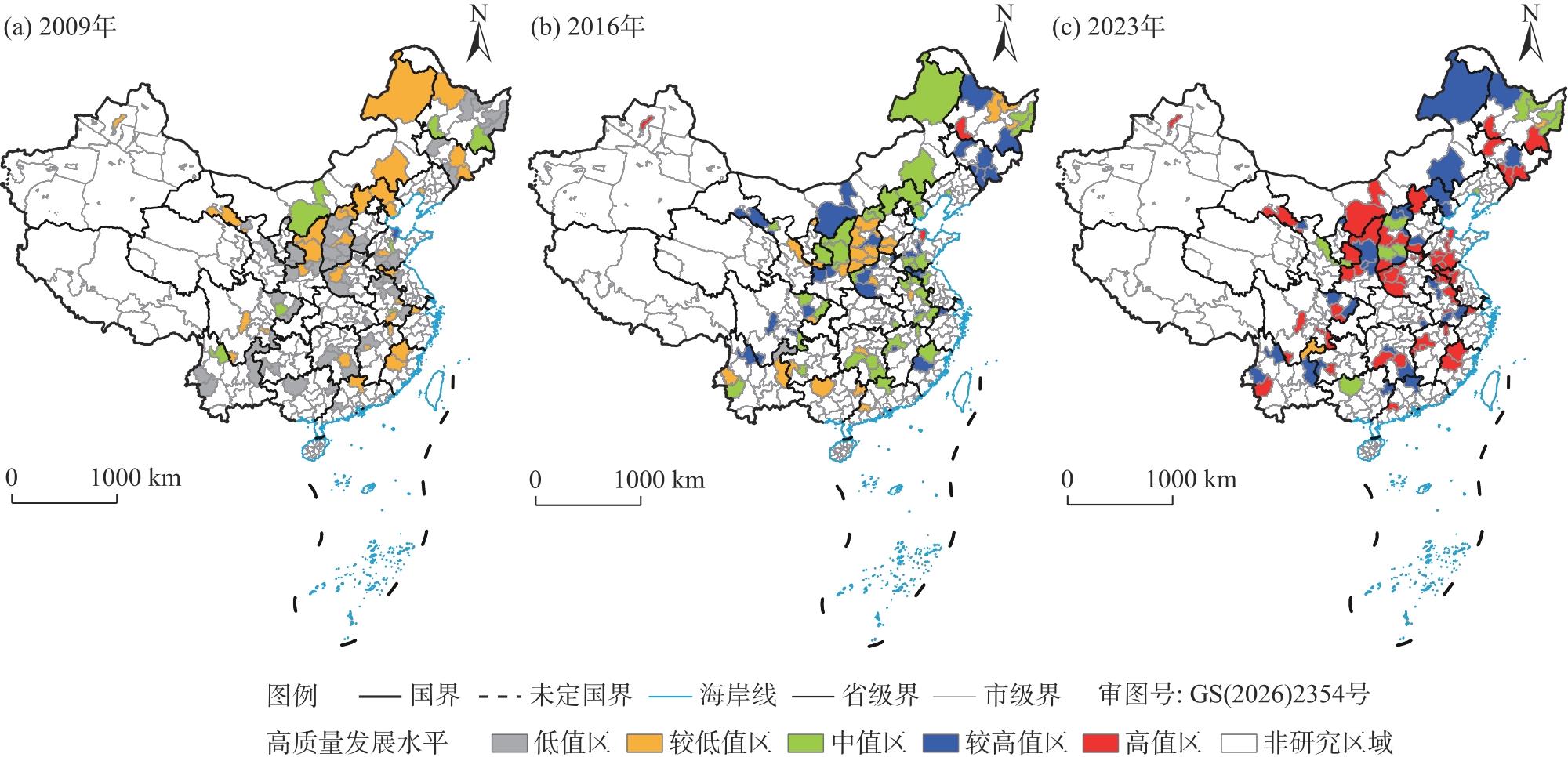
表4
基准回归结果"
| 变量 | 无控制变量的HQDL | 有控制变量的HQDL |
|---|---|---|
| NQP | 0.201***(5.493) | 0.200***(5.461) |
| FINADP | - | 0.055***(4.973) |
| OPEN | - | 0.020**(1.964) |
| URBAN | - | -0.021*(-1.928) |
| FINANCE | - | 0.003*(2.034) |
| 常数项 | 0.036***(14.065) | 0.014**(2.052) |
| 个体固定 | 是 | 是 |
| 时间固定 | 是 | 是 |
| 样本量 | 1545 | 1545 |
| R2 | 0.514 | 0.526 |
表5
内生性检验结果"
| 变量 | NQP | HQDL |
|---|---|---|
| L.NQP | 0.785***(14.820) | - |
| NQP | - | 0.295***(2.963) |
| 控制变量 | 是 | 是 |
| 不可识别检验 | 10.738(0.001) | |
| 弱工具变量 | 219.631(16.38) | |
| 个体固定 | 是 | 是 |
| 时间固定 | 是 | 是 |
| 样本量 | 1442 | 1442 |
表6
稳健性检验结果"
| 变量 | 双边缩尾 | 更换解释变量测算方法 | 子样本回归 |
|---|---|---|---|
| NQP | 0.166***(5.037) | 0.008***(3.365) | 0.171***(4.995) |
| 常数项 | 0.019***(3.496) | 0.026***(3.538) | 0.025***(3.632) |
| 控制变量 | 是 | 是 | 是 |
| 个体固定 | 是 | 是 | 是 |
| 时间固定 | 是 | 是 | 是 |
| 样本量 | 1545 | 1545 | 1133 |
| R2 | 0.630 | 0.520 | 0.509 |
表7
不同生命周期资源型城市异质性分析"
| 变量 | 成长型 | 成熟型 | 衰退型 | 再生型 |
|---|---|---|---|---|
| NQP | 0.475***(5.105) | 0.101*(1.808) | -0.081(-0.446) | 0.378***(8.896) |
| 常数项 | 0.001(0.057) | 0.022***(2.993) | 0.027(0.919) | -0.013(-0.923) |
| 控制变量 | 是 | 是 | 是 | 是 |
| 个体固定 | 是 | 是 | 是 | 是 |
| 时间固定 | 是 | 是 | 是 | 是 |
| 样本量 | 180 | 855 | 315 | 195 |
| R2 | 0.763 | 0.611 | 0.386 | 0.813 |
表8
不同生命周期资源型城市机制分析"
| 变量 | ER | UIS | EN | DIG |
|---|---|---|---|---|
| NQP | 0.133*(1.903) | 0.307**(2.560) | 347.788*(1.844) | 14.130***(5.472) |
| 常数项 | 0.035***(3.777) | 2.106***(134.446) | -43.285(-1.426) | 2.017**(2.426) |
| 控制变量 | 是 | 是 | 是 | 是 |
| 个体固定 | 是 | 是 | 是 | 是 |
| 时间固定 | 是 | 是 | 是 | 是 |
| 样本量 | 180 | 855 | 315 | 195 |
| R2 | 0.132 | 0.739 | 0.494 | 0.748 |
表9
不同区域资源型城市异质性分析"
| 变量 | 东部地区 | 中部地区 | 西部地区 | 东北地区 |
|---|---|---|---|---|
| NQP | 0.155***(5.095) | 0.037(0.294) | 0.247***(3.091) | 0.022(0.140) |
| 常数项 | 0.026**(2.239) | 0.004(0.264) | -0.001(-0.136) | 0.088***(2.712) |
| 控制变量 | 是 | 是 | 是 | 是 |
| 个体固定 | 是 | 是 | 是 | 是 |
| 时间固定 | 是 | 是 | 是 | 是 |
| 样本量 | 270 | 540 | 525 | 210 |
| R2 | 0.869 | 0.514 | 0.653 | 0.360 |
表10
空间杜宾模型结果"
| 变量 | 直接效应 | 间接效应 | 总效应 |
|---|---|---|---|
| NQP | 0.215*** (5.922) | 0.624* (1.720) | 0.839**(2.258) |
| FINADP | 0.048*** (4.699) | -0.209** (-2.156) | -0.161 (-1.633) |
| OPEN | 0.013 (1.383) | -0.426*** (-3.910) | -0.413*** (-3.750) |
| URBAN | -0.024** (-2.347) | -0.114 (-1.404) | -0.138* (-1.709) |
| FINANCE | 0.003* (1.954) | 0.000 (0.032) | 0.003 (0.298) |
| 个体固定 | 是 | 是 | 是 |
| 时间固定 | 是 | 是 | 是 |
| 样本量 | 1545 | ||
| R2 | 0.155 | ||
| [1] | 习近平经济思想研究中心. 新质生产力的内涵特征和发展重点[N]. 人民日报, 2024-03-01(009). |
| [Xi Jinping Economic Thought Research Center. The connotation and characteristics of new quality productive forces and development priorities[N]. People’s Daily, 2024-03-01(009).] | |
| [2] | 韩文龙. 新质生产力的政治经济学阐释[J]. 马克思主义研究, 2024(3): 100-115. |
| [Han Wenlong. A political economy explanation of the new quality productivity[J]. Studies on Marxism, 2024(3): 100-115.] | |
| [3] | 钞小静, 王清. 新质生产力驱动高质量发展的逻辑与路径[J]. 西安财经大学学报, 2024, 37(1): 12-20. |
| [Chao Xiaojing, Wang Qing. The logic and path of high-quality development driven by new quality productivity[J]. Journal of Xi’an University of Finance and Economics, 2024, 37(1): 12-20.] | |
| [4] | 张林, 蒲清平. 新质生产力的内涵特征、理论创新与价值意蕴[J]. 重庆大学学报(社会科学版), 2023, 29(6): 137-148. |
| [Zhang Lin, Pu Qingping. The connotation characteristic, theoretical innovation and value implication of new quality productivity[J]. Journal of Chongqing University (Social Science Edition), 2023, 29(6): 137-148.] | |
| [5] | 余东华, 马路萌. 数字化转型、平台化变革与企业创新绩效——基于“技术-组织-创新”范式的分析[J]. 改革, 2024(2): 55-74. |
| [Yu Donghua, Ma Lumeng. Digital transformation, platformization transformation and enterprise innovation performance: Analysis based on the paradigm of “technology-organization-innovation”[J]. Reform, 2024(2): 55-74.] | |
| [6] | 宋冬林, 丁文龙. 以新质生产力为抓手实现东北振兴新突破[J]. 学术交流, 2023(12): 105-122. |
| [Song Donglin, Ding Wenlong. Using new quality productivity as a lever to achieve new breakthroughs in revitalizing northeast China[J]. Academic Exchange, 2023(12): 105-122.] | |
| [7] | 张军扩, 侯永志, 刘培林, 等. 高质量发展的目标要求和战略路径[J]. 管理世界, 2019, 35(7): 1-7. |
| [Zhang Junkuo, Hou Yongzhi, Liu Peilin, et al. The goals and strategy path of high-quality development[J]. Journal of Management World, 2019, 35(7): 1-7.] | |
| [8] |
王珏. 中国资源型城市绿色转型的动力源泉及其驱动因素[J]. 经济地理, 2024, 44(4): 75-83, 99.
doi: 10.15957/j.cnki.jjdl.2024.04.008 |
|
[Wang Jue. Power source and driving factors of green transformation of resource-based cities in China[J]. Economic Geography, 2024, 44(4): 75-83, 99.]
doi: 10.15957/j.cnki.jjdl.2024.04.008 |
|
| [9] |
杨巨星, 孙慧, 周晋楠, 等. 中国资源型城市转型脱碳时空演进及路径选择[J]. 干旱区地理, 2026, 49(1): 151-163.
doi: 10.12118/j.issn.1000-6060.2024.743 |
|
[Yang Juxing, Sun Hui, Zhou Jinnan, et al. Spatiotemporal evolution and pathway selection of transformation decarbonization in resource-based cities of China[J]. Arid Land Geography, 2026, 49(1): 151-163.]
doi: 10.12118/j.issn.1000-6060.2024.743 |
|
| [10] | 姜雨, 王亚平, 程钰. 数字化发展对中国资源型城市经济韧性的影响[J]. 湖南师范大学自然科学学报, 2024, 47(6): 1-9. |
| [Jiang Yu, Wang Yaping, Cheng Yu. Influence of digital development on economic resilience of resource-based cities in China[J]. Journal of Natural Science of Hunan Normal University, 2024, 47(6): 1-9.] | |
| [11] |
杨贺, 薛东前, 宋永永. 中国资源型城市的收缩与转型关系研究[J]. 资源科学, 2025, 47(6): 1248-1262.
doi: 10.18402/resci.2025.06.07 |
|
[Yang He, Xue Dongqian, Song Yongyong. Study on relationship between shrinkage and transformation of resource-based cities in China[J]. Resources Science, 2025, 47(6): 1248-1262.]
doi: 10.18402/resci.2025.06.07 |
|
| [12] |
徐英启, 程钰, 王晶晶. 中国资源型城市碳排放效率时空演变与绿色技术创新影响[J]. 地理研究, 2023, 42(3): 878-894.
doi: 10.11821/dlyj020220256 |
| [Xu Yingqi, Cheng Yu, Wang Jingjing. The impact of green technological innovation on the spatiotemporal evolution of carbon emission efficiency of resource-based cities in China[J]. Geographical Research, 2023, 42(3): 878-894.] | |
| [13] |
赵明亮, 冯健康, 孙威. 环境规制影响资源型城市绿色全要素生产率的途径与政策建议[J]. 自然资源学报, 2023, 38(1): 186-204.
doi: 10.31497/zrzyxb.20230112 |
|
[Zhao Mingliang, Feng Jiankang, Sun Wei. Ways and policy suggestions of environmental regulation on green total factor productivity in resource-based cities[J]. Journal of Natural Resources, 2023, 38(1): 186-204.]
doi: 10.31497/zrzyxb.20230112 |
|
| [14] |
张文忠, 余建辉. 中国资源型城市转型发展的政策演变与效果分析[J]. 自然资源学报, 2023, 38(1): 22-38.
doi: 10.31497/zrzyxb.20230102 |
|
[Zhang Wenzhong, Yu Jianhui. Policy evolution and transformation effect analysis of sustainable development of resource-based cities in China[J]. Journal of Natural Resources, 2023, 38(1): 22-38.]
doi: 10.31497/zrzyxb.20230102 |
|
| [15] |
狄乾斌, 梁晨露, 陈小龙. 新质生产力赋能东北地区资源型城市高质量发展的机制与效应[J]. 地理科学进展, 2025, 44(8): 1578-1595.
doi: 10.18306/dlkxjz.2025.08.003 |
|
[Di Qianbin, Liang Chenlu, Chen Xiaolong. Mechanism and effects of new quality productivity empowering the high-quality development of resource-based cities in northeast China[J]. Progress in Geography, 2025, 44(8): 1578-1595.]
doi: 10.18306/dlkxjz.2025.08.003 |
|
| [16] |
王琦, 马丽. 新质要素驱动资源型城市产业转型的机制与路径研究[J]. 自然资源学报, 2026, 41(1): 308-326.
doi: 10.31497/zrzyxb.20260117 |
|
[Wang Qi, Ma Li. Mechanisms and pathways of industrial transformation in resource-based cities driven by new quality factors[J]. Journal of Natural Resources, 2026, 41(1): 308-326.]
doi: 10.31497/zrzyxb.20260117 |
|
| [17] |
李博, 梁铎瀚, 余建辉. 新质生产力视角下公共数据开放对资源型城市转型的影响[J]. 资源科学, 2024, 46(10): 1895-1911.
doi: 10.18402/resci.2024.10.01 |
|
[Li Bo, Liang Duohan, Yu Jianhui. The impact of public data access on the transformation of resource-based cities from the perspective of new quality productive forces[J]. Resources Science, 2024, 46(10): 1895-1911.]
doi: 10.18402/resci.2024.10.01 |
|
| [18] | 韩喜平, 马丽娟. 发展新质生产力与推动高质量发展[J]. 思想理论教育, 2024(4): 4-11. |
| [Han Xiping, Ma Lijuan. Developing new quality productive forces and promoting high-quality development[J]. Ideological & Theoretical Education, 2024(4): 4-11.] | |
| [19] | 任保平, 王子月. 数字新质生产力推动经济高质量发展的逻辑与路径[J]. 湘潭大学学报(哲学社会科学版), 2023, 47(6): 23-30. |
| [Ren Baoping, Wang Ziyue. The logic and path of digital new quality productivity promoting high quality economic development[J]. Journal of Xiangtan University (Philosophy and Social Sciences Edition), 2023, 47(6): 23-30.] | |
| [20] | 王艳华. 新质生产力驱动资源型城市高质量发展的理论逻辑与实践路径[J]. 河南大学学报(社会科学版), 2025, 65(2): 22-30, 152-153. |
| [Wang Yanhua. Research on mechanisms and pathways for driving high-quality development in resource-based cities through new quality productivity[J]. Journal of Henan University (Social Sciences Edition), 2025, 65(2): 22-30, 152-153.] | |
| [21] | 杜传忠, 疏爽, 李泽浩. 新质生产力促进经济高质量发展的机制分析与实现路径[J]. 经济纵横, 2023(12): 20-28. |
| [Du Chuanzhong, Shu Shuang, Li Zehao. Mechanism and path of new quality productivity in promoting high-quality economic development[J]. Economic Review Journal, 2023(12): 20-28.] | |
| [22] | 刘柳邑, 程钰, 赵鸿潇, 等. 黄河流域资源型城市绿色技术创新对碳排放效率的影响研究[J]. 干旱区资源与环境, 2025, 39(12): 12-25. |
| [Liu Liuyi, Cheng Yu, Zhao Hongxiao, et al. Impact of green technology innovation on carbon emission efficiency in resource-based cities along the Yellow River Basin[J]. Journal of Arid Land Resources and Environment, 2025, 39(12): 12-25.] | |
| [23] | 李海霞, 杜金柱. 新质生产力赋能产业结构升级——影响机制与空间溢出效应[J]. 山西财经大学学报, 2025, 47(4): 71-83. |
| [Li Haixia, Du Jinzhu. New quality productive forces empowering industrial structure upgrading: Influencing mechanism and spatial spillover effect[J]. Journal of Shanxi University of Finance and Economics, 2025, 47(4): 71-83.] | |
| [24] | 王珏, 吕德胜. 数字经济能否促进黄河流域高质量发展——基于产业结构升级视角[J]. 西北大学学报(哲学社会科学版), 2022, 52(6): 120-136. |
| [Wang Jue, Lü Desheng. Can digital economy promote high-quality development of the Yellow River Basin: A study from the perspective of industrial structure upgrading[J]. Journal of Northwest University (Philosophy and Social Sciences Edition), 2022, 52(6): 120-136.] | |
| [25] | 昌敦虎, 李明奎, 原佳倩, 等. 中国资源型城市可持续转型对促进就业和环境治理的影响——基于“人与自然和谐共生”视角的分析[J]. 人口研究, 2023, 47(3): 63-77. |
| [Chang Dunhu, Li Mingkui, Yuan Jiaqian, et al. The employment promotion and environment improvement through sustainable transformation in China’s resource-based cities: The perspective of harmonious co-existence between humanity and nature[J]. Population Research, 2023, 47(3): 63-77.] | |
| [26] |
阳杨, 郭佳钦, 王少国. 新质生产力、创业活跃度与城市高质量发展[J]. 科技进步与对策, 2024, 41(22): 1-12.
doi: 10.6049/kjjbydc.L2024XZ645 |
| [Yang Yang, Guo Jiaqin, Wang Shaoguo. New quality productive forces, entrepreneurial activity and high-quality urban development[J]. Science & Technology Progress and Policy, 2024, 41(22): 1-12.] | |
| [27] | 汤龙, 陈享光, 赵妍妍. 返乡创业能提高农村居民收入吗——基于返乡创业试点政策的考察[J]. 农业技术经济, 2024(7): 111-128. |
| [Tang Long, Chen Xiangguang, Zhao Yanyan. Can returning home for entrepreneurship improve the income of rural residents: Investigation based on the pilot policy of returning home for entrepreneurship[J]. Journal of Agrotechnical Economics, 2024(7): 111-128.] | |
| [28] | 朱高立, 圣莉, 杨清可, 等. 数字化转型对减污降碳协同的影响机制及门槛效应: 基于110个地级资源型城市的调查[J]. 环境科学, 2025, 46(12): 7513-7523. |
| [Zhu Gaoli, Sheng Li, Yang Qingke, et al. Impact mechanism and threshold effect of digital transformation on coordinated pollution and carbon reduction: An investigation based on 110 prefecture-level resource-based cities[J]. Environmental Science, 2025, 46(12): 7513-7523.] | |
| [29] | 孔祥忠. 数字新质生产力对产业链绿色转型的影响[J]. 中国流通经济, 2024, 38(10): 59-70. |
| [Kong Xiangzhong. The impact of digital new quality productive forces on the green transformation of industrial chain[J]. China Business and Market, 2024, 38(10): 59-70.] | |
| [30] | 韩文龙, 张瑞生, 赵峰. 新质生产力水平测算与中国经济增长新动能[J]. 数量经济技术经济研究, 2024, 41(6): 5-25. |
| [Han Wenlong, Zhang Ruisheng, Zhao Feng. The measurement of new quality productivity and new driving force of the Chinese economy[J]. Journal of Quantitative & Technological Economics, 2024, 41(6): 5-25.] | |
| [31] | 李小康, 鲍玮珺, 韦润. 新质生产力对长江经济带经济高质量发展的影响研究[J]. 水利经济, 2025, 43(6): 45-55, 109. |
| [Li Xiaokang, Bao Weijun, Wei Run. The impact of new quality productive forces on the high-quality economic development of the Yangtze River Economic Belt[J]. Journal of Economics of Water Resources, 2025, 43(6): 45-55, 109.] | |
| [32] |
曹婧博, 康琛宇. 数字经济驱动中国资源型城市高质量发展的门槛效应[J]. 资源科学, 2023, 45(11): 2234-2247.
doi: 10.18402/resci.2023.11.11 |
|
[Cao Jingbo, Kang Chenyu. The threshold effect of digital economy to promote the high-quality development of resource-based cities in China[J]. Resources Science, 2023, 45(11): 2234-2247.]
doi: 10.18402/resci.2023.11.11 |
|
| [33] | 江艇. 因果推断经验研究中的中介效应与调节效应[J]. 中国工业经济, 2022(5): 100-120. |
| [Jiang Ting. Mediating effects and moderating effects in causal inference[J]. China Industrial Economics, 2022(5): 100-120.] | |
| [34] | 许磊, 刘永团, 刘硕, 等. 新质生产力、资源配置效率对资源型城市产业结构升级的影响[J]. 中国矿业, 2025, 34(3): 33-42. |
| [Xu Lei, Liu Yongtuan, Liu Shuo, et al. Impact of new quality productive forces and resource allocation efficiency on industrial structure upgrading in resource-based cities[J]. China Mining Magazine, 2025, 34(3): 33-42.] | |
| [35] |
魏建飞, 袁悠燃, 李强, 等. 核心-边缘视角下黄河流域新质生产力空间关联网络结构及影响因素[J]. 经济地理, 2025, 45(11): 59-69.
doi: 10.15957/j.cnki.jjdl.2025.11.006 |
|
[Wei Jianfei, Yuan Youran, Li Qiang, et al. Spatial correlation network and influencing factors of new quality productive forces in the Yellow River Basin from the core-edge perspective[J]. Economic Geography, 2025, 45(11): 59-69.]
doi: 10.15957/j.cnki.jjdl.2025.11.006 |
|
| [36] |
高帅, 张务伟. 中国新质生产力与新型城镇化的协同演化研究[J]. 干旱区地理, 2025, 48(8): 1445-1456.
doi: 10.12118/j.issn.1000-6060.2025.150 |
|
[Gao Shuai, Zhang Wuwei. Synergistic evolution of new quality productivity and new urbanization in China’s provinces[J]. Arid Land Geography, 2025, 48(8): 1445-1456.]
doi: 10.12118/j.issn.1000-6060.2025.150 |
| [1] | 张毓利, 刘巧妹, 王思媛, 樊馨雨, 徐彤, 王彬彬. 中国式现代化与旅游高质量发展耦合协调的时空特征与动力机制研究[J]. 干旱区地理, 2026, 49(9): 1965-1976. |
| [2] | 史玉芳, 赵妍, 刘欣悦. 关中平原城市群新质生产力空间关联网络及影响因素研究[J]. 干旱区地理, 2026, 49(6): 1215-1225. |
| [3] | 杨岸. 中国农业新质生产力发展水平的测度、时空演进与障碍因素分析[J]. 干旱区地理, 2026, 49(6): 1226-1237. |
| [4] | 马小雯, 郭精军, 谢雁. 新质生产力对黄河流域城市绿色发展的赋能效应研究[J]. 干旱区地理, 2026, 49(6): 1238-1248. |
| [5] | 尹继娇, 杨扬, 徐新扬, 杨图南. 中国物流新质生产力与城市韧性的空间组织网络结构演化及驱动力[J]. 干旱区地理, 2026, 49(6): 1249-1263. |
| [6] | 吕宛青, 宋志高, 肖钊富. 中国新型城镇化与旅游业高质量发展耦合协调、障碍诊断及驱动因素[J]. 干旱区地理, 2026, 49(5): 1063-1073. |
| [7] | 卢雅焱, 封甜, 杨兆萍, 韩芳, 贾莹莹. 中国省域新质生产力与旅游高质量发展适配度时空演变及障碍因子研究[J]. 干旱区地理, 2026, 49(4): 643-655. |
| [8] | 王生霞, 武芯如. 新质生产力与文旅融合发展的协同演进及空间效应[J]. 干旱区地理, 2026, 49(4): 656-668. |
| [9] | 吴佩隆, 谢雪梅, 白凯. 新质生产力对中国省域旅游全要素生产率的影响研究[J]. 干旱区地理, 2026, 49(4): 669-682. |
| [10] | 刘法建, 梁婉欣, 黄超群, 李松渊, 张博涵. 中国旅游新质生产力发展时空演化特征与驱动因素[J]. 干旱区地理, 2026, 49(3): 429-439. |
| [11] | 石卓达, 杨宏伟. 新质生产力对中国生态旅游高质量发展的影响[J]. 干旱区地理, 2026, 49(3): 440-450. |
| [12] | 卢昭东, 秦璐, 马燕. 新质生产力对中国旅游经济高质量发展的影响[J]. 干旱区地理, 2026, 49(3): 451-461. |
| [13] | 史亚娟, 王永瑜, 罗雷. 农业水价综合改革对中国种植业高质量发展的影响与作用机制[J]. 干旱区地理, 2026, 49(3): 607-618. |
| [14] | 白洋, 陈明珠, 周春山, 李亚茹, 唐诚. 中国旅游新质生产力的演化测度与障碍识别[J]. 干旱区地理, 2026, 49(2): 211-223. |
| [15] | 周文丽, 武珊珊, 苏鹏. 新质生产力对旅游业高质量发展的影响效应研究——基于黄河流域9省区的实证[J]. 干旱区地理, 2026, 49(2): 224-234. |
|
||