干旱区地理 ›› 2026, Vol. 49 ›› Issue (6): 1288-1298.doi: 10.12118/j.issn.1000-6060.2025.596 cstr: 32274.14.ALG2025596
许可娟( ), 何瑛(), 王军
收稿日期:2025-09-25
修回日期:2025-11-12
出版日期:2026-06-25
发布日期:2026-06-29
通讯作者:
何瑛(1976-),女,教授,主要从事乡村旅游、文化旅游融合等方面的研究. E-mail: 1001257@luas.edu.cn作者简介:许可娟(1987-),女,副教授,主要从事智慧旅游等方面的研究. E-mail: xr.1121@163.com
基金资助:
XU Kejuan(), HE Ying(), WANG Jun
Received:2025-09-25
Revised:2025-11-12
Published:2026-06-25
Online:2026-06-29
摘要:
民宿在生态脆弱与欠发达地区的空间分布规律与形成机制,对优化区域旅游资源配置、推动文旅产业可持续协调发展具有重要意义。以甘肃省为例,运用最邻近指数、核密度估计、空间自相关分析与地理探测器,基于2667家民宿兴趣点数据及14项影响因子,探究民宿空间分布格局及驱动机制。结果表明:(1) 民宿空间分布高度聚集,呈现出“东密西疏、双核引领、‘勺子’状分布、边缘稀疏”的格局,兼具“集聚依赖”与“尺度敏感”双重特征。(2) 热点区集中于敦煌市、兰州市、陇南市沿线,次热点区环绕分布;天水市辖区、崆峒区、西峰区等区域内部差异显著;中东部多数县区为连片冷点区,区域发展不均衡。(3) 非民宿酒店密度是首要驱动因子,气候舒适度则作为关键的条件性调节因子,通过与核心因子的强交互作用显著驱动集聚。(4) 甘肃民宿发展遵循“设施-资源-环境”协同驱动的差异化逻辑,其空间格局既受顶级旅游资源宏观牵引,又在微观上高度依赖现有住宿设施与交通节点。
许可娟, 何瑛, 王军. 甘肃省民宿空间格局及影响因素研究[J]. 干旱区地理, 2026, 49(6): 1288-1298.
XU Kejuan, HE Ying, WANG Jun. Spatial distribution and influencing factors of homestays in Gansu Province[J]. Arid Land Geography, 2026, 49(6): 1288-1298.
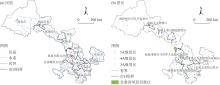
图1
甘肃省民宿空间分布 注:基于自然资源部标准地图服务网站审图号为GS(2019)3333号的标准地图制作,底图边界无修改。下同。"
表1
甘肃省民宿最邻近指数分析结果"
| 区域 | R | z得分 | 分布类型 | 典型特征 |
|---|---|---|---|---|
| 甘肃省 | 0.1307 | -85.879485 | 极强聚集 | - |
| 甘南州 | 0.1435 | -40.993991 | 极强 聚集区 | 要素高度集中于狭窄空间(如绿洲、河谷),受自然地形或旅游资源刚性约束 |
| 酒泉市 | 0.1463 | -32.583187 | ||
| 张掖市 | 0.1792 | -21.007829 | ||
| 陇南市 | 0.2097 | -28.164531 | ||
| 兰州市 | 0.2418 | -31.111134 | 强聚集区 | 聚集性显著,地形约束呈现弱化趋势 |
| 定西市 | 0.2876 | -13.214153 | ||
| 天水市 | 0.3036 | -18.507540 | ||
| 白银市 | 0.3362 | -8.424242 | ||
| 平凉市 | 0.3668 | -8.819701 | ||
| 武威市 | 0.4199 | -7.526988 | 中等 聚集区 | 点状城镇群分布,兼顾核心区聚集与部分扩散 |
| 临夏州 | 0.4351 | -8.229381 | ||
| 庆阳市 | 0.4853 | -7.499384 | ||
| 金昌市 | 0.5171 | -3.919032 | 弱聚集区 | 工业化城市布局相对均衡 |
| 嘉峪关市 | 0.5749 | -7.542445 |
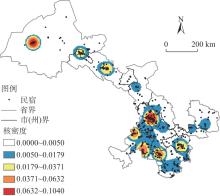
图2
甘肃省民宿核密度"
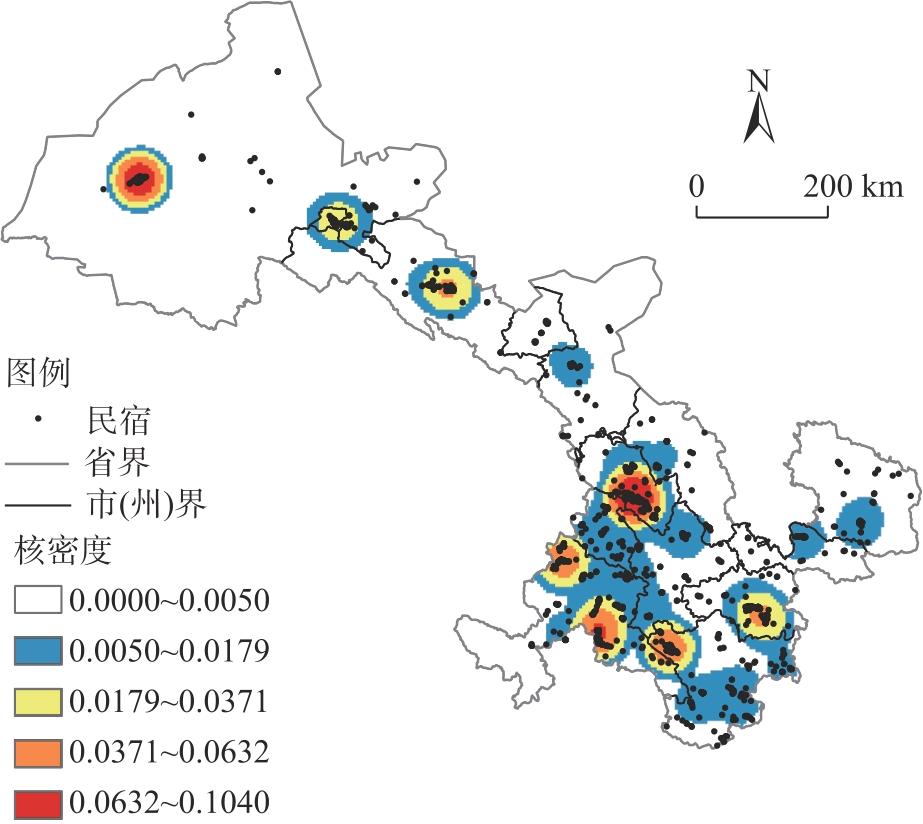
表2
甘肃省民宿全局Moran’s I"
| 地理尺度指数 | 5 km | 7.5 km | 10 km | 县域 | 市域 |
|---|---|---|---|---|---|
| 全局Moran’s I | 0.2407 | 0.1706 | 0.1451 | -0.0056 | -0.2664 |
| z得分 | 46.5121 | 22.8909 | 14.5770 | -0.1730 | -0.8689 |
| P值 | 0.0000 | 0.0000 | 0.0000 | 0.8627 | 0.3849 |
图3
甘肃省民宿集聚特征"
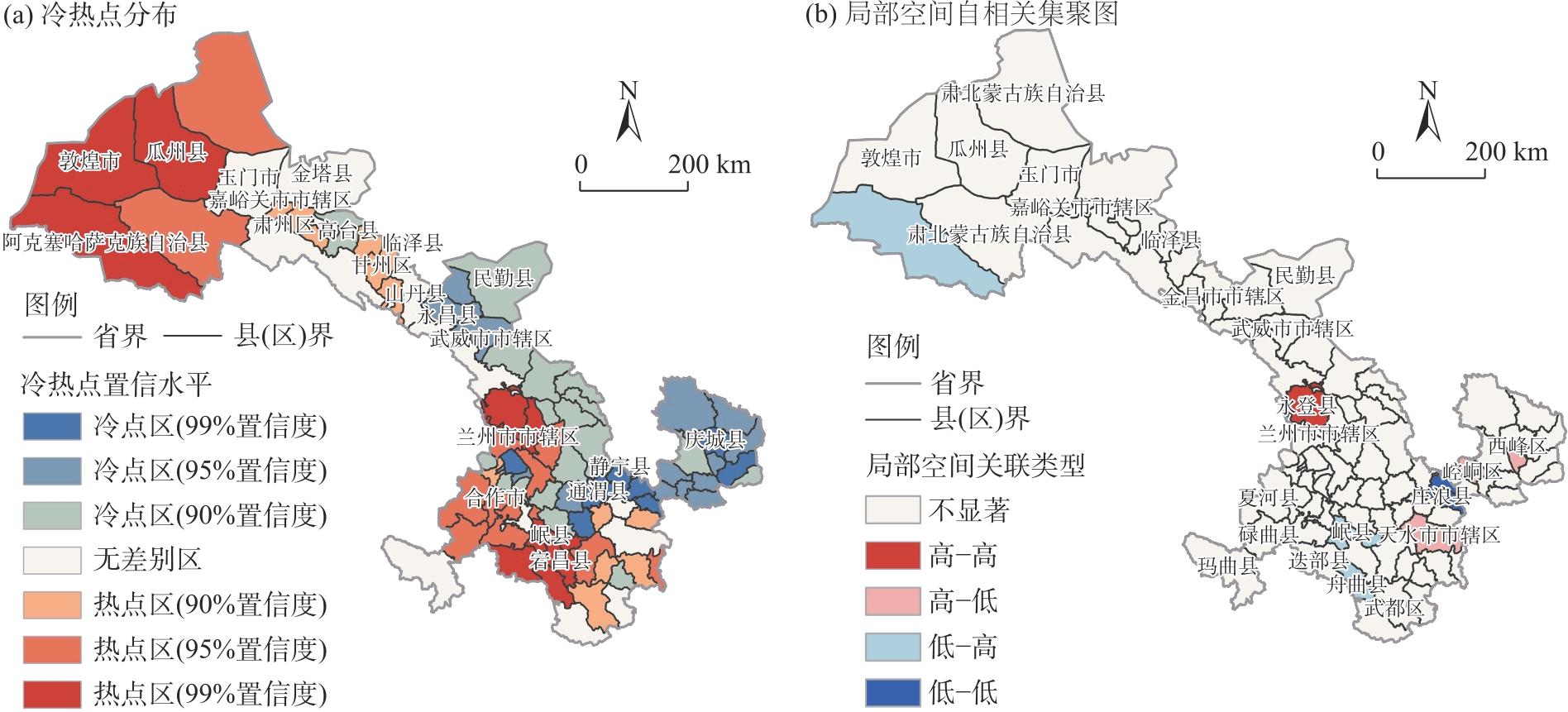
表3
影响因素指标选取与描述"
| 维度层 | 指标层 | 具体指标 | 解释力(q值) |
|---|---|---|---|
| 旅游资源禀赋 | X1 | 非民宿酒店密度[ | 0.375* |
| X2 | 景区核密度[ | 0.264* | |
| X3 | 文化及非遗密度[ | 0.188* | |
| X4 | 水系临近度[ | 0.004* | |
| 社会经济 | X5 | 城镇居民人均可支配收入[ | 0.096* |
| X6 | 乡村居民人均可支配收入[ | 0.098* | |
| X7 | 年均接待游客人次[ | 0.009* | |
| X8 | 人均GDP[ | 0.093* | |
| X9 | 人口密度[ | 0.089* | |
| 自然环境 | X10 | 海拔高程[ | 0.029* |
| X11 | 气候舒适度[ | 0.074* | |
| X12 | NDVI[ | 0.045* | |
| 交通与区位 | X13 | 路网密度[ | 0.009* |
| X14 | 夜间灯光强度[ | 0.014* |
表4
民宿空间分异因子交互结果"
| 序号 | 因子交互 | q值 | 序号 | 因子交互 | q值 |
|---|---|---|---|---|---|
| 1 | X1∩X11 | 0.548 | 6 | X2∩X8 | 0.483 |
| 2 | X1∩X9 | 0.498 | 7 | X2∩X11 | 0.473 |
| 3 | X1∩X6、X1∩X5 | 0.495 | 8 | X1∩X10 | 0.459 |
| 4 | X2∩X6 | 0.491 | 9 | X1∩X12 | 0.455 |
| 5 | X1∩X8 | 0.487 | 10 | X1∩X2 | 0.434 |
| [1] |
沈士琨, 史春云. 苏南、浙北地区民宿空间分布特征及其影响因素[J]. 热带地理, 2022, 42(1): 123-135.
doi: 10.13284/j.cnki.rddl.003417 |
|
[Shen Shikun, Shi Chunyun. Spatial distribution characteristics and influencing factors for homestays inns in southern Jiangsu and northern Zhejiang[J]. Tropical Geography, 2022, 42(1): 123-135. ]
doi: 10.13284/j.cnki.rddl.003417 |
|
| [2] | 国务院公报编辑部. 2025年3月第11946期国务院公报[EB/OL]. [2025-03-01]. https://www.gov.cn/gongbao/2025/issue_11946/202503/content_7015860.html. |
| [Gazette Office of the State Council. Gazette of the State Council of the People’s Republic of China, issue 11946, March 2025[EB/OL]. [2025-03-01]. https://www.gov.cn/gongbao/2025/issue_11946/202503/content_7015860.html.] | |
| [3] | 文化和旅游部, 公安部, 自然资源部, 等. 关于促进乡村民宿高质量发展的指导意见[J]. 中华人民共和国国务院公报, 2022(25): 38-41. |
| [Ministry of Culture and Tourism, Ministry of Public Security, Ministry of Natural Resources, et al. Guiding opinions on promoting the high-quality development of rural homestays[J]. Gazette of the State Council of the People’s Republic of China, 2022(25): 38-41. ] | |
| [4] | 中共中央国务院. 关于做好二〇二三年全面推进乡村振兴重点工作的意见[J]. 创造, 2023, 31(10): 1-7. |
| [Central Committee of the Communist Party of China, State Council. Opinions on doing a good job in the key work of comprehensively promoting rural revitalization in 2023[J]. Creation, 2023, 31(10): 1-7. ] | |
| [5] | 国务院公报编辑部. 2025年3月第11906期国务院公报[EB/OL]. [2025-03-12]. https://www.gov.cn/gongbao/2025/issue_11906/202503/content_7011166.html. |
| [Gazette Office of the State Council. Gazette of the State Council of the People’s Republic of China, issue 11906, March 2025[EB/OL]. [2025-03-12]. https://www.gov.cn/gongbao/2025/issue_11906/202503/content_7011166.html.] | |
| [6] | Adamiak C, Szyda B, Dubownik A, et al. Airbnb offer in Spain: Spatial analysis of the pattern and determinants of its distribution[J]. ISPRS International Journal of Geo-Information, 2019, 8(3): 155, doi: 10.3390/ijgi8030155. |
| [7] | Hei Y Y, Sui Y F, Gao W, et al. Geodetector: Based analysis of spatiotemporal distribution characteristics and influencing mechanisms for rural homestays in Beijing[J]. Land, 2025, 14(5): 997, doi: 10.3390/land14050997. |
| [8] |
Li Y, Dong D Y, Wang Y N. Exploring spatial distribution and influencing factors of B&Bs in Beijing-Tianjin-Hebei in the regional integration context based on big data[J]. Journal of Resources and Ecology, 2024, 15(3): 626-638.
doi: 10.5814/j.issn.1674-764x.2024.03.010 |
| [9] | Wang W X, Yao Q Y, Gu X, et al. Spatial distribution pattern and influencing factors of homestays in Chongqing, China[J]. Applied Sciences, 2022, 12(17): 8832, doi: 10.3390/app12178832. |
| [10] | Qiu Y S, Zhu Z M, Huang H P, et al. Study on the evolution of B&Bs spatial distribution based on exploratory spatial data analysis (ESDA) and its influencing factors: With Yangtze River Delta as an example[J]. European Journal of Remote Sensing, 2020, 54: 1-13. |
| [11] | 郝诗雨, 赵媛, 李可. 厦门市民宿的空间分布特征与影响因素研究[J]. 华中师范大学学报(自然科学版), 2018, 52(6): 916-924. |
| [Hao Shiyu, Zhao Yuan, Li Ke. Spatial distribution characteristics and influencing factors of bed and breakfast (B&B) in Xiamen City[J]. Journal of Central China Normal University (Natural Sciences), 2018, 52(6): 916-924. ] | |
| [12] | 金一, 杨敏哲, 关伟, 等. 湖南省民宿价格空间分布特征及其影响因素研究[J]. 地域研究与开发, 2022, 41(3): 111-116. |
| [Jin Yi, Yang Minzhe, Guan Wei, et al. Spatial distribution characteristics and influencing factors of bed and breakfast lodging prices in Hunan Province[J]. Areal Research and Development, 2022, 41(3): 111-116. ] | |
| [13] | 董之滔, 孙凤芝, 田菲菲, 等. 山东省民宿空间分布特征及影响因素研究[J]. 干旱区资源与环境, 2023, 37(2): 112-119. |
| [Dong Zhitao, Sun Fengzhi, Tian Feifei, et al. Spatial distribution characteristics of homestays in Shandong Province[J]. Journal of Arid Land Resources and Environment, 2023, 37(2): 112-119. ] | |
| [14] | 向雁, 侯艳林, 李福夺. 乡村民宿分布热点探测、空间格局及影响因素——以贵州省为例[J]. 中国农业资源与区划, 2024, 45(11): 130-141. |
| [Xiang Yan, Hou Yanlin, Li Fuduo. Spatial clustering hotspot detection, spatial clustering hotspot detection, distribution and influencing factors of rural homestay inns: A case study of Guizhou Province[J]. Chinese Journal of Agricultural Resources and Regional Planning, 2024, 45(11): 130-141. ] | |
| [15] |
吴诗涵, 杨国良, 李忠东, 等. 四川省乡村旅游空间分布特征及影响因素研究[J]. 地域研究与开发, 2024, 43(5): 88-93, 102.
doi: 10.3969/j.issn.1003-2363.2024.05.014 |
|
[Wu Shihan, Yang Guoliang, Li Zhongdong, et al. Study on spatial distribution characteristics and influencing factors of rural tourism in Sichuan Province[J]. Areal Research and Development, 2024, 43(5): 88-93, 102. ]
doi: 10.3969/j.issn.1003-2363.2024.05.014 |
|
| [16] | Hanim N S M, Redzuan O, Naufal N, et al. The homestay program in Malaysia: Motivation for participation and development impact[J]. Tourism: An International Interdisciplinary Journal, 2014, 62(4): 407-421. |
| [17] | 邱玮玮, 林业江. 国内外乡村民宿研究进展比较: 基于CiteSpace的分析[J]. 社会科学家, 2022(7): 46-52. |
| [Qiu Weiwei, Lin Yejiang. Comparison of research progress on rural homestays at home and abroad: Based on CiteSpace analysis[J]. Social Scientist, 2022(7): 46-52. ] | |
| [18] | 王彩彩, 邱依思, 徐虹, 等. 乡村民宿数字化转型对生存韧性的影响: “双阶动态能力”的中介效应[J]. 旅游学刊, 2025, 40(5): 45-58. |
| [Wang Caicai, Qiu Yisi, Xu Hong, et al. The impact of digital transformation on survival resilience of rural homestays: Mediating effect of “two-stage dynamic capability”[J]. Tourism Tribune, 2025, 40(5): 45-58. ] | |
| [19] | 马亮, 颜亭玉. 中国乡村民宿发展研究综述与展望[J]. 中国农业资源与区划, 2023, 44(12): 165-170. |
| [Ma Liang, Yan Tingyu. A review and prospect of research on the development of rural homestays in China[J]. Chinese Journal of Agricultural Resources and Regional Planning, 2023, 44(12): 165-170. ] | |
| [20] | 徐菲菲, 胡娟, 刘婧媛, 等. 乡村振兴背景下乡村民宿主创业动机与获得感研究[J]. 人文地理, 2023, 38(1): 140-146, 192. |
| [Xu Feifei, Hu Juan, Liu Jingyuan, et al. Research on village homestay of owners entrepreneurial motivation and the acquisition under the perspective of rural revitalization[J]. Human Geography, 2023, 38(1): 140-146, 192. ] | |
| [21] | 王斯亮, 邱铜铜. 中国地方政府制定乡村民宿发展政策的多元行动逻辑[J]. 干旱区资源与环境, 2024, 38(3): 22-30. |
| [Wang Siliang, Qiu Tongtong. The multiple action logic of local governments in formulating policies on rural homestay in China[J]. Journal of Arid Land Resources and Environment, 2024, 38(3): 22-30. ] | |
| [22] | 周伟伟, 胡春丽, 荣培君. 秦岭陕西段乡村民宿旅游空间分布及影响因素研究[J]. 中国农业资源与区划, 2024, 45(4): 235-246. |
| [Zhou Weiwei, Hu Chunli, Rong Peijun. Research on spatial distribution and influencing factors of rural homestay tourism in the Qinling Mountains Shaanxi section[J]. Chinese Journal of Agricultural Resources and Regional Planning, 2024, 45(4): 235-246. ] | |
| [23] | 蔡晓梅, 卜美玲, 吴泳琪, 等. 制造异托邦: 大城市周边乡村民宿集群的空间演变与机制——以深圳市较场尾为例[J]. 旅游学刊, 2022, 37(11): 27-39. |
| [Cai Xiaomei, Bu Meiling, Wu Yongqi, et al. Manufacturing Heterotopia: The spatial evolution and mechanism of rural homestay clustering around large cities: Case of Shenzhen Jiaochangwei[J]. Tourism Tribune, 2022, 37(11): 27-39. ] | |
| [24] | 徐远琪. 民宿发展演变及空间分布特征——以广东省民宿发展为例[J]. 智能城市, 2025, 11(2): 81-83. |
| [Xu Yuanqi. Evolution and spatial distribution characteristics of homestays: A case study of Guangdong Province[J]. Intelligent City, 2025, 11(2): 81-83. ] | |
| [25] | 王生霞, 窦煉美, 王登翠. 乡村民宿的时空演进及其影响因素研究——以浙江省为例[J]. 中国商论, 2025, 34(3): 82-86. |
| [Wang Shengxia, Dou Lianmei, Wang Dengcui. Study on the spatiotemporal distribution factors of rural homestays: Take Zhejiang Province as an example[J]. China Business Review, 2025, 34(3): 82-86. ] | |
| [26] | 黄婷. 基于POI数据的湖南省乡村民宿空间分异及驱动因素分析[J]. 现代农业研究, 2024, 30(7): 41-45. |
| [Huang Ting. Spatial differentiation and driving factors of rural homestays in Hunan Province based on POI data[J]. Modern Agricultural Research, 2024, 30(7): 41-45. ] | |
| [27] | 雷亚伦, 袁利彬, 王川, 等. 黔东南苗族传统聚落空间分布特征及影响因素[J]. 科学技术与工程, 2025, 25(9): 3861-3871. |
| [Lei Yalun, Yuan Libin, Wang Chuan, et al. Spatial characteristics and influencing factors of Miao traditional settlements in Qiandongnan[J]. Science Technology and Engineering, 2025, 25(9): 3861-3871. ] | |
| [28] | 董洁, 张爽, 周启上, 等. 甘肃省乡村旅游示范村空间格局及其影响因素归因分析[J]. 干旱区资源与环境, 2025, 39(7): 198-208. |
| [Dong Jie, Zhang Shuang, Zhou Qishang, et al. Spatial pattern of model rural tourism villages in Gansu Province and its influencing factors[J]. Journal of Arid Land Resources and Environment, 2025, 39(7): 198-208. ] | |
| [29] |
周晓芳, 邓俊. 中国乡村旅游地不平衡不充分发展及地域系统类型划分[J]. 地理学报, 2024, 79(2): 515-533.
doi: 10.11821/dlxb202402014 |
| [Zhou Xiaofang, Deng Jun. Unbalanced and inadequate development of rural tourism destinations and the types of areal systems in China[J]. Acta Geographical Sinica, 2024, 79(2): 515-533. ] | |
| [30] | 新华指数研究院, 中国经济信息社. 中国·甘肃乡村旅游发展指数报告(2025)[M]. 北京: 中国经济信息社, 2025. |
| [Xinhua Index Research Institute, China Economic Information Service. China Gansu rural tourism development index report (2025)[M]. Beijing: China Economic Information Service, 2025. ] | |
| [31] |
李鹏, 虞虎, 王英杰. 中国3A级以上旅游景区空间集聚特征研究[J]. 地理科学, 2018, 38(11): 1883-1891.
doi: 10.13249/j.cnki.sgs.2018.11.016 |
| [Li Peng, Yu Hu, Wang Yingjie. Spatial agglomeration characteristics of 3A-class to 5A-class scenic spots in China[J]. Scientia Geographical Sinica, 2018, 38(11): 1883-1891. ] | |
| [32] | Kumar A, Sharma R, Patel S. Automated web usage data mining and recommendation system using K-nearest neighbor classification method[J]. Journal of Intelligent Information Systems, 2021, 57(2): 345-362. |
| [33] | 张超, 杨秉赓. 计量地理学基础[M]. 北京: 高等教育出版社, 1991. |
| [Zhang Chao, Yang Binggeng. Foundation of quantitative geography[M]. Beijing: Higher Education Press, 1991. ] | |
| [34] |
杨燕, 胡静, 刘大均, 等. 贵州省苗族传统村落空间结构识别及影响机制[J]. 经济地理, 2021, 41(2): 232-240.
doi: 10.15957/j.cnki.jjdl.2021.02.025 |
|
[Yang Yan, Hu Jing, Liu Dajun, et al. Spatial structure identification and influence mechanism of Miao traditional villages in Guizhou Province[J]. Economic Geography, 2021, 41(2): 232-240. ]
doi: 10.15957/j.cnki.jjdl.2021.02.025 |
|
| [35] | 陈国磊, 田玲玲, 罗静, 等. 长江经济带城市黑臭水体空间分布格局及影响因子[J]. 长江流域资源与环境, 2019, 28(5): 1003-1014. |
| [Chen Guolei, Tian Lingling, Luo Jing, et al. Spatial distribution pattern and influencing factors of the Urban Black Odorous Water Bodies in the Yangtze River Economic Belt[J]. Resources and Environment in the Yangtze Basin, 2019, 28(5): 1003-1014. ] | |
| [36] |
王劲峰, 徐成东. 地理探测器: 原理与展望[J]. 地理学报, 2017, 72(1): 116-134.
doi: 10.11821/dlxb201701010 |
|
[Wang Jinfeng, Xu Chengdong. Geodetector: Principle and prospective[J]. Acta Geographica Sinica, 2017, 72(1): 116-134. ]
doi: 10.11821/dlxb201701010 |
|
| [37] |
慕石雷, 杨玉欢, 乌日陶克套胡. 国家沙漠(石漠)公园空间分异格局与影响因素[J]. 干旱区地理, 2024, 47(2): 356-368.
doi: 10.12118/j.issn.1000-6060.2022.552 |
|
[Mu Shilei, Yang Yuhuan, Wuri Taoketaohu. Spatial differentiation pattern and influencing factors of national desert (rocky desert) parks[J]. Arid Land Geography, 2024, 47(2): 356-368. ]
doi: 10.12118/j.issn.1000-6060.2022.552 |
|
| [38] | 何瑛. 甘肃省非物质文化遗产空间分布及影响因素研究[J]. 西北师范大学学报(自然科学版), 2023, 59(5): 116-126. |
| [He Ying. Geographical distribution and affecting factors of the intangible cultural heritage in Gansu Province[J]. Journal of Northwest Normal University (Natural Science), 2023, 59(5): 116-126. ] | |
| [39] | 高宏宗, 杨波, 邓瑞瑞, 等. 甘肃省旅游气候舒适度时空差异[J]. 西北师范大学学报(自然科学版), 2024, 60(5): 79-88. |
| [Gao Hongzong, Yang Bo, Deng Ruirui, et al. Spatio-temporal differences of tourism climate comfort degree in Gansu Province[J]. Journal of Northwest Normal University (Natural Science Edition), 2024, 60(5): 79-88. ] | |
| [40] | 华婧, 吴宾, 陈佐旗, 等. 精准扶贫背景下中国贫困县的夜间灯光时空变化分析[J]. 遥感学报, 2024, 28(4): 940-955. |
| [Hua Jing, Wu Bin, Chen Zuoqi, et al. Spatiotemporal variations in nighttime lights in poverty-stricken counties in China[J]. Journal of Remote Sensing, 2024, 28(4): 940-955. ] | |
| [41] |
唐宇, 薛东前, 宋永永, 等. 中国夜间文旅消费集聚区空间格局及影响机理[J]. 干旱区地理, 2024, 47(3): 485-495.
doi: 10.12118/j.issn.1000-6060.2023.183 |
|
[Tang Yu, Xue Dongqian, Song Yongyong, et al. Spatial pattern and influence mechanism of night-time cultural tourism consumption agglomeration areas in China[J]. Arid Land Geography, 2024, 47(3): 485-495. ]
doi: 10.12118/j.issn.1000-6060.2023.183 |
| [1] | 曹浩然, 孟梅, 刘红光. 2000—2024年甘肃省土地生态脆弱性时空变化特征及模拟预测研究[J]. 干旱区地理, 2026, 49(4): 841-855. |
| [2] | 张嘉伟, 裴婷婷, 陈英, 谢保鹏. 大食物观下甘肃省粮食和重要农产品供给安全评价及影响因素[J]. 干旱区地理, 2026, 49(3): 619-630. |
| [3] | 李骞国, 孙龙凯, 惠蕃艳, 朱宗斌. 甘肃省县域乡村韧性时空演变特征及驱动机制研究[J]. 干旱区地理, 2026, 49(2): 393-403. |
| [4] | 李晓柯, 陈强强. 数字经济对甘肃省城乡收入差距的影响机制与空间效应[J]. 干旱区地理, 2026, 49(1): 198-210. |
| [5] | 刘艺欣, 裴婷婷, 陈英, 谢保鹏. 基于县域尺度的甘肃省乡村振兴发展水平测度及时空分异[J]. 干旱区地理, 2025, 48(9): 1683-1693. |
| [6] | 余瀚, 孟志华, 王静爱. 甘肃省自然灾害社会脆弱性评价与综合区划[J]. 干旱区地理, 2025, 48(8): 1421-1431. |
| [7] | 马海清, 陈强强. 甘肃省农业碳排放时空分异特征及影响因素[J]. 干旱区地理, 2025, 48(5): 879-892. |
| [8] | 李潇飞, 龚健, 叶菁, 方鸿嘉, 张世镇, 林家胜. 生态系统服务权衡协同下的甘肃省生态功能分区优化[J]. 干旱区地理, 2025, 48(3): 467-479. |
| [9] | 胡舒云, 陆玉麒. 甘肃省冷凉区宜农空间识别与开发[J]. 干旱区地理, 2025, 48(2): 257-270. |
| [10] | 董晓媛, 胥德泽, 施小斌, 杜森. 黄河流域甘肃段生态敏感性评价研究——以广河县为例[J]. 干旱区地理, 2024, 47(4): 599-611. |
| [11] | 陈繁繁, 白永平, 梁建设, 张春悦, 赵越, 龚享林. 兰州市蔬菜市场的空间分布特征及影响因素研究[J]. 干旱区地理, 2024, 47(2): 293-306. |
| [12] | 姜筱筱, 李雪梅, 韩惠, 许民, 凌红波. 甘肃省土地利用转变对碳储量变化的影响研究[J]. 干旱区地理, 2024, 47(12): 2075-2082. |
| [13] | 谭丹, 聂灿齐, 黄武斌, 李文瑶, 谢丽君. 甘肃省雷暴大风活动特征及潜势预报研究[J]. 干旱区地理, 2024, 47(12): 2083-2092. |
| [14] | 张君霞, 黄武斌, 李安泰, 杨秀梅, 黎倩, 边宏伟. 甘肃省主要地质灾害精细化气象风险预警预报[J]. 干旱区地理, 2023, 46(9): 1443-1452. |
| [15] | 杨思存,霍琳,王成宝,温美娟. 基于STIRPAT模型的甘肃省农业碳排放特征分析[J]. 干旱区地理, 2023, 46(9): 1493-1502. |
|
||

