干旱区地理 ›› 2026, Vol. 49 ›› Issue (8): 1724-1736.doi: 10.12118/j.issn.1000-6060.2025.376 cstr: 32274.14.ALG2025376
贾卓( ), 詹自然, 郑承翊, 文明星
收稿日期:2025-07-01
修回日期:2025-07-18
出版日期:2026-08-25
发布日期:2026-08-21
作者简介:贾卓(1984-),男,博士,副教授,主要从事生态经济与区域空间规划研究. E-mail: jiazhuo@lzu.edu.cn
基金资助:
JIA Zhuo(), ZHAN Ziran, ZHENG Chengyi, WEN Mingxing
Received:2025-07-01
Revised:2025-07-18
Published:2026-08-25
Online:2026-08-21
摘要:
城镇功能与乡村功能的互补共生,既是城乡融合的核心要义,也是破解城乡二元矛盾的关键路径。基于2011—2023年甘肃省市域面板数据,构建城镇功能与乡村功能评价体系,采用熵权TOPSIS法、三维核密度估计等方法分析城镇功能和乡村功能的时空演变特征,利用耦合协调度模型分析城镇功能和乡村功能的融合发展水平,通过联立方程模型揭示城镇功能和乡村功能的交互影响。结果表明:(1) 甘肃省城镇功能和乡村功能均呈现上升趋势,城镇功能呈现“沿轴集聚、梯度分异”的空间格局,乡村功能呈现“东西差异、带状延伸”的空间格局。(2) 甘肃省城镇功能和乡村功能之间的融合发展水平不断增强,且与城镇化水平具有空间趋同性。(3) 甘肃省城镇功能和乡村功能之间存在交互强化作用。经济水平、政府调控和技术水平对城镇功能和乡村功能均具有促进作用,城镇资本要素和城镇劳动力要素对城镇功能具有正向作用,乡村资本要素和乡村劳动力要素对乡村功能具有正向作用。
贾卓, 詹自然, 郑承翊, 文明星. 甘肃省城镇功能和乡村功能的融合发展与交互影响[J]. 干旱区地理, 2026, 49(8): 1724-1736.
JIA Zhuo, ZHAN Ziran, ZHENG Chengyi, WEN Mingxing. Integrated development and interactive influence between urban function and rural function of Gansu Province[J]. Arid Land Geography, 2026, 49(8): 1724-1736.
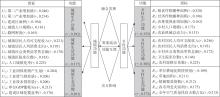
图1
城镇功能和乡村功能的评价体系 注:“+”表示正向指标;“-”表示负向指标;括号内数值为各指标权重。"
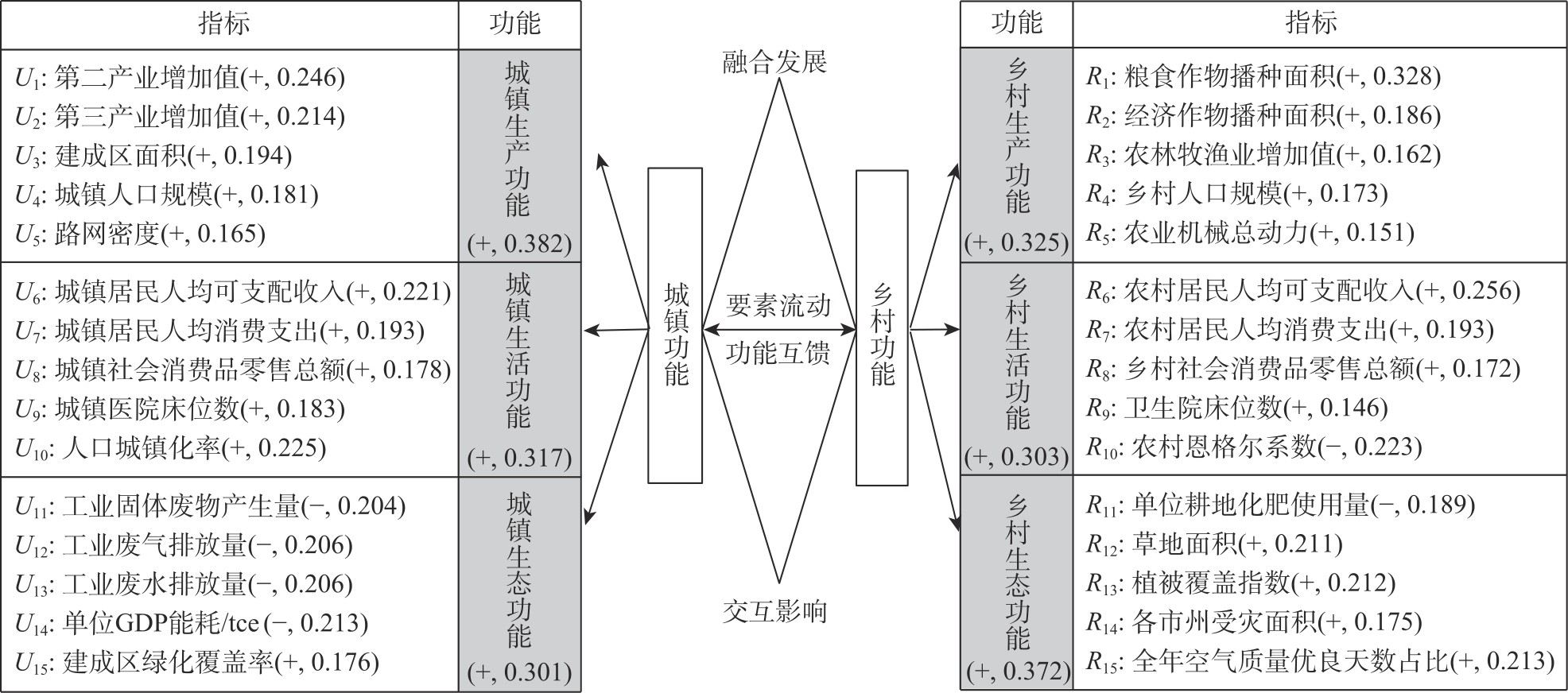
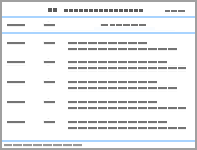
表1
变量的描述性统计"
| 变量 | 含义 | 观测值 | 标准差 | 最小值 | 最大值 |
|---|---|---|---|---|---|
| U | 城镇功能 | 182 | 0.174 | 0.078 | 0.685 |
| R | 乡村功能 | 182 | 0.196 | 0.157 | 0.521 |
| A | 经济水平/104元·人-1 | 182 | 2.619 | 0.656 | 13.142 |
| G | 政府调控/108元 | 182 | 104.351 | 16.784 | 502.917 |
| KU | 城镇资本要素/108元 | 182 | 361.775 | 62.481 | 1954.269 |
| KR | 乡村资本要素/108元 | 182 | 31.517 | 4.171 | 177.579 |
| LU | 城镇劳动力要素/104人 | 182 | 15.501 | 5.510 | 79.040 |
| LR | 乡村劳动力要素/104人 | 182 | 48.080 | 1.250 | 168.550 |
| T | 技术水平/108元 | 182 | 14.268 | 0.431 | 86.338 |
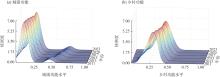
图2
甘肃省城镇功能与乡村功能的核密度估计分析"
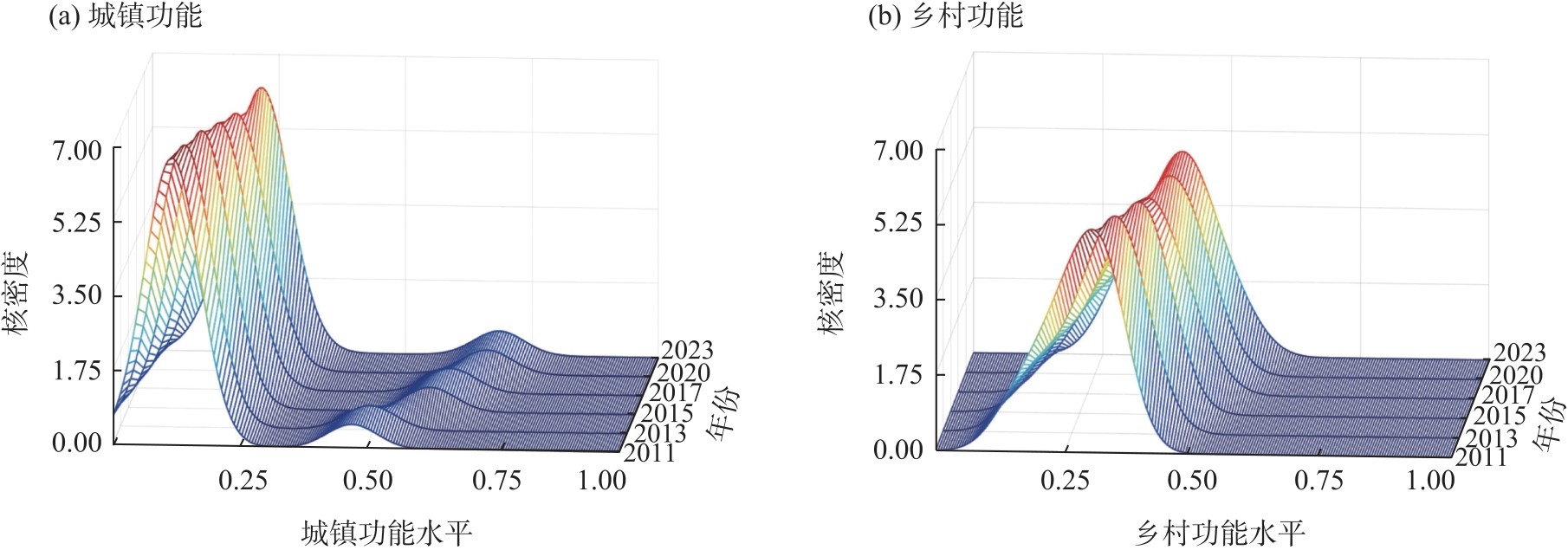
图3
甘肃省城镇功能的空间格局 注:基于自然资源部标准地图服务网站审图号为GS(2019)1822号的标准地图制作,底图边界无修改。临夏州、甘南州分别为临夏回族自治州、甘南藏族自治州的简称。下同。"
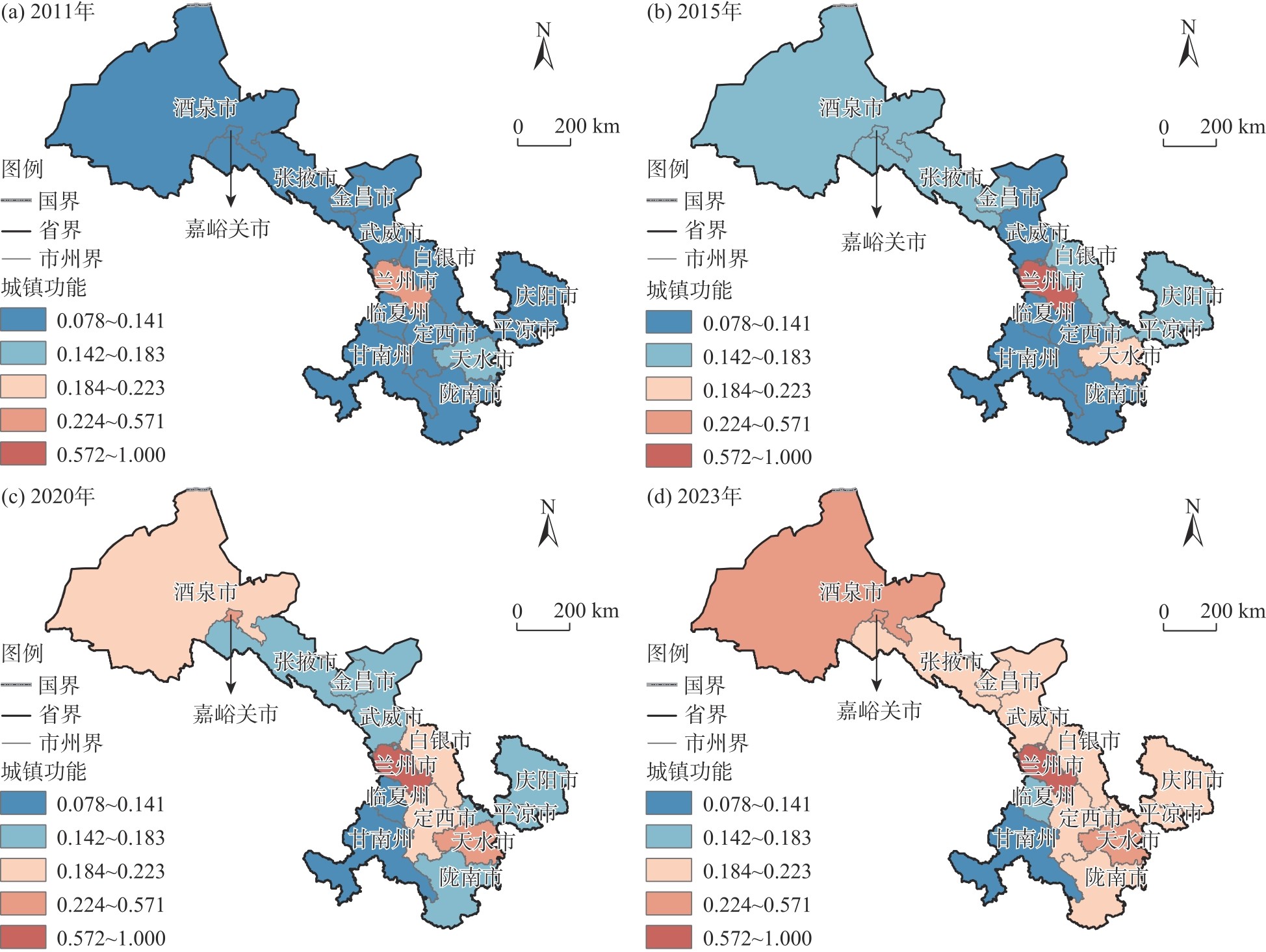
图4
甘肃省乡村功能的空间格局"
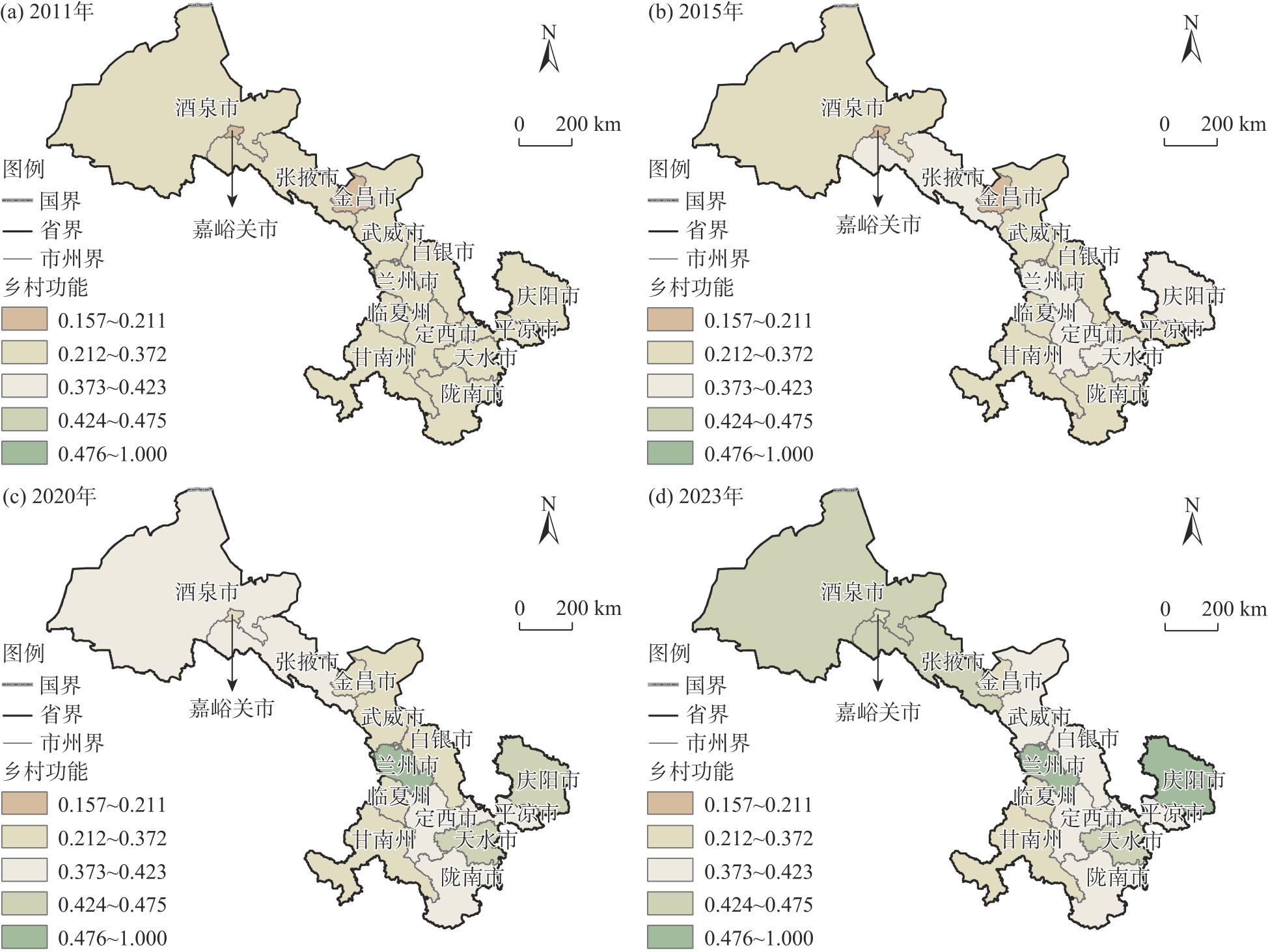
图5
甘肃省城镇功能与乡村功能的融合发展水平"
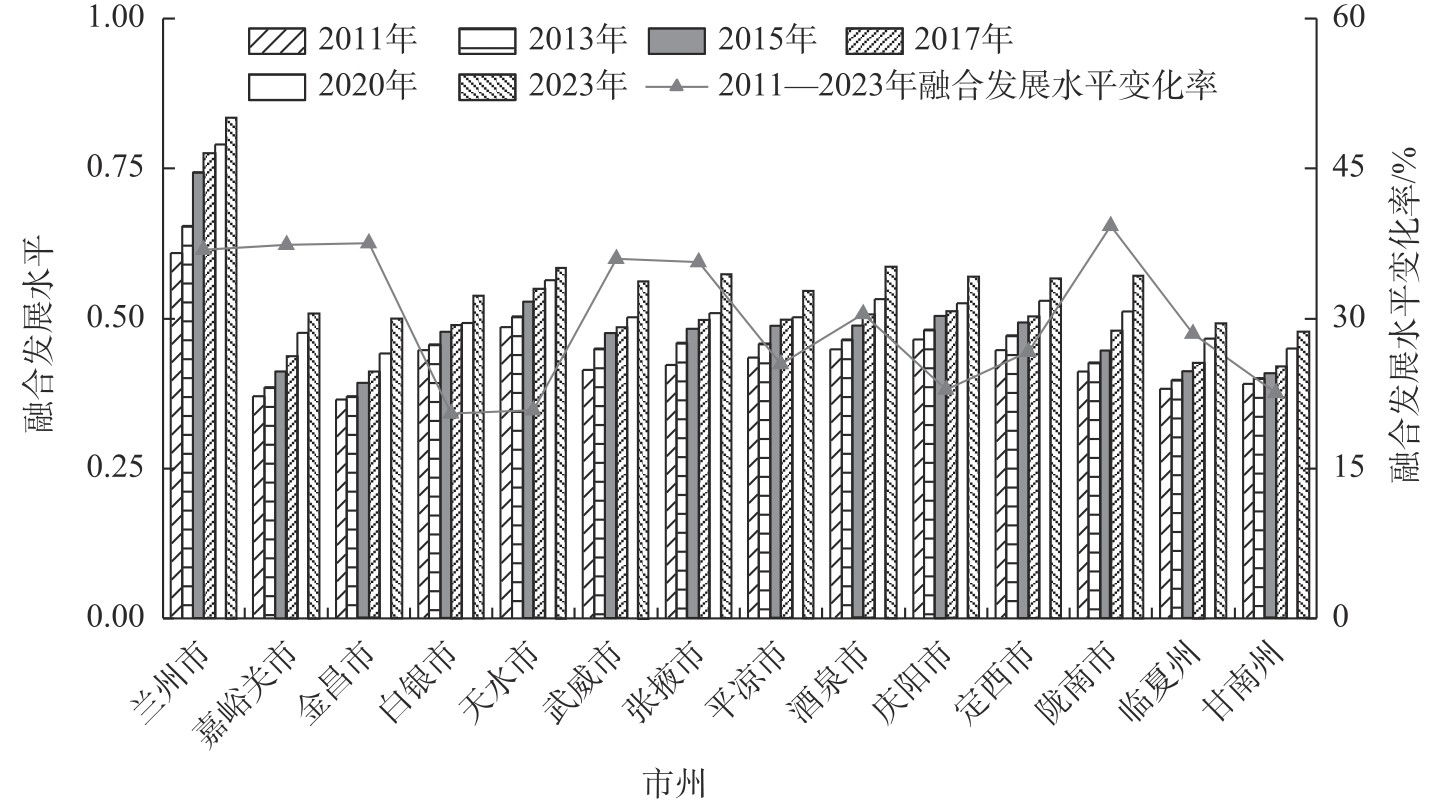
表2
甘肃省城镇功能与乡村功能交互影响的估计结果"
| 变量 | 城镇功能方程 | 乡村功能方程 | |||
|---|---|---|---|---|---|
| 系统广义矩估计方法 | 三阶段最小二乘法 | 系统广义矩估计方法 | 三阶段最小二乘法 | ||
| lnU | - | - | 0.195**(3.445) | 0.188**(3.316) | |
| lnR | 0.227**(5.236) | 0.219**(5.627) | - | - | |
| lnA | 0.166***(3.625) | 0.163***(3.521) | 0.185***(3.958) | 0.182***(3.425) | |
| lnG | 0.220*(4.013) | 0.195**(3.785) | 0.257**(4.369) | 0.221**(4.169) | |
| lnKU | 0.219**(4.529) | 0.211**(4.412) | - | - | |
| lnKR | - | - | 0.144**(3.201) | 0.152**(3.314) | |
| lnLU | 0.229**(4.126) | 0.233**(4.236) | - | - | |
| lnLR | - | - | 0.117*(3.195) | 0.146*(3.252) | |
| lnT | 0.214*(4.332) | 0.177*(3.462) | 0.233**(4.569) | 0.163**(3.795) | |
| 时间效应 | 控制 | 控制 | 控制 | 控制 | |
| 空间效应 | 控制 | 控制 | 控制 | 控制 | |
| R2 | 0.699 | 0.632 | 0.710 | 0.692 | |
| 样本量 | 182 | 182 | 182 | 182 | |
表3
甘肃省城镇功能与乡村功能交互影响的异质性分析"
| 变量 | 城镇功能方程 | 乡村功能方程 | |||||
|---|---|---|---|---|---|---|---|
| 陇中地区 | 河西地区 | 陇东南地区 | 陇中地区 | 河西地区 | 陇东南地区 | ||
| lnU | - | - | - | 0.194**(3.995) | 0.142**(3.365) | 0.121(3.125) | |
| lnR | 0.227**(4.775) | 0.170**(3.635) | 0.135(3.295) | - | - | - | |
| lnA | 0.322***(5.478) | 0.317**(5.362) | 0.294***(4.965) | 0.223***(4.559) | 0.215***(4.362) | 0.192***(3.578) | |
| lnG | 0.226*(4.236) | 0.215**(4.162) | 0.238***(4.362) | 0.311**(5.362) | 0.289**(4.362) | 0.305**(5.264) | |
| lnKU | 0.252***(4.521) | 0.239***(4.325) | 0.221***(4.113) | - | - | - | |
| lnKR | - | - | - | 0.231**(4.859) | 0.224**(4.785) | 0.254**(4.996) | |
| lnLU | 0.274**(4.218) | 0.219**(4.117) | 0.207**(4.055) | - | - | - | |
| lnLR | - | - | - | 0.173*(3.658) | 0.125*(3.256) | 0.216*(4.147) | |
| lnT | 0.255*(4.824) | 0.245*(4.785) | 0.217*(4.119) | 0.287**(4.352) | 0.227**(4.334) | 0.276**(4.741) | |
| 时间效应 | 控制 | 控制 | 控制 | 控制 | 控制 | 控制 | |
| 空间效应 | 控制 | 控制 | 控制 | 控制 | 控制 | 控制 | |
| R2 | 0.617 | 0.633 | 0.698 | 0.607 | 0.662 | 0.669 | |
| 样本量 | 52 | 65 | 65 | 52 | 65 | 65 | |
| [1] |
刘苗苗, 吴卫东. 陕西省新型城镇化与乡村振兴耦合性实证研究[J]. 干旱区地理, 2024, 47(8): 1420-1430.
doi: 10.12118/j.issn.1000-6060.2024.030 |
|
[Liu Miaomiao, Wu Weidong. Empirical study of the coupling of new urbanization and rural revitalization in Shaanxi Province[J]. Arid Land Geography, 2024, 47(8): 1420-1430.]
doi: 10.12118/j.issn.1000-6060.2024.030 |
|
| [2] |
樊杰. “十四五”“十五五”时期的区域协调发展及其经济地理学定律[J]. 经济地理, 2025, 45(1): 1-7.
doi: 10.15957/j.cnki.jjdl.2025.01.001 |
|
[Fan Jie. Regional coordinated development and its economic geography principles during the 14th Five-Year Plan and the 15th Five-Year Plan periods[J]. Economic Geography, 2025, 45(1): 1-7.]
doi: 10.2307/143175 |
|
| [3] |
Li L, Yang L, Wang H, et al. Spatiotemporal evolution characteristics and impact factors of urban-rural integrated development in China[J]. Chinese Geographical Science, 2025, 35(4): 802-818.
doi: 10.1007/s11769-025-1510-9 |
| [4] |
方创琳, 廖霞, 孙彪. 中国城乡融合发展的实践模式与实施成效解析[J]. 经济地理, 2024, 44(9): 1-11.
doi: 10.15957/j.cnki.jjdl.2024.09.001 |
|
[Fang Chuanglin, Liao Xia, Sun Biao. Urban-rural integrated development in China: Practical models and implementation effects[J]. Economic Geography, 2024, 44(9): 1-11.]
doi: 10.15957/j.cnki.jjdl.2024.09.001 |
|
| [5] |
Soliman A M. Regional planning scenarios in South Lebanon: The challenge of rural-urban interactions in the era of liberation and globalization[J]. Habitat International, 2004, 28(3): 385-408.
doi: 10.1016/S0197-3975(03)00039-0 |
| [6] | Zarifa D, Seward B, Milian R P. Location, location, location: Examining the rural-urban skills gap in Canada[J]. Journal of Rural Studies, 2019(72): 252-263. |
| [7] | Baier N, Pieper J, Schweikart J, et al. Capturing modelled and perceived spatial access to ambulatory health care services in rural and urban areas in Germany[J]. Social Science and Medicine, 2020, 265: 113328, doi: 10.1016/j.socscimed.2020.113328. |
| [8] |
Seale E. Coping strategies of urban and rural welfare or generations and the regulation of the poor[J]. New Political Economy, 2013, 18(2): 141-170.
doi: 10.1080/13563467.2012.664124 |
| [9] | 张红宇. 城乡融合发展的理论透视与实践绩效[J]. 改革, 2025(5): 1-12. |
| [Zhang Hongyu. Theoretical perspective and practical performance of integrated urban-rural development[J]. Reform, 2025(5): 1-12.] | |
| [10] | Chen K Q, Long H L, Liao L W, et al. Land use transitions and urban-rural integrated development: Theoretical framework and China’s evidence[J]. Land Use Policy, 2020, 92: 104465, doi: 10.1016/j.landusepol.2020.104465. |
| [11] |
崔树强, 周国华, 吴国华, 等. 空间交互视角下长株潭城市群地区城乡融合度评价及其驱动机制[J]. 地理研究, 2023, 42(4): 1029-1049.
doi: 10.11821/dlyj020221213 |
| [Cui Shuqiang, Zhou Guohua, Wu Guohua, et al. The evaluation of urban-rural integration degree and its driving mechanism in Changsha-Zhuzhou-Xiangtan urban agglomeration from the perspective of spatial interaction[J]. Geographical Research, 2023, 42(4): 1029-1049.] | |
| [12] |
朱小会, 于法稳. 县域城乡融合发展的演变特征、区域差异及影响因素研究[J]. 自然资源学报, 2025, 40(5): 1386-1411.
doi: 10.31497/zrzyxb.20250515 |
|
[Zhu Xiaohui, Yu Fawen. Evolution characteristics, regional differences and influencing factors of urban-rural integrated development at the county scale[J]. Journal of Natural Resources, 2025, 40(5): 1386-1411.]
doi: 10.31497/zrzyxb.20250515 |
|
| [13] |
周德, 戚佳玲, 钟文钰. 城乡融合评价研究综述: 内涵辨识、理论认知与体系重构[J]. 自然资源学报, 2021, 36(10): 2634-2651.
doi: 10.31497/zrzyxb.20211013 |
|
[Zhou De, Qi Jialing, Zhong Wenyu. Review of urban-rural integration evaluation: Connotation identification, theoretical analysis, and system reconstruction[J]. Journal of Natural Resources, 2021, 36(10): 2634-2651.]
doi: 10.31497/zrzyxb.20211013 |
|
| [14] |
周佳宁, 邹伟, 秦富仓. 等值化理念下中国城乡融合多维审视及影响因素[J]. 地理研究, 2020, 39(8): 1836-1851.
doi: 10.11821/dlyj020190572 |
| [Zhou Jianing, Zou Wei, Qin Fucang. Review of urban-rural multi-dimensional integration and influencing factors in China based on the concept of equivalence[J]. Geographical Research, 2020, 39(8): 1836-1851.] | |
| [15] | 谢守红, 周芳冰, 吴天灵, 等. 长江三角洲城乡融合发展评价与空间格局演化[J]. 城市发展研究, 2020, 27(3): 28-32. |
| [Xie Shouhong, Zhou Fangbing, Wu Tianling, et al. Evaluation and spatial pattern evolution of urban and rural integrated development in the Yangtze River Delta[J]. Urban Development Studies, 2020, 27(3): 28-32.] | |
| [16] |
车冰清, 朱传耿, 仇方道. 淮海经济区城乡空间融合格局及形成机制[J]. 自然资源学报, 2020, 35(8): 1897-1907.
doi: 10.31497/zrzyxb.20200811 |
|
[Che Bingqing, Zhu Chuangeng, Qiu Fangdao. Regional differential characteristics of urban-rural space integration development in Huaihai economic zone and its formation mechanism[J]. Journal of Natural Resources, 2020, 35(8): 1897-1907.]
doi: 10.31497/zrzyxb.20200811 |
|
| [17] | 刘明辉, 卢飞. 城乡要素错配与城乡融合发展——基于中国省级面板数据的实证研究[J]. 农业技术经济, 2019(2): 33-46. |
| [Liu Minghui, Lu Fei. Study on the influence of factor mismatch on urban-rural integration development: Evidence from Chinese provincial panel data[J]. Journal of Agrotechnical Economics, 2019(2): 33-46.] | |
| [18] |
周佳宁, 毕雪昊, 邹伟. “流空间”视域下淮海经济区城乡融合发展驱动机制[J]. 自然资源学报, 2020, 35(8): 1881-1896.
doi: 10.31497/zrzyxb.20200810 |
|
[Zhou Jianing, Bi Xuehao, Zou Wei. Driving mechanism of urban-rural integration in Huainan economic zone: Based on the space of flow[J]. Journal of Natural Resources, 2020, 35(8): 1881-1896.]
doi: 10.31497/zrzyxb.20200810 |
|
| [19] |
周德, 戚佳玲, 钟文钰, 等. 城市群城乡融合发展: 测度评价、障碍因素与驱动因素[J]. 地理研究, 2023, 42(11): 2914-2939.
doi: 10.11821/dlyj020220537 |
| [Zhou De, Qi Jialing, Zhong Wenyu, et al. Urban and rural integration development in urban agglomerations: Measurement and evaluation, obstacle factors and driving factors[J]. Geographical Research, 2023, 42(11): 2914-2939.] | |
| [20] | 王武林, 罗婉璐, 周伟健. 福建省县域城乡融合时空演变与跃迁机制[J]. 人文地理, 2025, 40(1): 113-123. |
| [Wang Wulin, Luo Wanlu, Zhou Weijian. Spatio-temporal evolution and transition mechanism of urban-rural integration in county territory of Fujian Province[J]. Human Geography, 2025, 40(1): 113-123.] | |
| [21] |
谢智敏, 甄峰. 基于多源数据的南京市域城乡融合水平测度研究[J]. 地理科学, 2023, 43(1): 1-10.
doi: 10.13249/j.cnki.sgs.2023.01.001 |
|
[Xie Zhimin, Zhen Feng. Measuring urban-rural integration level in Nanjing based on multi-source data[J]. Scientia Geographica Sinica, 2023, 43(1): 1-10.]
doi: 10.13249/j.cnki.sgs.2023.01.001 |
|
| [22] |
乔家君, 马玉玲. 城乡界面动态模型研究[J]. 地理研究, 2016, 35(12): 2283-2297.
doi: 10.11821/dlyj201612008 |
| [Qiao Jiajun, Ma Yuling. Research on dynamic model of urban-rural interface[J]. Geographical Research, 2016, 35(12): 2283-2297.] | |
| [23] |
于雪霞, 周国华, 吴国华, 等. 中国中部农区城乡融合发展的时空特征及驱动机制[J]. 地理研究, 2025, 44(2): 400-418.
doi: 10.11821/dlyj020240420 |
| [Yu Xuexia, Zhou Guohua, Wu Guohua, et al. Spatiotemporal characteristics and driving mechanisms of urban-rural integrated development in rural areas of central China[J]. Geographical Research, 2025, 44(2): 400-418.] | |
| [24] | Sun B D, Zhang T L, Wang Y, et al. Are mega-cities wrecking urban hierarchies? A cross-national study on the evolution of city-size distribution[J]. Cities, 2021, 108: 102999, doi: 10.1016/j.cities.2020.102999. |
| [25] |
何仁伟. 城乡融合与乡村振兴: 理论探讨、机理阐释与实现路径[J]. 地理研究, 2018, 37(11): 2127-2140.
doi: 10.11821/dlyj201811001 |
| [He Renwei. Urban-rural integration and rural revitalization: Theory, mechanism and implementation[J]. Geographical Research, 2018, 37(11): 2127-2140.] | |
| [26] | 陆铭. 从分散到集聚: 农村城镇化的理论、误区与改革[J]. 农业经济问题, 2021(9): 27-35. |
| [Lu Ming. From dispersion to agglomeration: Theory, misunderstanding and reform of rural urbanization[J]. Issues in Agricultural Economy, 2021(9): 27-35.] | |
| [27] | 段锴丰, 施建刚, 吴光东, 等. 城乡融合系统: 理论阐释、结构解析及运行机制分析[J]. 人文地理, 2023, 38(3): 1-10, 68. |
| [Duan Kaifeng, Shi Jiangang, Wu Guangdong, et al. Urban-rural integration system: Theory explanation, structure and operation mechanism analysis[J]. Human Geography, 2023, 38(3): 1-10, 68.] | |
| [28] | 苏红键. 统筹新型城镇化和乡村全面振兴的关键问题与推进思路[J]. 中国软科学, 2024(11): 77-86. |
| [Su Hongjian. Key issues and promoting strategies for coordinating new urbanization and overall rural revitalization[J]. China Soft Science, 2024(11): 77-86.] | |
| [29] | 郭磊磊, 郭剑雄. 城乡融合: 中国西部地区的分化[J]. 西安财经学院学报, 2019, 32(1): 62-68. |
| [Guo Leilei, Guo Jianxiong. The different development of urban and rural integration in western China[J]. Journal of Xi’an University of Finance and Economics, 2019, 32(1): 62-68.] | |
| [30] |
刘彦随, 郭仁忠, 张立强, 等. 乡村地域系统转型机理与情景模拟[J]. 地理学报, 2025, 80(4): 855-870.
doi: 10.11821/dlxb202504001 |
|
[Liu Yansui, Guo Renzhong, Zhang Liqiang, et al. Transformation mechanism and scenario simulation of rural areal system[J]. Acta Geographica Sinica, 2025, 80(4): 855-870.]
doi: 10.11821/dlxb202504001 |
|
| [31] |
邹利林, 章丽君, 梁一凡, 等. 新时代国土空间功能的科学认知与研究框架[J]. 自然资源学报, 2022, 37(12): 3060-3072.
doi: 10.31497/zrzyxb.20221203 |
|
[Zou Lilin, Zhang Lijun, Liang Yifan, et al. Scientific cognition and research framework of territorial space function in the New Era[J]. Journal of Natural Resources, 2022, 37(12): 3060-3072.]
doi: 10.31497/zrzyxb.20221203 |
|
| [32] |
赵宏波, 魏甲晨, 孙东琪, 等. 大城市内部“生产-生活-生态空间”多尺度耦合协调度——以郑州市为例[J]. 资源科学, 2021, 43(5): 944-953.
doi: 10.18402/resci.2021.05.08 |
|
[Zhao Hongbo, Wei Jiachen, Sun Dongqi, et al. Multi-scale analysis on the coupling coordination degree of productionliving-ecological spaces in cities: A case study of Zhengzhou City[J]. Resources Science, 2021, 43(5): 944-953.]
doi: 10.18402/resci.2021.05.08 |
|
| [33] |
袁雪松, 周俊, 胡蓓蓓, 等. 基于FLUS模型粤港澳大湾区“三生空间”多情景模拟预测[J]. 地理科学, 2023, 43(3): 564-574.
doi: 10.13249/j.cnki.sgs.2023.03.018 |
|
[Yuan Xuesong, Zhou Jun, Hu Beibei, et al. Multi-scenario simulation and prediction of ecological-productive-living spaces in Guangdong-Hong Kong-Macao Greater Bay Area based on FLUS model[J]. Scientia Geographica Sinica, 2023, 43(3): 564-574.]
doi: 10.13249/j.cnki.sgs.2023.03.018 |
|
| [34] | 黄烈佳, 鲁昭, 胡伟艳. 长江经济带城市空间“三生”功能耦合协调时空演化特征及影响因素[J]. 长江流域资源与环境, 2024, 33(4): 687-698. |
| [Huang Liejia, Lu Zhao, Hu Weiyan. Spatio-temporal coupling characteristics and influencing factors of “production-living-ecological” functions of urban space in the Yangtze River Economic Belt[J]. Resources and Environment in the Yangtze Basin, 2024, 33(4): 687-698.] | |
| [35] |
尹君锋, 宋长青, 石培基, 等. 耦合视角下甘肃省县域乡村“三生”功能协调度的时空跃迁特征与影响因素[J]. 地理研究, 2024, 43(4): 874-892.
doi: 10.11821/dlyj020230643 |
| [Yin Junfeng, Song Changqing, Shi Peiji, et al. Spatial and temporal transition characteristics and influencing factors of “production-living-ecological” functions of rural areas at county level in Gansu Province from the perspective of coupling[J]. Geographical Research, 2024, 43(4): 874-892.] | |
| [36] |
周侗, 王佳琳. 中原城市群乡村“三生”功能分区识别及调控路径[J]. 地理科学, 2023, 43(7): 1227-1238.
doi: 10.13249/j.cnki.sgs.2023.07.010 |
|
[Zhou Tong, Wang Jialin. Classifying and regulation pathway of rural “production-living-ecology” regional area in the Center Plains Urban Agglomeration[J]. Scientia Geographica Sinica, 2023, 43(7): 1227-1238.]
doi: 10.13249/j.cnki.sgs.2023.07.010 |
|
| [37] | 程宪波, 陶宇, 欧维新. 江苏省乡村三生功能耦合协调时空变化特征分析[J]. 长江流域资源与环境, 2022, 31(1): 222-233. |
| [Cheng Xianbo, Tao Yu, Ou Weixin. Spatio-temporal characteristics and evolutions of rural production-living-ecological functions coupling coordination in Jiangsu[J]. Resources and Environment in the Yangtze Basin, 2022, 31(1): 222-233.] | |
| [38] |
钟洋, 董秀军. 中部地区新型城镇化与乡村全面振兴耦合协调的时空演化及影响因素[J]. 地理学报, 2025, 80(8): 2159-2180.
doi: 10.11821/dlxb202508010 |
|
[Zhong Yang, Dong Xiujun. Spatio-temporal evolution and influencing factors of coupling coordination between new urbanization and comprehensive rural revitalization in central China[J]. Acta Geographica Sinica, 2025, 80(8): 2159-2180.]
doi: 10.11821/dlxb202508010 |
|
| [39] | 冯晓龙, 周晓时, 司伟. 统筹城乡融合发展的重点任务、现实挑战与推进路径[J]. 中国农村经济, 2025(1): 175-183. |
| [Feng Xiaolong, Zhou Xiaoshi, Si Wei. Key tasks, current challenges, and implementation pathways for coordinating integrated urban-rural development[J]. Chinese Rural Economy, 2025(1): 175-183.] | |
| [40] |
江剑平, 李祎, 何召鹏. 中国新质生产力与高质量就业耦合协调度变化特征[J]. 经济地理, 2025, 45(2): 144-152.
doi: 10.15957/j.cnki.jjdl.2025.02.014 |
|
[Jiang Jianping, Li Yi, He Zhaopeng. Change characteristics of coupling coordination degree between new quality productive forces and high-quality employment in China[J]. Economic Geography, 2025, 45(2): 144-152.]
doi: 10.15957/j.cnki.jjdl.2025.02.014 |
|
| [41] |
童昀, 杨琪, 刘海猛. 中国城市群社会绿色转型演化特征及对经济绿色转型的影响[J]. 地理学报, 2025, 80(8): 2088-2108.
doi: 10.11821/dlxb202508006 |
|
[Tong Yun, Yang Qi, Liu Haimeng. Evolutionary characteristics of social green transformation in chinese urban agglomerations and its impact on economic green transformation[J]. Acta Geographica Sinica, 2025, 80(8): 2088-2108.]
doi: 10.11821/dlxb202508006 |
|
| [42] |
魏建飞, 袁悠燃, 李强, 等. 黄河流域国土空间效率时空变化及障碍因子分析[J]. 干旱区地理, 2025, 48(6): 1055-1066.
doi: 10.12118/j.issn.1000-6060.2024.654 |
|
[Wei Jianfei, Yuan Youran, Li Qiang, et al. Spatio-temporal variation and obstacle factors of territorial spatial efficiency in the Yellow River Basin[J]. Arid Land Geography, 2025, 48(6): 1055-1066.]
doi: 10.12118/j.issn.1000-6060.2024.654 |
|
| [43] | 林树高, 诸培新, 陆汝成. 长江经济带城乡地域功能融合发展的时空格局与响应过程[J]. 中国人口·资源与环境, 2024, 34(1): 162-174. |
| [Lin Shugao, Zhu Peixin, Lu Rucheng. Spatio-temporal patterns and response processes of the integrated development of urban and rural regional functions in the Yangtze River Economic Belt[J]. China Population, Resources and Environment, 2024, 34(1): 162-174.] | |
| [44] |
王建康, 谷国锋, 姚丽, 等. 中国新型城镇化的空间格局演变及影响因素分析[J]. 地理科学, 2016, 36(1): 63-71.
doi: 10.13249/j.cnki.sgs.2016.01.008 |
|
[Wang Jiankang, Gu Guofeng, Yao Li, et al. Analysis of new urbanization’s spatial pattern evolution and influence factors in China[J]. Scientia Geographica Sinica, 2016, 36(1): 63-71.]
doi: 10.13249/j.cnki.sgs.2016.01.008 |
|
| [45] |
田甜, 韩宇, 付山. “乡村振兴”视角下人力资本投资对农业发展影响的实证研究[J]. 农学学报, 2022, 12(4): 96-100.
doi: 10.11923/j.issn.2095-4050.casb2021-0138 |
|
[Tian Tian, Han Yu, Fu Shan. The impact of human capital investment on agricultural development from the perspective of rural revitalization: An empirical study[J]. Journal of Agriculture, 2022, 12(4): 96-100.]
doi: 10.11923/j.issn.2095-4050.casb2021-0138 |
|
| [46] |
贾卓, 杨永春, 赵锦瑶, 等. 黄河流域兰西城市群工业集聚与污染集聚的空间交互影响[J]. 地理研究, 2021, 40(10): 2897-2913.
doi: 10.11821/dlyj020201097 |
| [Jia Zhuo, Yang Yongchun, Zhao Jinyao, et al. The spatial correlation and interaction between industrial agglomeration and pollution agglomeration of Lanzhou-Xining urban agglomeration in the Yellow River Basin[J]. Geographical Research, 2021, 40(10): 2897-2913.] | |
| [47] | 朱欢, 郑洁, 赵秋运, 等. 经济增长、能源结构转型与二氧化碳排放——基于面板数据的经验分析[J]. 经济与管理研究, 2020, 41(11): 19-34. |
| [Zhu Huan, Zheng Jie, Zhao Qiuyun, et al. Economic growth, energy structure transformation and carbon dioxide emission: Empirical analysis based on panel data[J]. Research on Economics and Management, 2020, 41(11): 19-34.] | |
| [48] |
仝德, 任一帆, 邱君丽, 等. 深圳城中村私宅租金与统租改造选址的空间交互影响[J]. 地理研究, 2024, 43(1): 136-148.
doi: 10.11821/dlyj020230382 |
| [Tong De, Ren Yifan, Qiu Junli, et al. Spatial interactions between rents of private rental housing and site selection of micro-regeneration in urbanising villages in Shenzhen[J]. Geographical Research, 2024, 43(1): 136-148.] | |
| [49] |
李艳梅, 付丽媛, 迟远英. 北京绿色低碳循环发展与双循环新发展格局互动关系的实证研究[J]. 经济地理, 2024, 44(11): 24-32, 72.
doi: 10.15957/j.cnki.jjdl.2024.11.003 |
| [Li Yanmei, Fu Liyuan, Chi Yuanying. Interactive relationship between green low-carbon circular development and dual circulation in Beijing[J]. Economic Geography, 2024, 44(11): 24-32, 72.] | |
| [50] | 徐妍, 郭品. 房价、资源错配与企业创新——基于房价效率因素和非效率因素的分析[J]. 经济问题, 2019(7): 16-28. |
| [Xu Yan, Guo Pin. Housing price, resource misallocation and enterprise innovation: Analysis based on housing price efficiency factors and non-efficiency factors[J]. China Population, Resources and Environment, 2019(7): 16-28.] | |
| [51] | 位华, 李依禾. 绿色金融视角下经济增长与环境质量关系研究[J]. 山东社会科学, 2023(3): 131-140. |
| [Wei Hua, Li Yihe. Relationship between economic growth and environmental quality from the perspective of green finance[J]. Shandong Social Sciences, 2023(3): 131-140.] | |
| [52] |
高沙尔·吾拉孜, 杨廷章, 孙威. 京津冀地区制造业与生产性服务业的互动关系和机制分析[J]. 地理科学进展, 2024, 43(7): 1290-1306.
doi: 10.18306/dlkxjz.2024.07.003 |
|
[Wulazii Gaoshaer, Yang Tingzhang, Sun Wei. Interactive relationship of manufacturing and producer service industries in the Beijing-Tianjin-Hebei region and mechanism[J]. Progress in Geography, 2024, 43(7): 1290-1306.]
doi: 10.18306/dlkxjz.2024.07.003 |
|
| [53] |
陈龙, 张志斌, 赵学伟, 等. 甘肃省区域空间格局形成机制与发展战略[J]. 干旱区地理, 2023, 46(9): 1556-1566.
doi: 10.12118/j.issn.1000-6060.2022.591 |
|
[Chen Long, Zhang Zhibin, Zhao Xuewei, et al. Formation mechanism and development strategy of regional spatial pattern of Gansu Province[J]. Arid Land Geography, 2023, 46(9): 1556-1566.]
doi: 10.12118/j.issn.1000-6060.2022.591 |
|
| [54] | 贾卓, 赵锦瑶, 娜赫雅, 等. 兰州-西宁城市群工业集聚格局及其影响因素空间溢出[J]. 兰州大学学报(自然科学版), 2022, 58(2): 143-150, 156. |
| [Jia Zhuo, Zhao Jinyao, Na Heya, et al. The spatial pattern and spatial spillover of its influencing factors in the industrial aspects of Lanzhou-Xining urban agglomeration[J]. Journal of Lanzhou University (Natural Sciences), 2022, 58(2): 143-150, 156.] | |
| [55] |
李季, 王静. 河西走廊绿洲社会-生态系统韧性时空格局演变特征[J]. 干旱区研究, 2025, 42(10): 1887-1898.
doi: 10.13866/j.azr.2025.10.12 |
|
[Li Ji, Wang Jing. Evolutionary characteristics of spatiotemporal patterns of resilience in oasis social-ecological systems in the Hexi Corridor[J]. Arid Zone Research, 2025, 42(10): 1887-1898.]
doi: 10.13866/j.azr.2025.10.12 |
|
| [56] |
尹君锋, 石培基, 黄万状, 等. 甘肃省县域乡村振兴与新型城镇化耦合协调发展的时空分异特征及影响因素[J]. 自然资源学报, 2023, 38(8): 2148-2168.
doi: 10.31497/zrzyxb.20230814 |
|
[Yin Junfeng, Shi Peiji, Huang Wanzhuang, et al. Spatiotemporal differentiation characteristics and influencing factors of coupling coordinated development of rural revitalization and new urbanization at the county level in Gansu Province[J]. Journal of Natural Resources, 2023, 38(8): 2148-2168.]
doi: 10.31497/zrzyxb.20230814 |
| [1] | 王晟军, 张昊延, 毛龙, 邱晓峄, 陶卓琳, 赵莎, 颉耀文. 2001—2023年气候因素与人类活动对甘肃省植被变化的影响[J]. 干旱区地理, 2026, 49(8): 1614-1625. |
| [2] | 许可娟, 何瑛, 王军. 甘肃省民宿空间格局及影响因素研究[J]. 干旱区地理, 2026, 49(6): 1288-1298. |
| [3] | 曹浩然, 孟梅, 刘红光. 2000—2024年甘肃省土地生态脆弱性时空变化特征及模拟预测研究[J]. 干旱区地理, 2026, 49(4): 841-855. |
| [4] | 张嘉伟, 裴婷婷, 陈英, 谢保鹏. 大食物观下甘肃省粮食和重要农产品供给安全评价及影响因素[J]. 干旱区地理, 2026, 49(3): 619-630. |
| [5] | 李骞国, 孙龙凯, 惠蕃艳, 朱宗斌. 甘肃省县域乡村韧性时空演变特征及驱动机制研究[J]. 干旱区地理, 2026, 49(2): 393-403. |
| [6] | 李晓柯, 陈强强. 数字经济对甘肃省城乡收入差距的影响机制与空间效应[J]. 干旱区地理, 2026, 49(1): 198-210. |
| [7] | 刘艺欣, 裴婷婷, 陈英, 谢保鹏. 基于县域尺度的甘肃省乡村振兴发展水平测度及时空分异[J]. 干旱区地理, 2025, 48(9): 1683-1693. |
| [8] | 余瀚, 孟志华, 王静爱. 甘肃省自然灾害社会脆弱性评价与综合区划[J]. 干旱区地理, 2025, 48(8): 1421-1431. |
| [9] | 马海清, 陈强强. 甘肃省农业碳排放时空分异特征及影响因素[J]. 干旱区地理, 2025, 48(5): 879-892. |
| [10] | 李潇飞, 龚健, 叶菁, 方鸿嘉, 张世镇, 林家胜. 生态系统服务权衡协同下的甘肃省生态功能分区优化[J]. 干旱区地理, 2025, 48(3): 467-479. |
| [11] | 胡舒云, 陆玉麒. 甘肃省冷凉区宜农空间识别与开发[J]. 干旱区地理, 2025, 48(2): 257-270. |
| [12] | 姜筱筱, 李雪梅, 韩惠, 许民, 凌红波. 甘肃省土地利用转变对碳储量变化的影响研究[J]. 干旱区地理, 2024, 47(12): 2075-2082. |
| [13] | 谭丹, 聂灿齐, 黄武斌, 李文瑶, 谢丽君. 甘肃省雷暴大风活动特征及潜势预报研究[J]. 干旱区地理, 2024, 47(12): 2083-2092. |
| [14] | 张君霞, 黄武斌, 李安泰, 杨秀梅, 黎倩, 边宏伟. 甘肃省主要地质灾害精细化气象风险预警预报[J]. 干旱区地理, 2023, 46(9): 1443-1452. |
| [15] | 杨思存,霍琳,王成宝,温美娟. 基于STIRPAT模型的甘肃省农业碳排放特征分析[J]. 干旱区地理, 2023, 46(9): 1493-1502. |
|
||