干旱区地理 ›› 2026, Vol. 49 ›› Issue (11): 2437-2450.doi: 10.12118/j.issn.1000-6060.2025.845 cstr: 32274.14.ALG2025845
• 区域发展 • 上一篇
宗鑫1,2( ), 赵佳琦1(), 张晓龙1, 周艳1,2
收稿日期:2025-12-24
修回日期:2026-02-02
出版日期:2026-11-25
发布日期:2026-11-13
通讯作者:
赵佳琦(2001-),女,硕士研究生,主要从事资源与环境、农村发展方面的研究. E-mail: zjq_10080717@126.com作者简介:宗鑫(1985-),男,博士,副教授,主要从事资源与环境、农村发展方面研究. E-mail: zongxin85@126.com论文构思:赵佳琦、张晓龙;数据管理:赵佳琦;规范分析:赵佳琦;获取资助:宗鑫、周艳、赵佳琦;调查研究:赵佳琦、张晓龙;方法设计:赵佳琦;项目管理:宗鑫;提供资源:宗鑫、周艳;软件编程:赵佳琦;监督指导:宗鑫;验证复核:宗鑫;可视化:赵佳琦;初稿撰写:赵佳琦;修订编辑:宗鑫、赵佳琦。
基金资助:
ZONG Xin1,2(), ZHAO Jiaqi1(), ZHANG Xiaolong1, ZHOU Yan1,2
Received:2025-12-24
Revised:2026-02-02
Published:2026-11-25
Online:2026-11-13
摘要:
推动农业绿色发展是应对全球气候变化、实现高质量发展的国家战略,但农户在绿色转型中普遍面临内生能力不足与外部风险冲击的双重约束。为此,将生计韧性理论引入绿色生产行为研究,基于宁夏地区614份农户调查数据,综合运用计量模型与多主体仿真进行交叉验证。结果表明:(1)生计韧性显著促进农户绿色生产行为,但呈现维度异质性与时序动态性:自组织能力是转型初期首要驱动力,学习能力在中后期持续增强并成为主导,二者存在正向交互,而缓冲能力影响不显著。(2)生计韧性通过提升环境认知、技术有用性与技术易用性3条路径传导。仿真进一步揭示3条路径存在“速度-衰减”权衡,环境认知作用持久,技术易用性见效快但衰减快。(3)合作社、企业等外部组织虽直接促进绿色生产行为,但对农户内生能力存在替代效应,呈现复杂双重影响。(4)异质性分析发现,兼业户与高土地连片农户的韧性转化效率更高,纯农户与土地碎片化农户则面临更强转型约束。通过计量与仿真的交叉验证,实现了从静态因果识别到动态机制验证的方法跨越,为制定分阶段、差异化、赋能型的农业绿色转型政策提供了实证依据。
宗鑫, 赵佳琦, 张晓龙, 周艳. 生计韧性如何影响农户绿色生产行为——基于宁夏农户调查的计量分析与仿真模拟[J]. 干旱区地理, 2026, 49(11): 2437-2450.
ZONG Xin, ZHAO Jiaqi, ZHANG Xiaolong, ZHOU Yan. How does livelihood resilience affect farmers’ green production behavior: An econometric analysis and simulation based on a farmer survey in Ningxia[J]. Arid Land Geography, 2026, 49(11): 2437-2450.
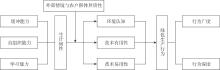
图1
分析框架"

表1
评价指标体系"
| 变量 | 维度 | 维度权重 | 指标 | 指标权重 | 指标定义 |
|---|---|---|---|---|---|
| 绿色生产行为 | 行为广度 | 0.3750 | 采用绿色农业 技术种类 | 0.3750 | 目前采用的绿色农业技术数量/种 |
| 行为深度 | 0.6251 | 化肥使用情况 | 0.1927 | 您家上年每公顷实际化肥施用量比当地推荐标准/周边农户平均水平大约减少了多少?未减少=1,减少1%~10%=2,减少11%~20%=3,减少21%~30%=4,减少30%以上=5 | |
| 农药使用情况 | 0.2040 | 您家上年每公顷实际农药施用量比当地推荐标准/周边农户平均水平大约减少了多少?未减少=1,减少1%~10%=2,减少11%~20%=3,减少21%~30%=4,减少30%以上=5 | |||
| 废弃物处理 | 0.2284 | 您家对农药瓶、化肥袋等废弃物的处理方式是?随意丢弃=1,焚烧/填埋=2,部分回收=3,大部分回收=4,全部回收=5 | |||
| 生计韧性 | 缓冲能力 | 0.5871 | 耕地面积 | 0.1197 | 家庭拥有耕地面积/hm2 |
| 劳动力数量 | 0.0292 | 家庭具有劳动能力人数/人 | |||
| 家庭总收入 | 0.0603 | 家庭年总收入/元 | |||
| 固定资产数量 | 0.0539 | 家庭固定资产数量/个 | |||
| 社会资本 | 0.3240 | 家庭成员是否为村干部或在相关组织(例如:政府、企事业单位、合作社等)任职:是=1,否=0 | |||
| 自组织能力 | 0.0837 | 邻里信任度 | 0.0257 | 对邻居的信任程度:很不信任=1,不太信任=2,一般=3,比较信任=4,非常信任=5 | |
| 组织信任度 | 0.0138 | 对村委会或相关组织(政府、企事业单位、合作社等)的信任程度:很不信任=1,不太信任=2,一般=3,比较信任=4,非常信任=5 | |||
| 亲戚信任度 | 0.0242 | 对亲戚的信任程度:很不信任=1,不太信任=2,一般=3,比较信任=4,非常信任=5 | |||
| 交通便利度 | 0.0129 | 对村交通便利情况评价:很不满意=1,不太满意=2,一般=3,比较满意=4,非常满意=5 | |||
| 人居环境满意度 | 0.0071 | 对居住环境满意程度:很不满意=1,不太满意=2,一般=3,比较满意=4,非常满意=5 | |||
| 学习能力 | 0.3292 | 农业技术培训 | 0.0810 | 是否接受过农业技术培训:是=1,否=0 | |
| 户主受教育程度 | 0.0521 | 户主受教育程度:未读过书=1,小学=2,初中=3,高中/中专=4,大专/本科及以上=5 | |||
| 信息获取 | 0.0778 | 获得农业信息的渠道数量/个 | |||
| 学习意识 | 0.0236 | 学习新技术的主动性:很不主动=1,不太主动=2,一般=3,比较主动=4,非常主动=5 | |||
| 技术分享 | 0.0947 | 与邻里交流农业技术的频率:从不=1,很少=2,有时=3,经常=4,总是=5 |
表2
变量定义及描述性统计"
| 类别 | 变量 | 变量定义 | 均值 | 标准差 | 观测值 |
|---|---|---|---|---|---|
| 被解释变量 | 绿色生产行为 | 基于 | 0.408 | 0.199 | 614 |
| 核心解释变量 | 生计韧性 | 基于 | 0.241 | 0.123 | 614 |
| 中介变量 | 环境认知 | 您了解当前农业面源污染对环境的危害吗?完全不了解=1,不太了解=2,一般了解=3,比较了解=4,非常了解=5 | 3.565 | 1.304 | 614 |
| 技术有用性 | 您听说过绿色农业技术(如有机肥、生物农药等)在增产或节本方面的实际效果吗?没听过=1,很少听=2,偶尔听=3,经常听=4,总是听到=5 | 3.422 | 1.129 | 614 | |
| 技术易用性 | 您认为自己有能力掌握绿色农业技术吗?不能=1,不太能=2,一般=3,比较能=4,完全能=5 | 3.290 | 1.157 | 614 | |
| 控制变量 | 年龄 | 年龄/岁 | 57.607 | 12.124 | 614 |
| 性别 | 女性=1,男性=2 | 1.472 | 0.500 | 614 | |
| 健康状况 | 身体健康=1,偶有疾病=2,大病缠身=3 | 1.394 | 0.672 | 614 | |
| 家庭总人口 | 家庭总人口/人 | 5.088 | 2.588 | 614 | |
| 抚养比 | (65岁以上老人数量+15岁以下孩童数量)/家庭劳动力数量 | 1.089 | 1.101 | 614 |
表3
基准回归结果"
| 变量 | 绿色生产行为 | ||||||
|---|---|---|---|---|---|---|---|
| 回归1 | 回归2 | 回归3 | 回归4 | 回归5 | 回归6 | 回归7 | |
| 生计韧性 | 0.181*** (0.0563) | 0.177*** (0.0568) | 0.214*** (0.0553) | - | - | - | - |
| 年龄 | - | -0.00111 (0.000777) | -0.00104 (0.000750) | -0.00127* (0.000754) | -0.00142** (0.000663) | -0.00121 (0.000750) | -0.00146** (0.000670) |
| 性别 | - | -0.00522 (0.0163) | 0.00638 (0.0160) | 0.00541 (0.0161) | 0.00619 (0.0143) | 0.00339 (0.0160) | 0.00680 (0.0143) |
| 健康状况 | - | 0.0326*** (0.0116) | 0.0267** (0.0116) | 0.0269** (0.0117) | 0.0204* (0.0107) | 0.0248** (0.0117) | 0.0210* (0.0108) |
| 家庭总人口 | - | - | -0.00921** (0.00396) | -0.00868** (0.00395) | -0.00712* (0.00363) | -0.00766* (0.00394) | -0.00741** (0.00365) |
| 抚养比 | - | - | 0.0412*** (0.00819) | 0.0392*** (0.00821) | 0.0258*** (0.00765) | 0.0401*** (0.00829) | 0.0252*** (0.00778) |
| 缓冲能力 | - | - | - | 0.103 (0.0679) | - | - | 0.0263 (0.0578) |
| 自组织能力 | - | - | - | - | 6.136*** (0.541) | - | 6.200*** (0.551) |
| 学习能力 | - | - | - | - | - | 0.285** (0.138) | -0.104 (0.124) |
| 常数项 | 0.364*** (0.0169) | 0.391*** (0.0537) | 0.372*** (0.0535) | 0.431*** (0.0497) | 0.137*** (0.0502) | 0.395*** (0.0553) | 0.148*** (0.0537) |
| 观测值 | 614 | 614 | 614 | 614 | 614 | 614 | 614 |
| R2 | 0.013 | 0.025 | 0.064 | 0.049 | 0.263 | 0.052 | 0.264 |
表4
稳健性检验"
| 变量 | 生计韧性 回归8 | 绿色生产行为 回归9 | 稳健回归 回归10 | 分位数回归 回归11 | 1%缩尾 回归12 |
|---|---|---|---|---|---|
| 工具变量 | 0.008*** (0.0020) | - | - | - | - |
| 生计韧性 | - | 2.936*** (0.8830) | 0.193*** (0.0665) | 0.176** (0.0715) | 0.213*** (0.0559) |
| 控制变量 | 是 | 是 | 是 | 是 | 是 |
| 常数项 | 0.321*** (0.031) | -0.541* (0.3030) | 0.387*** (0.0531) | 0.393*** (0.0570) | 0.371*** (0.0532) |
| 观测值 | 614 | 614 | 614 | 614 | 614 |
| R2 | 0.061 | - | 0.059 | - | 0.064 |
表5
中介效应检验"
| 变量 | 环境认知 回归13 | 技术有用性 回归14 | 技术易用性 回归15 |
|---|---|---|---|
| 生计韧性 | 1.642***(0.404) | 1.016***(0.393) | 1.134***(0.352) |
| 控制变量 | 是 | 是 | 是 |
| 常数项 | 3.236***(0.355) | 2.848***(0.306) | 2.896***(0.313) |
| 观测值 | 614 | 614 | 614 |
| R2 | 0.051 | 0.050 | 0.048 |
表6
调节效应检验"
| 变量 | 企业规制调节 回归16 | 合作社调节 回归17 | 双调节模型 回归18 |
|---|---|---|---|
| 生计韧性 | 0.492***(0.188) | 0.216***(0.058) | 0.492***(0.189) |
| 企业规制 | 0.106***(0.014) | - | 0.105***(0.014) |
| 生计韧性× 企业规制 | -0.107**(0.052) | - | -0.106**(0.052) |
| 合作社参与 | - | 0.137***(0.043) | 0.104***(0.039) |
| 生计韧性× 合作社 | - | -0.261**(0.116) | -0.209*(0.110) |
| 控制变量 | 是 | 是 | 是 |
| 常数项 | 0.017(0.063) | 0.369***(0.053) | 0.018(0.063) |
| 观测值 | 614 | 614 | 614 |
| R2 | 0.285 | 0.072 | 0.290 |
表7
异质性检验"
| 变量 | 纯农户 回归19 | 兼业户 回归20 | 高连片组 回归21 | 低连片组 回归22 | 加入合作社 回归23 | 未加入合作社 回归24 |
|---|---|---|---|---|---|---|
| 生计韧性 | 0.169* (0.0971) | 0.285** (0.0964) | 0.230*** (0.0815) | 0.159* (0.0944) | -0.142 (0.1590) | 0.215*** (0.0580) |
| 控制变量 | 是 | 是 | 是 | 是 | 是 | 是 |
| 常数项 | 0.406*** (0.0645) | 0.340*** (0.0928) | 0.385*** (0.0625) | 0.312*** (0.0836) | 0.731*** (0.1850) | 0.361*** (0.0559) |
| 观测值 | 378 | 236 | 453 | 161 | 44 | 570 |
| R2 | 0.038 | 0.102 | 0.070 | 0.079 | 0.189 | 0.061 |
表8
计量-仿真交叉验证的对应框架"
| 计量分析发现 | 仿真验证目的 | 关键动态机制参数 | 验证意义 |
|---|---|---|---|
| 自组织能力效应最强 | 验证社会网络在技术扩散初期的启动优势 | 网络效应乘数基于相对强度校准;影响半径3户 | 识别网络建设的最佳时机与关键节点 |
| 3条中介路径均显著 | 比较不同认知路径的传导效率与衰减特征 | 传导速度技术易用性最快;衰减率环境认知最慢 | 优化认知培育与技术培训的时序组合 |
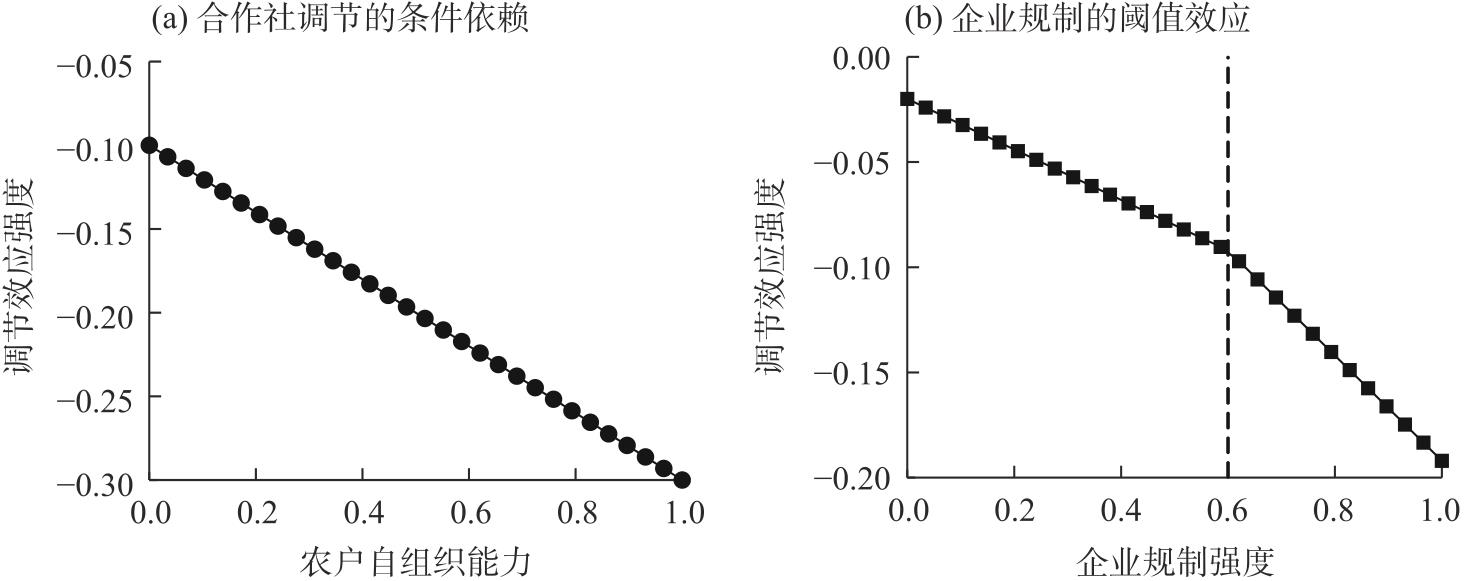
| 合作社存在替代效应 | 识别替代效应发生的条件边界 | 条件依赖系数随农户自组织能力提高而线性减弱 | 明确合作社功能优化的优先对象 |
| 群体异质性显著 | 量化不同群体的动态转化效率差异 | 转化速率兼业户快但增速渐缓;纯农户增长平稳但持续 | 制定群体差异化的精准支持策略 |
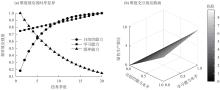
图2
生计韧性维度的动态效应异质性"
图3
中介传导的“速度-衰减”权衡"
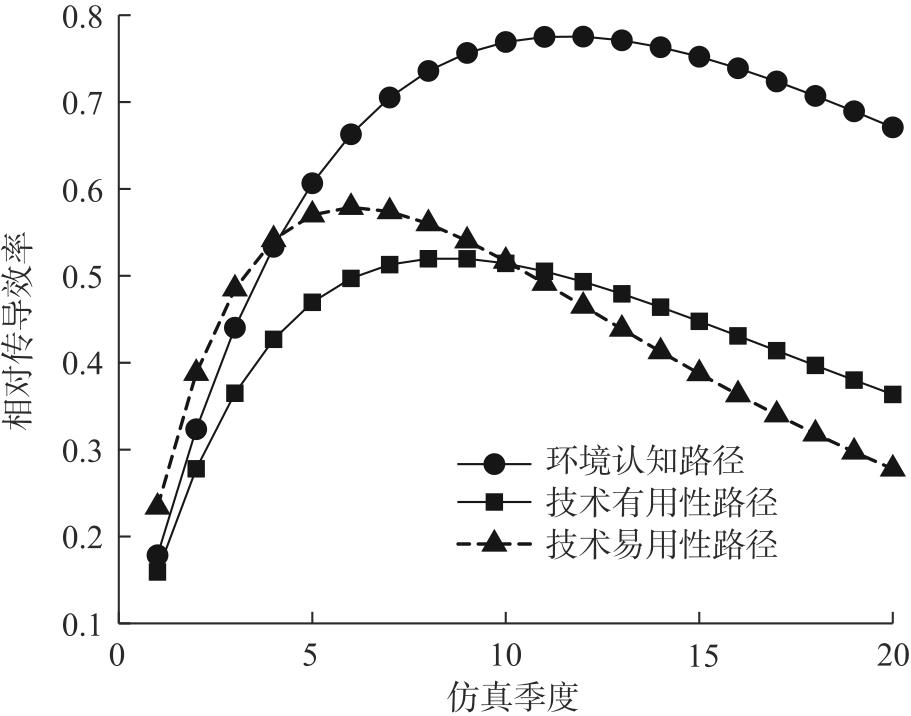
图4
群体异质性的动态收敛差异"
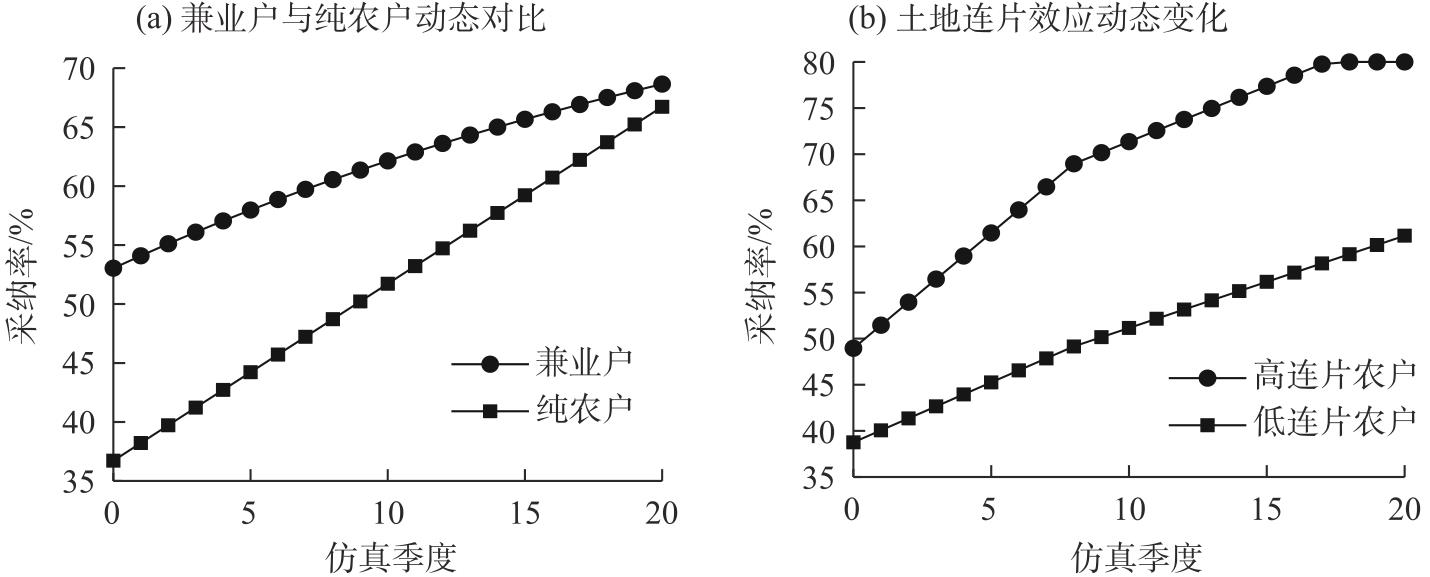
图5
调节效应的条件依赖验证"
| [1] | 熊爱华, 宋婷婷. 社会资本对农户绿色生产意愿的影响研究[J]. 统计与决策, 2020, 36(5): 76-80. |
| [Xiong Aihua, Song Tingting. Research on the influence of social capital on farmers’ green production willingness[J]. Statistics & Decision, 2020, 36(5): 76-80.] | |
| [2] | 唐小清, 杨立敏, 刘晶, 等. 资本禀赋、感知价值、政府规制对农户绿色技术采纳行为的影响——基于四川省大竹县422份农户调查数据[J]. 中国农机化学报, 2024, 45(8): 330-337. |
| [Tang Xiaoqing, Yang Limin, Liu Jing, et al. Impact of capital endowment, perceived value and government regulation on farmers’ green technology adoption behavior: Based on 422 household survey data in Dazhu County, Sichuan Province[J]. Journal of Chinese Agricultural Mechanization, 2024, 45(8): 330-337.] | |
| [3] | 刘铮, 葛立群, 潘荣光, 等. 碳中和背景下水稻种植户生产绿色转型研究[J]. 农业经济, 2022(3): 12-14. |
| [Liu Zheng, Ge Liqun, Pan Rongguang, et al. Research on green production transformation of rice farmers under the background of carbon neutrality[J]. Agricultural Economy, 2022(3): 12-14.] | |
| [4] | 李晓晓, 高汉, 胡南燕, 等. 数字素养对农户绿色生产技术采纳的影响及机制分析——基于6省1585户蔬菜种植户的实证分析[J]. 中国农业大学学报, 2025, 30(9): 336-349. |
| [Li Xiaoxiao, Gao Han, Hu Nanyan, et al. Impact of digital literacy on the adoption of green production technology by farm households and its mechanism: An empirical analysis based on 1585 vegetable-growing households in 6 provinces[J]. Journal of China Agricultural University, 2025, 30(9): 336-349.] | |
| [5] | Mao H, Zhou L, Ying R Y, et al. Time preferences and green agricultural technology adoption: Field evidence from rice farmers in China[J]. Land Use Policy, 2021, 109: 105627, doi: 10.1016/j.landusepol.2021.105627. |
| [6] | 于艳丽, 李桦. 社区监督、风险认知与农户绿色生产行为——来自茶农施药环节的实证分析[J]. 农业技术经济, 2020(12): 109-121. |
| [Yu Yanli, Li Hua. Community supervision, risk perception and farmers’ green production: Empirical analysis from the application of tea growers[J]. Journal of Agrotechnical Economics, 2020(12): 109-121.] | |
| [7] |
Oyetunde-Usman Z, Olagunju K O, Ogunpaimo O R. Determinants of adoption of multiple sustainable agricultural practices among smallholder farmers in Nigeria[J]. International Soil and Water Conservation Research, 2021, 9(2): 241-248.
doi: 10.1016/j.iswcr.2020.10.007 |
| [8] | 郭岩, 汪兴东. 土地禀赋、务农黏性与农户绿色生产行为——基于江西省“百村千户”面板数据[J]. 中国生态农业学报(中英文), 2025, 33(7): 1419-1429. |
| [Guo Yan, Wang Xingdong. Land endowment, farming stickiness, and green production behavior: Based on panel data of “hundreds of villages and thousands of households” in Jiangxi Province[J]. Chinese Journal of Eco-Agriculture, 2025, 33(7): 1419-1429.] | |
| [9] | 孙小燕, 刘雍. 土地托管能否带动农户绿色生产?[J]. 中国农村经济, 2019(10): 60-80. |
| [Sun Xiaoyan, Liu Yong. Can land trusteeship improve farmers’ green production?[J]. Chinese Rural Economy, 2019(10): 60-80.] | |
| [10] |
谢宇, 薛选登. 数字经济赋能绿色发展福利——基于黄河流域资源型城市的经验证据[J]. 干旱区地理, 2025, 48(6): 1127-1139.
doi: 10.12118/j.issn.1000-6060.2024.406 |
|
[Xie Yu, Xue Xuandeng. Digital economy empowers green development welfare: Empirical evidence based on resource-based cities in the Yellow River Basin[J]. Arid Land Geography, 2025, 48(6): 1127-1139.]
doi: 10.12118/j.issn.1000-6060.2024.406 |
|
| [11] |
任诗琦, 王永瑜. 黄河流域地级市绿色发展水平测度与空间收敛性研究[J]. 干旱区地理, 2025, 48(6): 1031-1042.
doi: 10.12118/j.issn.1000-6060.2024.702 |
|
[Ren Shiqi, Wang Yongyu. Measurement and spatial convergence of green development level of prefecture-level cities in the Yellow River Basin[J]. Arid Land Geography, 2025, 48(6): 1031-1042.]
doi: 10.12118/j.issn.1000-6060.2024.702 |
|
| [12] | 高帅, 程炜, 唐建军. 风险冲击视角下革命老区农户生计韧性研究——以太行革命老区为例[J]. 中国农村经济, 2024(3): 107-125. |
| [Gao Shuai, Cheng Wei, Tang Jianjun. Research on the livelihood resilience of farmers in old revolutionary base areas from the perspective of risk shocks: Taking the Taihang Old Revolutionary Base area as an example[J]. Chinese Rural Economy, 2024(3): 107-125.] | |
| [13] |
Speranza C I, Wiesmann U, Rist S. An indicator framework for assessing livelihood resilience in the context of social-ecological dynamics[J]. Global Environmental Change, 2014, 28: 109-119.
doi: 10.1016/j.gloenvcha.2014.06.005 |
| [14] |
Cissé J D, Barrett C B. Estimating development resilience: A conditional moments-based approach[J]. Journal of Development Economics, 2018, 135: 272-284.
doi: 10.1016/j.jdeveco.2018.04.002 |
| [15] | Mihunov V V, Lam N S N, Rohli R V, et al. Emerging disparities in community resilience to drought hazard in south-central United States[J]. International Journal of Disaster Risk Reduction, 2019, 41: 101302, doi: 10.1016/j.ijdrr.2019.101302. |
| [16] | Ma L, Zhang Y N, Li T, et al. Livelihood capitals and livelihood resilience: Understanding the linkages in China’s government-led poverty alleviation resettlement[J]. Habitat International, 2024, 147: 103057, doi: l0.1016/j.habitatint.2024.103057. |
| [17] | 刘伟, 于倩倩. 易地搬迁对陕南农户生计弹性的影响研究[J]. 地理与地理信息科学, 2023, 39(1): 105-110. |
| [Liu Wei, Yu Qianqian. Impact of poverty alleviation resettlement on rural household livelihood resilience in southern Shaanxi[J]. Geography and Geo-Information Science, 2023, 39(1): 105-110.] | |
| [18] | 刘蓉, 王艳伟, 任飞武, 等. 农村基础设施投入对农民生计韧性的影响效应及作用机制[J]. 南方农业学报, 2025, 56(4): 1326-1340. |
| [Liu Rong, Wang Yanwei, Ren Feiwu, et al. The impact of rural infrastructure investment on farmers’ livelihood resilience: Effects and its mechanism[J]. Journal of Southern Agriculture, 2025, 56(4): 1326-1340.] | |
| [19] | 董玥, 杨忍, 邓颖贤, 等. 粮食主产区典型镇域的农业系统变化与农户生计韧性评价——以河南省高杨店镇为例[J]. 农业资源与环境学报, 2023, 40(5): 1208-1222. |
| [Dong Yue, Yang Ren, Deng Yingxian, et al. Changes in the agricultural system and evaluation of the livelihood resilience of farmers in a typical town in a major grain-producing area of China: A case study of Gaoyangdian Town, Henan Province[J]. Journal of Agricultural Resources and Environment, 2023, 40(5): 1208-1222.] | |
| [20] | 洪名勇, 姜月. 农地确权对农户生计韧性的影响研究[J]. 农业经济与管理, 2025(4): 43-52. |
| [Hong Mingyong, Jiang Yue. Research on influencing mechanism of farmland rights confirmation on livelihood resilience of rural households[J]. Agricultural Economics and Management, 2025(4): 43-52.] | |
| [21] | 吴诗嫚, 祝浩, 卢新海. 土地综合整治对农户生计韧性的影响效应及机制分析——以湖北省部分县市为例[J]. 农业现代化研究, 2023, 44(6): 1002-1013. |
| [Wu Shiman, Zhu Hao, Lu Xinhai. Impact effects and mechanisms of comprehensive land consolidation on farmers’ livelihood resilience: A case study of some counties in Hubei Province[J]. Research of Agricultural Modernization, 2023, 44(6): 1002-1013.] | |
| [22] |
孙彦, 赵雪雁. 山区农户的生计干预效率及其影响因素——以陇南山区为例[J]. 地理研究, 2023, 42(7): 1874-1891.
doi: 10.11821/dlyj020220867 |
| [Sun Yan, Zhao Xueyan. Efficiency and influencing factors of livelihood interventions of farming households in mountainous areas: A case study of Longnan mountainous areas[J]. Geographical Research, 2023, 42(7): 1874-1891.] | |
| [23] |
邰秀军, 封峰. 数字金融对脱贫农户生计韧性的影响——基于乌兰察布市的调查分析[J]. 干旱区地理, 2026, 49(7): 1509-1519.
doi: 10.12118/j.issn.1000-6060.2025.513 |
|
[Tai Xiujun, Feng Feng. Impact of digital finance on the livelihood resilience of poverty alleviated farmers: A survey analysis based on Ulanqab City[J]. Arid Land Geography, 2026, 49(7): 1509-1519.]
doi: 10.12118/j.issn.1000-6060.2025.513 |
|
| [24] | 喻立凡, 曹大宇, 廖冰. 生计资本、生态认知对农户绿色生产技术采纳意愿的影响研究[J]. 中国农业资源与区划, 2024, 45(12): 27-39. |
| [Yu Lifan, Cao Dayu, Liao Bing. Research on the impact of livelihood capital and ecological cognition on farmers’ willingness to adopt green technologies[J]. Chinese Journal of Agricultural Resources and Regional Planning, 2024, 45(12): 27-39.] | |
| [25] | 王晓焕, 李桦, 张罡睿. 生计资本如何影响农户亲环境行为?——基于价值认知的中介效应[J]. 农林经济管理学报, 2021, 20(5): 610-620. |
| [Wang Xiaohuan, Li Hua, Zhang Gangrui. How does livelihood capital affect farmers’ pro-environment behavior? Mediating effect based on value perception[J]. Journal of Agro-Forestry Economics and Management, 2021, 20(5): 610-620.] | |
| [26] |
Folke C. Resilience: The emergence of a perspective for social-ecological systems analyses[J]. Global Environmental Change, 2006, 16(3): 253-267.
doi: 10.1016/j.gloenvcha.2006.04.002 |
| [27] |
翟彬, 王宇阁, 朱芳芳, 等. 生计策略下黄河流域农户生计韧性差异及其影响因素——以河南省为例[J]. 经济地理, 2024, 44(2): 156-165.
doi: 10.15957/j.cnki.jjdl.2024.02.016 |
| [Zhai Bin, Wang Yuge, Zhu Fangfang, et al. Differences in livelihood resilience of farm households in the Yellow River Basin under the background of livelihood strategies and its influencing factors: Taking Henan Province as an example[J]. Economic Geography, 2024, 44(2): 156-165.] | |
| [28] |
Liu W, Li J, Ren L J, et al. Exploring livelihood resilience and its impact on livelihood strategy in rural China[J]. Social Indicators Research, 2020, 150(3): 977-998.
doi: 10.1007/s11205-020-02347-2 |
| [29] |
Kahneman D, Tversky A. Prospect theory: An analysis of decision under risk[J]. Econometrica, 1979, 47(2): 263-291.
doi: 10.2307/1914185 |
| [30] | 魏浩冉, 姚娟, 李睿. 社会支持对农户秸秆持续资源化利用意愿的影响——基于感知有用性、感知易用性的中介效应[J]. 干旱区资源与环境, 2025, 39(12): 99-109. |
| [Wei Haoran, Yao Juan, Li Rui. The impact of social support on farmers’ willingness to continuously reuse straw: The mediating role of perceived usefulness and perceived ease of use[J]. Journal of Arid Land Resources and Environment, 2025, 39(12): 99-109.] | |
| [31] | 吴晔, 黎樟浩, 马连婧. 从回避到参与: 社会规范重构新闻消费行为的实证研究[J]. 新闻与写作, 2025(5): 29-40. |
| [Wu Ye, Li Zhanghao, Ma Lianjing. From avoidance to participation: An empirical study on social norm reconstruction of news consumption behavior[J]. News and Writing, 2025(5): 29-40.] | |
| [32] | 李琳, 韩继良, 朱玉春. 农业科技服务促进了农户绿色生产技术采纳吗?——基于激励措施的调节效应[J]. 中国农业大学学报, 2023, 28(12): 232-247. |
| [Li Lin, Han Jiliang, Zhu Yuchun. Does agricultural science and technology service promote farmers’ adoption of green production technology? Moderating effect based on incentive measure[J]. Journal of China Agricultural University, 2023, 28(12): 232-247.] | |
| [33] |
吕晓, 张启岚, 张学波, 等. 共同富裕目标下农地流转对农户生计韧性的影响——基于沈阳市典型农户的实证研究[J]. 自然资源学报, 2025, 40(3): 636-651.
doi: 10.31497/zrzyxb.20250305 |
|
[Lü Xiao, Zhang Qilan, Zhang Xuebo, et al. The impact of farmland transfer on farmers’ livelihood resilience under the goal of common prosperity: An empirical study of typical farmers in Shenyang[J]. Journal of Natural Resources, 2025, 40(3): 636-651.]
doi: 10.31497/zrzyxb.20250305 |
|
| [34] | 江艇. 因果推断经验研究中的中介效应与调节效应[J]. 中国工业经济, 2022(5): 100-120. |
| [Jiang Ting. Mediating effects and moderating effects in causal inference[J]. China Industrial Economics, 2022(5): 100-120.] | |
| [35] | 张红丽, 李洁艳, 史丹丹. 环境规制、生态认知对农户有机肥采纳行为影响研究[J]. 中国农业资源与区划, 2021, 42(11): 42-50. |
| [Zhang Hongli, Li Jieyan, Shi Dandan. Research on the influence of environmental regulation and ecological cognition on farmers’ organic fertilizer adoption behavior[J]. Chinese Journal of Agricultural Resources and Regional Planning, 2021, 42(11): 42-50.] | |
| [36] | 李昊, 曹辰, 李林哲. 绿色认知能促进农户绿色生产行为吗?——基于社会规范锁定效应的分析[J]. 干旱区资源与环境, 2022, 36(9): 18-25. |
| [Li Hao, Cao Chen, Li Linzhe. Can green cognition promote farmers’ green production behavior? Analysis of lock-in effect based on social norms[J]. Journal of Arid Land Resources and Environment, 2022, 36(9): 18-25.] | |
| [37] | 陈凯, 朱伟丽. 农户绿色生产驱动机制构建研究——基于TAM-SLA理论框架[J]. 中国特色社会主义研究, 2023(3): 71-79. |
| [Chen Kai, Zhu Weili. Research on the construction of driving mechanism for farmers’ green production: Based on the TAM-SLA theoretical framework[J]. Studies on Socialism with Chinese Characteristics, 2023(3): 71-79.] |
| [1] | 邰秀军, 封峰. 数字金融对脱贫农户生计韧性的影响——基于乌兰察布市的调查分析[J]. 干旱区地理, 2026, 49(7): 1509-1519. |
| [2] | 仲俊涛, 高俊杰, 米文宝, 陈颖慧. 数字鸿沟对青藏高原东北缘农户生计韧性的影响[J]. 干旱区地理, 2026, 49(10): 2018-2029. |
| [3] | 郑爱文, 王丽丽. 数字乡村建设对农户生计韧性的影响机制及其效应分析[J]. 干旱区地理, 2026, 49(10): 2006-2017. |
|
||